

Navigating Korea’s Sharing Economy: C2 Mastery in Safe Secondhand Trading & Fraud Prevention
Phase 1: Empathy (Storytelling Opening)
안녕하세요! Welcome back! It’s your Daily Hangul editor here. Imagine this scenario: You are strolling through the vibrant streets of Seongsu-dong, having spotted a rare, mint-condition vintage film camera listed on a popular secondhand app for a deal that seems almost too good to be true. You send a quick message to the seller, who immediately insists on off-platform bank transfers via a private link, citing “app fee glitches.” Your intuition signals caution—how do you assertively pivot to an escrow-backed safe payment method without sounding accusatory or breaking social etiquette?
As advanced C2 learners, mastering Korean isn’t merely about grammatical accuracy; it’s about navigating the subtle social landscape of high-trust digital ecosystems like Danggeun Market (당근마켓) and Joonggonara (중고나라). Korea’s peer-to-peer secondhand economy relies heavily on community trust, yet sophisticated fraud tactics require precise, authoritative, and culturally attuned communication. Drawing from real experiences of long-term expats and native power-traders, this guide equips you with high-level linguistic tools to safeguard your financial transactions while maintaining impeccably polite, native-level rapport.
Phase 2: Deep Dive into 3 Core C2 Expressions
1. 안전거래로 진행하는 편이 서로에게 깔끔할 것 같습니다.
- Pronunciation: [An-jeon-geo-rae-ro jin-haeng-ha-neun pyeon-i seo-ro-e-ge kkal-kkeum-hal gkeot gat-seum-ni-da] (Sounds like: Ahn-jeon-go-rae-ro jin-hang-ha-noon pyun-ee)
- Meaning: “It would be cleaner and more transparent for both of us to proceed via escrow/safe transaction.”
- K-Culture Moment: Used in high-value secondhand trades (e.g., electronics, designer goods) on platforms like Bunjang or Joonggonara when a seller suggests direct wire transfer.
- Editor’s Insight: The word 깔끔하다 (literally “clean”) here functions as a sophisticated social buffer. Rather than saying “I don’t trust you,” using 깔끔하다 framing implies that a structured escrow payment eliminates ambiguity for both parties equally.
- Situation Spectrum:
- Casual: ⚠️ (Sounds overly formal for trading a 5,000 KRW mug)
- Semi-formal: ✅ (Ideal for most peer-to-peer app chats)
- Formal: ✅ (Appropriate for business-to-consumer transactions)
- 🤔 Think About It: How does utilizing indirect language like “깔끔하다” preserve the seller’s “kibun” (mood/face) while firmly protecting your financial security?
2. 더치트 조회 후 거래를 결정해도 될까요?
- Pronunciation: [Deo-chi-teu jo-hoe hu geo-rae-reul gyeol-jeong-hae-do doel-kka-yo?]
- Meaning: “Would it be alright if I finalize the transaction after checking ‘The Cheat’ database?”
- K-Culture Moment: Mentioning “The Cheat” (더치트)—Korea’s primary fraud prevention database where users report scam phone numbers and bank accounts—signals to sellers that you are a seasoned local who cannot be easily duped.
- Editor’s Insight: While asking to check someone’s history could sound suspicious in Western contexts, in Korea, referencing ‘The Cheat’ is considered standard diligence. Framing it with 후 거래를 결정하다 demonstrates high-level linguistic pragmatism.
- Situation Spectrum:
- Casual: ⚠️
- Semi-formal: ✅
- Formal: ✅
- 🤔 Think About It: In your culture, is asking for fraud verification during a trade considered offensive, or is it seen as standard practice?
3. 현장 상태 확인 후 계좌이체해 드리겠습니다.
- Pronunciation: [Hyeon-jang sang-tae hwa-gin hu gye-jwa-i-che-hae deu-ri-get-seum-ni-da]
- Meaning: “I will wire the payment on-site immediately after inspecting the item’s physical condition.”
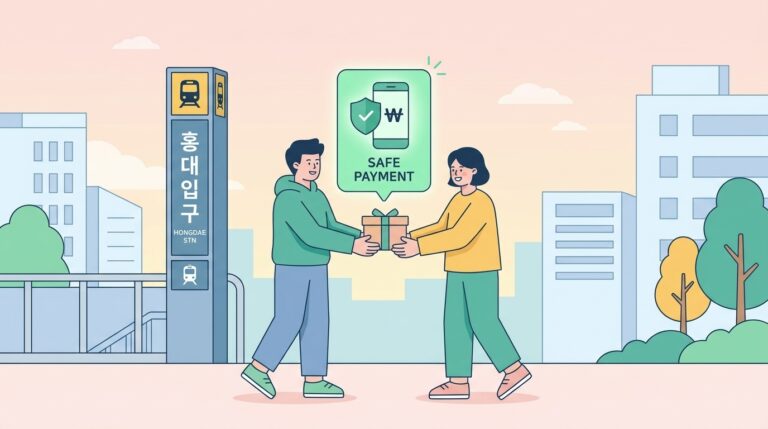
- K-Culture Moment: Essential during direct, in-person trades (직거래) near subway stations or apartment complex entrances.
- Editor’s Insight: This phrase uses the formal honorific 드리겠습니다 (I will humbly give you), balancing an unyielding boundary (no upfront money before inspection) with high respect.
- Situation Spectrum:
- Casual: 🚫
- Semi-formal: ✅
- Formal: ✅
- 🤔 Think About It: Why is confirming physical condition on-site crucial when trading in Korean transit hubs?
Phase 3: Textbook Korean vs. Real Korean
Scenario 1: Proposing Safe Payment
- 📖 교과서 한국어: 사기가 우려되니 안전 결제 서비스를 이용해 주세요. (I am worried about fraud, so please use the safe payment service.)
- 🗣️ 진짜 한국어: 먹튀 방지 차원에서 안전결제로 트실래요? 아니면 직거래도 괜찮습니다. (Shall we open a safe payment transaction to avoid any risk of non-delivery? Otherwise, I’m down for an in-person trade.)
- 💡 왜 다를까?: Textbook sentences sound accusatory (“I suspect you might commit fraud”). Real C2 phrasing uses modern expressions like 먹튀 방지 차원에서 (to prevent hit-and-run tactics) in a casual, matter-of-fact tone, offering a reasonable alternative (직거래).
Scenario 2: Politely Declining Off-Platform Delivery Links
- 📖 교과서 한국어: 외부 링크로 결제하는 것은 위험하므로 거절하겠습니다. (I decline because paying via external links is dangerous.)
- 🗣️ 진짜 한국어: 외부 링크 결제는 아무래도 좀 찝찝해서요. 앱 내 안전결제 아니면 직거래로 진행하고 싶습니다. (External links feel a bit sketchy to me. I’d prefer sticking to in-app safe payment or doing a direct in-person deal.)
- 💡 왜 다를까?: The native term 찝찝하다 captures an intuitive feeling of uneasiness or discomfort without outright accusing the counterparty of being a criminal.
Phase 4: K-Culture Deep Dive & Non-verbal Etiquette
4-1. Nunchi & Non-Verbal Gestures
When meeting for an in-person transaction (직거래) at a designated location like a subway exit, non-verbal cues carry immense weight:
1. The Screen Mirroring Gesture: When completing a mobile bank transfer (계좌이체) on-site, it is standard practice to tilt your phone screen slightly toward the seller or immediately show them the transfer confirmation screen (송금 완료 화면).
2. Item Inspection Protocol: Politely say “잠시 상태 좀 확인해 볼게요~” (Let me quickly check the condition~) while maintaining a slight bow and a warm smile. This prevents the inspection from feeling like a police interrogation.
4-2. Cultural Code: Manner Temperature (매너온도)
In platforms like Danggeun Market, every user starts with a base “Manner Temperature” of 36.5°C (matching body temperature). High scores (40°C+) indicate ultra-trustworthy locals, while accounts below 36.5°C or brand-new accounts insisting on external links warrant heightened scrutiny. Recognizing how social proof mechanisms function in Korea allows you to assess risks instantly.
Phase 5: Real-World Roleplay Scenario
Setting: Chat box inside a secondhand app. You are negotiating for a high-end laptop with a seller named ‘SeoulTechGuy’.
- SeoulTechGuy: 안녕하세요! 노트북 아직 거래 가능합니다. 직거래는 제가 바빠서 어렵고, 택배로 보내드릴게요. (Hello! The laptop is still available. I’m too busy for an in-person trade, so I’ll ship it to you.)
- You: 🎭 [Polite yet vigilant] 안녕하세요! 게시글 잘 봤습니다. 혹시 안전결제로 진행해도 될까요? (Hello! Read your post. Could we possibly proceed via safe payment?)
- SeoulTechGuy: 아, 제가 안전결제 수수료 때문에 정산받는 게 늦어져서요. 그냥 계좌로 바로 쏘시면 1만원 깎아드릴게요. (Ah, safe payment fees delay my payout. If you wire directly to my bank account right now, I’ll discount it by 10,000 KRW.)
- You: 🎭 [Firm boundary setting] 제안은 감사하지만, 고가 제품이다 보니 안전결제나 직거래가 아니면 조금 부담스럽네요. (I appreciate the offer, but since it’s a high-value item, I feel uncomfortable unless it’s safe payment or in-person.)
- SeoulTechGuy: 그럼 제가 카톡으로 안전결제 전용 링크 하나 보내드릴 테니 거기서 결제하시겠어요? (Then I’ll send you a dedicated safe payment link via KakaoTalk. Will you pay there?)
- You: 🎭 [Spotting the scam tactic instantly] 외부 링크는 3자 사기 위험이 있어서 이용하지 않습니다. 앱 내 시스템으로만 거래하고 싶습니다. (I do not use external links due to third-party fraud risks. I wish to trade strictly through the in-app system.)
- SeoulTechGuy: 흠… 거래 안 하실 건가요? 다른 구매 희망자도 연락 와서요. (Hmm… Are you not buying then? Other interested buyers are messaging me.)
- You: 🎭 [Calm C2 conclusion] 네, 앱 내 안전결제나 직거래가 어려우시다면 이번 거래는 사양하겠습니다. 좋은 거래 하세요! (Yes, if in-app safe payment or direct trade is difficult, I will pass this time. Have a great trade!)
🔀 Interactive Choice Point
What would you do if the seller pushes back again saying: “시간 맞춰볼 테니 직거래로 하시죠! 대신 선금 3만원 보내세요.” (I’ll adjust my schedule for an in-person trade! But send a 30,000 KRW deposit first.)
- Option A: Pay the 30,000 KRW deposit right away to reserve the laptop. (Risk/Bad)
- Option B: Politely decline paying upfront deposits without prior verification, offering to meet at a public station instead. (Best)
- Option C: Send a angry message accusing them of scamming. (Sub-optimal)
Feedback:
* Option A (Bad): Requesting upfront deposit fees (선금) for secondhand items prior to meeting is a notorious scam tactic. Never wire funds before seeing the item.
* Option B (Best): Setting clear, respectful boundaries in Korean avoids conflict while mitigating financial exposure.
* Option C (Risk): Emotional accusations can lead to unnecessary app report disputes or account flags.
Phase 6: 10-Second Emotion Shadowing Drill
Practice these native cadences using speech pauses (/) and internal emotional tone:
[🧐 신중하고 단호하게 / Cautious & Firm]
외부 링크 결제는 / 아무래도 좀 찝찝해서요. / 앱 내 결제로만 진행하겠습니다.
(Oe-bu ring-keu gyeol-je-neun / a-mu-rae-do jom jjip-jjip-hae-seo-yo. / Aeb nae gyeol-je-ro-man jin-haeng-ha-get-seum-ni-da.)-
[😊 정중하지만 분명하게 / Polite yet Assertive]
고가 제품인 만큼 / 현장에서 상태 확인 후 / 바로 송금해 드리겠습니다.
(Go-ga je-pum-in man-keum / hyeon-jang-e-seo sang-tae hwa-gin hu / ba-ro song-geum-hae deu-ri-get-seum-ni-da.)
Phase 7: K-Culture Mini Dictionary
- 더치트 (The Cheat | Deo-chi-teu): Korea’s premier fraud prevention platform where victims register bank accounts and phone numbers associated with scam activity.
- 3자 사기 (Third-Party Fraud | Sam-ja-sa-gi): A scam mechanism where a fraudster poses as a seller to a real buyer, and as a buyer to a real seller, intercepting payments in between.
- 안전결제/에스크로 (Escrow Safe Payment | An-jeon-gyeol-je): A system where payment is held by the platform until the buyer confirms receipt and condition of the goods.
- 매너온도 (Manner Temperature | Mae-neo-on-do): A metric used on local apps (e.g., Karrot) reflecting user reliability based on peer reviews and successful trades.
Phase 8: Traveler & Expat Survival Kit
Survival Expressions TOP 3
- 직거래는 어디서 할까요? (Where shall we meet for the in-person trade?)
- 더치트 조회가 안 되는데, 계좌 다시 확인해 주시겠어요? (I can’t find this account on The Cheat; could you double-check the account number?)
- 상태가 설명과 달라서 이번 거래는 어려울 것 같습니다. (The condition differs from the description, so I don’t think I can complete this purchase.)
Editor’s Travel Note
When conducting in-person peer trades in Seoul, always pick public, camera-monitored locations such as subway exits or convenience store fronts. You can verify safe transit routes and trade spots by opening the Naver Map Application.
Phase 9: One Step Deeper (Reflective Essay)
Korea’s secondhand market is one of the most technologically advanced and densely populated in the world. The transition from blind trust to digital escrow safety protocols mirrors the rapid shift from traditional community-based reliance (정, Jeong) to high-tech urban consumerism. Understanding these linguistic nuances allows C2 speakers to honor Korean social warmth while effortlessly exercising modern financial prudence.
💬 Your Turn: Have you ever used peer-to-peer secondhand apps in Korea? What strategies did you use to ensure a smooth trade? Share your thoughts in the comments below!
Phase 10: FAQ & Common Mistakes
Q: Is it rude to ask a Korean seller for an escrow safe payment?
A: Not at all. As long as you frame it politely (e.g., “안전거래로 진행하는 편이 서로에게 깔끔할 것 같습니다”), it is viewed as standard safety diligence.
Q: What should I do if a seller insists on receiving a payment link via KakaoTalk?
A: Refuse the link immediately. Genuine in-app escrow features operate strictly inside the platform app; off-platform links are almost universally phishing sites.
Q: Can I negotiate the price (네고) during an in-person meeting?
A: Unannounced on-site negotiation (현장 네고) is considered extremely bad etiquette in Korea unless you discover unmentioned defects.
🚨 Common Mistakes TOP 3
- Mistake: Sending upfront deposit fees (선금) to hold an item before seeing it.
- Correct Action: Insist on meeting in person without prior deposit or use official in-app safe payment.
- Mistake: Clicking external payment links sent via messaging apps.
- Correct Action: Complete all transactions inside official mobile apps.
- Mistake: Demanding sudden price cuts right at the trade site.
- Correct Action: Agree on all pricing (네고) within the app chat before meeting.
Phase 11: Action Missions
- Bronze Mission: Practice saying “안전거래로 진행하는 편이 서로에게 깔끔할 것 같습니다” out loud 3 times with proper emotional shadowing.
- Silver Mission: Download a local secondhand app and identify 3 key safety features (e.g., Manner Temperature, Fraud Alert Badges).
- Gold Mission: Successfully complete a secondhand purchase in Korea using appropriate safe payment terms or an in-person trade protocol!
🎮 K-Culture Mission: Watch a contemporary Korean drama episode where characters use secondhand apps, and spot how they greet each other during an in-person deal!
Phase 12: Interactive Quiz Challenge
Test your mastery of C2 secondhand trade nuances!
- Which phrase is the most culturally refined way to suggest escrow safe payment?
- A) 사기 치지 말고 안전결제로 해요.
- B) 안전거래로 진행하는 편이 서로에게 깔끔할 것 같습니다.
- C) 안전결제 안 하면 거래 취소합니다.
- True or False: Requesting an unannounced price cut on-site during a direct trade is considered good practice in Korea.
Click to view answers and explanations!
- Answer: B – Option B uses polite, indirect phrasing (“서로에게 깔끔할 것 같습니다”) which preserves mutual social respect while establishing clear boundaries.
- Answer: False – On-site price negotiation (현장 네고) without prior notice is considered very rude unless an unlisted defect is discovered.







