

Master Korean TRPG Strategy: How to Lead the Board Like a Native Speaker
Phase 1: Empathy (스토리 몰입형 오프닝)
안녕하세요! 매일한글 에디터입니다.
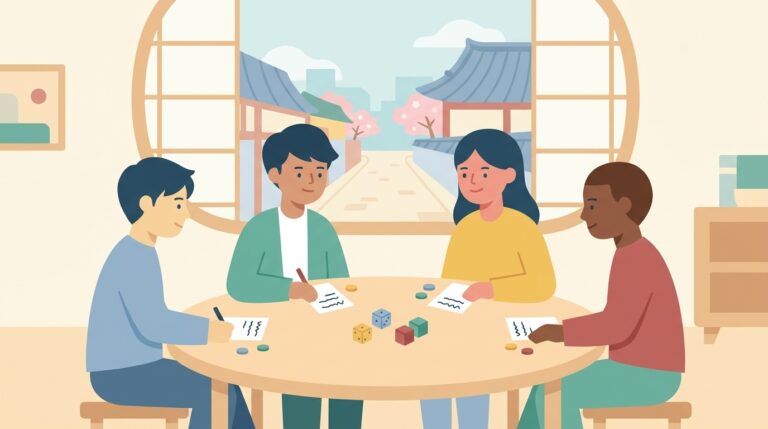
Imagine sitting inside a dimly lit, atmospheric board game cafe room in Hongdae, Seoul. The wooden table is covered with character sheets, colorful dice, and miniature figurines. Your Korean Game Master (GM) leans forward, lowers their voice, and asks: “성문 입구에 경비병이 삼엄하게 서 있습니다. 당신의 다음 전략은 무엇입니까?” (Guards are standing strictly at the city gate. What is your next move?)
You have a brilliant tactical maneuver in mind—you want to trick the guards, drop a subtle distraction, and set up a trap. But suddenly, your brain freezes. The only textbook Korean coming to mind is “공격할 거예요” (I will attack) or “거짓말할 거예요” (I will lie). It works, but it completely ruins the immersive storytelling atmosphere of a C1-level tabletop role-playing game (TRPG).
If you have ever felt frustrated because your Korean couldn’t match your strategic mind, you are not alone! Advanced language mastery isn’t just about flawless grammar; it’s about expressing subtle tactical nuances, psychological play, and game-table banter with native flair. Today, based on real feedback from advanced Korean learners navigating Seoul’s vibrant tabletop scene, we are diving deep into high-level strategic idioms that will transform you from a passive listener into the ultimate party strategist.
Phase 2: Core Expressions (핵심 표현 3선 심층 분석)
1. 판을 짜다 (Pan-eul jjada)
- Pronunciation: [pan-eul jja-da] (Sounds like weaving a mat, “pan-eul jah-dah”)
- Meaning: Literal: To weave a woven floor mat (판). Real: To orchestrate a complex strategy, set the stage, or engineer a tactical trap.
- K-Culture Moment: Frequently heard in K-dramas like Vincenzo or Reborn Rich when characters secretly organize a multi-step scheme long before their enemies notice.
- Editor’s Insight: In TRPGs or strategic board games, saying this implies you aren’t just taking a turn—you are manipulating the entire battlefield context.
- Situation Spectrum: Casual ✅ / Semi-formal ✅ / Formal ⚠️
- 🤔 Think About It: How does the metaphor of “weaving a mat” reflect the Korean mindset of carefully building context (눈치 and background) before executing a decisive action?
2. 밑밥을 깔다 (Mitbabeul kkalda)
- Pronunciation: [mit-bab-eul kkal-da] (Sounds like “Meet-bahp-eul kkal-dah”)
- Meaning: Literal: To scatter groundbait into water before fishing. Real: To lay the groundwork, drop subtle verbal hints, or set up a psychological trap.
- K-Culture Moment: Used when a character in a drama drops subtle hints to deceive a rival or prepare someone for a dramatic revelation.
- Editor’s Insight: Perfect for C1 players attempting persuasion checks in TRPGs. It shows you are strategically preparing NPC expectations before striking.
- Situation Spectrum: Casual ✅ / Semi-formal ⚠️ / Formal 🚫
- 🤔 Think About It: In fishing and conversation, why does Korean culture value subtle preliminary setups over direct, abrupt demands?
3. 수틀리다 (Suteullida)
- Pronunciation: [su-teul-li-da] (Sounds like “Soo-teul-ree-dah”)
- Meaning: Literal: An embroidery frame slipping out of alignment. Real: When a strategic plan goes awry, backfires, or someone’s mood turns sour.
- K-Culture Moment: Uttered when a high-stakes heist in a film goes wrong due to an unexpected betrayal or a critical failure.
- Editor’s Insight: When your D20 roll lands on a natural 1 in a TRPG session, this is the exact word to describe your master plan falling apart!
- Situation Spectrum: Casual ✅ / Semi-formal ⚠️ / Formal 🚫
- 🤔 Think About It: Isn’t it fascinating how traditional handicraft terms (embroidery frames) became native Korean metaphors for tactical failure?
Phase 3: Textbook Korean vs. Real Korean (교과서 한국어 vs 진짜 한국어)
Situation 1: Explaining a contingency plan when tactical danger arises
- 📖 교과서 한국어: “제 계획이 실패하면 어떻게 할 것입니까?” (What will you do if my plan fails?)
- 🗣️ 진짜 한국어: “만약 수틀리면 바로 B플랜으로 갈아타죠.” (If things go awry, we pivot straight to Plan B.)
- 💡 왜 다를까?: Native speakers use dynamic metaphoric verbs like 수틀리다 instead of rigid textbook nouns like 실패 (failure) to express strategic flexibility during gaming.
Situation 2: Revealing that your conversational trick was deliberate
- 📖 교과서 한국어: “저는 당신을 속이기 위해 미리 준비했습니다.” (I prepared in advance to trick you.)
- 🗣️ 진짜 한국어: “제가 이미 대화로 밑밥 다 깔아뒀거든요?” (I already laid all the groundwork through our dialogue, you know?)
- 💡 왜 다를까?: 밑밥을 깔다 adds playfulness and tactical pride to your roleplay banter, far superior to plain dictionary translations.
Phase 4: K-Culture Deep Dive & Non-verbal Manners (문화 딥다이브)
4-1. Nunchi (눈치) & Table Gestures in Korean TRPGs
Playing TRPGs in Korea requires high Nunchi (reading the room). When another player presents a brilliant tactical plan, native players softly tap the knuckles of their middle finger on the wooden table twice—a silent sign of respect and agreement that keeps the GM’s narrative flow uninterrupted. Also, leaning forward while keeping steady eye contact with the GM demonstrates deep immersion (몰입).
4-2. The Evolution of Board Game Cafes in Seoul
Seoul’s board game cafes (보드게임 카페) in university spots like Sinchon and Hongdae have evolved beyond casual games into dedicated story-driven hubs. Tactical play here relies on seamless back-and-forth banter, known as 티키타카 (Tiki-taka). Showing strategic respect to your fellow party members through clever Korean vocabulary elevates the gaming experience for everyone at the table.
Phase 5: Real-Life Roleplay Scenario (실전 롤플레이 시나리오)
Setting: A cozy TRPG room in Hongdae. The party is negotiating with an NPC guard captain.
- Turn 1 GM (NPC): 성문 앞에 경비병 두 명이 서 있습니다. 경계가 삼엄합니다. (Seongmun ap-e gyeongbibyeong du myeong-i seo isseumnida. Gyeonggyega sameomhamnida.)
- (Two guards stand before the city gate. Security is tight.)
- Turn 2 Player: [😎 음흉하게 미소 지으며] 제가 말로 시간을 끌 테니, 은밀하게 뒤로 돌아서 판을 짜보죠.
- ( [😎 Smiling slyly] I’ll stall them with conversation while you stealthily circle around and set the stage.)
- Turn 3 GM: 경비병이 의심스러운 눈초리로 당신을 바라봅니다. “거기 누구냐!”
- (The guard looks at you suspiciously. “Who goes there!”)
- Turn 4 Player: [🤝 손사래를 치며] 아, 지나가는 상인입니다! 일단 대화로 밑밥을 깔아볼게요.
- ( [🤝 Waving hands dismissively] Ah, just a passing merchant! Let me drop some preliminary groundwork through banter first.)
- Turn 5 GM: 좋습니다. 설득 주사위를 굴려주세요. 난이도(DC)는 15입니다.
- (Great. Roll a persuasion check. The DC is 15.)
- Turn 6 Player: [🎲 주사위를 던지며] 20 나왔습니다! 대성공이네요!
- ( [🎲 Rolling the dice] Got a 20! Critical success!)
- Turn 7 GM: 경비병이 완벽히 속아 넘어갔습니다. 의심을 거두고 길을 터주는군요.
- (The guard is completely fooled. He lowers his suspicion and steps aside.)
- Turn 8 Player: [😏 자신감 있게] 역시 계획대로네요. 혹시라도 수틀릴 걱정은 없었습니다!
- ( [😏 Confidently] Just as planned. I had zero worries about things going awry!)
🔀 Interactive Choice Point
When the GM asks how you will react if an ambush occurs, what do you say?
* Option A: “제가 미리 밑밥을 깔아뒀으니 걱정 마세요.” (Best: Demonstrates strategic preparation and C1-level natural fluency.)
* Option B: “그냥 칼을 뽑고 정면으로 공격합시다!” (Bad: Lacks tactical nuance and ruins the roleplay depth.)
* Option C: “판을 다시 짜야 하니 일단 후퇴하시죠.” (Risk: High strategic retreat; realistic, but shifts team momentum.)
Phase 6: 10-Second Emotion Shadowing Drill (감정 섀도잉 드릴)
- [😎 은밀하고 자신 있게 / Secretive & Confident]
- 내가 이미 / 밑밥 다 깔아뒀으니까 / 걱정하지 마.
- (Nae-ga i-mi / mit-bab da kkal-a-dwo-sseu-ni-kka / geog-jeong-ha-ji ma.)
- [💥 아쉬워하며 / Frustrated & Regretful]
- 여기서 / 수틀리면 / 처음부터 판을 다시 짜야 해요.
- (Yeo-gi-seo / su-teul-ri-myeon / cheo-um-bu-teo pan-eul da-si jja-ya hae-yo.)
Phase 7: K-Culture Mini Dictionary (K-Culture 미니 사전)
- 주사위 갓 (Jusawi-gat) | Dice God | Slang used when a player gets exceptionally lucky dice rolls during high-stakes turns.
- 티키타카 (Tiki-taka) | Seamless Banter | Rapid, rhythmic back-and-forth dialogue between TRPG players or gaming partners.
- TRPG (티알피지) | Tabletop RPG | Phonetically pronounced as “Ti-Al-Pi-Ji” in Korean gaming spaces.
- 판치다 (Panchida) | To Dominate/Run Rampant | Describing a situation where one strategy or enemy completely controls the board.
Phase 8: Traveler’s Survival Kit (여행자를 위한 생존 키트)
Top 3 Board Game Cafe Expressions
- 주사위 굴릴게요! (Jusawi gullilgeyo!) — I’m rolling the dice!
- 제 캐릭터 스킬 쓸게요. (Je chaerikteo seukil sseulgeyo.) — I’ll activate my character skill.
- 다음 순서 누구예요? (Daeum sunseo nuguyeyo?) — Whose turn is next?
Editor’s Travel Note
When traveling in Seoul, visit Hongdae or Gangnam board game rooms for immersive sessions. You can reserve private TRPG rooms easily via the 네이버 지도 앱 다운로드 platform by searching for “TRPG 카페”.
Phase 9: A Step Deeper (한 발 더 깊이)
Korean TRPG sessions balance strict linguistic politeness (존댓말) with creative roleplay freedom. Even when playing villains, players maintain polite honorifics out-of-character to show respect to the Game Master and party members. This harmony between game strategy and social courtesy reflects the core values of modern Korean communication.
💬 Your Turn: Which of today’s 3 strategic expressions (판을 짜다, 밑밥을 깔다, 수틀리다) will you try in your next game night? Tell us in the comments below!
Phase 10: FAQ & Common Mistakes (FAQ & 오해 방지)
Q: Can I use “판을 짜다” in corporate business strategy in Korea?
A: Yes! It is widely used in business, political commentary, and entertainment when describing macro-level strategic planning.
Q: Is “밑밥을 깔다” too informal for business meetings?
A: Yes. In formal corporate contexts, use “사전 작업을 하다” (to conduct preliminary work) instead of fishing metaphors.
Q: What is the exact nuance of “수틀리다”?
A: It implies an unexpected snag that disrupts a smooth plan or sours someone’s mood, making it perfect for dramatic plot twists.
🚨 Common Mistakes TOP 3
- Mistake: Using generic “계획을 만들다” for deep strategic plans. Correct Action: Use 판을 짜다 to sound natural and strategic.
- Mistake: Saying “상황이 나빠졌다” when a roll fails. Correct Action: Say 수틀렸다 for cinematic tension.
- Mistake: Translating “lay a trap” word-for-word. Correct Action: Express psychological setup as 밑밥을 깔다.
Phase 11: Action Mission & Engagement (액션 미션)
- Bronze Level: Record yourself pronouncing “판을 짜다” three times with confident intonation.
- Silver Level: Create a TRPG character quote using “밑밥을 깔다” and share it with a friend.
- Gold Level: Join a Korean tabletop session or board game meetup and successfully use “수틀리면” during gameplay!
🎮 K-Culture Mission: Watch a Korean board game YouTube stream (e.g., 침착맨 board game episodes) and spot strategic idioms spoken in real time!
Phase 12: Interactive Quiz Challenge (인터랙티브 퀴즈)
Q1. What is the best Korean expression when you carefully set up a complex trap on the game board?
🔍 정답 및 해설 보기
판을 짜다 (Pan-eul jjada). It metaphorically refers to weaving a master plan before taking action.
Q2. Fill in the blank: “만약 일이 [ ] B플랜을 실행합시다.”
🔍 정답 및 해설 보기
수틀리면 (Suteullimyeon). It means ‘if things go awry’ or fail unexpectedly.
Q3. True or False: “밑밥을 깔다” literally comes from traditional Korean embroidery.
🔍 정답 및 해설 보기
False. It comes from fishing (scattering groundbait). Embroidery is the origin of






