

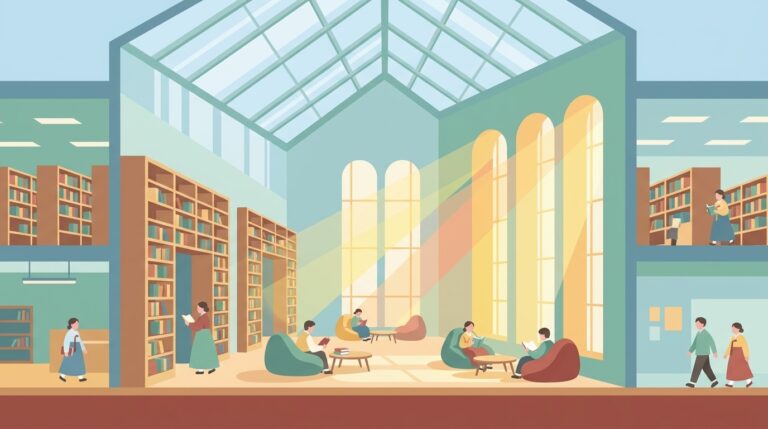
안녕하세요! 매일한글 에디터입니다. Have you ever stepped into a modern library in Seoul expecting a quiet room full of dusty bookshelves, only to find yourself standing inside a breathtaking architectural masterpiece with sunlit glass walls, barista-made coffee, and lively art exhibitions? Korean public libraries have undergone a massive transformation. No longer just silent study spaces, they are now vibrant “complex cultural spaces” (복합 문화 공간) that define urban architecture. Many advanced learners tell me they know words for “book” or “read,” but freeze when trying to engage in high-level discussions about modern spatial design, urban regeneration, or architectural aesthetics in Korean. Today, based on actual feedback from our C2-level learners, we will dive into sophisticated vocabulary and nuanced expressions to help you speak like a native architectural critic or culture enthusiast!
1. 공간의 재해석 (Gong-gan-ui jae-hae-seok)
- Pronunciation: [Gong-gan-ui jae-hae-seok] (Sounds like gong-gahn-wee jae-hae-seok)
- Meaning: Reinterpretation of space (Literally: Spatial reinterpretation)
- K-Culture Moment: Used frequently in architectural documentaries and trend magazines describing how historic sites or old buildings in Seoul (like Seoul Metropolitan Library) are turned into modern public hubs.
- Editor’s Insight: Beyond simply “redecorating,” this term implies a philosophical shift in how a physical environment functions and influences human behavior.
- Situation Spectrum: Casual 🚫 | Semi-formal ⚠️ | Formal ✅
- 🤔 Think About It: How does your culture view public spaces evolving over time compared to Korea’s fast-paced urban transformation?
2. 지식의 요람에서 문화의 장으로 (Ji-sik-ui yo-ram-e-seo mun-hwa-ui jang-eu-ro)
- Pronunciation: [Ji-sik-ui yo-ram-e-seo mun-hwa-ui jang-eu-ro] (Flows smoothly with emphasis on yo-ram and jang)
- Meaning: From a cradle of knowledge to a platform for culture
- K-Culture Moment: Seen in news articles celebrating the opening of innovative community libraries like the Namsan Public Library’s dynamic remodeling.
- Editor’s Insight: “요람” (cradle) evokes origin and nurture, while “장” (open arena/platform) implies active social engagement and vitality.
- Situation Spectrum: Casual 🚫 | Semi-formal ⚠️ | Formal ✅
- 🤔 Think About It: Does the word “library” in your native language carry a quiet, static imagery, or an active cultural one?
3. 탁 트인 개방감과 아늑함의 조화 (Tak teu-in gae-bang-gam-gwa a-neuk-ham-ui jo-hwa)
- Pronunciation: [Tak teu-in gae-bang-gam-gwa a-neuk-ham-ui jo-hwa] (Tak feels like a sharp intake of breath, signifying wide openness)
- Meaning: Harmony between a wide sense of openness and cozy comfort
- K-Culture Moment: Often uttered by visitors stepping into open-structure public libraries like Starfield Library or Eungam Information Library.
- Editor’s Insight: “개방감” (sense of openness) created by high ceilings and glass contrasts beautifully with “아늑함” (coziness) created by warm wood textures.
- Situation Spectrum: Casual ⚠️ | Semi-formal ✅ | Formal ✅
- 🤔 Think About It: Why do modern architectural designs place such high value on natural light and open vertical space in urban cities?
Scenario 1: Describing a refurbished public library
- 📖 교과서 한국어: 이 도서관은 책도 많고 건물 내부가 아주 멋집니다.
(This library has many books and the interior is very nice.) - 🗣️ 진짜 한국어: 단순한 도서관을 넘어 시민들을 위한 복합 문화 공간으로 완벽하게 탈바꿈했네요.
(It has completely transformed beyond a simple library into a full-fledged complex cultural space for citizens.) - 💡 왜 다를까? C2 speakers avoid generic adjectives like “멋지다” and use dynamic verbs like “탈바꿈하다” (metamorphose) and rich terms like “복합 문화 공간”.
Scenario 2: Commenting on architectural design
- 📖 교과서 한국어: 창문이 커서 밝고 넓어 보여요.
(The windows are big, so it looks bright and spacious.) - 🗣️ 진짜 한국어: 통유리창을 통해 들어오는 채광 덕분에 공간감이 훨씬 살고 답답함이 전혀 없어요.
(Thanks to the natural light streaming through the floor-to-ceiling glass, the spatial openness truly comes alive without feeling cramped at all.) - 💡 왜 다를까? Expressions like “공간감이 살다” (spatial feel comes alive) demonstrate native-level aesthetic sensibility.
4-1. Nunchi & Social Etiquette in Hybrid Libraries
Modern Korean public libraries feature diverse zones: whispering/co-working zones, cafe areas, and traditional silent reading rooms. Keep your Nunchi sharp! Notice the transition of flooring materials (e.g., carpet vs. tile) which often subtly signifies quiet zones versus social interaction zones.
4-2. Cultural Code: Urban Regeneration (도시 재생)
Korea’s rapid modernization has led to innovative architectural trends where historical public structures (like old government buildings or industrial facilities) are preserved and repurposed into multi-use public libraries. This reflects the modern Korean value of blending heritage with cutting-edge lifestyle amenities.
Setting: You are visiting a famous newly remodeled public library in Seoul and discussing its architectural layout with the Chief Spatial Curator (큐레이터).
- Curator: 안녕하세요! 이번에 새롭게 개관한 도서관의 공간 구성은 어떻게 느끼셨나요?
(Hello! How did you feel about the spatial layout of our newly opened library?) - You (🎭 Enthusiastic & Analytical): 단순한 열람실 위주가 아니라, 소통과 휴식이 공존하는 복합 문화 공간이라는 점이 인상 깊었어요.
(I was deeply impressed that it’s not just centered around reading rooms, but is a complex cultural space where communication and relaxation coexist.) - Curator: 정확히 보셨습니다. 특히 1층부터 3층까지 트여 있는 중정 구조에 신경을 많이 썼습니다.
(You noticed precisely. We paid special attention to the courtyard structure open from the 1st to 3rd floor.) - You (🎭 Impressed): 어쩐지 들어서자마자 탁 트인 개방감이 느껴지더라고요. 시각적 유기성이 뛰어납니다.
(No wonder I felt a wide sense of openness as soon as I entered. The visual continuity is outstanding.) - Curator: 시민들이 지역 사회의 공동체 의식을 느낄 수 있도록 설계했죠.
(We designed it so citizens could feel a sense of community.) - You (🎭 Reflective): 도시 재생의 훌륭한 본보기가 될 것 같습니다. 공간의 가치가 삶의 질을 높여주네요.
(It seems like a wonderful model of urban regeneration. The value of space truly enhances quality of life.) - Curator: 그렇게 말씀해 주시니 큰 보람을 느낍니다. 자주 방문해 주세요!
(Hearing you say that makes it so rewarding. Please visit often!) - You (🎭 Friendly): 네, 영감이 필요할 때마다 자주 찾게 될 것 같아요.
(Yes, I think I’ll drop by frequently whenever I need inspiration.)
🔀 Interactive Choice Point
How would you respond if the curator asks which design detail you liked most?
* Choice A (Best): “자연 채광을 활용한 창가 좌석 배치가 독서의 몰입감을 극대화해 주더군요.”
(Feedback: Perfect! Uses high-level terms like ‘자연 채광’ and ‘몰입감’ expertly.)
* Choice B (Bad): “그냥 의자가 편하고 조명이 예뻐서 좋았어요.”
(Feedback: Grammatically correct, but too simplistic for C2-level architectural discourse.)
* Choice C (Risk): “책이 너무 많아서 어디부터 봐야 할지 모르겠어요.”
(Feedback: Shifts the topic away from architecture to basic library navigation.)
Practice pronouncing these key phrases with native emotional cadence (/ denotes a brief pause):
[😊 Admiration]단순한 도서관이 아니라 / 공간의 재해석이 돋보이는 / 복합 문화 공간이네요!
(Dan-sun-han do-seo-gwan-i a-ni-ra / gong-gan-ui jae-hae-seok-i dot-bo-i-neun / bok-hap mun-hwa gong-gan-i-ne-yo!)[🤩 Deeply Impressed]탁 트인 개방감 덕분에 / 답답함이 전혀 없고 / 영감이 샘솟는 기분이에요.
(Tak teu-in gae-bang-gam deok-bu-ne / dap-dap-ham-i jeon-hyeo eop-go / yeong-gam-i saem-son-neun gi-bun-i-e-yo.)
- 복합 문화 공간 (Bok-hap Mun-hwa Gong-gan) | Complex Cultural Space | A modern venue combining arts, reading, cafes, and social events.
- 공간감 (Gong-gan-gam) | Sense of Space/Openness | The perceived dimensional quality and atmosphere of an interior environment.
- 도시 재생 (Do-si Jae-saeng) | Urban Regeneration | Revitalizing aging city structures for modern public and community utility.
- 몰입감 (Mo-rip-gam) | Sense of Immersion | The degree to which an environment allows deep focus and enjoyment.
TOP 3 Survival Phrases for Cultural Libraries
- 여기 문화 프로그램 신청은 어디서 하나요?
(Yeo-gi mun-hwa pro-geu-raem sin-cheong-eun eo-di-seo ha-na-yo? / Where can I apply for cultural programs here?)
Pro Tip: Use this to inquire about author talks, workshops, and music performances held at libraries. - 노트북 작업이 가능한 유선석이 어디인가요?
(No-teu-buk jak-eob-i ga-neung-han yu-seon-seok-i eo-di-in-ga-yo? / Where are the seats equipped with power outlets for laptops?) - 소통 공간과 정숙 공간이 구분되어 있나요?
(So-tong gong-gan-gwa jeong-suk gong-gan-i gu-bun-doe-eo in-na-yo? / Are the discussion zones and quiet zones separated?)
Editor’s Travel Note
When visiting famous public spaces like Seoul Metropolitan Library or Kim Geun-tae Memorial Library, seamlessly navigate public transit and check operating hours by using the 네이버 지도 앱 활용하기. It provides accurate floor maps and real-time public accessibility updates.
In modern Korea, public architecture is no longer just about utility; it reflects community values and individual well-being. By transforming rigid institutions like public libraries into dynamic, welcoming sanctuaries, Korean architecture fosters spontaneous connection and democratic access to culture. Space shapes thought, and learning to articulate spatial aesthetics enriches your cultural connection with contemporary Korea.
💬 Your Turn: Which public library or cultural space in Korea has inspired you the most architectural awe? Share your thoughts in the comments below!
Q: Can I speak freely in modern Korean public libraries?
A: While modern libraries feature open layouts and cafes, noise levels are still strictly zoned. Areas labeled ‘정숙실’ (Quiet Rooms) require absolute silence, while open lounges allow quiet conversation.
Q: What does ‘복합 문화 공간’ really mean in everyday context?
A: It refers to a multi-purpose venue where shopping, reading, artwork, coffee, and community events overlap naturally within one physical architecture.
Q: Is the term ‘공간감’ used only by professional architects?
A: No! It is widely used by the general public, interior design lovers, and lifestyle vloggers when evaluating cafes, libraries, or apartments.
🚨 Common Mistakes TOP 3
- ❌ Mistake 1: Saying “도서관이 인테리어가 좋아요” when making an advanced comment on public architecture.
- ✅ Correct Action: Use high-level vocabulary: “건축적 완성도와 공간감이 뛰어납니다.”
- ❌ Mistake 2: Confusing “개방감” (openness) with “개방성” (open-mindedness/accessibility character).
- ✅ Correct Action: Use “개방감” when describing physical room height/view, and “개방성” for social atmosphere.
- ❌ Mistake 3: Assuming all library floors allow coffee or drinks.
- ✅ Correct Action: Check signage or ask: “음료 반입이 가능한 구역인가요?”
- Bronze Mission: Read the Phase 6 Shadowing sentences aloud 3 times focusing on natural pauses.
- Silver Mission: Write a 2-sentence review of a public building near you in Korean using the term “공간의 재해석” and share it on social media.
- Gold Mission: Visit a local library or museum, take a photo, and post a caption in Korean incorporating at least 3 advanced terms from this guide!
🎮 K-Culture Mission: Watch a Korean architectural vlog or interior design show (like Architecture Discovery / 건축탐구 집) and spot how often presenters use the word “공간감”.
Question 1: Fill in the blank
“이 건물은 기존 공장을 리모델링하여 시민들을 위한 ( )(으)로 재탄생했습니다.”
1) 정숙실
2) 복합 문화 공간
3) 도시 계획
🔍 정답 및 해설 보기 (Click to view answer)
Correct Answer: 2) 복합 문화 공간
Explanation: The sentence describes urban regeneration turning an old factory into a dynamic multi-purpose space for citizens.
Question 2: True or False?
“‘공간감’은 오직 전문가들만 사용하는 학술 단어이므로 일상 회화에서는 절대 쓰면 안 된다.”
🔍 정답 및 해설 보기 (Click to view answer)
Correct Answer: False
Explanation: ‘공간감’ is commonly used by general speakers to describe feelings of spaciousness in interiors, cafes, and public buildings.







