

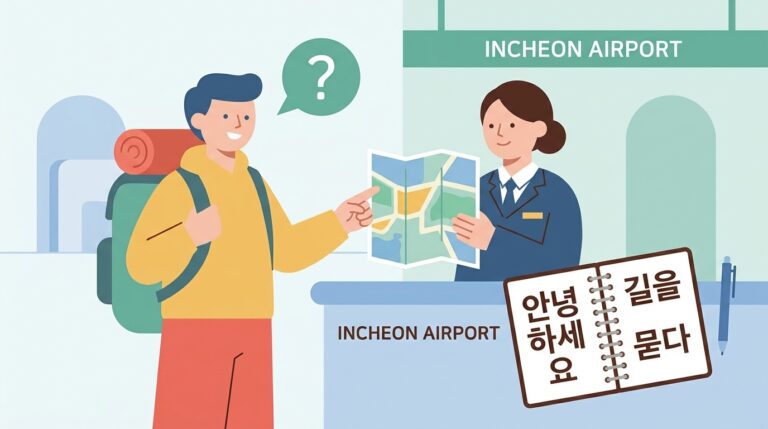
Don’t Panic at Incheon Airport: Find Your Gate in 1 Minute with This Easy Korean Phrase
Phase 1: Empathy & Story Opening
안녕하세요! This is your favorite lead editor from Daily Hangul!
Imagine this scenario: You’ve just landed at Incheon International Airport after a 12-hour flight. Your eyes are half-closed, your feet feel heavy, and you are holding a delicious cold banana milk you grabbed from a airport convenience store. But suddenly, you look at your watch—your connecting flight boards in just 20 minutes! You look up at the overhead signs, but the airport is massive, brightly lit, and crowded with people rushing in every direction.
You see an airport assistant standing near an information desk wearing a sleek uniform. You want to ask for help, but your mind goes blank. Should you say a complicated sentence from page 150 of your Korean textbook? Or will simple English work?
Don’t worry! Every Korean learner faces this exact panic moment at least once. Based on feedback from hundreds of our A1 beginner students, mastering just ONE core question will instantly clear your path and get you to your boarding gate with a warm, confident smile. Let’s make your Korean journey smooth right from the arrival hall!
Phase 2: Core Phrases Deep Dive
1. 게이트 어디예요? (Geiteu eodieyo?)
- Pronunciation: Gaye-teu oh-dee-yeo-yo? (Sounds like: “Gate” + “Oh-dear-y’all” without the r!)
- Meaning: Direct: “Gate where is it?” | Actual Nuance: “Where is the gate?”
- K-Culture Moment: You often hear idols or actors in K-vlogs asking airport staff this exact phrase when trying to find their departure lounge quickly.
- Editor’s Insight: Instead of worrying about complex grammar like location particles, just combine the English loanword 게이트 (Gate) with 어디예요? (Where is it?). It’s polite, clear, and 100% natural.
- Situation Spectrum:
- Casual: ⚠️ (Only with close friends)
- Semi-formal: ✅ (Perfect for airport staff & strangers)
- Formal: ✅ (Always acceptable)
- 🤔 Think About It: In English, you say “Where is the gate?” putting “Where” at the start. Why do you think Korean places the question word 어디 (Where) in the middle or end of the sentence?
2. 몇 번 게이트예요? (Myeot beon geiteu-yeyo?)
- Pronunciation: Myeot beon gaye-teu-yeo-yo? (Sounds like: “Muht-bon gate-yeo-yo”)
- Meaning: Direct: “How many number gate is it?” | Actual Nuance: “Which gate number is it?”
- K-Culture Moment: Frequently used at ticket counters when double-checking your boarding pass with Korean Air or Asiana staff.
- Editor’s Insight: 몇 번 (Myeot beon) means “which number”. If you know your gate number, you can easily ask to confirm!
- Situation Spectrum:
- Casual: ⚠️
- Semi-formal: ✅
- Formal: ✅
- 🤔 Think About It: Notice how numbers and counting words are essential in Korean daily life. How does your native language ask for specific numbers?
3. 저쪽으로 가세요. (Jeojjogeuro gaseyo.)
- Pronunciation: Juh-jjog-eu-ro gah-say-yo
- Meaning: Direct: “Please go toward that direction.” | Actual Nuance: “Please go that way.”
- K-Culture Moment: This is the phrase you will hear back from helpful airport staff while they point down a long corridor.
- Editor’s Insight: When you ask “어디예요?”, listen carefully for the direction word 저쪽 (that way over there) and the motion verb 가세요 (please go)!
- Situation Spectrum:
- Casual: 🚫
- Semi-formal: ✅
- Formal: ✅
- 🤔 Think About It: Korean directional words depend on distance relative to both speaker and listener. Isn’t it fascinating how spatial awareness is built into grammar?
Phase 3: Textbook Korean vs Real Korean
Situation 1: Asking for your gate location
- 📖 Textbook Korean: 탑승구는 어디에 있습니까? (Tapseungguneun eodie isseumnikka?)
- 🗣️ Real Korean: 게이트 어디예요? (Geiteu eodieyo?)
- 💡 Why the difference?: While the textbook phrase is grammatically formal, real locals at busy modern airports use quick, clear loanwords like 게이트 (Gate) and friendly ~어디예요? endings.
Situation 2: Understanding directions from staff
- 📖 Textbook Korean: 저 방향으로 걸어가십시오. (Jeo banghyangeuro georeogasipsio.)
- 🗣️ Real Korean: 저쪽으로 가면 돼요. (Jeojjogeuro gamyeon dwaeyo.)
- 💡 Why the difference?: Spoken Korean favors smooth, natural expressions like “~가면 돼요” (It’s okay/you can go this way) rather than stiff military-style commands.
Phase 4: K-Culture Deep Dive & Mannerisms
4-1. Nunchi (눈치) & Gestures
When asking for directions in Korea, non-verbal etiquette is just as important as words:
* Open Palm Pointing: When an airport staff member shows you where to go, they will rarely point with a single index finger (which can feel rude). Instead, they will use an open hand gently pointing toward the gate.
* Slight Head Nod: When approaching staff, start with a polite, soft 15-degree bow or head nod while saying “저기요…” (Excuse me…).
4-2. Culture Code: Korean Airport Efficiency
Incheon Airport is world-famous for its speed and technology—a true reflection of Korea’s 빨리빨리 (Ppalli-ppalli / Hurry-hurry) culture! Staff members are trained to give you short, super-accurate directions so you can clear security and reach your gate without missing a single beat.
Phase 5: Real-life Roleplay Scenario
Setting: Incheon Airport Terminal 1, busy departure hall.
Characters: You (A1 Traveler) & Min-ji (Friendly Airport Assistant)
- You: 저기요, 게이트 어디예요? (Jeogiyo, geiteu eodieyo?)
🎭 Action: Hold out your boarding pass politely with both hands.
(Excuse me, where is the gate?) - Min-ji: 여권이랑 탑승권 보여주세요. (Yeogwonirang tapseunggwon boyeojuseyo.)
🎭 Action: Smiles warmly and checks your pass.
(Please show me your passport and boarding pass.) - You: 여기 있어요. (Yeogi isseoyo.)
🎭 Action: Hand over the documents.
(Here it is.) - Min-ji: 아, 25번 게이트네요! (A, isip-o-beon geiteuneyo!)
🎭 Action: Points at the ticket number.
(Ah, it’s Gate 25!) - You: 25번 게이트요? (Isip-o-beon geiteuyo?)
🎭 Action: Repeat the number to double-check.
(Gate 25?) - Min-ji: 네, 저쪽으로 직진하세요. (Ne, jeojjogeuro jikjinhaseyo.)
🎭 Action: Points down the main hallway with an open palm.
(Yes, go straight that way.) - You: 감사합니다! (Gamsahamnida!)
🎭 Action: Bow head slightly.
(Thank you!) - Min-ji: 즐거운 여행 되세요! (Jeolgeoun yeohaeng doeseyo!)
🎭 Action: Waves gently.
(Have a nice trip!)
🔀 Interactive Choice Point
What do you say if you didn’t hear the gate direction clearly?
* Choice A: “뭐예요?” (Mwoyeyo?)
* Feedback (Bad ❌): Means “What is it?” and sounds very blunt or rude to staff.
* Choice B: “다시 말씀해 주세요.” (Dasi malsseumhae juseyo.)
* Feedback (Best ⭐): Polite and clear! Means “Please say it once again.”
* Choice C: “English please!”
* Feedback (Risk ⚠️): Staff might understand, but you miss a great chance to practice Korean!
Phase 6: 10-Second Emotion Shadowing Drill
Practice these aloud! Pay attention to pauses (/) and feeling markers:
[😊 Friendly & Asking Help]저기요, / 게이트 / 어디예요? (Jeogiyo, / geiteu / eodieyo?)[🤔 Curious & Confirming]25번 / 게이트예요? (Isip-o-beon / geiteu-yeyo?)[🙏 Grateful & Bright]아, / 감사합니다! (A, / gamsahamnida!)
Phase 7: K-Culture Mini Dictionary
- 게이트 (Geiteu) | Boarding Gate | Used universally across all Korean airports.
- 여권 (Yeogwon) | Passport | Essential keyword at customs and check-in desks.
- 탑승권 (Tapseunggwon) | Boarding Pass | Often requested alongside your passport.
- 환승 (Hwanseung) | Transfer/Transit | Crucial sign word if you are catching a connecting flight.
Phase 8: Traveler’s Survival Kit
Survival TOP 3 Phrases
- 도와주세요! (Dowajuseyo!) – Help me!
- 화장실 어디예요? (Hwajangsil eodieyo?) – Where is the restroom?
- 이거 맞아요? (Igeo majayo?) – Is this correct?
Editor’s Travel Note
Before stepping out into Seoul, ensure you have internet access and mapping ready! Be sure to download the Naver Map app for mobile navigation as Google Maps does not provide turn-by-turn walking directions in Korea. Also, pick up a T-Money transit card at airport convenience stores for easy subway travel.
Phase 9: One Step Deeper
In Korean culture, asking for directions is not just about getting information; it is a brief social exchange built on respect. By adding 저기요 (Excuse me) at the beginning and ending with ~요, you show respect to the person working hard to assist travelers from around the world.
💬 Your Turn: Have you ever gotten lost at an international airport? What is the first Korean word you want to try using when you arrive at Incheon? Leave a comment below and share your story!
Phase 10: FAQ & Common Mistakes
Q: Can I just say “게이트?” with a rising tone?
A: While people will understand you in an emergency, adding 어디예요? (Where is it?) makes you sound polite, respectful, and much more natural.
Q: What if the staff answers in fast Korean that I can’t understand?
A: Don’t panic! Smile and say “천천히 말해 주세요” (Cheoncheonhi malhae juseyo / Please speak slowly) or show them your ticket.
Q: Is “탑승구” wrong to use instead of “게이트”?
A: Not at all! 탑승구 (Tapseunggu) is the pure Korean word for gate, while 게이트 is the English loanword. Both are widely understood.
🚨 Common Mistakes TOP 3
- Mistake: Saying “너 어디 있어?” to staff.
- Correct Action: Use “게이트 어디예요?” to keep it polite.
- Mistake: Pointing directly at staff with one finger.
- Correct Action: Motion with an open palm or simply gesture toward your boarding pass.
- Mistake: Forgetting to say “감사합니다” when leaving.
- Correct Action: Always say thank you with a small head nod!
Phase 11: Action Mission & Engagement
- 🥉 Bronze Mission: Read “게이트 어디예요?” out loud 5 times in front of your mirror.
- 🥈 Silver Mission: Record your pronunciation on your phone and compare it with the shadowing drill above.
- 🥇 Gold Mission: Use this phrase at an airport or in your next Korean conversation class!
🎮 K-Culture Mission: Watch a vlog of someone traveling through Incheon Airport on YouTube and count how many times you spot the word 게이트 (Gate) or 탑승구 (Boarding Gate) on airport signs!
Phase 12: Interactive Quiz Challenge
Test your knowledge before your flight!
-
Situation Quiz: You want to politely ask an assistant where your gate is. What is the best phrase?
Click to view answer
게이트 어디예요? (Geiteu eodieyo?)
-
Fill in the Blank: “저기요, ____ 어디예요?” (Excuse me, where is the gate?)
Click to view answer
게이트 (Geiteu)
-
True or False: Pointing with one finger is the standard polite gesture when giving directions in Korea.
Click to view answer
False! Open palm pointing is considered much more polite and respectful.







