

Phase 1: Empathy & Storytelling Opening
안녕하세요! 매일한글 에디터입니다. (Hello! I’m your Daily Hangul Chief Editor!)
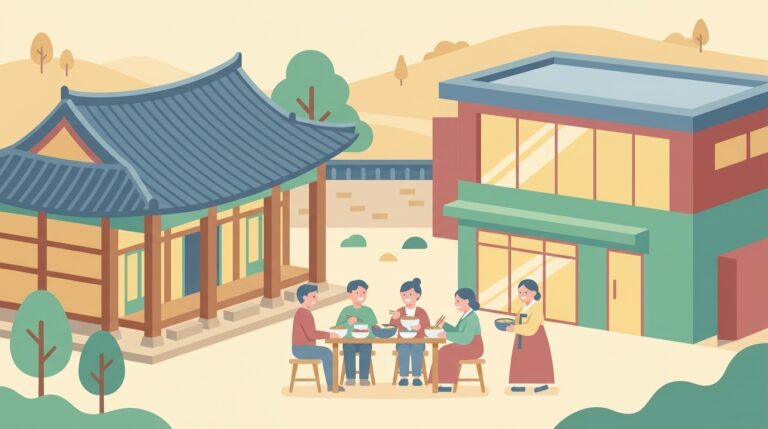
Have you ever watched a K-drama where a character hits rock bottom and seeks shelter at a peaceful mountain temple, or finds a warm bowl of soup served by volunteers at a local neighborhood church? In Korea, religious facilities such as Buddhist temples (사찰) and Christian churches (교회) are far more than places for prayer or Sunday mass. They act as vital social safety nets, cultural preservation hubs, and community sanctuaries.
Many advanced Korean learners tell me, “I know words like ‘도와주다’ (to help), but when I watch news documentaries or read articles about temple stay community outreach or neighborhood welfare initiatives, I stumble over formal and nuanced Korean expressions.” If you’ve felt that wall when discussing the deeper social dynamics of Korean spirituality, you are not alone! C1-level Korean requires understanding how spirituality manifests in public service and community solidarity. Based on real feedback from our advanced learners, this guide will empower you to discuss complex social roles, ethical contributions, and community support in fluent, culturally rich Korean. Let’s dive in together!
Phase 2: Deep Dive into 3 Core C1 Expressions
1. 사회적 안식처 (Sahojeok ansikcheo)
- Pronunciation: [Saho-jeok an-sik-cheo] (Sounds like “Sah-ho-juck ahn-seek-chuh”)
- Meaning: Literal: Social sanctuary / Real Nuisance: A safe space provided by an institution where vulnerable people find physical, mental, and emotional refuge from society’s pressures.
- K-Culture Moment: In documentaries exploring urban solitude in Seoul, local religious spaces are frequently described as a ‘사회적 안식처’ for exhausted youth and isolated senior citizens.
- Editor’s Insight: Combining ‘사회적’ (social) and ‘안식처’ (sanctuary/haven), this C1 noun phrase elevates your discussion from simply saying “safe place” (안전한 곳) to analyzing institutional support systems.
- Situation Spectrum: Casual 🚫 | Semi-formal ⚠️ | Formal ✅
- 🤔 Think About It: Does your native language have a term that explicitly links spiritual sanctuaries with social welfare safety nets?
2. 귀감이 되다 (Gwigami doeda)
- Pronunciation: [Gwi-gam-i doe-da] (Sounds like “Gwee-gahm-ee dway-dah”)
- Meaning: Literal: To become a mirror/model / Real Nuisance: To serve as a paragon or exemplary model for others through altruistic actions.
- K-Culture Moment: When a historical Korean church opens its doors to provide shelter during harsh winters, news anchors report: “지역 사회에 귀감이 되고 있습니다” (It is setting an exemplary standard for the community).
- Editor’s Insight: ‘귀감’ originates from ancient bronze mirrors used for self-reflection. Saying an organization’s social work ‘귀감이 되다’ expresses profound respect for their moral leadership.
- Situation Spectrum: Casual 🚫 | Semi-formal ✅ | Formal ✅
- 🤔 Think About It: How does your culture publicly honor religious organizations that engage in non-proselytizing social work?
3. 소외된 이웃을 보살피다 (Sowaedoen iuseul bosalpida)
- Pronunciation: [So-wae-doen i-u-seul bo-sal-pi-da] (Sounds like “So-weh-dohn ee-oo-seul boh-sahl-pee-dah”)
- Meaning: Literal: To look after marginalized neighbors / Real Nuisance: Actively caring for marginalized, overlooked, or vulnerable groups in society without expectation of reward.
- K-Culture Moment: Seen during winter ‘Kimjang’ (김장 – Kimchi making) charity drives hosted by temple or church volunteers distributing free Kimchi to elderly living alone.
- Editor’s Insight: ‘소외되다’ means to be marginalized or alienated. Using ‘보살피다’ (to tenderly care for) instead of ‘돕다’ (to help) conveys warmth, responsibility, and human dignity.
- Situation Spectrum: Casual ⚠️ | Semi-formal ✅ | Formal ✅
- 🤔 Think About It: In your country, is charitable work viewed as an institutional duty or an individual moral calling?
Phase 3: Textbook Korean vs. Real Native Korean
Situation 1: Expressing that a local temple or church offers free meals to those in need
- 📖 Textbook Korean: 이 종교 시설은 가난한 사람들에게 무료로 음식을 줍니다. (This religious facility gives food to poor people for free.)
- 🗣️ Real Native Korean: 이 시설은 취약계층을 위해 무료 급식 봉사를 지속적으로 펼치고 있어요. (This facility continuously carries out free meal services for vulnerable groups.)
- 💡 Why the Difference?: Textbook Korean can sound blunt or insensitive (“가난한 사람들”). C1 native Korean uses respectful social terms like ‘취약계층’ (vulnerable social strata) and active welfare verbs like ‘봉사를 펼치다’ (to extend volunteer services).
Situation 2: Discussing how religious facilities help preserve regional tradition and community cohesion
- 📖 Textbook Korean: 종교 시설은 지역 사람들을 모이게 만들어요. (Religious facilities make local people gather together.)
- 🗣️ Real Native Korean: 종교 시설이 지역 공동체의 유대감을 강화하는 구심점 역할을 하네요. (Religious facilities play a pivotal role in strengthening community solidarity.)
- 💡 Why the Difference?: Instead of basic verbs like ‘모이게 만들다’, advanced speakers use sophisticated sociological phrasing such as ‘구심점’ (pivotal focal point) and ‘유대감을 강화하다’ (strengthen bonds of solidarity).
Phase 4: K-Culture Deep Dive & Non-Verbal Etiquette
4-1. Nunchi (눈치) & Non-Verbal Manners in Korean Religious Spaces
When visiting or discussing Korean religious facilities acting in their social capacities:
1. Two-Handed Respect (두 손 쓰기): When receiving food at a community sharing event or giving donations, always use two hands or support your right wrist with your left hand.
2. Modest Demeanor (정숙한 태도): In Korean Buddhist temples (사찰) and traditional churches, quiet speech and lowered gaze signal ‘Nunchi’—respecting those seeking spiritual peace or rest.
3. Removing Shoes Smoothly: Many traditional religious welfare offices require removing shoes. Always align your footwear toward the exit after stepping off the threshold as a mark of refined courtesy.
4-2. Cultural Code Analysis: Temple Food & Neighborhood Welfare Drives
Have you watched K-dramas where characters go on a quiet retreat to taste ‘사찰음식’ (Temple Food)? Temple food is not just a cuisine; it is a philosophy of sustainability and social sharing. Buddhist temples in Korea regularly host community meals made from naturally harvested ingredients, sharing them equally regardless of social status. Similarly, Korean churches run ‘나눔 카페’ (Sharing Cafes) where profits fund local youth scholarships. Korean spirituality centers around ‘정’ (Jeong – deep emotional attachment and sharing) translated into actionable social safety nets.
Phase 5: Real-World Roleplay Scenario
Setting: A podcast studio in Seoul. You (an advanced foreign language scholar) are discussing the social impact of local religious facilities with Host Min-jun (민준).
Characters:
- Learner (You): C1 Korean speaker exploring social welfare in Korea.
- Min-jun (민준): Podcast Host & Social Policy Researcher.
Dialogue:
- Min-jun: 한국의 종교 시설이 단순히 신앙의 공간을 넘어 사회적 역할을 하고 있다는 점이 흥미롭네요.
(Hanguk-ui jonggyo siseol-i dansunhi sinang-ui gonggan-eul neomeo sahoejeok yeokhal-eul hago itdaneun jeom-i heungmiropneeyo.)
English: It’s fascinating how Korean religious facilities go beyond simple places of faith to play a social role.
🎭 Action: Nods thoughtfully while looking at the microphone. -
You: 맞아요. 취약계층을 위한 무료 급식이나 상담 프로그램처럼 사회적 안식처 역할을 톡톡히 하고 있더라고요.
(Majayo. Chwiyaak-gyecheung-eul wi-han muryo geupsik-ina sangdam peurogeuraem-cheoreom sahoejeok ansikcheo yeokhal-eul toktok-hi hago itdago-yo.)
English: Exactly. They play a significant role as a social sanctuary, offering free meals and counseling programs for vulnerable groups.
🎭 Action: Gestures warmly with both hands. -
Min-jun: 특히 재난 상황이나 추운 겨울에 지역 사회를 보살피는 모습이 인상적이지 않나요?
(Teuk-hi jaenan sanghwang-ina chu-un gyeo-ul-e jiyeok sahoe-reul bosalpineun moseub-i insangjeok-iji annayo?)
English: Isn’t it particularly impressive how they care for the local community during disasters or harsh winters?
🎭 Action: Smiles warmly in agreement. -
You: 네, 소외된 이웃을 보살피며 솔선수범하는 모습은 사회 전체에 귀감이 된다고 생각해요.
(Ne, sowaedoen iuseul bosalpimyeo solseonsubeom-haneun moseub-eun sahoe jeonchae-e gwigami doendago saenggak-haeyo.)
English: Yes, leading by example in caring for marginalized neighbors serves as a true model for society as a whole.
🎭 Action: Speaks with confident and earnest voice inflection. -
Min-jun: 이러한 나눔 문화가 현대 한국 사회에서 어떤 의미를 가진다고 보시나요?
(Ireo-han nanum munhwa-ga hyeondae hanguk sahoe-eseo eotdeon uimi-reul gajindago bosinayo?)
English: What meaning do you think this sharing culture holds in modern Korean society?
🎭 Action: Leans forward attentively. -
You: 개인화된 현대 사회에서 지역 공동체의 유대감을 강화하는 아주 중요한 구심점 역할을 합니다.
(Gaeinhwadoen hyeondae sahoe-eseo jiyeok gongdongchae-ui yudaegam-eul ganghwahaneun aju jungyo-han gusimjeom yeokhal-eul hamnida.)
English: In an individualized modern society, it serves as a crucial focal point that strengthens community bonds.
🎭 Action: Maintains respectful eye contact. -
Min-jun: 정말 깊이 있는 분석이네요! 단순한 자선 사업을 넘어선 문화적 가치를 짚어주셨어요.
(Jeongmal gipi itneun bunseok-ineyo! Dansunhan jaseon sa-eob-eul neomeoseon munsahjeok gachi-reul jipeo-jusyeosseoyo.)
English: That is a profound analysis! You highlighted a cultural value that goes beyond simple charity.
🎭 Action: Claps softly in admiration. -
You: 한국의 ‘정(情)’ 문화가 종교 시설의 사회적 실천으로 발현된 좋은 예시라고 봅니다.
(Hanguk-ui ‘Jeong’ munhwa-ga jonggyo siseol-ui sahoejeok silcheon-euro balhyeon-doen jo-eun yesi-rago bomnida.)
English: I see it as a great example of Korea’s culture of ‘Jeong’ manifested through the social practice of religious facilities.
🎭 Action: Concludes with a warm, humble smile.
🔀 Interactive Branching Point
*During the podcast, Min-jun asks:
Frequently Asked Questions (FAQ)
Q: What does "사회적 안식처 (Sahojeok ansikcheo)" mean in Korean and how do you pronounce it?
A: In Korean, "사회적 안식처 (Sahojeok ansikcheo)" is pronounced [Saho-jeok an-sik-cheo] and means: Literal: Social sanctuary / Real Nuisance: A safe space provided by an institution where vulnerable people find physical, mental, and emotional refuge from society's pressures.
Q: What does "귀감이 되다 (Gwigami doeda)" mean in Korean and how do you pronounce it?
A: In Korean, "귀감이 되다 (Gwigami doeda)" is pronounced [Gwi-gam-i doe-da] and means: Literal: To become a mirror/model / Real Nuisance: To serve as a paragon or exemplary model for others through altruistic actions.
Q: What does "소외된 이웃을 보살피다 (Sowaedoen iuseul bosalpida)" mean in Korean and how do you pronounce it?
A: In Korean, "소외된 이웃을 보살피다 (Sowaedoen iuseul bosalpida)" is pronounced [So-wae-doen i-u-seul bo-sal-pi-da] and means: Literal: To look after marginalized neighbors / Real Nuisance: Actively caring for marginalized, overlooked, or vulnerable groups in society without expectation of reward.







