

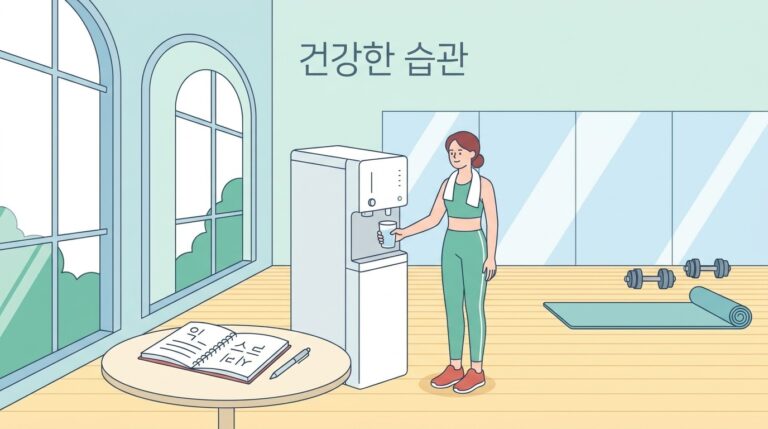
Phase 1: Empathy (Storytelling Opening)
안녕하세요! I am your Daily Hangul editor. Imagine this: you just finished an intense 20-minute treadmill run at a sleek gym in Gangnam. Sweat is pouring, your throat is dry, and you urgently need a drink of water. You look around, but all the machine labels and signs are in Korean. You see a sleek silver machine in the corner with blue and red lights. Is that the water purifier? Where are the cups? How do you ask the gym staff or fellow gym-goer politely without breaking a sweat?
Don’t worry! Navigating a Korean gym (피트니스 센터) is a rite of passage for expats and travelers. In Korea, water purifiers (정수기) are standard in almost every gym, but asking for help or finding cups requires a few simple, natural phrases. Based on real feedback from international learners in Seoul, we compiled this easy A2-level guide so you can stay hydrated and confident during your workout!
Phase 2: Core Expressions Deep Dive
1. 정수기 어디에 있어요? (Where is the water purifier?)
- Pronunciation: [Jeong-su-gi eo-di-e i-sso-yo?] (Sounds like: Joung-soo-gee uh-dee-eh ees-so-yo?)
- Meaning: Literal: “Water purifier where is?” / Natural: “Where is the water dispenser?”
- K-Culture Moment: You’ll hear this in K-dramas whenever characters visit a public space, gym, or office breakroom.
- Editor’s Insight: In English, we often say “Where can I get water?”, but Koreans directly name the machine: 정수기 (water purifier).
- Situation Spectrum: Casual ⚠️ | Semi-formal ✅ | Formal ✅
- 🤔 Think About It: In your home country, do gyms provide free water purifiers, or do you usually have to buy bottled water?
2. 종이컵 있어요? (Do you have paper cups?)
- Pronunciation: [Jong-i-keop i-sso-yo?] (Sounds like: Jong-ee-cup ees-so-yo?)
- Meaning: Literal: “Paper cup exists?” / Natural: “Are there paper cups available?”
- K-Culture Moment: Many Korean gyms provide small cone-shaped paper cups (종이컵/깔때기 컵) right next to the purifier.
- Editor’s Insight: If you don’t bring a personal tumbler, asking for a 종이컵 will save your life!
- Situation Spectrum: Casual ⚠️ | Semi-formal ✅ | Formal ✅
- 🤔 Think About It: Why do you think eco-friendly metal tumblers are becoming more popular than disposable cups in Korean gyms?
3. 시원한 물 나와요? (Does cold water come out?)
- Pronunciation: [Si-won-han mul na-wa-yo?] (Sounds like: See-won-han mool nah-wah-yo?)
- Meaning: Literal: “Cool water comes out?” / Natural: “Is cold water available?”
- K-Culture Moment: Koreans love cold water year-round—a cultural trend famously called Eol-Juk-A (Freeze to death, but still ice coffee/water!).
- Editor’s Insight: 시원하다 means refreshing/cool. You can push the cold lever (usually marked blue) on the machine.
- Situation Spectrum: Casual ⚠️ | Semi-formal ✅ | Formal ✅
- 🤔 Think About It: Why is temperature preference for drinking water so important in Korean post-workout culture?
Phase 3: Textbook Korean vs. Real Korean
Situation 1: Asking where to drink water
- 📖 Textbook: 물을 어디에서 마실 수 있습니까? (Where may I drink water?)
- 🗣️ Real Korean: 정수기 어디 있어요? (Where’s the water purifier?)
- 💡 Why the difference? Native speakers drop heavy grammar structures like “-ㄹ 수 있습니까” in casual settings and focus directly on key nouns.
Situation 2: Stating you are going to get water
- 📖 Textbook: 제가 물을 마셔도 되겠습니까? (May I drink water?)
- 🗣️ Real Korean: 물 좀 마실게요! (I’ll grab some water!)
- 💡 Why the difference? In Korean culture, politely announcing your action with “-ㄹ게요” sounds much more natural and friendly than asking for strict permission.
Phase 4: K-Culture Deep Dive & Non-Verbal Manners
4-1. Eye Contact & Nunchi (눈치)
When approaching a water station that someone else is using, stand a step back. Make gentle eye contact, give a short head nod (목인사), and wait your turn. If someone fills a large tumbler, they might offer you a turn first with a small hand sign sweeping toward the dispenser.
4-2. Culture Code: Free Amenities & Tumbler Etiquette
Korean gyms pride themselves on clean facilities. Drinking water is almost always 100% free. However, it is considered polite to quickly fill your cup and step aside so others finishing cardio aren’t kept waiting.
Phase 5: Real-Life Roleplay Scenario
Setting: A modern fitness center in Seoul. Trainer Min-woo (민우) sees you panting after a workout.
- Min-woo: 운동 잘되어 가시나요? (Un-dong jal-doe-eo ga-si-na-yo? / How is your workout going?)
- You: 네, 그런데 너무 목말라요. 🎭 (Ne, geu-ron-de neo-mu mok-mal-ra-yo. / [Wiping sweat] Yes, but I’m so thirsty.)
- Min-woo: 아, 정수기 저쪽에 있어요! (A, jeong-su-gi jeo-tjok-e i-sso-yo! / Ah, the water purifier is over there!)
- You: 혹시 종이컵도 있나요? 🎭 (Hok-si jong-i-keop-do i-na-yo? / [Looking around] By any chance, are there paper cups too?)
- Min-woo: 네, 정수기 옆에 컵 있어요. (Ne, jeong-su-gi yeop-e keop i-sso-yo. / Yes, cups are right next to the machine.)
- You: 시원한 물 나와요? (Si-won-han mul na-wa-yo? / Does cold water come out?)
- Min-woo: 그럼요! 파란색 버튼 누르세요. (Geu-reom-yo! Pa-ran-saek beou-teon nu-reu-se-yo. / Of course! Press the blue button.)
- You: 감사합니다! 물 좀 마실게요. 🎭 (Gam-sa-ham-ni-da! Mul jom ma-sil-ge-yo. / [Nodding politely] Thank you! I’ll get some water.)
- Min-woo: 네, 편하게 마세요! (Ne, pyeon-ha-ge ma-si-se-yo! / Sure, take your time!)
🔀 Interactive Choice Point
The trainer points to the water machine, but you don’t see any cups nearby. What do you say?
* Choice A: “저기요, 물 주세요!” (Hey, give me water!)
* Choice B: “혹시 컵 어디에 있어요?” (By any chance, where are the cups?)
* Choice C: “물 없어요.” (There is no water.)
Feedback:
* Choice A (Risk): Too blunt and sounds like you are ordering drinks at a restaurant.
* Choice B (Best): Polite, natural, and uses soft introductory phrasing (“혹시”).
* Choice C (Bad): Inaccurate if water is available but cups are hidden.
Phase 6: 10-Second Emotion Shadowing Drill
Practice saying these lines with realistic human emotion! Slashes (/) indicate natural pauses.
[😩 Exhausted & Thirsty]저 / 너무 / 목말라요… (Jeo / neo-mu / mok-mal-ra-yo…)[😊 Relieved & Polite]아, / 정수기 / 여기 있네요! (A, / jeong-su-gi / yeo-gi in-ne-yo!)[🙏 Grateful & Friendly]감사합니다, / 물 좀 마실게요! (Gam-sa-ham-ni-da, / mul jom ma-sil-ge-yo!)
Phase 7: K-Culture Mini Dictionary
- 정수기 (Jeong-su-gi) | Water Purifier | Essential appliance found in gyms, banks, and restaurants across Korea.
- 목말라요 (Mok-mal-ra-yo) | I am thirsty | Expression used when your throat feels dry.
- 얼음 (Eol-eum) | Ice | Useful word if the gym purifier has a built-in ice dispenser.
- 텀블러 (Teom-beul-reo) | Tumbler / Water Bottle | Reusable personal water bottle standard in Korean gym culture.
Phase 8: Traveler’s Survival Kit
Survival TOP 3 Expressions
- 정수기 어디예요? (Where is the water dispenser?)
- 컵 있어요? (Are there cups?)
- 물 좀 마실게요. (I’ll drink some water.)
Editor’s Travel Note
Before heading out to train, search for local facilities on the 네이버 지도 앱 다운로드 (Naver Map App Download). You can search “피트니스” (Fitness) or “헬스장” (Gym) near your hotel to find places with day passes (일일권) and full water amenities.
Phase 9: One Step Deeper (Culture Reflection)
In many Western countries, gym members carry giant 2-liter water jugs or buy bottled water at the front desk. In Korea, free purified water is an expected baseline of hospitality. Offering public access to clean drinking water reflects the deep-rooted Korean culture of shared convenience and hospitality.
💬 Your Turn: Does your local gym provide free filtered water, or do you always bring your own water bottle? Share your gym routines in the comments below!
Phase 10: FAQ & Common Mistakes
Q: Can I drink hot water from the gym water purifier?
A: Yes! Most Korean water purifiers have two levers or buttons: Red for hot water (온수) and Blue for cold water (냉수). Be careful not to press the red button by accident after a workout!
Q: Is tap water safe to drink directly from the sink in Korea?
A: Tap water in Korea is technically safe, but almost nobody drinks directly from the tap. Everyone prefers using the filtered water dispenser (정수기).
Q: What should I do with disposable paper cups when finished?
A: Look for a small trash bin or dedicated cup holder stand next to the purifier to discard or stack your used cup.
🚨 Common Mistakes Warning
- ❌ Mistake 1: Saying “수영장 어디 있어요?” (Where is the swimming pool?) when looking for water.
- ✅ Correct Action: Say “정수기 어디 있어요?” (Where is the water purifier?).
- ❌ Mistake 2: Expecting bottled water for free.
- ✅ Correct Action: Look for the public dispenser machine.
- ❌ Mistake 3: Pressing the red button expecting cold water.
- ✅ Correct Action: Press the blue button or select cold mode.
Phase 11: Action Mission & Engagement
- Bronze Mission: Say “정수기 어디 있어요?” out loud 3 times in front of your mirror.
- Silver Mission: Write a comment below answering: “시원한 물이 좋아요, 따뜻한 물이 좋아요?” (Do you like cold water or warm water?).
- Gold Mission: Visit a local gym or Korean center and successfully locate the water purifier using Korean!
🎮 K-Culture Mission: Watch a gym scene in a contemporary Korean drama and spot the silver water purifier in the background!
Phase 12: Interactive Quiz Challenge
Q1. What is the Korean word for ‘Water Purifier’?
1) 정수기
2) 청소기
3) 냉장고
Click to reveal Answer & Explanation
Answer: 1) 정수기 (Jeongsu-gi). 청소기 means vacuum cleaner, and 냉장고 means refrigerator!
Q2. Which button color typically dispenses cold water in Korea?
1) Red
2) Blue
3) Yellow
Click to reveal Answer & Explanation
Answer: 2) Blue (파란색) indicates cold water (냉수).
Q3. True or False: It is impolite to ask for paper cups at a Korean gym.
Click to reveal Answer & Explanation
Answer: False! Gyms provide paper cups specifically for member convenience.







