

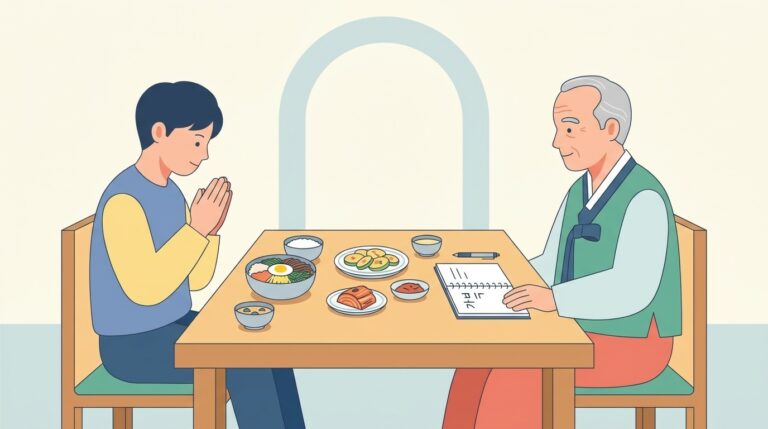
Phase 1: Empathy & Storytelling
안녕하세요! I’m your Daily Hangul (매일한글) editor and Korean culture guide! Have you ever sat down at a dinner table in Korea, surrounded by delicious sizzling BBQ or steaming stew, reached for your chopsticks right away, and suddenly felt a freezing silence fall over the room? Don’t panic! You didn’t commit a crime, but you might have skipped one of Korea’s most important dining rules: respecting elders at the table. In Korean culture, dining is a shared social ritual where age and respect dictate the rhythm of the meal. Knowing when to pick up your spoon—and what to say before taking that first bite—can turn an awkward moment into a heartwarming bond with Korean friends or host families. Today, we are mastering the essential phrase “어른 먼저 드세요” (Please eat first, elder) and table manners for A1 beginners!
Phase 2: Top 3 Core Expressions
1. 먼저 드세요 (Meonjeo deuseyo)
- Pronunciation: [meon-jeo deu-se-yo] (Sounds like “mun-jeo do-say-yo”)
- Meaning: “Please eat first.”
- K-Culture Moment: In K-Dramas, you often see younger characters politely waiting at the dinner table, gesturing with two hands for the grandparents to pick up their spoons first while saying this phrase.
- Editor’s Insight: “먼저” means “first” and “드세요” is the honorific form of “eat”. It shows thoughtfulness and respect.
- Situation Spectrum: Casual 🚫 | Semi-formal ✅ | Formal ✅
- 🤔 Think About It: Does your culture wait for elders or host to start eating before everyone else begins?
2. 잘 먹겠습니다 (Jal meokgetseumnida)
- Pronunciation: [jal meok-get-seum-ni-da] (Sounds like “jall muk-get-soom-nee-da”)
- Meaning: “I will eat well / Thank you for the meal.”
- K-Culture Moment: Said loudly together before starting a meal at family dinners, school lunches, or company dinners.
- Editor’s Insight: It expresses gratitude to the cook or host who prepared or paid for the meal.
- Situation Spectrum: Casual ⚠️ (use 잘 먹을게) | Semi-formal ✅ | Formal ✅
- 🤔 Think About It: How do you show gratitude before eating in your home country?
3. 맛있게 드세요 (Masitge deuseyo)
- Pronunciation: [ma-sit-ge deu-se-yo] (Sounds like “mah-sheet-geh do-say-yo”)
- Meaning: “Bon appétit / Please enjoy your meal.”
- K-Culture Moment: Used by restaurant staff when serving dishes or by friends when starting to eat.
- Editor’s Insight: Use this when offering food to someone elder or equal in status to wish them an enjoyable meal.
- Situation Spectrum: Casual 🚫 | Semi-formal ✅ | Formal ✅
- 🤔 Think About It: Why do many languages have a special phrase just for wishing a good meal?
Phase 3: Textbook Korean vs. Real Korean
Situation 1: Offering the first bite to an elder
- 📖 Textbook Korean: 식사를 먼저 하십시오. (Siksareul meonjeo Hasipseio – Very formal and robotic)
- 🗣️ Real Korean: 어른 먼저 드세요! (Eoreun meonjeo deuseyo! – Warm and natural)
- 💡 Why is it different? Real conversation prefers honorific verbs like ‘드시다’ over overly formal dictionary phrasing.
Situation 2: Starting the meal gracefully
- 📖 Textbook Korean: 음식을 맛있게 먹겠습니다. (Eumsigeul masitge meokgetseumnida – Unnatural)
- 🗣️ Real Korean: 잘 먹겠습니다! (Jal meokgetseumnida! – Natural & universal)
- 💡 Why is it different? ‘잘 먹겠습니다’ is the set cultural idiom universally understood across Korea.
Phase 4: K-Culture Deep Dive & Mannerisms
4-1. Nunchi & Body Gestures
- The Golden Spoon Rule: Never pick up your spoon or chopsticks before the eldest person at the table picks up theirs.
- Two-Hand Gesture: When passing food, water, or drinks to elders, always support your right forearm with your left hand.
- Drinking Etiquette: If drinking with elders, turn your face and body slightly away from them when taking a sip.
4-2. Cultural Insight: K-Food Family Dining
In Korean K-Dramas and everyday life, food is affection. Elders express love by putting choice pieces of side dishes onto your rice bowl. Accepting it happily with a polite “감사합니다!” builds instant trust.
Phase 5: Interactive Roleplay Scenario
Setting: Dining with your Korean friend Minjun (민준) and his grandfather (할아버지) at a traditional Korean restaurant.
- Turn 1 (Grandfather): 🎭 [Smiling warm-heartedly] 허허, 음식이 다 나왔구나. (Haha, all the food is served.)
- Turn 2 (You): 🎭 [Waiting politely without touching chopsticks] 할아버지, 어른 먼저 드세요. (Grandfather, please eat first.)
- Turn 3 (Grandfather): 🎭 [Picks up chopsticks happily] 그래, 고맙다! 너도 많이 먹으렴. (Alright, thank you! You eat a lot too.)
- Turn 4 (You): 🎭 [Bowing head slightly] 네, 잘 먹겠습니다! (Yes, I will eat well!)
- Turn 5 (Minjun): 🎭 [Passing side dish] 이것도 먹어봐. 맛있어. (Try this too. It’s delicious.)
- Turn 6 (You): 🎭 [Receiving with both hands] 고마워! 맛있게 먹을게. (Thanks! I’ll enjoy it.)
- Turn 7 (Grandfather): 🎭 [Looking pleased] 한국 예절을 잘 아는구나! (You know Korean etiquette so well!)
- Turn 8 (You): 🎭 [Smiling brightly] 감사합니다! (Thank you!)
🔀 Interactive Choice Point
The grandfather offers you a bowl of soup using both hands. What do you do?
* Choice A: Take it with one hand while continuing to chew your food.
* Choice B: Hold the bowl with two hands, bow slightly, and say “감사합니다!”.
* Choice C: Refuse it politely because you are already full.
- Feedback:
- Choice A (Risk): Taking items with one hand from elders is considered disrespectful in Korea.
- Choice B (Best): Perfect! Receiving with two hands and expressing thanks shows incredible warmth and respect.
- Choice C (Bad): Directly refusing food from an elder on the first offer can make them feel awkward. It’s better to accept politely first.
Phase 6: 10-Second Emotion Shadowing Drill
- Sentence 1: [😊 Respectful & Polite] 어른 먼저 / 드세요. (Eoreun meonjeo / deuseyo.)
- Sentence 2: [😋 Cheerful & Excited] 잘 / 먹겠습니다! (Jal / meokgetseumnida!)
- Sentence 3: [💖 Warm & Friendly] 맛있게 / 드세요! (Masitge / deuseyo!)
Phase 7: K-Culture Mini Dictionary
- 어른 (Eoreun) | Elder / Adult | Refers to older family members, seniors, or superiors at work.
- 예의 (Yeeui) | Etiquette / Courtesy | Crucial value in Korean social life emphasizing mutual respect.
- 수저 (Sujeo) | Spoon and Chopsticks | The set of utensils used in traditional Korean dining.
- 눈치 (Nunchi) | Social Tact | The art of sensing others’ feelings and table timing without speaking.
Phase 8: Traveler’s Survival Kit
Top 3 Survival Phrases
- 어른 먼저 드세요. (Eoreun meonjeo deuseyo.) – Please eat first (to elders).
- 잘 먹겠습니다! (Jal meokgetseumnida!) – Thank you for the meal!
- 잘 먹었습니다! (Jal meogeosseumnida!) – I have eaten well! (Said after finishing the meal).
Editor’s Travel Note
When navigating Korean dining spots or booking popular traditional restaurants, download and use the 네이버 지도 앱 다운로드 (Naver Map app) for accurate locations, reviews, and opening hours.
Phase 9: One Step Deeper
Korean dining etiquette is not about strict control; it’s about relational warmth. By allowing the eldest person to initiate the meal, everyone acknowledges family hierarchy and expresses care for senior members. When you say “어른 먼저 드세요”, you instantly communicate that you value their wisdom and presence.
💬 Your Turn: What is the most unique dining habit or rule in your home country? Share with us in the comments below!
Phase 10: FAQ & Common Mistakes
Q: Can I use “어른 먼저 드세요” with someone who is just a few years older?
A: For friends or colleagues who are slightly older, you can simply say “먼저 드세요” (Please go ahead and eat first) rather than using the word “어른”.
Q: What should I say when finishing the meal?
A: Say “잘 먹었습니다!” (Jal meogeosseumnida), which means “I ate very well, thank you!”
Q: Is it rude to lift my rice bowl while eating?
A: Yes! Unlike in some neighbor countries, in Korea, rice bowls stay on the table. Use your spoon to eat rice.
🚨 Common Mistakes TOP 3
- Picking up chopsticks first: Wait until the eldest picks up their utensil.
- Holding bowls with hands: Leave rice/soup bowls flat on the table.
- Blowing nose at table: Excuse yourself to the restroom instead.
Phase 11: Action Mission
- Bronze Level: Say “잘 먹겠습니다!” out loud 3 times before your next meal.
- Silver Level: Practice saying “어른 먼저 드세요” with correct pause phrasing.
- Gold Level: Use “잘 먹었습니다!” after dining at a local Korean restaurant.
🎮 K-Culture Mission: Watch a meal scene in your favorite K-Drama and notice who touches their spoon first!
Phase 12: Interactive Quiz Challenge
Q1. What should you say BEFORE eating a meal in Korea?
A) 잘 먹었습니다
B) 잘 먹겠습니다
C) 안녕히 계세요
Click to view Answer & Explanation
Correct Answer: B) 잘 먹겠습니다! (I will eat well!). Option A is used AFTER finishing the meal.
Q2. True or False: You should pick up your rice bowl to eat near your mouth in Korea.
Click to view Answer & Explanation
Correct Answer: False! In Korea, keep rice bowls on the table and use your spoon.







