

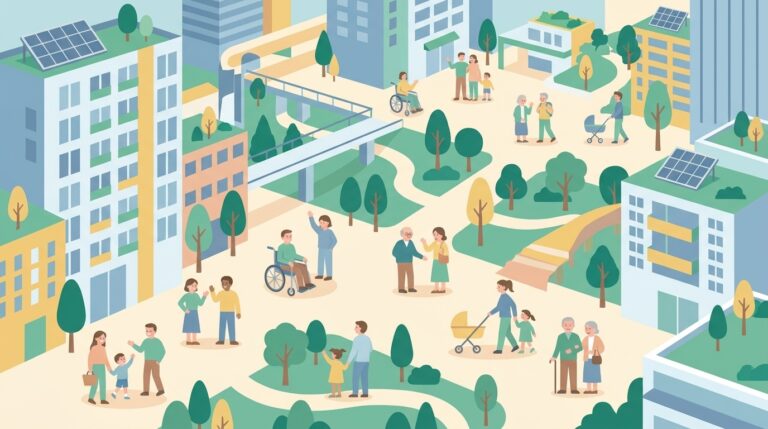
Beyond Walls: Discussing Public Housing Equity in Modern Korea
Phase 1: 공감 (Storytelling Opening)
안녕하세요! 매일한글 에디터입니다. Have you ever watched a modern K-Drama like Green Mothers’ Club or Kdrama Real Estate stories where housing isn’t just about shelter, but status? In Seoul, housing is a deeply nuanced topic. For years, public rental housing (공공 임대 주택) faced societal prejudice, often stigmatized due to real estate polarization. But today, a powerful shift is happening across Korean society. Urban planners, youth activists, and local communities are championing inclusive urban planning—advocating for ‘Social Mix’ (소셜 믹스) to dismantle socio-economic barriers.
As a C2-level Korean learner, mastering everyday conversation is no longer your only goal. You are ready to engage in elevated socio-cultural discussions, articulate ethical perspectives on urban policy, and express empathy using sophisticated Korean. By learning how to discuss housing equity thoughtfully, you gain authentic insight into contemporary Korean values. This guide relies on real learner feedback and expert insights from our Daily Hangul curriculum to help you navigate sensitive social topics fluently and respectfully.
Phase 2: 핵심 표현 3선 심층 분석
1. 낙인효과를 해소하다 (Nagin-hyogwa-reul haeso-hada)
- Pronunciation: [Nagin-hyo-gwa-reul hae-so-ha-da] (Sounds like nah-geen hyo-gwah-reul hae-so-hah-dah)
- Meaning: Literal: To dissolve the stigma effect. / Nuance: To actively overcome and dismantle social prejudice attached to a specific group or housing project.
- K-Culture Moment: Seen in contemporary urban planning debates on Korean news programs where experts discuss integrating public rental units seamlessly into high-end private apartment complexes.
- Editor’s Insight: 낙인 means ‘brand’ or ‘stigma’. Using 해소하다 (to alleviate/dissolve) instead of just 없애다 (to remove) gives your Korean an analytical, professional C2 polish.
- Situation Spectrum: Casual 🚫 | Semi-formal ⚠️ | Formal ✅
- 🤔 Think About It: How does your culture address urban housing segregation, and how does the phrase ‘stigma effect’ translate into your native language’s socio-political discourse?
2. 소셜 믹스 (So-syeol Mik-seu)
- Pronunciation: [So-syeol mik-seu] (English loanword pronounced with Korean phonetic rhythm: so-shull meek-seu)
- Meaning: Literal: Social Mix. / Nuance: Urban planning policy that integrates public rental and private housing units within the same residential complex to foster social integration.
- K-Culture Moment: Frequently cited in K-Drama plotlines featuring urban redevelopment projects or neighborhood committee meetings.
- Editor’s Insight: Although borrowed from English, 소셜 믹스 is an official policy term used by the Seoul Metropolitan Government. Using it demonstrates deep familiarity with modern Korean municipal terminology.
- Situation Spectrum: Casual ⚠️ | Semi-formal ✅ | Formal ✅
- 🤔 Think About It: Is residential integration actively enforced in your home country’s urban planning, or is it left to market forces?
3. 색안경을 벗고 바라보다 (Saeg-an-gyeong-eul beot-go bara-boda)
- Pronunciation: [Saeg-an-gyeong-eul beot-go ba-ra-bo-da] (Pronounced saeg-ahn-gyeong-eul beot-go bah-rah-boh-dah)
- Meaning: Literal: To take off tinted glasses and look. / Nuance: To abandon biased or prejudiced views and view a situation or person objectively.
- K-Culture Moment: A classic phrase spoken by empathetic characters in K-Dramas advocating for fairness and community solidarity.
- Editor’s Insight: An essential idiomatic expression for advanced debate. It softens critique while firmly urging open-mindedness.
- Situation Spectrum: Casual ✅ | Semi-formal ✅ | Formal ✅
- 🤔 Think About It: What idiomatic metaphor does your native language use for overcoming implicit bias?
Phase 3: 교과서 한국어 vs 진짜 한국어
Situation 1: Calling for an end to public housing prejudice
- 📖 교과서 한국어: 공공 임대 주택 입주자에 대한 편견을 없애야 합니다. (We must eliminate prejudice against public rental housing residents.)
- 🗣️ 진짜 한국어: 임대주택이라고 색안경 끼고 보는 시선부터 바꿔야죠. (We really need to change the biased way people look down on public housing.)
- 💡 왜 다를까? Advanced native speakers use metaphorical expressions like 색안경 끼고 보다 (looking through tinted glasses) and conversational endings like -야죠 to sound natural yet persuasive.
Situation 2: Discussing integrated community policy
- 📖 교과서 한국어: 주거 복지 정책을 확대하고 있습니다. (We are expanding housing welfare policies.)
- 🗣️ 진짜 한국어: 계층 간 경계를 허무는 소셜 믹스가 제대로 자리 잡아야 해요. (A social mix that breaks down barriers between socio-economic classes really needs to take root.)
- 💡 왜 다를까? Expressions like 경계를 허물다 (tear down barriers) and 자리 잡다 (take root) show sophisticated mastery of policy nuances.
Phase 4: K-Culture 딥다이브 & 비언어적 매너
4-1. 눈치(Nunchi) & Non-Verbal Conduct
When discussing socio-economic topics like public housing in Korea, tone and body language carry tremendous weight. Avoid overly confrontational body language. Keep your voice calm, steady, and empathetic. Use slight nods (고개 끄덕임) to show active listening. When expressing disagreement on policy, start with a subtle hedge like 취지는 이해하지만… (I understand the intention, but…) while maintaining gentle eye contact to show respect.
4-2. Cultural Code Analysis: Korean Apartment Culture
In South Korea, apartments (아파트) account for over 60% of residences. Historically, brand-name private apartments were viewed as status symbols. However, modern municipal initiatives like Seoul’s SH (Seoul Housing & Communities Corporation) are redesigning public rental units with identical high-end architecture to eliminate physical distinctions between private and rental units. Discussing 공공 임대 주택 is no longer just about welfare—it is a debate on urban dignity and civic equality.
Phase 5: 실전 롤플레이 시나리오
Setting: A public urban council meeting in Seoul regarding a new residential redevelopment project.
Characters:
* 민우 (Min-woo): Urban planning scholar advocating for inclusive housing.
* 수진 (Sujin): Local resident association representative.
- 민우: 🎭 (자료를 펼치며 온화한 목소리로) 이번 재개발 사업에는 소셜 믹스 모델을 적극 도입해야 합니다.
(Ibeon jae-gae-bal sa-eob-e-neun so-syeol mik-seu mod-el-eul jeog-geug do-ib-hae-ya ham-ni-da.)
(Opening documents, speaking in a warm tone) We should actively introduce a social mix model to this redevelopment project. -
수진: 🎭 (조금 우려스러운 표정으로) 취지는 좋은데, 기존 주민들의 반발이 있지 않을까요?
(Chwi-ji-neun joh-eun-de, gi-jon ju-min-deul-ui ban-bal-i it-ji anh-eul-kka-yo?)
(With a slightly concerned look) The intention is good, but won’t there be pushback from existing residents? -
민우: 🎭 (진정성 있게 고개를 끄덕이며) 그 마음 이해합니다. 하지만 분리 배치가 오히려 편견을 키웁니다.
(Geu ma-eum i-hae-ham-ni-da. Ha-ji-man bun-ri bae-chi-ga o-hi-reo pyeon-gyeon-eul ki-um-ni-da.)
(Nodding sincerely) I understand your concern. However, physical separation actually deepens prejudice. -
수진: 🎭 (생각에 잠기며) 음, 그렇다면 단지 내 커뮤니티 시설을 함께 쓰게 되는 건가요?
(Eum, geu-reoh-ta-myeon dan-ji nae keo-myeu-ni-ti si-seol-eul ham-kke sseu-ge doe-neun geon-ga-yo?)
(Lost in thought) Mmm, so does that mean community facilities in the complex will be shared? -
민우: 🎭 (밝게 미소 지으며) 맞습니다. 공용 공간을 함께 쓰며 자연스럽게 이웃이 되는 거죠.
(Mat-seum-ni-da. Gong-yong gong-gan-eul ham-kke sseu-myeo ja-yeon-seu-reob-ge i-us-i doe-neun geo-jyo.)
(Smiling warmly) Exactly. By sharing common spaces, residents naturally become true neighbors. -
수진: 🎭 (팔짱을 풀고 긍정적으로) 결국 인식 개선이 가장 중요한 열쇠겠네요.
(Gyeol-guk in-sig gae-seon-i gang-jang jung-yo-han yeol-swae-get-nae-yo.)
(Uncrossing arms and responding positively) In the end, improving social awareness will be the key. -
민우: 🎭 (확신에 찬 어조로) 네, 낙인효과를 해소하면 모두의 주거 가치가 함께 올라갑니다.
(Ne, nagin-hyogwa-reul haeso-ha-myeon mo-du-ui ju-geo ga-chi-ga ham-kke ol-la-gam-ni-da.)
(With a confident tone) Yes, when we eliminate the stigma effect, housing value rises for everyone. -
수진: 🎭 (미소를 지으며) 함께 상생할 수 있는 방안을 더 논의해 보시죠.
(Ham-kke sang-saeng-hal su it-neun bang-an-eul deo non-ui-hae bo-si-jo.)
(Smiling) Let’s discuss further ways we can achieve mutual prosperity together.
🔀 Interactive Branching Option
How should Min-woo respond if Sujin expresses sharp hesitation about public housing?
* Option A (Best): “주민분들의 우려를 깊이 공감합니다. 성공 사례를 바탕으로 상생 방안을 마련하겠습니다.” (Deeply empathize and offer evidence-based solutions.)
* Option B (Risk): “시대에 뒤떨어진 편견입니다. 무조건 받아들이셔야 합니다.” (Dismiss resident concerns as outdated prejudice.)
* Option C (Bad): “그러면 반대하는 주민들은 논의에서 제외하시죠.” (Exclude concerned citizens from the conversation.)
Phase 6: 10초 감정 섀도잉 드릴
Practice reading these sentences with clear emotional intention and natural pauses (/).
[😊 진정성 있게]임대주택에 대한 / 색안경을 벗을 때 / 진정한 포용 도시가 시작됩니다.
(Im-dae-ju-taeg-e dae-han / saeg-an-gyeong-eul beot-eul ttae / jin-jeong-han po-yong do-si-ga si-jag-doem-ni-da.)-
[🤔 단호하지만 단정한 조로]계층 간의 벽을 허무는 소셜 믹스는 / 더 이상 선택이 아닌 / 필수 정책입니다.
(Gye-cheong gan-ui byeog-eul heo-mu-neun so-syeol mik-seu-neun / deo i-sang seon-taeg-i a-nin / pil-su jeong-chaeg-im-ni-da.)
Phase 7: K-Culture 미니 사전
- 소셜 믹스 (So-syeol Mik-seu): Housing policy integrating low-income rental units with private ownership apartments to prevent social isolation.
- 임대아파트 (Im-dae A-pa-teu): Public or corporate rental housing complexes built for social housing assistance.
- 주거 권리 (Ju-geo Kwon-ri): Basic human right to access safe, affordable, and dignified housing.
- 님비 현상 (Nim-bi Hyeon-sang): ‘Not In My Back Yard’ phenomenon regarding public infrastructure or social housing placement.
Phase 8: 여행자를 위한 생존 키트
Top 3 Practical Expressions
- 소셜 믹스 단지인가요? (So-syeol mik-seu dan-ji-in-ga-yo?) – Is this an integrated social housing complex?
- 주거 복지 정책이 잘 되어 있네요. (Ju-geo bok-ji jeong-chaeg-i jal doe-eo it-nae-yo.) – The housing welfare policies here are well designed.
- 이웃 간의 소통이 활발해요. (I-ut gan-ui so-tong-i hwal-bal-hae-yo.) – Inter-neighbor communication is very active.
Editor’s Travel & Residence Note
If you are researching public services, urban policies, or finding housing in South Korea, use the LH 한국토지주택공사 공식 홈페이지 for public housing listings, or check neighborhood maps using 네이버 지도 앱 다운로드 to explore residential amenities and transit access.
Phase 9: 한 발 더 깊이
Korean urban culture is rapidly evolving from luxury property ownership toward collective wellbeing and social dignity. Modern Korean society is having honest conversations about overcoming housing inequality. Choosing to use respectful vocabulary when referring to public housing reflects high cultural intelligence and a deep understanding of human dignity in modern Korea.
💬 Your Turn: How is inclusive housing discussed in your home city? Share your thoughts in Korean in the comments below!
Phase 10: FAQ & 오해 방지
Q: Is ‘임대아파트’ an offensive term in Korean?
A: No, ‘임대아파트’ is an official municipal term. However, using it with negative socio-economic generalizations can sound insensitive. Frame discussions around urban equity (주거 복지) and social mix (소셜 믹스).
Q: What is the most polite way to discuss public housing policy in Korea?
A: Use formal academic or civic phrasing such as 공공 임대 주택 (Public Rental Housing) and discuss 주거 권리 (Housing Rights) rather than highlighting individual resident income levels.
Q: Is ‘소셜 믹스’ widely understood by native speakers?
A: Yes! It is frequently highlighted in news media, city council debates, and modern civic forums across major Korean cities.
🚨 Common Mistakes TOP 3
- Mistake: Calling public housing residents “불쌍한 사람” (Pitiful people).
- Correct Action: Focus on systemic housing rights: “주거 복지가 필요한 시민들” (Citizens requiring housing welfare support).
- Mistake: Assuming all rental units are low-quality.
- Correct Action: Recognize modern urban developments: “최근 공공 임대 주택은 품질이 매우 우수합니다.” (Recent public rental housing boasts excellent quality.)
- Mistake: Using casual slurs derived from rental apartment names.
- Correct Action: Strictly avoid colloquial social discrimination slurs; use official urban policy terminology.
Phase 11: 액션 미션 & 참여 유도
- 🥉 Bronze: Record yourself reading one sentence from Phase 6 using proper pauses.
- 🥈 Silver: Write a 2-sentence comment using the phrase 낙인효과를 해소하다 on social media.
- 🥇 Gold: Participate in an online forum or class debate in Korean discussing urban housing policy.
- 🎮 K-Culture Mission: Watch a contemporary Korean documentary or drama dealing with urban real estate and spot the term 소셜 믹스 or 주거 복지!
Phase 12: 인터랙티브 퀴즈 챌린지
Quiz 1: Situation Judgment
Which phrase is best when advocating for inclusive community design in a neighborhood meeting?
* A) 무조건 임대아파트 비율을 늘립시다.
* B) 계층 간 경계를 허무는 소셜 믹스 모델이 필요합니다.
* C) 편견이 있는 주민과는 대화하지 않겠습니다.
🔍 정답 및 해설 보기
정답: B
해설: Option B uses refined C2 vocabulary (계층 간 경계를 허물다, 소셜 믹스 모델) appropriate for formal civic discussion.
Quiz 2: Fill-in-the-Blank
임대주택에 대한 ( )을/를 해소하기 위해 다양한 커뮤니티 프로그램이 운영 중이다.
* A) 낙인효과
* B) 과대광고
* C) 일교차
🔍 정답 및 해설 보기
정답: A (낙인효과)
해설: 낙인효과를 해소하다 means to dismantle the stigma effect attached to public rental housing.
Quiz 3: True / False
In modern Seoul urban planning, ‘소셜 믹스’ means building private apartments and public rental apartments in completely separated districts.
🔍 정답 및 해설 보기
정답: False
해설: ‘소셜 믹스’ specifically refers to integrating public rental units and private ownership units within the same residential complex to build an inclusive community.







