

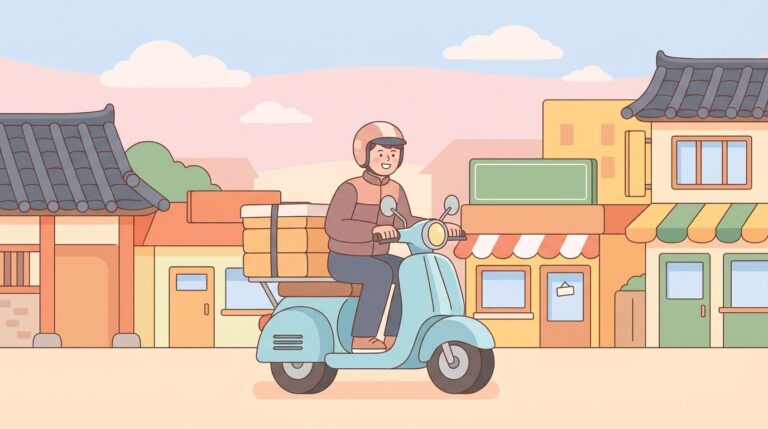
Phase 1: 공감 (Welcome & Empathy)
안녕하세요! 매일한글 에디터입니다. Have you ever ordered food in Korea, sat back dreaming of sizzling fried chicken or steaming tteokbokki, and then wondered… “When is it actually coming?” You open your food delivery app or look at your phone, but you freeze up thinking about how to ask without sounding rude or confused.
In Korea, delivery speed is practically an art form—often called Ppal-li Ppal-li (빨리빨리) culture. But even in a nation where food arrives at lightning speed, traffic jams and rain happen! Knowing how to check your delivery time casually and politely is a total game-changer. It turns an anxious waiting game into a smooth, confident interaction. Based on real feedback from hundreds of our A2 learners living or traveling in Korea, mastering these three short phrases will instantly elevate your daily survival skills!
Phase 2: 핵심 표현 3선 심층 분석 (Top 3 Expressions)
1. 얼마나 걸려요? (Eolmana geollyeoyo?)
- Pronunciation: [Eol-ma-na geol-ryeo-yo?] (Think of ‘geol’ like the English word ‘girl’ with a soft ‘l’)
- Meaning: “How long does it take?” (Direct) vs. “About how many minutes until my food arrives?” (Nuance)
- K-Culture Moment: You hear this all the time in K-Dramas when main characters order late-night chimaek (chicken + beer) at the Han River park!
- Editor’s Insight: This is the ultimate starter phrase. It’s polite, clear, and universally understood by delivery drivers and restaurant owners.
- Situation Spectrum: Casual ⚠️ | Semi-formal ✅ | Formal ✅
- 🤔 Think About It: In your home country, do you ask customer service direct questions about time, or do you wait silently for app updates?
2. 언제쯤 도착해요? (Eonje-jjeum dochak-haeyo?)
- Pronunciation: [Eon-je-jjeum do-chak-hae-yo?]
- Meaning: “Around when will it arrive?” (Direct) vs. “Could you give me a rough estimate of arrival time?” (Nuance)
- K-Culture Moment: Used frequently when texting a rider via delivery app messaging features.
- Editor’s Insight: The magic word here is ~쯤 (~jjeum), which means “around” or “approximately.” Adding it makes your question sound much softer and more natural!
- Situation Spectrum: Casual ⚠️ | Semi-formal ✅ | Formal ✅
- 🤔 Think About It: Adding “approximately” shows consideration for unexpected traffic delays in Korean social etiquette.
3. 음식 거의 다 됐나요? (Eomsik geoei da dwaennayo?)
- Pronunciation: [Eom-sik geo-ui da dwaen-na-yo?]
- Meaning: “Is the food almost ready?” (Direct) vs. “Is my order being prepared or already on its way?” (Nuance)
- K-Culture Moment: Classic line used when calling a local neighborhood Chinese restaurant (Jajangmyeon shop) directly.
- Editor’s Insight: Use this when an hour has passed and you want to check if the food left the kitchen without sounding angry.
- Situation Spectrum: Casual 🚫 | Semi-formal ✅ | Formal ✅
- 🤔 Think About It: Notice how asking about the food’s status (Is it ready?) sounds gentler than asking about the driver’s driving speed!
Phase 3: 교과서 한국어 vs 진짜 한국어 (Textbook vs. Real-Life)
Situation 1: Asking how long delivery takes
- 📖 교과서 한국어: 배달 소요 시간이 어떻게 됩니까? (What is the delivery duration? – Too stiff!)
- 🗣️ 진짜 한국어: 배달 얼마나 걸려요? (How long will delivery take? – Friendly & natural)
- 💡 왜 다를까? Textbook phrases sound like legal documents. Real Koreans prefer short, active verbs in daily life.
Situation 2: Asking if driver is near
- 📖 교과서 한국어: 기사님께서 어디에 계십니까? (Where is the driver located? – Sounds like a police investigation!)
- 🗣️ 진짜 한국어: 기사님, 거의 다 오셨나요? (Rider-nim, are you almost here? – Warm & respectful)
- 💡 왜 다를까? Addressing workers with respectful titles like 기사님 (Gisanim) builds instant rapport.
Phase 4: K-Culture 딥다이브 & 비언어적 매너 (Culture & Manner)
4-1. Nunchi & Gestures
When answering the door or talking to a delivery rider:
* Slight Bow (15 degrees): Always nod lightly while saying “Gamsahabnida!” (Thank you!).
* Two-Handed Receive: When accepting food bags or handing over payment cards, use both hands to show respect.
4-2. Culture Code: The Magic of Baedal Culture
In Korea, delivery isn’t just about fast food—it’s a lifestyle. You can order fresh sashimi, hot soup, or shaved ice desserts straight to a picnic mat at the park! Delivery workers use special insulation bags to keep food scalding hot. Showing appreciation with a quick word of thanks goes a long way in Korean social manners.
Phase 5: 실전 롤플레이 시나리오 (Roleplay Scenario)
Setting: You ordered fried chicken 40 minutes ago. You call the restaurant to ask about your order.
Characters: You (Learner) & Restaurant Owner (NPC)
- Owner: 네, 매일치킨입니다! (Ne, Maeil-Chicken-imnida! / Yes, Daily Chicken!)
- 🎭 Tone: Fast and energetic
- You: 저기요, 주문한 치킨 얼마나 걸려요? (Jeogiyo, jumunhan chikin eolmana geollyeoyo? / Excuse me, how long will the chicken I ordered take?)
- 🎭 Gesture: Hold phone with both hands politely
- Owner: 아, 고객님! 지금 막 출발했습니다. (A, gogaengnim! Jigeum mak chulbal-haessumnida. / Ah, valued customer! It just left right now.)
- 🎭 Tone: Reassuring and polite
- You: 아, 정말요? 언제쯤 도착해요? (A, jeongmalyo? Eonje-jjeum dochak-haeyo? / Ah, really? Around when will it arrive?)
- 🎭 Tone: Curious and relieved
- Owner: 한 10분 정도 걸릴 것 같아요. (Han sip-bun jeongdo geollil geot gataeyo. / It will take about 10 minutes.)
- 🎭 Tone: Clear estimate
- You: 네, 알겠습니다. 감사합니다! (Ne, algaessumnida. Gamsahabnida! / Yes, I understand. Thank you!)
- 🎭 Gesture: Nodding head while talking
- Owner: 네, 맛있게 드세요! (Ne, mas-itgae deuseyo! / Yes, enjoy your meal!)
- 🎭 Tone: Friendly farewell
- You: 네, 수고하세요! (Ne, sugohaseyo! / Yes, thank you for your hard work!)
- 🎭 Tone: Warm ending
🔀 Interactive Choice Point
What if the owner says it will take 30 MORE minutes than expected?
* Choice A (Best): “아, 그래요? 천천히 안전하게 와주세요!” (Ah, really? Take your time and come safely!) -> Outcome: Creates high goodwill. Driver feels respected.
* Choice B (Bad): “왜 이렇게 늦어요? 취소해주세요!” (Why so late? Cancel it!) -> Outcome: Rude without checking context; food might already be on the road.
* Choice C (Risk): “그냥 빨리 오세요!” (Just come fast!) -> Outcome: Puts unnecessary pressure and breaks basic polite etiquette.
Phase 6: 10초 감정 섀도잉 드릴 (10-Sec Emotion Shadowing)
Practice these lines with appropriate emotional pitch!
[🥺 아쉽고 궁금해서]주문한 음식 / 얼마나 걸려요?
(Jumunhan eomsik / eolmana geollyeoyo?)[😊 기쁘고 반갑게]거의 / 다 오셨나요?
(Geoei / da osyeon-nayo?)[🙏 감사하며 따뜻하게]천천히 / 안전하게 / 오세요!
(Cheoncheon-hi / anjeon-hage / oseyeo!)
Phase 7: K-Culture 미니 사전 (Mini Dictionary)
- 배달팁 (Baedal-tip) | Delivery Fee | The extra shipping charge added when ordering via apps.
- 라이더 (Rider) | Delivery Person | The person driving a motorcycle or bicycle delivering your food.
- 요청사항 (Yocheong-sahang) | Special Requests | Instructions section in apps (e.g., “Please leave at front door”).
- 도착 예정 시간 (Dochak Yaejeong Sigan) | Estimated Time of Arrival (ETA) | The standard arrival countdown shown on screen.
Phase 8: 여행자를 위한 생존 키트 (Traveler’s Survival Kit)
Survival TOP 3
- 문 앞에 두고 가주세요. (Mun ap-ae dugo ga-juseyo.) – Please leave it in front of the door.
- 벨 누르지 말아주세요. (Bel nureuji mal-a-juseyo.) – Please don’t ring the doorbell.
- 조심히 오세요! (Joshim-hi oseyeo!) – Please drive safely!
Editor’s Travel Note
Before ordering, download the essential food delivery applications. You can easily use the 배달의민족 앱 다운로드 or try 쿠팡이츠 앱 다운로드 which both offer smooth user interfaces for food tracking in urban areas!
Phase 9: 한 발 더 깊이 (Deeper Cultural Insight)
In Korea, asking “Eolmana geollyeoyo?” isn’t considered aggressive rushing—it’s a reflection of shared time awareness in a high-density, fast-paced society. However, modern Koreans balanced speed with empathy by adding safety-wishing phrases like “Anjeon-hage oseyeo” (Come safely). Showing care for the delivery person’s safety reveals true Korean fluency and cultural empathy.
💬 Your Turn: Have you ever used a delivery app in Korea? What kind of food would you order right now? Leave a comment below!
Phase 10: FAQ & 오해 방지 (FAQ & Common Mistakes)
Q: Can I use “얼마나 걸려요?” when taking a taxi or waiting at a cafe?
A: Yes! It works everywhere for any time-related waiting situation.
Q: What is the polite word for delivery rider?
A: Address them as 기사님 (Gisanim) or 기사님, 감사합니다!
Q: Is it okay to say “빨리 오세요” (Come quickly)?
A: Avoid this if possible, as it can sound demanding. Use 천천히 오세요 (Take your time) instead!
🚨 Common Mistakes TOP 3
- ❌ ** 실수 1:** Asking “몇 시에 떠나요?” (What time do you leave?) when asking about arrival time.
- 👉 Correct: Use 언제 도착해요? (When do you arrive?).
- ❌ ** 실수 2:** Speaking informal language (반말) like “얼마나 걸려?” to older restaurant managers.
- 👉 Correct: Always add ~요 -> 얼마나 걸려요?
- ❌ ** 실수 3:** Handing payment cards over with one single hand carelessly.
- 👉 Correct: Hand it over using both hands with a gentle head nod.
Phase 11: 액션 미션 & 참여 유도 (Action Missions)
- 🥉 Bronze Mission: Say “얼마나 걸려요?” out loud 3 times looking in the mirror!
- 🥈 Silver Mission: Practice writing a mock delivery chat message in Korean in the comments below.
- 🥇 Gold Mission: Order real food in Korea (or at a Korean restaurant) and check time in Korean!
🎮 K-Culture Mission: Watch a K-Drama eating scene and spot if someone says “다 됐나요?” or “오셨다!”!
Phase 12: 인터랙티브 퀴즈 챌린지 (Quiz Challenge)
Quiz 1. Fill in the blank!
When asking “How long does it take?”, fill in the missing word:
“배달 _____ 걸려요?”
🔍 Click to view Answer & Explanation
Answer: 얼마나 (Eolmana)
Explanation: “얼마나” means “how much/how long” when paired with the time verb 걸리다 (geollida).
Quiz 2. True or False?
Saying “천천히 오세요” (Take your time/come safely) to a delivery driver is considered polite in Korea.
🔍 Click to view Answer & Explanation
Answer: True (진짜)
Explanation: Showing consideration for driver safety is highly valued in Korean culture!






