

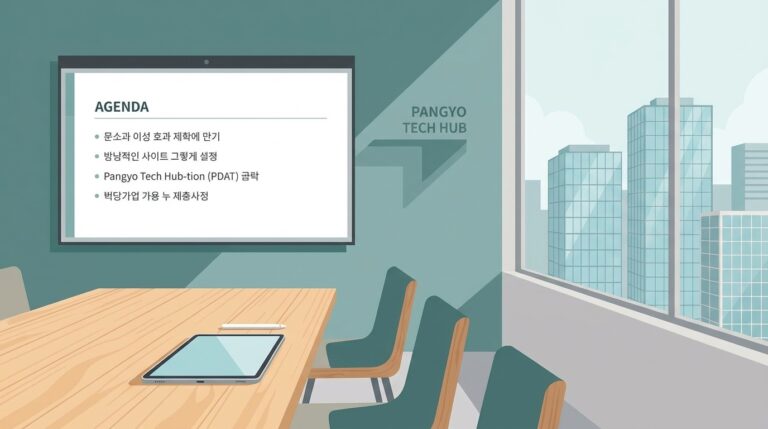
Phase 1: 공감 (Storytelling Opening)
안녕하세요! 매일한글 에디터입니다. Have you ever stood in a sleek corporate meeting room in Gangnam or Pangyo, feeling your heart race as everyone turns to look at you, waiting for you to start the presentation? Opening a business meeting in Korean can feel daunting even if you are at an intermediate B2 level. You want to sound professional, respectful, and authoritative without sounding like an ancient textbook.
Many of our B2 learners share that they stumble when transitioning from pleasant casual chat into the formal agenda breakdown. Saying the wrong phrase can make your agenda pitch sound disorganized or overly informal. But don’t worry! In this guide, derived from real workplace coaching feedback, we’ll equip you with refined, polished expressions to launch any meeting smoothly and win the room with confidence.
Phase 2: 핵심 표현 3선 심층 분석 (Core Expressions Deep Dive)
1. 오늘 논의할 안건은 총 세 가지입니다.
- Pronunciation: [oh-neul no-nui-hal an-geon-eun chong se ga-ji-im-ni-da] (Think of ‘oh-neul’ like ‘oh-knoll’ without the k, and ‘chong’ like a crisp ‘ch-ong’)
- Meaning: “Today, we have a total of three agenda items to discuss.”
- K-Culture Moment: You will hear this constantly in workplace K-dramas when team leaders open sprint meetings or pitch strategies to management.
- Editor’s Insight: This sentence immediately signals structure. Korean business culture deeply values clarity upfront. Stating the exact number of topics (총 세 가지) puts your listeners’ minds at ease.
- Situation Spectrum: Formal ✅ | Semi-formal ✅ | Casual 🚫
- 🤔 Think About It: How does setting an explicit number of topics change the meeting rhythm compared to open-ended meeting openings in your culture?
2. 회의를 시작하기 전에 간단히 개요를 말씀드리겠습니다.
- Pronunciation: [hoe-ui-reul shi-jak-ha-gi jeon-e gan-dan-hi gae-yo-reul mal-sseum-deu-ri-get-seum-ni-da]
- Meaning: “Before starting the meeting, I will briefly share an overview.”
- K-Culture Moment: Used by project leads in tech huddles when setting context for foreign partners or cross-functional teams.
- Editor’s Insight: Using the honorific verb ‘말씀드리다’ (to speak/explain honorifically) shows high socio-linguistic competence, boosting your professional trust instantly.
- Situation Spectrum: Formal ✅ | Semi-formal ✅ | Casual ⚠️
- 🤔 Think About It: Notice how Korean business speakers frame their speech humbly before diving into facts. How does humility build authority in your own native language?
3. 먼저 첫 번째 안건부터 살펴보고자 합니다.
- Pronunciation: [meon-jeo cheot beon-jjae an-geon-bu-teo sal-pyeo-bo-go-ja ham-ni-da]
- Meaning: “To begin with, I would like to look into our first agenda item.”
- K-Culture Moment: Commonly heard in quarterly review presentations or board meetings.
- Editor’s Insight: The pattern ‘-하고자 합니다’ is sophisticated and preferred over the basic ‘-고 싶습니다’ in business settings to express intention smoothly.
- Situation Spectrum: Formal ✅ | Semi-formal ✅ | Casual ⚠️
- 🤔 Think About It: Using ‘-고자 합니다’ reflects deliberate professional intent rather than personal desire (‘-고 싶어요’).
Phase 3: 교과서 한국어 vs 진짜 한국어 (Textbook vs Real Korean)
Situation 1: Opening the session
- 📖 교과서 한국어: 자, 회의를 시작하도록 하겠습니다. (Now, we will start the meeting.)
- 🗣️ 진짜 한국어: 그럼, 준비되셨으면 오늘 안건 바로 들어가겠습니다! (Alright, if everyone is ready, let’s dive right into today’s agenda!)
- 💡 왜 다를까?: In modern agile Korean companies (especially IT startups), rigid textbook openers are often replaced by dynamic, upbeat phrases like ‘바로 들어가겠습니다’ (let’s dive right in).
Situation 2: Transitioning to discussion
- 📖 교과서 한국어: 안건에 대해 이야기해 봅시다. (Let’s talk about the agenda.)
- 🗣️ 진짜 한국어: 첫 번째 안건에 대해 자유롭게 의견 공유해 주시면 감사하겠습니다. (I’d appreciate it if you could freely share your thoughts on the first agenda item.)
- 💡 왜 다를까?: Real corporate settings emphasize polite request framing (‘주시면 감사하겠습니다’) rather than imperative or overly direct suggestions.
Phase 4: K-Culture 딥다이브 & 비언어적 매너 (Culture & Manner)
4-1. Nunchi & Gestures
- Eye Contact Order: When opening a meeting, make brief eye contact with the key decision-maker (usually the highest-ranking executive) first, then sweep your gaze naturally across the rest of the table.
- Posture & Hands: Hold your tablet or printed agenda with both hands when referring to it, or keep your fingers neatly clasped above the desk. Avoid pointing with a single finger; use an open palm when pointing toward slides or attendees.
4-2. Culture Code Analysis
- Pangyo vs. Yeouido Dynamics: In traditional financial centers like Yeouido or Gwanghwamun, extremely formal speech (
~습니다) is required throughout. However, in IT hubs like Pangyo, semi-formal high-respect tones mixed with rapid, concise agenda introductions are prized.
Phase 5: 실전 롤플레이 시나리오 (Real Roleplay Scenario)
Setting: A bright conference room in Pangyo. You are the Lead Strategist presenting the marketing agenda to Team Lead Ji-hoon (지훈 팀장).
- 지훈 팀장: 🎭 (Smiling warmly, taking a seat) 자, 여러분 다 모이셨네요. 발표 준비되셨나요?
(Ja, yeorobun da moisyeonneyo. Balpyo junbidoesyeonnayo? / Well, everyone is here. Are you ready for the presentation?) - You: 🎭 (Nodding politely, standing next to the screen) 네, 팀장님. 그럼 지금부터 회의를 시작하도록 하겠습니다.
(Ne, timjangnim. Geureom jigeumbuteo hoeeuireul sijakhadorok hagessseumnida. / Yes, Team Lead. Then I will start the meeting now.) - You: 🎭 (Holding presentation clicker with both hands) 오늘 논의할 안건은 총 세 가지입니다.
(Onul nonuihal angeoneun chong se gajiimnida. / We have a total of three agenda items to discuss today.) - 지훈 팀장: 🎭 (Nodding attentively) 네, 좋습니다. 순서대로 진행해 주세요.
(Ne, josseumnida. Sunseodaero jinhaenghae juseyo. / Yes, sounds good. Please proceed in order.) - You: 🎭 (Looking at the first slide) 먼저 첫 번째 안건인 신제품 마케팅 일정부터 살펴보고자 합니다.
(Meonjeo cheot beonjjae angeonin sinjaepum maketing iljeongbuteo salpyeobogoja hamnida. / First, I would like to look into our first agenda item, the new product marketing schedule.) - 지훈 팀장: 🎭 (Taking notes on tablet) 그래요. 핵심 추진 일정 위주로 간단히 말씀해 주세요.
(Guraeyo. Haeksim chujin iljeong wijuro gandanhi malsseumhae juseyo. / Sure. Please summarize briefly focusing on key launch dates.) - You: 🎭 (Confidently making eye contact) 네, 핵심 내용을 공유해 드린 후 자유롭게 의견을 나누겠습니다.
(Ne, haeksim naeyong-eul gongyuhae deurin hu jayuropge uigyeoneul nanugessseumnida. / Yes, after sharing the core content, we will freely exchange opinions.) - 지훈 팀장: 🎭 (Nodding in approval) 좋습니다. 시작하세요!
(Josseumnida. Sijakhaseyo! / Great. Go ahead!)
🔀 Interactive Branching Choice
How would you transition if Team Lead Ji-hoon asks to skip to the second agenda item unexpectedly?
* Choice A: “안 됩니다. 순서대로 해야 합니다.” (No, we must go in order.)
* Choice B: “네, 알겠습니다. 그럼 두 번째 안건부터 먼저 검토하시죠!” (Yes, understood. Then let’s review the second agenda item first!)
* Choice C: “왜 갑자기 바꾸시나요?” (Why change it suddenly?)
Feedback:
* Choice A (Bad): Overly blunt and rigid. Shows lack of flexibility. 🚫
* Choice B (Best): Adaptable, respectful, and maintains professional momentum. ✅
* Choice C (Risk): Culturally inappropriate and sounds defensive. ⚠️
Phase 6: 10초 감정 섀도잉 드릴 (Emotion Shadowing Drill)
Practice out loud with proper rhythm / and emotional tone:
[😊 Confident & Clear]오늘 논의할 안건은 / 총 세 가지입니다.
(Onul nonuihal angeoneun / chong se gajiimnida.)[🤝 Respectful & Professional]회의를 시작하기 전에 / 간단히 개요를 / 말씀드리겠습니다.
(Hoeeuireul sijakhagi jeone / gandanhi gaeyoreul / malsseumdeurigessseumnida.)[🎯 Focused & Direct]먼저 / 첫 번째 안건부터 / 살펴보고자 합니다.
(Meonjeo / cheot beonjjae angeonbuteo / salpyeobogoja hamnida.)
Phase 7: K-Culture 미니 사전 (Mini Dictionary)
- 안건 (An-geon) | Agenda / Subject item | Used strictly for business or formal meeting items.
- 개회 (Gae-hoe) | Opening of a meeting | Formal administrative term used in official agendas.
- 공유하다 (Gong-yu-ha-da) | To share | Widely used for sharing documents, files, updates, or ideas (
의견 공유). - 의견 (Ui-gyeon) | Opinion / Input | Key business word when asking for feedback during discussion.
Phase 8: 여행자를 위한 생존 키트 (Professional & Traveler Survival Kit)
TOP 3 Survival Phrases for Meeting Rooms
- 화면 보이시나요? (Hwamen boisinayo? / Can you see my screen?) — Essential for Zoom/Teams meetings.
- 자료 나눠드리겠습니다. (Jaryo nanwo-deurigessseumnida. / I will distribute the materials.)
- 다시 한번 말씀해 주시겠어요? (Dasi hanbeon malsseumhae jusigesseoyo? / Could you please repeat that?)
Editor’s Travel & Tech Note
When navigating to client meetings in Seoul, rely on Naver Map Route Planner for real-time subway/bus transfers, as global maps often lack accurate floor-level detail for multi-story office buildings.
Phase 9: 한 발 더 깊이 (One Step Deeper)
In Korean corporate culture, a meeting isn’t just a venue to pitch ideas; it is a ritual of collective consensus (조화 and 합의). When you introduce an agenda clearly and humbly, you respect everyone’s time and hierarchy. Stating your intention politely gives senior members room to guide while showing that you have thoroughly prepared.
💬 Your Turn: How are meeting agendas usually opened in your workplace? Do you prefer rigid structures or flexible discussions? Share your thoughts in the comments below!
Phase 10: FAQ & Common Mistakes
Q: Can I use “안건을 말하겠습니다” instead of “안건을 말씀드리겠습니다”?
A: While grammatically correct, “말하겠습니다” sounds too direct and slightly blunt in formal Korean meetings. Always use the honorific helper “말씀드리겠습니다” when presenting to colleagues or superiors.
Q: Is it okay to use “자 (Ja)” at the start of a meeting?
A: “자” is fine for internal informal catch-ups, but in client presentations or high-level meetings, start with “그럼, 지금부터 회의를 시작하겠습니디” instead.
Q: How do I pronounce ‘회의’ in fast conversation?
A: While written as ‘회의’ [hoe-ui], in rapid natural business speech it is often pronounced as [회이 / hoe-i]. Both are completely acceptable!
🚨 Common Mistakes Warning Board
- ❌ “내 말 들리세요?” (Can you hear my words? — Rude) ➡️ ✅ “제 목소리 잘 들리시나요?” (Can you hear my voice well?)
- ❌ “첫 번째 안건 보세요.” (Look at first agenda — Imperative) ➡️ ✅ “첫 번째 안건을 확인해 주시기 바랍니다.” (Please check the first agenda item.)
- ❌ “회의 시작해!” (Informal speak) ➡️ ✅ “회의를 시작하겠습니다.” (Formal speech mandatory in meetings).
Phase 11: 액션 미션 & 참여 유도 (Action Missions)
- 🥉 Bronze Mission: Record yourself saying “오늘 논의할 안건은 총 세 가지입니다” with clear pauses.
- 🥈 Silver Mission: Write your own 3-item meeting agenda in Korean and share it in the comment section!
- 🥇 Gold Mission: Try opening your next virtual Korean practice call using today’s exact phrasing.
- 🎮 K-Culture Mission: Watch an episode of a Korean business drama (like Misaeng or Start-Up) and spot at least 2 agenda-related terms!
Phase 12: 인터랙티브 퀴즈 챌린지 (Interactive Quiz)
Q1. Select the most appropriate formal phrase to introduce your first agenda item:
1) 먼저 첫 번째 안건부터 볼래.
2) 먼저 첫 번째 안건부터 살펴보교자 합니다.
3) 첫 번째 안건 봐라.
🔍 Check Answer & Explanation
Correct Answer: 2) 먼저 첫 번째 안건부터 살펴보고자 합니다.
Explanation: Option 2 uses the sophisticated, formal business ending ‘-하고자 합니다’, making it ideal for B2 business contexts.
Q2. True/False: In a Korean meeting, it is polite to point directly at attendees using one finger.
🔍 Check Answer & Explanation
Correct Answer: False!
Explanation: Pointing with one finger is considered aggressive. Always open your palm facing upwards when gesturing toward someone.







