

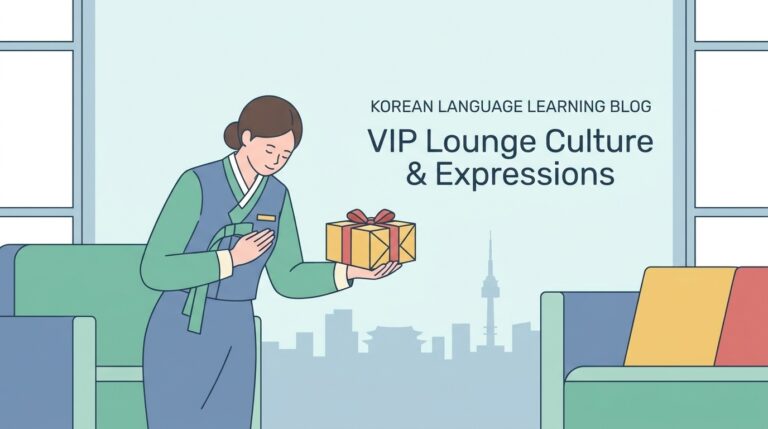
안녕하세요! 매일한글 에디터입니다.
Imagine managing the VIP retention department for a high-end K-Beauty flag ship store in Cheongdam-dong. Your top-tier clients expect more than standard courtesy—they demand warmth, discretion, and an exquisite level of Korean honorific sophistication. Retaining VIP clients in Korea requires navigating the delicate balance between professional reverence and genuine connection (정, Jeong). When executed poorly, automated corporate jargon alienates loyal patrons; when done right, customer retention soars. Based on real-world feedback from international business professionals in Seoul, this guide provides advanced C1-level Korean expressions designed to elevate your customer loyalty strategies and build unbreakable brand loyalty.
1. 단골손님을 위해 특별히 준비했습니다
- Pronunciation: [Dan-gol-son-nim-eul wi-hae teuk-byeol-hi jun-bi-haess-seub-ni-da] (Pronounced like ‘Dan-gol-son-nim-eul wee-hae took-byeol-heejoon-bee-haep-nee-da’)
- Meaning: “We have specially prepared this for our valued regular client.”
- K-Culture Moment: Frequently heard in luxury K-Beauty spas or fine dining establishments when a manager presents an exclusive gift or off-menu treat to an esteemed regular.
- Editor’s Insight: The word 단골 (Dan-gol) carries immense emotional warmth in Korean culture. Combining 단골 with formal phrasing shows that while you maintain professional distance, you deeply value the long-standing relationship.
- Situation Spectrum: Casual 🚫 / Semi-formal ⚠️ / Formal ✅
- 🤔 Think About It: How does your culture express gratitude to long-term clients without sounding overly transactional?
2. 고객님의 변함없는 성원에 보답하고자 합니다
- Pronunciation: [Go-gaek-nim-ui byeon-ham-eobs-neun seong-won-e bo-dap-ha-go-ja ham-ni-da] (Pronounced like ‘Go-gaek-nee-mue byeon-ham-eop-neun sung-won-eh boh-dap-ha-goh-jah ham-nee-da’)
- Meaning: “We wish to repay your unwavering support.”
- K-Culture Moment: Found in official VIP tier upgrade letters, invitation cards for private K-Pop brand ambassador galas, or annual loyalty rewards announcements.
- Editor’s Insight: 보답하다 (to repay/reciprocate) elevates a standard reward program into an act of mutual respect. It frames loyalty rewards as appreciation rather than a sales gimmick.
- Situation Spectrum: Casual 🚫 / Semi-formal ⚠️ / Formal ✅
- 🤔 Think About It: In Korean business, relationship maintenance is often framed as mutual repayment. Is reciprocity emphasized similarly in your home language?
3. 맞춤형 혜택을 다각도로 검토 중입니다
- Pronunciation: [Mat-chum-hyeong hye-taeg-eul da-gak-do-ro geom-to jung-im-ni-da] (Pronounced like ‘Mat-choom-hyeong hyeh-taeg-eul dah-gak-doh-roh geom-toh joong-im-nee-da’)
- Meaning: “We are reviewing tailored benefits from various angles.”
- K-Culture Moment: Used by senior CS managers when negotiating customized corporate sponsorship packages or personal VIP concierge plans.
- Editor’s Insight: 다각도로 (from multiple angles) reassures high-value clients that their feedback is actively shaping strategic decisions rather than being dismissed with a template reply.
- Situation Spectrum: Casual 🚫 / Semi-formal ⚠️ / Formal ✅
- 🤔 Think About It: Notice how Korean business Korean uses abstract spatial metaphors like ‘various angles’ to show thoroughness.
Scenario 1: Offering a Tier Upgrade
📖 교과서 한국어: 등급이 올라가셔서 혜택을 드립니다. (You upgraded so we give you benefits.)
🗣️ 진짜 한국어: 우수 고객으로 모시게 되어 특별 혜택을 마련했습니다. (It is our honor to welcome you as a premium client, so we have prepared exclusive privileges.)
💡 왜 다를까? C1-level CS requires elevated humble verbs like 모시다 (to serve/attend) to highlight client prestige rather than simple transaction status.
Scenario 2: Handling a VIP Loyalty Inquiry
📖 교과서 한국어: 포인트 적립 조건이 안 됩니다. (You do not meet the point collection conditions.)
🗣️ 진짜 한국어: 해당 부분은 기준을 다각도로 재검토하여 안내해 드리겠습니다. (We will re-examine those criteria from multiple perspectives and update you promptly.)
💡 왜 다를까? Direct refusals damage loyalty. Sophisticated Korean CS delays negative answers by promising holistic re-evaluation (다각도 재검토).
4-1. 눈치 (Nunchi) & Non-verbal Gestures
When presenting loyalty gifts or upgrade contracts to Korean VIP clients, always hand over cards or packages using two hands (두 손으로 전달). Maintain soft eye contact, followed by a slight 15-degree bow (목례). Never point directly with one finger; use an open palm when pointing toward a seating area or document line.
4-2. Cultural Code Analysis: The Evolution of Jeong in K-Commerce
Historically, 정 (Jeong) was shown through free extra portions (덤) at traditional markets. In modern Korean luxury CS, 정 has evolved into hyper-personalized concierge service, birthday hand-written notes from store directors, and customized membership perks. Loyalty programs in Korea succeed when they feel like an exclusive personal connection rather than an automated algorithm.
Setting: A quiet private VIP lounge in Gangnam. Manager Min-jun is speaking with Mrs. Lee, a top 0.1% tier loyalty client.
- Manager Min-jun: 고객님, 바쁘신 와중에 방문해 주셔서 진심으로 감사드립니다. (Go-gaek-nim, ba-ppeun-sin wa-jung-e bang-mun-hae ju-syeo jin-sim-eu-ro gam-sa-deu-rim-ni-da.) – Thank you so much for visiting us despite your busy schedule.
🎭 Hands tea with both hands - VIP Client: 별말씀을요. 이번 신제품 라인업 소식 듣고 왔어요. (Byeol-mal-sseum-eul-yo. I-beon sin-je-pum ra-in-eob so-sig deut-go wass-eo-yo.) – Don’t mention it. I came after hearing about the new product lineup.
- Manager Min-jun: 변함없는 성원에 보답하고자 고객님만을 위한 프라이빗 세션을 준비했습니다. (Byeon-ham-eobs-neun seong-won-e bo-dap-ha-go-ja go-gaek-nim-man-eul wi-han peu-ra-i-bit se-syeon-eul jun-bi-haess-seub-ni-da.) – To repay your unwavering support, we prepared a private session just for you.
🎭 Bows slightly with a sincere warm smile - VIP Client: 어머, 정말요? 신경 써 주셔서 고마워요. (Eo-meo, jeong-mal-yo? Sin-gyeong sseo ju-syeo go-maw-eo-yo.) – Oh, really? Thank you for paying such close attention.
- Manager Min-jun: 당연합니다. 단골손님을 위해 특별히 준비한 맞춤형 케어 키트도 함께 챙겨 두었습니다. (Dang-yeon-ham-ni-da. Dan-gol-son-nim-eul wi-hae teuk-byeol-hi jun-bi-han mat-chum-hyeong ke-eo ki-teu-do ham-kke chaeng-gyeo du-eoss-seub-ni-da.) – Of course. We also packed a tailored care kit specially prepared for our valued loyal guest.
🎭 Gestures toward a luxury wrapped box - VIP Client: 역시 늘 기대 이상이네요. 멤버십 혜택도 더 늘었다면서요? (Yeok-si neul gi-dae i-sang-i-ne-yo. Mem-beo-sip hye-taeg-do deo neul-eoss-da-myeon-seo-yo?) – As expected, you always exceed expectations. I heard membership perks increased too?
- Manager Min-jun: 네, 고객님의 라이프스타일에 맞춘 혜택을 다각도로 검토하여 업데이트했습니다. (Ne, go-gaek-nim-ui ra-i-peu-seu-ta-il-e mat-chun hye-taeg-eul da-gak-do-ro geom-to-ha-yeo up-de-i-teu-haess-seub-ni-da.) – Yes, we reviewed and updated benefits from various angles tailored to your lifestyle.
🎭 Presents brochure using open right palm - VIP Client: 섬세한 배려에 늘 감동받아요. 앞으로도 계속 이용할 수밖에 없겠네요. (Seom-se-han bae-ryeo-e neul gam-dong-bad-a-yo. A-preo-do gye-sok i-yong-hal su-bbaek-e eob-ges-ne-yo.) – I am always touched by your delicate care. Looks like I will have no choice but to keep coming back.
🔀 Interactive Choice:
How should Manager Min-jun respond to lock in client loyalty?
* Option A: “네, 다른 매장 가지 마시고 꼭 저희 매장만 와 주세요!”
* Option B: “고객님의 기대에 부응할 수 있도록 언제나 최선을 다해 모시겠습니다.”
* Option C: “포인트 적립률도 올랐으니까 많이 구매해 주세요.”
Feedback:
* Best Choice (Option B): Perfectly balances humility, deep respect, and professional commitment.
* Bad Choice (Option A): Sounds overly desperate and unrefined for a VIP setting.
* Risk Choice (Option C): Reduces a meaningful relationship moment down to monetary transaction.
Practice pronouncing these key loyalty retention phrases with full emotional expression:
- [😊 Warm & Proud] 저희 브랜드의 / 우수 고객으로 모시게 되어 / 큰 영광입니다.
- [🥺 Humble & Sincere] 변함없는 성원에 / 보답할 수 있도록 / 늘 노력하겠습니다.
- [😌 Confident & Reassuring] 고객 맞춤형 혜택을 / 다각도로 검토하여 / 제공해 드리겠습니다.
- 우수고객 (U-su-go-gaek) | VIP/High-tier Loyalty Client | Used in formal customer classification and retention communications.
- 맞춤형 혜택 (Mat-chum-hyeong Hye-taek) | Tailored/Customized Benefits | Essential phrasing when presenting personalized membership plans.
- 보답하다 (Bo-dap-ha-da) | To Reciprocate/Repay | Key verb framing loyalty rewards as gratitude rather than marketing.
- 단골 케어 (Dan-gol Ke-eo) | Loyalty Client Care | Industry term for high-touch customer retention operations.
*
Frequently Asked Questions (FAQ)
Q: What does "단골손님을 위해 특별히 준비했습니다" mean in Korean and how do you pronounce it?
A: In Korean, "단골손님을 위해 특별히 준비했습니다" is pronounced [Dan-gol-son-nim-eul wi-hae teuk-byeol-hi jun-bi-haess-seub-ni-da] and means: "We have specially prepared this for our valued regular client."
Q: What does "고객님의 변함없는 성원에 보답하고자 합니다" mean in Korean and how do you pronounce it?
A: In Korean, "고객님의 변함없는 성원에 보답하고자 합니다" is pronounced [Go-gaek-nim-ui byeon-ham-eobs-neun seong-won-e bo-dap-ha-go-ja ham-ni-da] and means: "We wish to repay your unwavering support."
Q: What does "맞춤형 혜택을 다각도로 검토 중입니다" mean in Korean and how do you pronounce it?
A: In Korean, "맞춤형 혜택을 다각도로 검토 중입니다" is pronounced [Mat-chum-hyeong hye-taeg-eul da-gak-do-ro geom-to jung-im-ni-da] and means: "We are reviewing tailored benefits from various angles."







