

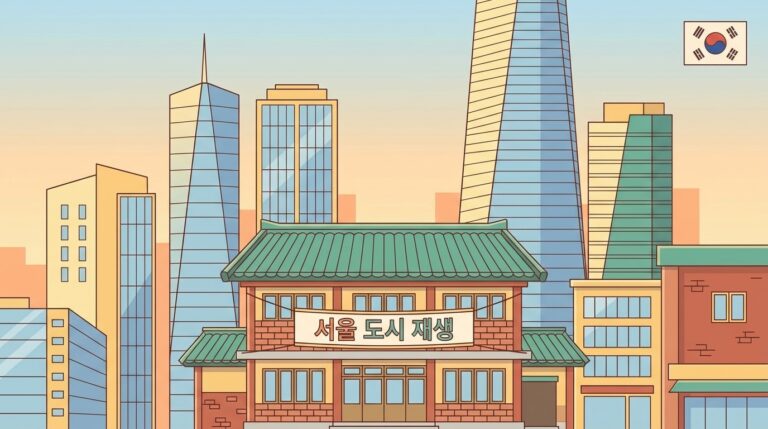
Phase 1: Empathy (Storytelling Opening)
안녕하세요! 매일한글 에디터입니다. (Hello! I’m your Daily Hangul editor.)
Picture this: You are standing at the sky deck of the 123-story Lotte World Tower in Jamsil, or walking through the transformed Oil Tank Culture Park (문화비축기지) in Mapo. Surrounding you are native Korean architects, urban planners, or local friends discussing how Seoul seamlessly blends mega-skyscrapers with historic urban renewal projects. You want to contribute to the conversation with sophistication—not just saying “이 건물 높아요” (This building is tall), but expressing nuanced ideas like “도시의 마천루와 역사적 유산이 멋진 대조를 이루네요” (The skyline and historical heritage form a stunning contrast).
Many C1-level learners hit a plateau when discussing specialized topics like architecture and city planning. You might know high-level words from books, but stumble on how Koreans naturally express architectural aesthetics, urban regeneration, and iconic landmarks in conversational settings. Don’t worry! Based on hundreds of real coaching sessions with advanced learners, I’ve tailored this guide to bridge the gap between dictionary Korean and real-world urban discourse. Let’s elevate your Korean to landmark heights!
Phase 2: Deep-Dive Analysis of 3 Core Expressions
1. 한눈에 내려다보이다 (Han-nune naeryeodaboida)
- Pronunciation: [Han-nune nae-ryeo-da-bo-i-da] (Sounds like ‘han-noo-neh nae-ryaw-da-boy-dah’)
- Meaning: Literal: To be looked down upon in one glance / Nuance: To command a sweeping, panoramic view of a city or landscape from a high elevation.
- K-Culture Moment: Commonly heard in modern K-Dramas when CEOs or main characters stand in penthouse suites overlooking the Han River skyline.
- Editor’s Insight: While “야경이 예쁘다” (The night view is pretty) works for beginners, using “한눈에 내려다보이다” immediately signals C1 sophistication, capturing both visual elevation and expansive scale.
- Situation Spectrum:
- Casual: ✅ (“여기서 서울 시내가 한눈에 내려다보여!”)
- Semi-formal: ✅ (“전망대에서 도시 전체가 한눈에 내려다보입니다.”)
- Formal: ✅ (“본 파노라마 전경은 도심의 빌딩 숲을 한눈에 내려다보게 해줍니다.”)
- 🤔 Think About It: How does your native language describe high-altitude panoramic views? Does it focus on the vantage point or the feeling of dominance over the horizon?
2. 구도심에 새로운 숨결을 불어넣다 (Gudosime saerowon sumgyeoreul bureoneotda)
- Pronunciation: [Gu-do-si-me sae-ro-won sum-gyeo-reul bu-reo-neot-da] (‘goo-do-shim-eh sae-ro-won soom-gyeol-eul boo-raw-naw-da’)
- Meaning: Literal: To breathe new life into the old city center / Nuance: To revitalize historically rich yet neglected urban areas through modern architectural renewal.
- K-Culture Moment: Used frequently in urban design documentaries and Korean news reports covering projects like Seongsu-dong’s factory conversions or Euljiro’s hip retro transformations.
- Editor’s Insight: This expression elegantly combines “구도심” (old downtown core) with poetic imagery (“숨결을 불어넣다” – breathe life into). It shifts your discourse from basic description to refined architectural commentary.
- Situation Spectrum:
- Casual: ⚠️ (Sounds a bit poetic for casual chatter; better for serious urban chats)
- Semi-formal: ✅ (“이 도시 재생 프로젝트가 구도심에 새로운 숨결을 불어넣고 있어요.”)
- Formal: ✅ (“본 사업은 낙후된 구도심에 새로운 숨결을 불어넣는 계기가 될 것입니다.”)
- 🤔 Think About It: In Korean, revitalizing an old space is often phrased as giving it “breath” (숨결). What metaphor does your culture use for urban rejuvenation?
3. 랜드마크로 자리 잡다 (Raendeumakeuro jari japda)
- Pronunciation: [Raen-deu-ma-keu-ro ja-ri jap-da] (‘ren-deu-mah-keu-ro jah-ree jahp-dah’)
- Meaning: Literal: To take root as a landmark / Nuance: To establish a building or space as a defining cultural and architectural symbol of a region.
- K-Culture Moment: Heard during city inaugurations, travel vlogs about Dongdaemun Design Plaza (DDP), or documentary features on N Seoul Tower.
- Editor’s Insight: Koreans frequently blend English loanwords like “랜드마크” with dynamic native verbs like “자리 잡다” (to take root/take place). Using this shows you understand natural hybrid phrasing in contemporary business and culture.
- Situation Spectrum:
- Casual: ✅ (“이 빌딩이 이제 이 동네 랜드마크로 자리 잡았네!”)
- Semi-formal: ✅ (“DDP는 서울의 대표적인 랜드마크로 자리 잡았습니다.”)
- Formal: ✅ (“해당 건축물은 지역 경제를 견인하는 랜드마크로 자리 잡았습니다.”)
- 🤔 Think About It: Why do you think modern cities rely so heavily on architectural icons to define their cultural identity?
Phase 3: Textbook Korean vs. Real Native Korean
Situation 1: Expressing awe at a high-rise building’s view
- 📖 Textbook Korean: “이 건물은 매우 높아서 전망이 좋습니다.” (This building is very high, so the view is good.)
- 🗣️ Real Native Korean: “탁 트인 전망 덕분에 도심 전경이 한눈에 들어오네요!” (Thanks to the wide-open view, the whole cityscape comes into view at once!)
- 💡 Why the difference?: Advanced native speakers prefer sensory, vivid adjectives like “탁 트인” (unobstructed/wide-open) and expressive verbs like “한눈에 들어오다” over basic adjectives like “좋다”.
Situation 2: Praising an urban regeneration project
- 📖 Textbook Korean: “옛날 건물을 고쳐서 다시 사용해서 좋습니다.” (It’s good because they fixed the old building and used it again.)
- 🗣️ Real Native Korean: “산업 유산의 가치를 살린 감각적인 재생 공간이네요.” (It’s a stylish regenerated space that preserves the value of industrial heritage.)
- 💡 Why the difference?: C1 discussions in Seoul’s trendy design hubs (like Seongsu or Mullae) heavily rely on terms like “재생 공간” (regenerated space) and “가치를 살리다” (bring out value) to highlight emotional and cultural appreciation.
Phase 4: K-Culture Deep-Dive & Non-Verbal Manners
4-1. Nunchi & Gestures at Architectural Landmarks
When visiting observation decks like Seoul Sky or high-end architectural forums:
* Posture: Stand slightly to the side when viewing city panoramas with companions, guiding their gaze with an open hand (palm upward) rather than pointing with a single index finger.
* Voice Level: In public landmark viewing areas, express awe with moderate, controlled tone (“와, 진짜 장관이네요!”) rather than shouting, demonstrating respectful situational awareness (Nunchi).
4-2. Cultural Code: The Dual Soul of Korean Architecture
Korean architecture today is defined by the coexistence of hyper-modernity and preservation. Skyscrapers like Lotte World Tower do not exist in isolation; they look down upon ancient spots like Seokchon Lake or Pungnaptoseong Fortress wall. Urban regeneration spaces like Seongsu-dong (often called the ‘Brooklyn of Seoul’) transform old shoe factories into modern art galleries. Understanding this duality helps you appreciate why Koreans value spaces that respect both heritage (역사성) and innovation (혁신성).
Phase 5: Interactive Real-Life Roleplay Scenario
Setting: You are touring the DDP (Dongdaemun Design Plaza) rooftop & exhibition area with Min-jun (민준), a local urban planning specialist.
- Min-jun: “여기 DDP 상부 공간에 오니까 느낌이 어떠세요? 곡선 건축이 참 독특하죠?”
- You: “네, 정말 신비로워요! [😊 감탄하며] 주변의 전통 시장과 첨단 건축이 묘하게 어우러지네요.”
- Min-jun: “맞아요! 처음에 파격적인 디자인 때문에 논란도 많았지만, 지금은 완벽히 안착했죠.”
- You: “🎭 [손짓으로 주변을 가리키며] 이제는 서울을 대표하는 랜드마크로 자리 잡은 것 같아요.”
- Min-jun: “정확한 지적이세요. 구도심 재생 프로젝트 중에서도 가장 성공적인 사례로 꼽히죠.”
- You: “상업적인 기능뿐만 아니라 시민들의 휴식 공간 역할도 톡톡히 하고 있네요.”
- Min-jun: “맞습니다. 앞으로 서울의 마천루들이 나아가야 할 방향을 보여주는 느낌이에요.”
- You: “도시의 과거와 미래를 연결하는 건축적 교량 역할을 하고 있군요!”
🔀 Interactive Choice Point
Min-jun asks: “이런 현대적 랜드마크와 주변 옛 동네의 조화에 대해 어떻게 생각하세요?”
- Choice A: “옛것을 다 부수고 이런 멋진 초고층 빌딩으로 다 바꿔야 도시가 발전하죠!”
- Choice B: “역사적 맥락을 지키면서 신구의 조화를 이루는 것이 도시 재생의 핵심이라고 생각해요.”
- Choice C: “글쎄요, 저는 그냥 쇼핑하기 편해서 좋은 것 같아요.”
Feedback on Choices:
* 🏆 Choice B (Best): Perfect C1 response! Demonstrates deep cultural insight and precise urban renewal vocabulary (역사적 맥락, 신구의 조화).
* ⚠️ Choice Risk (Choice A): Too extreme. Disregards Korea’s cultural value on historic preservation in urban renewal.
* ❌ Choice Bad (Choice C): Too shallow for an advanced C1 discourse context.
Phase 6: 10-Second Emotion Shadowing Drill
Practice these high-level architectural expressions with authentic emotional cadence (/ denotes pause):
[😊 감탄과 경외감을 담아]
“높은 곳에서 내려다보니까 / 서울의 마천루와 한강이 / 한눈에 쫙 펼쳐지네요!”[🤔 깊은 통찰을 담아]
“오래된 방직 공장을 리모델링해서 / 구도심에 새로운 숨결을 / 불어넣은 점이 인상적이에요.”[👍 자부심과 긍정을 담아]
“이 건물은 단순한 초고층 빌딩이 아니라 / 도시의 가치를 높이는 / 대표 랜드마크로 자리 잡았습니다.”
Phase 7: K-Culture Mini Dictionary
- 마천루 (Macheonru) | Skyscraper | Literally “scraping the sky building”. Used in media and urban articles to describe mega-tall structures.
- 도시 재생 (Dosi Jaesaeng) | Urban Regeneration | Refers to revitalizing deteriorating urban zones through cultural, social, and physical renewal.
- 스카이라인 (Seukai-rain) | City Skyline | Widely used loanword when evaluating the aesthetic line formed by high-rise architectures.
- 신구의 조화 (Sin-gu-ui Johwa) | Harmony of Old and New | Idiomatic architectural term describing projects that balance historic structures with modern design.
Phase 8: Traveler’s Survival Kit
Survival Phrases TOP 3
- “여기 야경을 한눈에 볼 수 있는 명소가 어디예요?” (Where is a famous spot where I can see the full night view at a glance?)
- “오래된 건물을 개조한 카페나 문화 공간이 인근에 있나요?” (Are there nearby cafes or cultural spaces renovated from old buildings?)
- “이 랜드마크 전망대 티켓은 현장 예매도 가능한가요?” (Can I purchase observation deck tickets for this landmark on-site?)
Editor’s Travel Note
When exploring architectural highlights in South Korea, bypass standard maps and download the 네이버 지도 앱 (Naver Map App). It provides accurate floor-by-floor guides for massive complexes like Coex Mall and Lotte World Tower, including underground transit connections!
Phase 9: One Step Deeper (Thoughtful Essay)
In traditional Korean philosophy (풍수지리 & 배산임수), architecture was never meant to conquer nature, but to blend into surrounding mountains and rivers. Today’s high-rise revolution in Seoul might seem at odds with this ancient harmony, yet urban renewal projects strive to reintroduce green spaces and pedestrian pathways elevated in the sky (such as Seoullo 7017). Modern Korean cities are constantly negotiating how to touch the clouds without losing touch with their roots.
💬 Your Turn: What is your favorite architectural landmark in your home country, and how does it balance historical tradition with modern functionality? Share your thoughts in the comments below!
Phase 10: FAQ & Common Mistakes
Q: What is the exact difference between ‘재개발’ (Redevelopment) and ‘도시 재생’ (Urban Regeneration)?
A: ‘재개발’ usually involves completely demolishing existing old structures to build high-rise apartments or new complexes from scratch. ‘도시 재생’ focuses on preserving the existing historical/cultural framework while upgrading infrastructure and adding artistic or commercial value.
Q: Can I use ‘마천루’ in everyday casual conversations?
A: Yes! While it sounds sophisticated, saying “서울도 이제 진짜 마천루가 많아졌어” in a casual chat sounds natural and shows advanced vocabulary mastery.
Q: Is ‘랜드마크’ understood by everyone in Korea?
A: Absolutely. It is an extremely common loanword used across news, navigation apps, daily conversations, and travel guides.
🚨 Common Mistakes Alert!
- ❌ Incorrect: “이 건물은 아주 높아서 랜드마크를 만들었어요.”
- ⭕ Correct Action: Use the idiomatic verb pairing: “이 건물은 지역의 랜드마크로 자리 잡았어요.” (This building established itself as a landmark.)
- ❌ Incorrect: “구도심을 공사해서 바람을 넣었어요.”
- ⭕ Correct Action: Use the metaphorical phrase: “구도심에 새로운 숨결을 불어넣었어요.” (Breathed new life into the old city center.)
Phase 11: Action Mission & Engagement
- 🥉 Bronze Mission: Record yourself reading Phase 6’s Shadowing Drill 1 with correct pauses (
/). - 🥈 Silver Mission: Post a picture of a landmark in your city on Instagram and write a Korean caption using “~로 자리 잡다”.
- 🥇 Gold Mission: Describe an urban regeneration space in your city in 3 Korean sentences using terms from Phase 7.
🎮 K-Culture Mission: Watch a travel vlog covering Seoul’s Sewoon Sangga (세운상가) or Seongsu-dong, and spot at least two instances where the narrator mentions urban transformation or architecture!
Phase 12: Interactive Quiz Challenge
Quiz 1. Situation Judgment
Which sentence best compliments an industrial factory transformed into a modern public gallery?
1. 건물을 다 부수고 다시 지어서 깔끔하네요.
2. 산업 유산의 멋을 살려 구도심에 새로운 숨결을 불어넣은 공간이네요.
3. 아주 높아서 하늘을 찌를 것 같아요.
🔍 Check Answer & Explanation
Answer: 2
Explanation: Option 2 uses C1-level regeneration terminology (“산업 유산의 멋을 살리다”, “구도심에 새로운 숨결을 불어넣다”) perfectly suited for urban renewal contexts.
Quiz 2. Fill-in-the-Blank
“이 전망대에 오르면 서울 시내 전경이 ______________ 내려다보입니다.”
(Hint: Meaning ‘at a single glance / panoramic’)
🔍 Check Answer & Explanation
Answer: 한눈에
Explanation: “한눈에 내려다보이다” is the standard advanced collocation for panoramic high-altitude views.
Quiz 3. True or False
Korean phrase ‘도시 재생’ refers to demolishing every old building to replace it with mega skyscrapers. (True / False)
🔍 Check Answer & Explanation
Answer: False
Explanation: That describes ‘재개발’ (redevelopment). ‘도시 재생’ (urban regeneration) preserves historical and structural identity while renewing urban functionality.






