

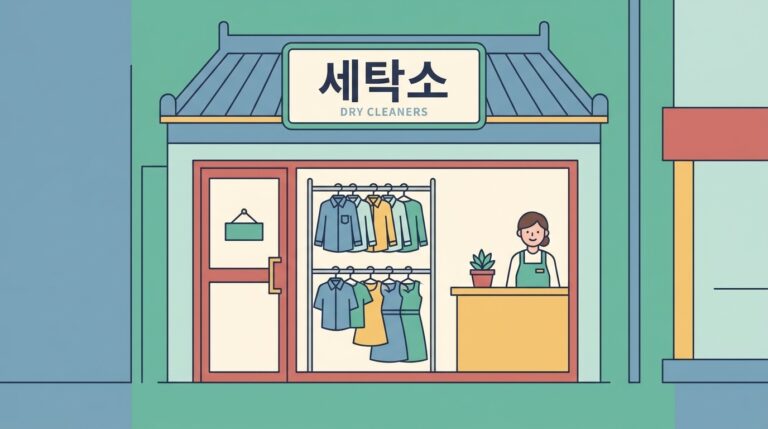
Master Korean Dry Cleaner Phrases: How to Ask for Ironing Like a Native
Phase 1: Welcome to Daily Hangul! (공감)
안녕하세요! Hello! I am your senior editor at Daily Hangul and your 10-year local culture navigator in Korea!
Picture this: You’ve just landed in Seoul for an exciting trip. You open your suitcase in your cozy hotel or Airbnb, ready to step out in your favorite outfit—only to realize your favorite shirt looks like a crumpled piece of paper! You locate a nearby local dry cleaner, known in Korea as a 세탁소 (Setakso). You walk inside, smell the warm steam, and see a friendly owner (사장님) looking at you with a welcoming smile.
Suddenly, your mind goes blank. How do I say “Please iron this shirt” in simple, polite Korean?
Don’t panic! Expressing everyday requests at a Korean dry cleaner is one of the easiest and most rewarding milestones for A1 beginners. Based on real learner feedback, mastering just a few key phrases will transform a potentially nerve-wracking moment into a warm, local cultural interaction. Let’s learn how to get your clothes looking crisp and fresh together!
Phase 2: Core Expressions Deep Dive (핵심 표현 3선)
1. 다림질해 주세요 (Darimjil-hae juseyo)
- Pronunciation: [dah-rim-jeel-hae joo-seh-yo] (Think: “dah-rim” + “jeel” + “hae” + “joo-say-yo”)
- Meaning: “Please iron this for me.”
- K-Culture Moment: In Korean workplace dramas, young office workers drop off their suit jackets at the neighborhood 세탁소 right before an important interview.
- Editor’s Insight: This expression combines 다림질 (ironing) + 하다 (to do) + ~해 주세요 (please do for me). It’s polite, clear, and perfectly suited for beginners!
- Situation Spectrum: Casual ⚠️ | Semi-formal ✅ | Formal ✅
- 🤔 Think About It: In Korean service settings, ending your request with ~주세요 (juseyo) shows instant respect and warmth. How do service requests differ in your native language?
2. 이거 세탁해 주세요 (Igeo setaek-hae juseyo)
- Pronunciation: [ee-geo seh-taek-hae joo-seh-yo] (Think: “eeg-oh” + “seh-taek” + “hae” + “joo-say-yo”)
- Meaning: “Please wash/clean this.”
- K-Culture Moment: After enjoying delicious Korean BBQ (삼겹살), Koreans often bring their padded winter coats to the dry cleaner to remove the smoky aroma.
- Editor’s Insight: 이거 (igeo) means “this,” and 세탁 (setaek) means laundry/cleaning. Pointing at an item while saying this phrase works like magic!
- Situation Spectrum: Casual ⚠️ | Semi-formal ✅ | Formal ✅
- 🤔 Think About It: Do you usually specify laundry instructions in your home country, or do you rely on the dry cleaner’s expertise?
3. 언제 찾으러 와요? (Eonje chajeureo wayo?)
- Pronunciation: [eon-jeh chah-jeu-reo wah-yo?] (Think: “eon-jay” + “chah-joo-roh” + “why-oh”)
- Meaning: “When can I come pick it up?”
- K-Culture Moment: Asking the friendly neighborhood laundry shop owner when your clothes will be ready before heading out for a weekend trip.
- Editor’s Insight: 언제 (eonje) means “when,” and 찾으러 와요 (chajeureo wayo) means “come to collect/pick up.”
- Situation Spectrum: Casual ⚠️ | Semi-formal ✅ | Formal ✅
- 🤔 Think About It: Korean services are famous for speed (Palli-Palli culture). Often, your items are ready the next day!
Phase 3: Textbook Korean vs. Real Native Korean (교과서 vs 진짜 한국어)
Situation 1: Asking for Ironing
- 📖 Textbook Korean: 다림질을 부탁드립니다. (Darimjireul butakdeurimnida.)
- 🗣️ Real Native Korean: 이것만 다려 주세요~ (Igeot-man daryeo juseyo~)
- 💡 Why the difference? While the textbook phrase is very formal, real locals use the verb 다리다 (to iron) in a warm, relaxed form with the helper ending ~해 주세요.
Situation 2: Asking when it will be ready
- 📖 Textbook Korean: 언제 작업이 완료됩니까? (Eonje jageobi wanryo-doebnikka?)
- 🗣️ Real Native Korean: 언제쯤 나와요? (Eonje-jjeum nawayo?)
- 💡 Why the difference? Locals naturally ask when clothes “come out” (나와요) rather than using heavy business verbs like “completed.”
Phase 4: K-Culture Deep Dive & Non-Verbal Manners
4-1. Nunchi & Gestures
When handing your clothing over to the owner (사장님), hold the item gently with both hands or support your right elbow with your left hand. Point politely at the wrinkled areas (like collars or sleeves). A small nod of the head when saying “감사합니다” (Thank you) creates immediate goodwill!
4-2. The Neighborhood 세탁소 (Setakso) Culture
In Korea, local dry cleaners are communal hubs. Located in residential apartment complexes and alleys, these small shops are operated by experienced master tailors and cleaners. They don’t just iron clothes—they fix zippers, tailor pants, and share friendly neighborhood news!
Phase 5: Real-Life Role-Play Scenario
Setting: A cozy neighborhood dry cleaner in Seoul.
Character: Owner (사장님 – Sajanngnim), a warm and helpful local elder.
- 사장님: 어서 오세요! 무슨 일로 오셨어요?
(Eoseo oseyo! Museun illo osyeosseoyo? / Welcome! How can I help you today?)
🎭 Smiling warmly behind the counter -
You: 안녕하세요! 이거 다림질해 주세요.
(Annyeonghaseyo! Igeo darimjil-hae juseyo. / Hello! Please iron this.)
🎭 Handing over the wrinkled shirt with both hands -
사장님: 아, 셔츠네요! 구김이 좀 많네요.
(A, syeocheuneyeo! Gugimi jom manneyeo. / Ah, a shirt! It’s quite wrinkled.)
🎭 Examining the sleeves -
You: 네, 예쁘게 부탁드려요.
(Ne, yeoppeuge butakdeuryeoyo. / Yes, please make it look nice!)
🎭 Smiling politely -
사장님: 알겠습니다. 내일 오후에 오세요.
(Algetseumnida. Naeil ohue oseyo. / Understood. Come tomorrow afternoon.)
🎭 Writing a pick-up slip -
You: 내일 몇 시에 찾으러 와요?
(Naeil myeot sie chajeureo wayo? / What time tomorrow should I pick it up?)
🎭 Looking at the receipt -
사장님: 오후 3시 이후에 오시면 돼요.
(Ohu se-si ihue osimyeon dwaeyo. / You can come after 3:00 PM.)
🎭 Handing you the paper ticket -
You: 네, 감사합니다! 내일 올게요.
(Ne, gamsahamnida! Naeil olgeyo. / Yes, thank you! I’ll come tomorrow.)
🎭 Bowing slightly and accepting the paper ticket
🔀 Interactive Choice Point
The owner asks if you need any stains removed from the collar. How do you reply?
- Option A: 그냥 다림질만해 주세요. (Geunang darimjil-man-hae juseyo. – Just iron it, please.)
- Option B: 네, 얼룩도 빼주세요! (Ne, eolluk-do ppae-juseyo! – Yes, please remove the stain too!)
- Option C: 야, 빨리 해! (Ya, ppalli hae! – Hey, do it fast!)
Feedback:
* Option A (Good): Clear, polite, and directly communicates that you only want ironing.
* Option B (BEST): Perfect! You handled an unexpected question politely and got extra service.
* Option C (RISK/BAD): Extremely rude casual language! Never use this with local business owners.
Phase 6: 10-Second Emotion Shadowing Drill
Practice saying these aloud with rhythm and feeling! Pay attention to the / pause marks.
- [😊 Friendly & Polite]
안녕하세요! / 이거 / 다림질해 주세요.
(Annyeonghaseyo! / Igeo / darimjil-hae juseyo.) -
[🤔 Inquiring & Curious]
언제 / 찾으러 와요?
(Eonje / chajeureo wayo?) -
[🙏 Grateful & Bright]
예쁘게 / 부탁드려요! / 감사합니다!
(Yeoppeuge / butakdeuryeoyo! / Gamsahamnida!)
Phase 7: K-Culture Mini Dictionary
- 세탁소 (Setakso) | Laundry shop / Dry cleaner. The go-to spot for washing, ironing, and alterations in Korea.
- 다리미 (Darimi) | Clothes iron. The tool used for pressing clothing.
- 드라이클리닝 (Deurai-keulleining) | Dry cleaning. Used for suits, coats, and delicate fabrics.
- 얼룩 (Eolluk) | Stain or spot on clothing.
Phase 8: Traveler’s Survival Kit
Top 3 Survival Phrases
- 얼룩 있어요. (Eolluk isseoyo.) = There is a stain here.
- 내일까지 돼요? (Naeil-kkaji dwaeyo?) = Can it be done by tomorrow?
- 영수증 주세요. (Yeongsujeung juseyo.) = Please give me a receipt.
Editor’s Travel Note
Finding local services in Seoul is easy when using local apps! Instead of global maps, try using the Naver Map app download to search for “세탁소” near your lodging. You can also check real-time business hours and user reviews before walking over.
Phase 9: A Step Deeper (한 발 더 깊이)
In Korean society, neighborhood dry cleaners represent the enduring warmth of community interactions. When you speak politely to local elders running a 세탁소, you are participating in a long-standing culture of mutual respect. Expressing a request clearly with “~해 주세요” bridges cultural gaps instantly and brings a genuine smile to local shop owners.
💬 Your Turn: Have you ever tried using local service shops while traveling in Korea? What expression are you most excited to try next? Share your thoughts in the comments below!
Phase 10: FAQ & Common Mistakes
Q: What if I don’t know the name of my clothing item?
A: Simply point to the item and say “이거 다림질해 주세요” (Igeo darimjil-hae juseyo). Using “이거” (this) while pointing is completely natural!
Q: How do I pay at a local dry cleaner?
A: Most dry cleaners accept modern credit cards, payment apps, and cash. You usually pay when dropping off the items or picking them up.
Q: Can I ask for fast service if I am leaving Korea soon?
A: Yes! You can politely ask “오늘 돼요?” (Oneul dwaeyo? – Is it possible today?).
🚨 Common Mistakes TOP 3
- Using casual language (반말): Saying “다림질해” instead of “다림질해 주세요” can sound rude to shopkeepers.
- Forgetting to keep the claim ticket: Always keep the paper tag or receipt given by the shop owner for smooth pick-up.
- Confusing ironing with washing: If you only need pressing, specify 다림질 (ironing) rather than 세탁 (washing).
Phase 11: Action Mission
- 🥉 Bronze Level: Practice saying “이거 다림질해 주세요” three times out loud in front of a mirror.
- 🥈 Silver Level: Record your pronunciation on your phone and compare it with our Shadowing Drill in Phase 6.
- 🥇 Gold Level: Visit a local Korean business or practice with a Korean friend using today’s role-play scenario!
🎮 K-Culture Mission: Next time you watch a modern K-drama, listen carefully during everyday life scenes—see if you can spot characters dropping off clothes at a 세탁소!
Phase 12: Interactive Quiz Challenge
Test your knowledge with these quick questions!
Q1. How do you politely ask someone to iron your clothing item in Korean?
Click for Answer & Explanation
Answer: 이거 다림질해 주세요 (Igeo darimjil-hae juseyo).
Explanation: Combine 이거 (this) + 다림질 (ironing) + 해 주세요 (please do for me).
Q2. What does “언제 찾으러 와요?” mean?
Click for Answer & Explanation
Answer: “When can I come pick it up?”
Explanation: 언제 (when) + 찾으러 와요 (come to pick up).
Q3. True or False: Holding items with two hands when giving them to a shop owner is polite in Korea.
Click for Answer & Explanation
Answer: True!
Explanation: Using both hands demonstrates respect in Korean non-verbal etiquette.







