Phase 1: Empathy Opening
안녕하세요! 매일한글 에디터입니다.
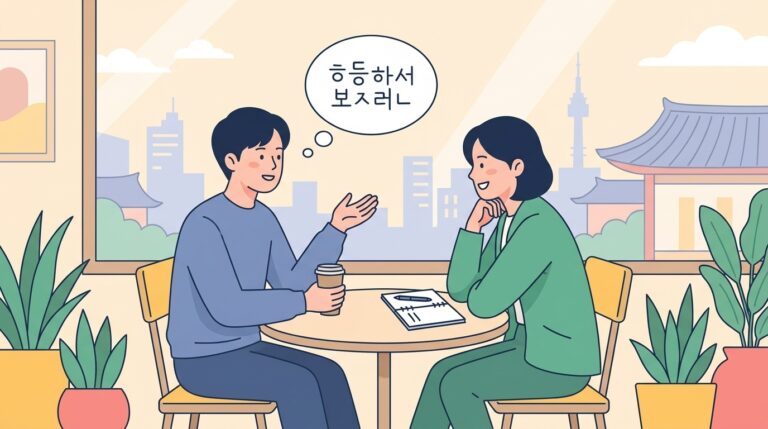
Have you ever poured your heart out to a close Korean friend after an exhausting day, expecting a warm comforting word, only to receive a cold, hyper-logical solution? Picture this: You are sitting at a trendy cafe in Seongsu-dong. You just told your friend how hurt you felt when your boss criticized your project in front of everyone. Instead of saying “아휴, 정말 속상했겠다” (Gosh, that must have been so upsetting), your friend blinks, takes a sip of iced americano, and calmly asks, “근데 보고서 서식은 왜 틀렸어?” (But why was your report formatting wrong in the first place?).
In modern Korean culture—where the MBTI craze has polarized society into high-empathy ‘F’ (Feeling) types and hyper-rational ‘T’ (Thinking) types—handling conversations with people who lack emotional resonance can be tricky. At a C2 advanced level, simply knowing basic emotion words like ‘슬프다’ (to be sad) isn’t enough. You need the sophisticated linguistic arsenal to express subtle frustration, set emotional boundaries gracefully, and call out low-empathy responses without causing unnecessary conflict.
This guide is crafted directly from real tutoring feedback from advanced Korean learners navigating high-stakes personal and professional relationships in Korea. Mastering these nuanced expressions will elevate your conversational fluency, protect your emotional energy, and allow you to navigate complex interpersonal dynamics like a true native speaker.
Phase 2: 3 Key Expressions Deep Dive
1. 영혼 없다 (Yeong-hon eop-da)
- Pronunciation: [yeong-hon eob-da] (Sounds like “young-hone eop-dah”—imagine sighing out ‘young’ while blowing out a candle)
- Meaning: Literally “To have no soul.” It refers to someone giving a mechanical, performative, or completely emotionally detached response.
- K-Culture Moment: Frequently seen in Korean variety shows when a host compliments a guest on cue, prompting the guest to laughingly accuse them: “방금 진짜 영혼 없었다!” (That was so soulless!).
- Editor’s Insight: At C2 level, use this to playfully or subtly call out a friend who is giving generic responses like “아 그래? 대박” (Oh really? Wow) without actually listening.
- Situation Spectrum: Casual ✅ | Semi-formal ⚠️ | Formal 🚫
- 🤔 Think About It: In your culture, do you call out robotic responses directly, or do you pretend not to notice? How does calling out “soullessness” change the power dynamic in a dialogue?
2. 벽 보고 얘기하는 기분이다 (Byeog bo-go yae-gi-ha-neun gi-bun-i-da)
- Pronunciation: [byeok bo-go yae-gi-ha-neun gi-bu-ni-da] (Focus on the quick bounce of ‘byeok’—like hitting a solid wall)
- Meaning: Literally “It feels like I am talking to a wall.” Used when the listener shows zero empathy, emotional reactivity, or willingness to connect.
- K-Culture Moment: A staple line in K-Dramas during intense relationship confrontation scenes where one partner realizes the other is purely analytical or emotionally unavailable.
- Editor’s Insight: C2 speakers use this structure to express deep cognitive and emotional burnout in a conversation without resorting to vulgarity.
- Situation Spectrum: Casual ✅ | Semi-formal ⚠️ | Formal 🚫
- 🤔 Think About It: Korean culture historically values Nunchi (tact/reading the room). Why might talking to an unempathetic person feel uniquely exhausting in a collective culture like Korea’s?
3. 공감까진 안 바라더라도… (Gong-gam-kka-jin an ba-ra-deo-ra-do…)
- Pronunciation: [gong-gam-kka-jin an ba-ra-deo-ra-do] (Stress the double consonant ‘kka’—like clicking your tongue lightly)
- Meaning: “Even if I’m not expecting deep empathy…” (followed by a request for basic courtesy or listening etiquette).
- K-Culture Moment: Used in adult workplace dialogues or mature personal relationships when setting clear boundaries against unsolicited advice or harsh criticisms.
- Editor’s Insight: This is a master-level diplomatic buffer expression. It acknowledges the other person’s nature while asserting your need to be heard.
- Situation Spectrum: Casual ✅ | Semi-formal ✅ | Formal ⚠️
- 🤔 Think About It: How does setting conditions on emotional expectations reflect modern Korean interpersonal boundary-setting (선 긋기)?
Phase 3: Textbook Korean vs Real Korean
Situation 1: Calling out cold, overly logical advice
- 📖 Textbook Korean: 당신의 말은 저에게 상처가 됩니다. (Your words hurt me.)
- 🗣️ Real Korean: 말을 꼭 그렇게 T처럼 차갑게 해야 돼? (Do you really have to speak so coldly like a ‘T’?)
- 💡 Why the difference?: Modern Koreans heavily utilize MBTI terminology (specifically ‘T’ for Thinking/Rational) as a socially acceptable shorthand to call out lack of emotional empathy without sounding overly aggressive.
Situation 2: Asking someone to pay genuine attention to your feelings
- 📖 Textbook Korean: 제 감정을 이해해 주시기 바랍니다. (Please understand my feelings.)
- 🗣️ Real Korean: 리액션에 영혼 좀 실어서 말해봐. (Put some actual soul into your reaction.)
- 💡 Why the difference?: Imperative demands for empathy sound overly formal and dramatic. Humorously demanding “soul” (영혼) lightens the mood while clearly communicating dissatisfaction.
Phase 4: K-Culture Deep Dive & Non-Verbal Manners
4-1. Nunchi & Non-Verbal Gestures
When interacting with a low-empathy speaker in Korea, non-verbal cues carry immense weight:
* The Heavy Micro-Sigh (한숨): A subtle exhale while gently dropping your gaze indicates that the other person’s logical response missed your emotional point entirely.
* Hand-Palm Stop Gestures: Gently raising one hand flat with the palm facing inward towards yourself signals: “I need comfort right now, not problem-solving.”
* Slight Tilt of the Head (고개 갸우뚱): Expresses polite disbelief when someone delivers an unfeeling, cold remark.
4-2. Cultural Code: The ‘MBTI T vs F’ Phenomenon
In contemporary Korea, personality typing isn’t just a trend; it’s a social navigational framework. The phrase “T-발 너 C야?” (a humorous, slightly slangy play on MBTI ‘T’ and strong emotional disconnect) exploded in popularity because young Koreans needed a way to discuss empathy deficits. Korea is transitioning from traditional Jeong (정 – deep emotional bonding) to modern individualized boundaries. Understanding this shift allows C2 learners to recognize that low-empathy responses are often viewed as a personality trait (‘T’) rather than personal malice.
Phase 5: Real-Life Roleplay Scenario
Setting: A late-afternoon scene at a quiet cafe. You are talking to your close coworker, Min-jun (민준), who is notoriously analytical.
- 민준: 🎭 (Laptops open, typing without looking up) 그래서, 아까 팀장님이 한 말 때문에 아직도 기분이 안 좋아?
- You: 🎭 (Resting your head on your hand, sighing softly) 응, 모두가 있는 자리에서 그렇게 지적받으니까 진짜 쥐구멍에라도 들어가고 싶었어.
- 민준: 🎭 (Adjusting glasses, voice completely calm) 그런데 객관적으로 보면 팀장님 말이 틀린 건 아니잖아. 자료 출처가 빠졌던데?
- You: 🎭 (Pouting slightly, crossing arms) 아니, 내가 틀렸다는 걸 몰라서 이러는 게 아니잖아.
- 민준: 🎭 (Looking confused) 맞는데 왜 그래? 다음부터 수정하면 되잖아.
- You: 🎭 (Shaking head with a faint smile) 민준 씨, 공감까진 안 바라더라도… 영혼 좀 실어서 위로해 주면 안 돼?
- 민준: 🎭 (Pauses typing, blinks in realization) 아… 미안. 내가 또 너무 T처럼 굴었지?
- You: 🎭 (Laughing) 맞아. 벽 보고 얘기하는 기분 들 뻔했잖아!
🔀 Interactive Branching Point
How would you respond if Min-jun still doesn’t get it and says: “근데 감정적으로 굴어봤자 해결되는 건 없잖아?” (But acting emotional doesn’t solve anything, right?)
- Option A: “됐다, 너랑은 더 이상 말 안 할래.” (Forget it, I won’t talk to you anymore.)
- Option B: “해결을 바라는 게 아니라, 그냥 ‘속상했겠다’ 한마디면 충분하다고.” (I’m not asking for a solution; a simple ‘that must have been hard’ is enough.)
- Option C: “너는 진짜 공감 능력이 제로구나?” (You really have zero empathy, don’t you?)
Feedback:
- Option A (Risk): High risk of creating permanent coldness in a workplace environment.
- Option B (Best): Perfect C2 level communication! Clear, assertive, and explicitly educates the listener on the required emotional cue.
- Option C (Bad): Too accusatory; leads to unnecessary defensiveness.
Phase 6: 10-Second Emotion Shadowing Drill
Practice reading these sentences aloud, respecting the pauses (/) and emotional tone indicators:
[🤖 차갑고 무덤덤하게]
그거 이미 지나간 일인데 / 왜 아직도 신경 쓰고 있어?
(Geu-geo i-mi ji-na-gan il-in-de / wae a-jik-do sin-gyeong sseo-go is-seo?)-
[😮💨 한숨 쉬며 서운하게]
말을 꼭 그렇게… / 영혼 없이 해야 돼?
(Mal-eul kkok geu-rae-ke… / yeong-hon eop-si hae-ya dwae?) -
[😊 다정하지만 단호하게]
공감까진 안 바라더라도 / 그냥 내 말 들어주기만 해 줘.
(Gong-gam-kka-jin an ba-ra-deo-ra-do / geu-nyang nae mal deu-reo-ju-gi-man hae jwo.)
Phase 7: K-Culture Mini Dictionary
- T성향 (T-Seong-hyang) | Thinking Personality Trait
Refers to an analytical, fact-based approach to conversations. Often used endearingly or critically to describe low emotional responsiveness. - 영혼봇 (Yeong-hon-bot) | Soul-less Robot
A playful slang term describing someone who nods along and offers empty affirmative words without active listening. - 감정 노동 (Gam-jeong No-dong) | Emotional Labor
The mental effort expended to manage feelings and expressions in social or professional interactions. - 선 긋기 (Seon Geut-gi) | Drawing a Line / Setting Boundaries
The act of subtly establishing personal or emotional limits when conversations become draining.
Phase 8: Traveler’s Survival Kit
Top 3 Survival Expressions
- 해결책 말고 공감이 필요해요. (Hae-gyeol-chaek mal-go gong-gam-i pil-yo-hae-yo.)
Pro Tip: Use this in personal settings when a Korean friend jumps straight into lecturing mode. - 아, 네… 그렇군요. (A, ne… geu-reo-kun-yo.)
Pro Tip: The ultimate flat tone technique to politely shut down unwanted cold advice. - 영혼 없는 리액션 감사합니다! (Yeong-hon eop-neun ri-aek-syeon gam-sa-ham-ni-da!)
Pro Tip: Delivered with humor, this dissolves awkwardness when someone gives a generic reply.
Editor’s Travel Note
When navigating long travel days or stressful situations in Korea, miscommunication can happen. Keep your apps handy to manage schedule adjustments smoothly! Make sure to check your travel routes on 네이버 지도 앱 다운로드 to avoid logistical stress that can lead to tense conversations.
Phase 9: One Step Deeper (Mini Essay)
In traditional Korean society, human relationships were defined by Jeong (정)—an inescapable emotional glue that prioritized empathy over cold logic. However, fast-paced modern life in urban hubs like Seoul has led younger generations to embrace MBTI constructs like ‘T’ and ‘F’ to navigate emotional burnout. Calling someone “T성향” (T-type) isn’t necessarily an insult; it’s an adaptive mechanism to set boundaries without burning bridges. True C2 Korean mastery lies not just in choosing complex vocabulary, but in understanding how Koreans balance emotional expression with self-preservation.
💬 Your Turn: Have you ever encountered a “T-type” response from a Korean speaker? How did you respond? Share your stories in the comments below!
Phase 10: FAQ & Common Mistakes
Q: Is calling someone “영혼 없다” rude?
A: In formal or business settings, yes. However, among friends or close coworkers, it is viewed as lighthearted banter to call out lack of enthusiasm.
Q: What is the best way to ask for empathy without sounding needy?
A: Frame your request using the buffer pattern: “공감까진 안 바라더라도…” (Even if I don’t expect deep empathy…) followed by what you need (e.g., “들어주기만 해 줘” – just listen to me).
Q: Why do Koreans use MBTI so much in emotional discussions?
A: It offers a non-confrontational framework. Saying “You are so cold” sounds like a personal attack, whereas “You are such a T” frames it as a humorous personality trait.
🚨 Common Mistakes TOP 3
- Mistake: Saying “공감하세요!” (Empathize!) as a direct command.
- Correct Action: Use soft request forms like “공감해 달라는 말이었어” (I just meant I wanted some empathy).
- Mistake: Translating “You have no heart” directly into “너는 마음이 없다.”
- Correct Action: Use native idioms like “너 진짜 차갑다” or “T 아니야?”
- Mistake: Using formal honorifics while calling someone out casually (e.g., “당신 영혼 없네요”).
- Correct Action: Match honorific levels consistently (e.g., “진짜 영혼 없으시네요~” in polite tone).
Phase 11: Action Mission & Engagement
- Bronze Mission: Record yourself pronouncing “영혼 없다” and “공감까진 안 바라더라도” 3 times with realistic emotional tones.
- Silver Mission: Use the phrase “말을 꼭 그렇게 T처럼 해야 돼?” in a sentence and post it in the comments below!
- Gold Mission: Identify a low-empathy response in a K-Drama scene this week and write a script rewrite using C2 boundary-setting phrases.
🎮 K-Culture Mission: Watch an episode of a popular Korean variety show (like Workman or Running Man) and count how many times someone accuses another member of having “영혼 없다”!
Phase 12: Interactive Quiz Challenge
Test your C2 mastery! Select your answer and click the toggle to check your results.
Question 1: Situation Judgment
Your friend responds to your bad day by listing 5 things you did wrong. Which response sets an assertive, C2-level boundary politely?
A) 당신은 참 나쁜 사람입니다.
B) 해결책도 좋은데, 오늘은 그냥 들어주면 안 될까?
C) 공감해라!
View Answer & Explanation
Correct Answer: B
Explanation: Option B acknowledges their effort (“해결책도 좋은데”) while clearly stating your emotional boundary (“오늘은 그냥 들어주면 안 될까?”). Option A is overly dramatic and Option C is an awkward direct command.
Question 2: Fill in the Blank
“리액션에 ________ 좀 실어서 말해봐! 너무 기계적잖아.”
A) 영혼
B) 지갑
C) 시계
View Answer & Explanation
Correct Answer: A (영혼)
Explanation: “영혼을 실어 말하다” means to speak with genuine soul/emotion.
Question 3: True / False Culture Quiz
Calling someone “T성향” in modern Korean is always a severe insult that ends friendships. (True / False)
View Answer & Explanation
Correct Answer: False
Explanation: It is widely used as playful banter and a socially acceptable shorthand for analytical personality traits.