

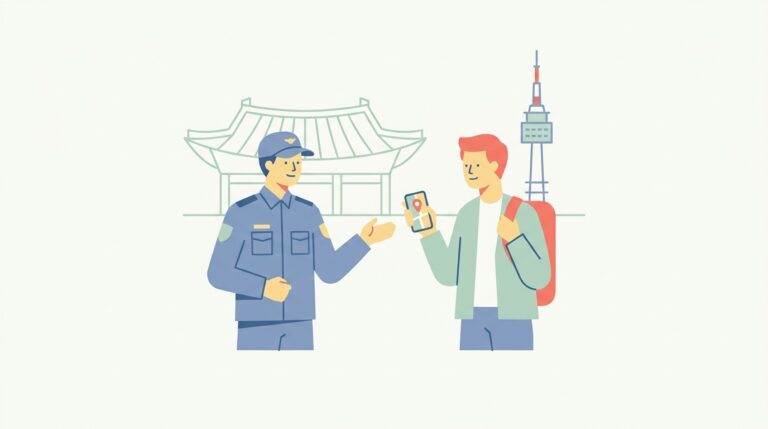
Emergency Korean: How to Call 119 in Korea Without Panic
Phase 1: Empathetic Opening
안녕하세요! This is your Daily Hangul editor and your 10-year local Korean culture navigator! Have you ever watched a gripping scene in a K-Drama where someone suddenly collapses on the streets of Gangnam or near the Han River, and someone frantically dials 119? It makes your heart race just watching it! But what if a real emergency happens while you are traveling or living in Korea? Calling an emergency service in a foreign language can feel overwhelming. Many expats and travelers panic when trying to explain where they are or what happened. That’s why we created this step-by-step guide based on real feedback from international learners. By mastering just a few essential A2-level phrases today, you will gain the confidence to handle unexpected situations safely and protect yourself and others in Korea!
Phase 2: Core Expressions Deep Dive
1. 도와주세요! (Do-wa-ju-se-yo!)
- Pronunciation: [Do-wa-ju-se-yo] (Sounds like “Doh-wah-joo-say-yoh” – think of asking someone gently to “do a favor for you”)
- Meaning: Literal: “Please give me help!” | Nuance: “Help me!” (Polite and urgent emergency call)
- K-Culture Moment: Frequently heard in K-dramas when a main character calls out to bystanders in crowded places like Hongdae or subway stations.
- Editor’s Insight: Combining ‘도와’ (help) and ‘주세요’ (please give) creates a polite yet immediate plea for assistance that works in any situation.
- Situation Spectrum:
- Casual: 🚫 (Do not drop polite endings during real emergencies!)
- Semi-formal/Formal: ✅ 도와주세요!
- 🤔 Think About It: In your country, do people call out politely even when crying for help? Notice how Korean polite endings (-요) remain natural even in tense moments.
2. 구급차를 불러주세요! (Gu-geup-cha-reul bul-leo-ju-se-yo!)
- Pronunciation: [Gu-geup-cha-reul bul-leo-ju-se-yo] (Think of “Goo-geup-cha” like a quick ambulance siren tone)
- Meaning: Literal: “Please call an ambulance!” | Nuance: “Please call 119 for an ambulance right now!”
- K-Culture Moment: Used in medical K-Dramas like Hospital Playlist when bystanders report an accident scene before responders arrive.
- Editor’s Insight: ‘구급차’ means ambulance. If ‘불러주세요’ feels too long under stress, yelling “구급차! 구급차!” works instantly.
- Situation Spectrum:
- Casual: 🚫
- Semi-formal/Formal: ✅ 구급차를 불러주세요!
- 🤔 Think About It: Did you know 119 handles both fire and medical emergencies in Korea, unlike 911 in some Western countries?
3. 여기에 사람이 쓰러졌어요. (Yeo-gi-e sa-ram-i sseu-reo-jyeos-seo-yo.)
- Pronunciation: [Yeo-gi-e sa-ram-i sseu-reo-jyeos-seo-yo] (Focus on “Yeo-gi” = Here)
- Meaning: Literal: “A person collapsed here.” | Nuance: “Someone has passed out / collapsed right here!”
- K-Culture Moment: Seen when citizens react to sudden fainting incidents on public transport or hiking trails in Seoraksan.
- Editor’s Insight: Clear situational reports help 119 dispatchers assign priority fast. Pointing while saying ‘여기에’ (here) provides immediate context.
- Situation Spectrum:
- Casual: 🚫
- Semi-formal/Formal: ✅ 여기에 사람이 쓰러졌어요.
- 🤔 Think About It: Notice how Korean sentences put location (‘여기에’) first to establish spatial clarity immediately.
Phase 3: Textbook Korean vs. Real Korean
Situation 1: Calling for Emergency Medical Help
- 📖 Textbook Korean: “저를 긴급히 병원으로 이송해 주십시오.” (Please transport me urgently to the hospital.)
- 🗣️ Real Korean: “119이죠? 빨리 구급차 좀 보내주세요!” (Is this 119? Please send an ambulance quickly!)
- 💡 Why the Difference? Formal textbook phrases are too stiff. Real native speakers use conversational urgency mixed with soft request particles like ‘좀’ (please/kindly).
Situation 2: Asking a Passerby for Help
- 📖 Textbook Korean: “당신은 저를 도와줄 수 있습니까?” (Are you able to assist me?)
- 🗣️ Real Korean: “저기요! 잠시만 도와주세요!” (Excuse me! Please help me for a moment!)
- 💡 Why the Difference? ‘당신’ (you) is rarely used in natural spoken Korean. Starting with ‘저기요!’ immediately grabs attention respectfully.
Phase 4: K-Culture Deep Dive & Non-verbal Manners
4-1. Nunchi & Emergency Gestures
When calling 119 or asking locals for help, direct non-verbal cues are vital. Wave both arms above your head in an ‘X’ shape if you cannot speak immediately. If you are on the phone with 119, try pointing at prominent building landmarks or convenience store signs (like GS25 or CU) and read the store name aloud—dispatchers can pinpoint store addresses instantly!
4-2. Culture Code: Korea’s 119 Translation Service
Did you know Korea’s 119 emergency center offers real-time foreign language translation services in over 20 languages? When you call 119, simply state “English, please!” or “통역 부탁해요” (Tong-yeok bu-tak-hae-yo). The dispatcher will initiate a 3-way call with a professional interpreter in seconds!
Phase 5: Real-Life Roleplay Scenario
Setting: You are walking near Myeongdong when an elderly tourist nearby faints on the sidewalk.
NPC Character: 119 Emergency Dispatcher (구급대원)
- 119 Dispatcher: 119입니다. 어떤 도움이 필요하신가요?
(119-im-ni-da. Eeo-tteon do-um-i pil-yo-ha-sin-ga-yo? / 119 service. What emergency help do you need?)
🎭 Action: Calm tone, listening through phone headset - You: 여보세요! 여기에 사람이 쓰러졌어요!
(Yeo-bo-se-yo! Yeo-gi-e sa-ram-i sseu-reo-jyeos-seo-yo! / Hello! Someone collapsed here!)
🎭 Action: Urgent, pointing toward the person on the ground - 119 Dispatcher: 위치가 어디인가요? 주변에 큰 건물이 있나요?
(Wi-chi-ga eo-di-in-ga-yo? Ju-byeon-e keun geon-mul-i in-na-yo? / Where is your location? Any big landmark nearby?)
🎭 Action: Typing rapidly on keyboard - You: 명동역 6번 출구 앞 편의점이에요!
(Myeong-dong-yeok yuk-beon chul-gu ap pyeon-ui-jeom-i-e-yo! / It’s in front of the convenience store at Myeongdong Station Exit 6!)
🎭 Action: Looking around at street signs quickly - 119 Dispatcher: 환자분이 의식이 있으신가요?
(Hwan-ja-bun-i ui-sig-i is-seu-sin-ga-yo? / Is the patient conscious?)
🎭 Action: Speaking clearly and firmly - You: 아니요, 눈을 안 떠요. 구급차 빨리 보내주세요!
(A-ni-yo, nun-eul an tteo-yo. Gu-geup-cha ppal-li bo-nae-ju-se-yo! / No, they are not opening their eyes. Please send an ambulance fast!)
🎭 Action: Checking patient's eyes with hands shaking slightly - 119 Dispatcher: 알겠습니다. 구급차가 바로 출동합니다. 현장에서 기다려주세요.
(Al-ges-seum-ni-da. Gu-geup-cha-ga ba-ro chul-dong-ham-ni-da. Hyeon-jang-e-seo gi-da-ryeo-ju-se-yo. / Understood. An ambulance is dispatched immediately. Please wait at the scene.)
🎭 Action: Confirming GPS location - You: 네, 감사합니다. 빨리 와주세요!
(Ne, gam-sa-ham-ni-da. Ppal-li wa-ju-se-yo! / Yes, thank you. Please come quickly!)
🎭 Action: Nodding relieved while staying beside the patient
🔀 Interactive Choice Point
What will you say next to bystanders nearby?
* Option A: “저기요, 119에 전화했으니 같이 기다려주세요!” (Best Choice)
* Option B: “왜 아무도 안 도와줘요?” (Bad Choice – sounds accusatory)
* Option C: “그냥 지나가세요.” (Risk Choice – dangerous in an emergency)
Feedback:
* Option A (Best): Excellent! Clear communication keeps everyone calm and helpful.
* Option B (Bad): Bystanders might feel defensive rather than eager to assist.
* Option C (Risk): Discourages nearby help when extra assistance or AED might be needed.
Phase 6: 10-Second Emotion Shadowing Drill
[🚨 Urgent & Shaking]
여기에 / 사람이 / 쓰러졌어요!
(Yeo-gi-e / sa-ram-i / sseu-reo-jyeos-seo-yo!)-
[😰 Anxious & Fast]
119이죠? / 구급차 좀 / 빨리 보내주세요!
(119-i-jyo? / Gu-geup-cha jom / ppal-li bo-nae-ju-se-yo!) -
[🙏 Earnest & Asking for Help]
저기요! / 여기 의사 선생님 / 계신가요?
(Jeo-gi-yo! / Yeo-gi ui-sa seon-saeng-nim / gye-sin-ga-yo? – Excuse me! Is there a doctor here?)
Phase 7: K-Culture Mini Dictionary
- 119 (일일구 – Il-il-gu): Emergency phone number in South Korea for fire, rescue, and ambulance services.
- 응급실 (Eung-geup-sil): Hospital Emergency Room (ER).
- 위치 (Wi-chi): Location/Address. Crucial word when dispatchers ask where you are.
- 구급대원 (Gu-geup-dae-won): Paramedic / Emergency Medical Technician (EMT).
Phase 8: Traveler’s Survival Kit
TOP 3 Emergency Survival Phrases
- 도와주세요! (Help me!)
- 119 불러주세요! (Please call 119!)
- 아파요! (A-pa-yo! – It hurts / I’m sick!)
- Pro Tip: If you cannot speak Korean at all on the phone, stay on the line! 119 automatically tracks landline/mobile cell tower locations in Korea.
- Editor’s Travel Note: Always keep navigation apps ready on your phone. You can check your current location in English by installing the Naver Map Navigation App.
Phase 9: One Step Deeper
In Korea, helping someone in distress is deeply rooted in the spirit of community (Jeong – 정). Koreans are generally very quick to assist visitors when an emergency occurs. Do not hesitate to call out ‘도와주세요!’ in public spaces. Someone will almost certainly step forward to help you navigate or talk to responders.
💬 Your Turn: Have you ever experienced an emergency while traveling abroad? Share your thoughts in the comments below!
Phase 10: FAQ & Common Mistakes
Q: Does calling 119 cost money in Korea?
A: No! Emergency ambulance calls and 119 rescue services in South Korea are 100% free of charge for both citizens and foreign visitors.
Q: What if I don’t know my exact address?
A: Look for street light poles, emergency location number plates on hiking trails, or convenience store storefront names and tell the operator!
Q: Can I text 119 instead of calling?
A: Yes! You can send photos or text messages in English to 119 if you cannot speak directly.
🚨 Common Mistakes TOP 3
- Mistake: Dialing 911 instead of 119. -> Correct Action: Dial 119 directly in South Korea.
- Mistake: Trying to use dictionary-formal sentences. -> Correct Action: Keep phrases short and clear like “도와주세요!”.
- Mistake: Hanging up prematurely. -> Correct Action: Stay on the phone until the 119 operator confirms dispatch.
Phase 11: Action Mission & Engagement
- 🥉 Bronze: Say “도와주세요!” aloud 3 times with urgent emotion.
- 🥈 Silver: Memorize the number 119 and how to say your city name in Korean.
- 🥇 Gold: Practice the Phase 5 roleplay dialogue with a study partner.
- 🎮 K-Culture Mission: Watch an episode of a Korean emergency response drama (like The First Responders) and spot emergency terms!
Phase 12: Interactive Quiz Challenge
Question 1 (Situation Judgement)
What is the best phrase to say when someone collapses next to you?
* A) 얼만가요? (Eol-man-ga-yo?)
* B) 여기에 사람이 쓰러졌어요! (Yeo-gi-e sa-ram-i sseu-reo-jyeos-seo-yo!)
* C) 맛있게 드세요! (Ma-sit-ge deu-se-yo!)
Click to view Answer & Explanation
Correct Answer: B
Explanation: Option B means “Someone collapsed here!” Option A asks for price, and Option C wishes someone a good meal.
Question 2 (Fill in the Blank)
Please call an ambulance! = “구급차를 ______!”
* A) 불러주세요 (bul-leo-ju-se-yo)
* B) 주세요 (ju-se-yo)
Click to view Answer & Explanation
Correct Answer: A
Explanation: ‘불러주세요’ means “please call/summon”.
Question 3 (True or False)
True or False: Calling an ambulance via 119 in South Korea incurs a heavy fee.
Click to view Answer & Explanation
Correct Answer: False
Explanation: 119 emergency medical services are free for residents and foreign tourists in South Korea.







