

How to Politely Complain About a Neighbor’s Dog in Korea
Phase 1: 공감 (Empathy & K-Story Opening)
안녕하세요! 매일한글 에디터입니다. (Hello! This is your Daily Hangul editor.)
Picture this: You’ve just moved into a cozy villa in Seoul. You’ve set up your room, ordered fried chicken, and settled down to watch your favorite K-Drama. Suddenly, “Mung! Mung! Mung!” A high-pitched barking echoes through the thin walls. It’s midnight, and the neighbor’s cute puppy has been barking nonstop for three hours.
You want to ask them to quiet down, but you’re worried about being rude, causing a scene, or ruining neighborly relationships. In Korean apartment culture, handling grievances requires a subtle mix of 눈치 (Nunchi – social tact) and polite firmness.
Don’t worry! Today, we’ll master practical expressions to politely complain about noise complaints without making enemies. Based on real feedback from international residents in Korea, this guide will empower you to solve apartment conflicts smoothly and respectfully.
Phase 2: 핵심 표현 3선 심층 분석 (3 Core Expressions)
1. 강아지 소리 때문에 잠을 못 자겠어요.
- Pronunciation: [Gang-a-ji so-ri ttae-mu-ne jam-eul mot ja-ges-seo-yo]
(Sounds like: “Gahng-ah-jee so-ree ttae-moo-neh jahm-euhl moht jah-get-so-yo” – rhyme ‘ttae’ with ‘pet’)- Meaning: Literal: I can’t sleep because of the puppy sound. / Actual: The dog barking is keeping me awake.
- K-Culture Moment: Seen in relatable slice-of-life dramas like Work Later, Drink Now when neighbors talk through thin walls.
- Editor’s Insight: Using “강아지” (puppy/dog) instead of just “개” (dog) sounds softer and shows you don’t hate animals, just the noise.
- Situation Spectrum: Casual 🚫 | Semi-formal ✅ | Formal ✅
- 🤔 Think About It: In your home country, do you directly tell the neighbor or call the police first? In Korea, direct personal contact is usually the very last resort after polite notes or security intervention!
2. 죄송하지만 신경 좀 써주세요.
- Pronunciation: [Joe-song-ha-ji-man sin-gyeong jom sseo-ju-se-yo]
(Sounds like: “Jwe-sohng-hah-jee-mahn sheen-gyeong johm ssoh-joo-seh-yo”)- Meaning: Literal: I am sorry, but please pay some attention. / Actual: I’m sorry to bring this up, but please take care of it.
- K-Culture Moment: Frequently used when asking coworkers or neighbors to fix an ongoing mild issue.
- Editor’s Insight: Adding “죄송하지만” (I am sorry, but) softens the request while “신경 좀 써주세요” clearly conveys that action needs to be taken.
- Situation Spectrum: Casual ⚠️ | Semi-formal ✅ | Formal ✅
- 🤔 Think About It: Why do Koreans apologize before stating a legitimate grievance? It softens potential social friction.
3. 층간소음 때문에 연락드렸어요.
- Pronunciation: [Cheung-gan-so-eum ttae-mu-ne yeol-lak-deu-ryeot-seo-yo]
(Sounds like: “Cheung-gahn-so-euhm ttae-moo-neh yeol-rahk-deu-ryut-seo-yo”)- Meaning: Literal: I contacted you because of inter-floor noise. / Actual: I’m reaching out regarding the noise between floors.
- K-Culture Moment: A standard opening phrase when messaging an apartment building management office or calling via intercom.
- Editor’s Insight: “층간소음” (noise between floors) is a major social issue in Korea. Framing it with this official term makes your complaint sound formal and serious.
- Situation Spectrum: Casual 🚫 | Semi-formal ✅ | Formal ✅
- 🤔 Think About It: How does official terminology change the tone of a complaint in your native language?
Phase 3: 교과서 한국어 vs 진짜 한국어 (Textbook vs Real Korean)
Situation 1: Leaving a polite note on the neighbor’s door
- 📖 교과서 한국어: 강아지 짖는 소리를 하지 마십시오. (Do not make dog barking sounds.)
- 🗣️ 진짜 한국어: 강아지 소리 때문에 조금 힘들어서요, 부탁드립니다! (It’s a bit tough for me due to the dog noise, so I kindly ask for your cooperation!)
- 💡 왜 다를까? Koreans rarely use imperative commands like “-하십시오” with neighbors. Using passive expressions like “조금 힘들어서요” (It’s a bit tough for me) highlights personal difficulty rather than directly blaming the owner.
Situation 2: Speaking to the apartment security guard (경비원님)
- 📖 교과서 한국어: 옆집 개가 짖는데 해결해 주세요. (The neighbor’s dog is barking, solve it.)
- 🗣️ 진짜 한국어: 저… 옆집 강아지 소리가 좀 심한데, 말씀 좀 전해주실 수 있나요? (Excuse me… the neighbor’s dog barking is getting a bit loud, could you please pass along the message?)
- 💡 왜 다를까? Asking security guards to mediate (말씀 전해주다) is the standard Korean apartment etiquette to prevent direct face-to-face conflict.
Phase 4: K-Culture 딥다이브 & 비언어적 매너 (K-Culture Deep Dive)
4-1. 눈치 (Nunchi) & Gestures
- Tone of Voice: Keep your voice soft, low, and hesitating. Starting with “저기요…” (Excuse me…) with a slight head tilt conveys politeness.
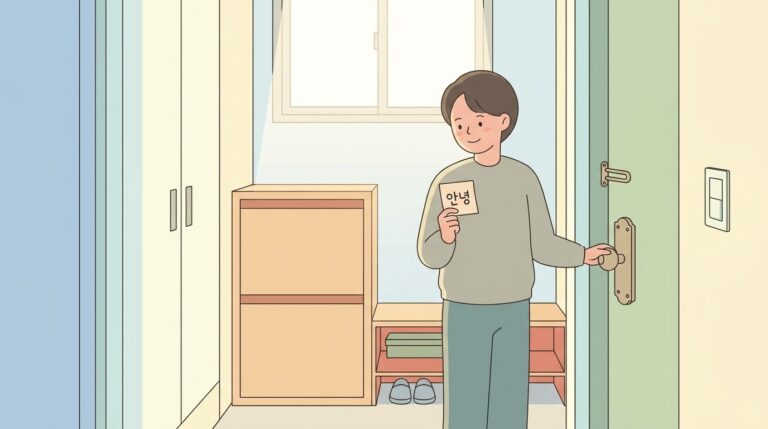
- Post-it Note Etiquette: Direct face-to-face confrontation is considered aggressive in Korean residential culture. Leaving a neatly written sticky note with a small gift (like a drink or wrapped sweets) on their door is a widely accepted gentler approach.
4-2. Culture Code: 층간소음 (Inter-floor Noise)
In dense urban areas like Seoul, over 70% of residents live in multi-family housing (Apatu or Villa). Noise complaints are taken seriously. Instead of knocking loudly, residents often use the building intercom or contact the management office (관리사무소).
Phase 5: 실전 롤플레이 시나리오 (Real Roleplay Scenario)
Setting: You encounter your neighbor, Min-su (민수), in the apartment hallway after another noisy night.
- 민수: 안녕하세요! 퇴근길이세요?
(An-nyeong-ha-se-yo! Toe-geun-gil-i-se-yo?)
[Hello! Are you on your way home from work?]
🎭 Smiling brightly while holding his small dog -
You: 아, 네! 안녕하세요. 저… 혹시 잠깐 이야기 가능할까요?
(A, ne! An-nyeong-ha-se-yo. Jeo… hok-si jam-kkan i-ya-gi ga-neung-hal-kka-yo?)
[Ah, yes! Hello. Um… by any chance, could we talk for a brief moment?]
🎭 Hesitant voice, politely bowing head -
민수: 그럼요! 무슨 일 있으세요?
(Geu-reom-yo! Mu-seun il is-seu-se-yo?)
[Of course! Is something wrong?]
🎭 Looks curious -
You: 다름이 아니라, 밤마다 강아지 짖는 소리가 조금 들려서요…
(Da-reum-i a-ni-ra, bam-ma-da gang-a-ji jit-neun so-ri-ga jo-geum deul-ryeo-seo-yo…)
[Actually, it’s just that I hear the dog barking a bit every night…]
🎭 Speaking softly, pointing gently towards the door -
민수: 아… 정말요? 저희 몽이가 밤에 혼자 있어서 짖었나 봐요. 죄송해요!
(A… jeong-mal-yo? Jeoh-ui Mong-i-ga bam-e hon-ja is-seo-seo jit-eot-na bwa-yo. Joe-song-hae-yo!)
[Ah… really? My dog Mong-i must have barked because he was alone at night. I’m so sorry!]
🎭 Apologetic face -
You: 아니에요. 저도 이해하지만, 제가 요즘 잠을 잘 못 자서요.
(A-ni-e-yo. Jeo-do i-hae-ha-ji-man, je-ga yo-jeum jam-eul jal mot ja-seo-yo.)
[No, it’s okay. I understand, but I haven’t been able to sleep well lately.]
🎭 Tired smile to show empathy -
민수: 아이구, 정말 죄송합니다. 밤에는 신경 꼭 쓸게요!
(A-i-gu, jeong-mal joe-song-ham-ni-da. Bam-e-neun sin-gyeong kkok sseul-ge-yo!)
[Oh dear, I am so sorry. I will definitely take care of it at night!]
🎭 Bowing slightly -
You: 네, 감사해요! 부탁드릴게요.
(Ne, gam-sa-hae-yo! Bu-tak-deu-ril-ge-yo.)
[Yes, thank you! I appreciate your help.]
🎭 Bowing politely
🔀 Interactive Branch: What would you do if the neighbor ignores you?
- Option A: Call the police right away.
- Feedback (Risk): Police usually treat indoor pet barking as a civil matter, and direct reporting can hurt neighbor relations permanently.
- Option B: Leave a polite note with a small drink, or speak to the apartment management/security office (경비실).
- Feedback (Best): This follows Korean social etiquette, allowing neutral mediation without escalation.
- Option C: Bang on their door in the middle of the night shouting “시끄러워요!” (It’s loud!).
- Feedback (Bad): High conflict risk! Banging on doors can be legally classified as harassment under local housing disputes.
Phase 6: 10초 감정 섀도잉 드릴 (10-Sec Emotion Shadowing Drill)
Practice these lines with realistic emotional pauses (/ marks a pause):
[🥺 아쉽고 미안한 톤으로]
저… / 강아지 소리 때문에 / 요즘 잠을 잘 못 자서요.
(Jeo… / gang-a-ji so-ri ttae-mu-ne / yo-jeum jam-eul jal mot ja-seo-yo.)-
[🙏 정중하고 공손하게]
죄송하지만 / 밤에는 / 신경 조금만 더 써주세요.
(Joe-song-ha-ji-man / bam-e-neun / sin-gyeong jo-geum-man deo sseo-ju-se-yo.)
Phase 7: K-Culture 미니 사전 (Mini Dictionary)
- 층간소음 (Cheung-gan-so-eum) | Inter-floor noise | Noise between apartments; a major urban topic in Korea.
- 반려견 (Ban-ryeo-gyeon) | Companion dog / Pet dog | Formal/respectful term for pets (more polite than just 개).
- 경비실 (Gyeong-bi-sil) | Security office | The primary mediation point for residential complaints.
- 신경 쓰다 (Sin-gyeong sseu-da) | To pay attention / care about | Idiom used to ask someone to handle a problem carefully.
Phase 8: 여행자를 위한 생존 키트 (Traveler’s Survival Kit)
Survival Expressions Top 3
- 조금만 조용히 해주세요. (Jo-geum-man jo-yong-hi hae-ju-se-yo.) – Please be a little quiet.
- 너무 시끄러워서 잠을 못 자요. (Neo-mu si-kkeu-reo-wo-seo jam-eul mot ja-yo.) – It’s too noisy, so I can’t sleep.
- 관리사무소가 어디에 있나요? (Gwan-ri-sa-mu-so-ga eo-di-e in-na-yo?) – Where is the management office?
Editor’s Travel Note
If you are staying in an Airbnb or long-term residence in Korea, avoid knocking on neighbors’ doors directly late at night. Instead, use localized tools. For finding building management contact info or neighbor communication channels, check out localized mapping services like 네이버 지도 앱 다운로드 to locate building services near you.
Phase 9: 한 발 더 깊이 (One Step Deeper Essay)
Korea’s high-density housing environment has led to a unique social dynamic known as 정 (Jeong – affection/bonding) mixed with strict mutual respect. Because people live so close together, complaints are rarely framed as direct personal attacks. Instead, people frame complaints around shared discomfort (“I haven’t been sleeping well”) rather than pointing fingers (“You are noisy”). Softening your speech with indirect phrases keeps harmony while getting your point across.
💬 Your Turn: How are apartment noise complaints handled in your home country? Leave a comment below and share your stories!
Phase 10: FAQ & 오해 방지 (FAQ & Common Mistakes)
Q: Can I call the police in Korea if a neighbor’s dog barks all night?
A: While you can call 112, the police usually encourage neighbors to resolve pet noise through civil mediation or the building’s management office (관리사무소) first.
Q: Is it rude to leave a sticky note on a neighbor’s door?
A: Not at all! In fact, leaving a polite note with indirect phrases like “부탁드립니다” (Kindly requesting) and a small beverage is considered very considerate.







