

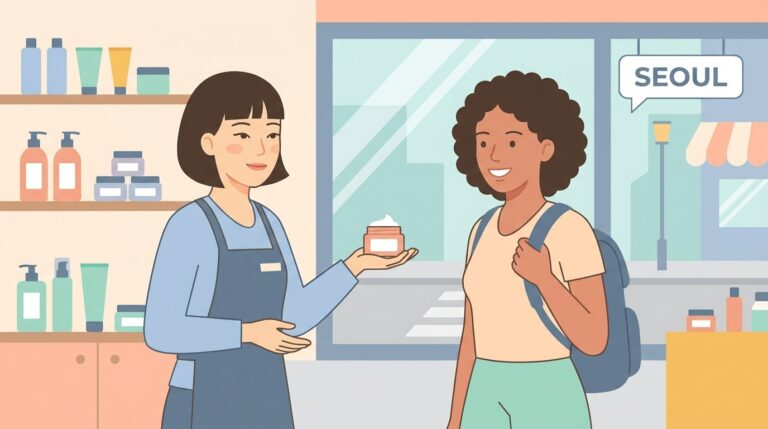
안녕하세요! 매일한글 에디터입니다. Have you ever stepped into a bustling Olive Young or a sleek cosmetic boutique in Seongsu-dong, only to feel completely overwhelmed? You see vibrant bottles with labels mentioning ‘Cica’, ‘Centella’, or ‘Hyaluronic Acid’, and you really want to test a patch on your wrist or ask if you can take home a couple of sample sachets suitable for your sensitive skin type. But suddenly, your mind goes blank! You worry that asking for samples might sound greedy, or that asking about specific ingredients like niacinamide or chemical filters will sound too complex. Trust me, every K-beauty enthusiast visiting Korea goes through this exact dilemma. Sampling and testing aren’t just shopping habits in Korea—they are a core part of the immersive K-Beauty culture where skincare is treated with utmost care and personalization. In this guide, tailored specifically for B2 intermediate learners, we will break down the natural, polite phrases that native Koreans use to ask for ingredient details and request samples with confidence.
1. 이 성분이 민감성 피부에 괜찮나요? (I- seongbun-i min-gam-seong pi-bu-e gwaen-chan-na-yo?)
- Pronunciation: [ee seong-boon-ee meen-gam-seung pee-boo-eh gwaen-chan-nah-yo] (Sounds like: “ee song-boon” + “meen-gam” with a soft rhythmic flow)
- Meaning: Direct: “Is this ingredient okay for sensitive skin?” | Actual Nuance: “Could you confirm if this specific formula is gentle enough for skin prone to redness or irritation?”
- K-Culture Moment: Featured in beauty vlog vlogs and dramas where characters with delicate skin ask staff for soothing Cica products before making a purchase.
- Editor’s Insight: At the B2 level, swapping out generic words like ‘좋아요?’ (Is it good?) for ‘괜찮나요?’ (Is it okay/safe?) demonstrates refined politeness and exact intent.
- Situation Spectrum:
- Casual (Friends): 이 성분 민감성에 괜찮아? (⚠️)
- Semi-formal (Staff/Stores): 이 성분이 민감성 피부에 괜찮나요? (✅)
- Formal (Dermatologist/Boutique): 이 성분이 민감성 피부에 적합한가요? (✅)
- 🤔 Think About It: Why do Korean skincare descriptions focus heavily on skin types (민감성, 건성, 지성) during product consultations?
2. 제 피부 타입에 맞는지 샘플 좀 써볼 수 있을까요? (Je pi-bu ta-ip-e man-neun-ji saem-peul jom sseo-bol su iss-eul-kka-yo?)
- Pronunciation: [je pee-boo tah-eep-eh mahn-neun-jee saem-peul jom sseo-bol soo eess-eul-kkah-yo]
- Meaning: Direct: “Can I try using a sample to see if it fits my skin type?” | Actual Nuance: “Would it be possible to get a sample so I can test patch it over a day or two?”
- K-Culture Moment: Frequently heard when shoppers purchase items and softly ask the cashier for specific sample sachets.
- Editor’s Insight: Adding ‘좀’ (jom – a little) softens the request significantly, making your request sound humble rather than demanding.
- Situation Spectrum:
- Casual: 샘플 좀 줄 수 있어? (🚫 – too blunt with staff)
- Semi-formal: 샘플 좀 써볼 수 있을까요? (✅)
- Formal: 혹시 샘플을 별도로 받아볼 수 있을까요? (✅)
- 🤔 Think About It: How does adding ‘좀’ reflect the Korean cultural nuance of indirectness when asking for favors?
3. 피부에 직접 테스트해봐도 될까요? (Pi-bu-e jik-jeo-peu tae-seu-teu-hae-bwa-do doel-kka-yo?)
- Pronunciation: [pee-boo-eh jeek-jeob tae-seuh-teuh-hae-bwah-doh doel-kkah-yo]
- Meaning: Direct: “May I test it directly on my skin?” | Actual Nuance: “Is it okay if I use the tester bottle on my hand or jawline?”
- K-Culture Moment: Standard line when looking at high-end foundation shades or serums at flagship stores in Myeongdong.
- Editor’s Insight: Using ‘직접’ (directly/personally) clarifies that you want to apply the tester on yourself rather than seeing a store clerk demonstrate it on paper.
- Situation Spectrum:
- Casual: 나 이거 테스트해봐도 돼? (⚠️)
- Semi-formal: 피부에 직접 테스트해봐도 될까요? (✅)
- Formal: 피부에 직접 테스트를 진행해봐도 괜찮겠습니까? (✅)
- 🤔 Think About It: How does hygiene awareness influence the etiquette of testing cosmetic products in public retail spaces in Korea?
📖 교과서 한국어: “샘플을 주세요.” (Saem-peul-eul ju-se-yo. – Give me samples.)
🗣️ 진짜 한국어: “혹시 이 라인 샘플 좀 챙겨주실 수 있나요?” (Hok-si i ra-in saem-peul jom chaeng-gyeo-ju-sil su in-na-yo? – Could you perhaps pack a few samples from this line for me?)
💡 왜 다를까?: Asking directly for free gifts (“Give me”) can sound demand-oriented in Korean. Using verbs like ‘챙겨주다’ (to thoughtfully pack/care for) paired with ‘혹시’ (by any chance) turns a demand into a polite and natural request.
📖 교과서 한국어: “이것은 진정 효과가 있습니까?” (I-geos-eun jin-jeong hyo-gwa-ga iss-seub-ni-ka? – Does this have a soothing effect?)
🗣️ 진짜 한국어: “이거 트러블 진정에 효과 좀 있어요?” (I-geo teu-reo-beul jin-jeong-e hyo-gwa jom iss-eo-yo? – Does this work pretty well for calming breakouts?)
💡 왜 다를까?: Native speakers favor practical terms like ‘트러블’ (skin trouble/breakout) over overly formal academic vocabulary when talking shop with cosmetic advisors.
4-1. 눈치 (Nunchi) & Gestures
When testing cosmetics in Korean stores, staff respect your personal space but remain attentive. When you want to ask for samples or ingredient details, make gentle eye contact, give a slight head nod (15-degree bow), and point toward the product with an open palm rather than a single index finger. If applying testers, use the provided disposable spatulas or cotton pads—doing so demonstrates great manners (매너).
4-2. Beauty Culture Code:
Frequently Asked Questions (FAQ)
Q: What does "이 성분이 민감성 피부에 괜찮나요? (I- seongbun-i min-gam-seong pi-bu-e gwaen-chan-na-yo?)" mean in Korean and how do you pronounce it?
A: In Korean, "이 성분이 민감성 피부에 괜찮나요? (I- seongbun-i min-gam-seong pi-bu-e gwaen-chan-na-yo?)" is pronounced [ee seong-boon-ee meen-gam-seung pee-boo-eh gwaen-chan-nah-yo] and means: Direct: "Is this ingredient okay for sensitive skin?" | Actual Nuance: "Could you confirm if this specific formula is gentle enough for skin prone to redness or irritation?"
Q: What does "피부에 직접 테스트해봐도 될까요? (Pi-bu-e jik-jeo-peu tae-seu-teu-hae-bwa-do doel-kka-yo?)" mean in Korean and how do you pronounce it?
A: In Korean, "피부에 직접 테스트해봐도 될까요? (Pi-bu-e jik-jeo-peu tae-seu-teu-hae-bwa-do doel-kka-yo?)" is pronounced [pee-boo-eh jeek-jeob tae-seuh-teuh-hae-bwah-doh doel-kkah-yo] and means: Direct: "May I test it directly on my skin?" | Actual Nuance: "Is it okay if I use the tester bottle on my hand or jawline?"







