

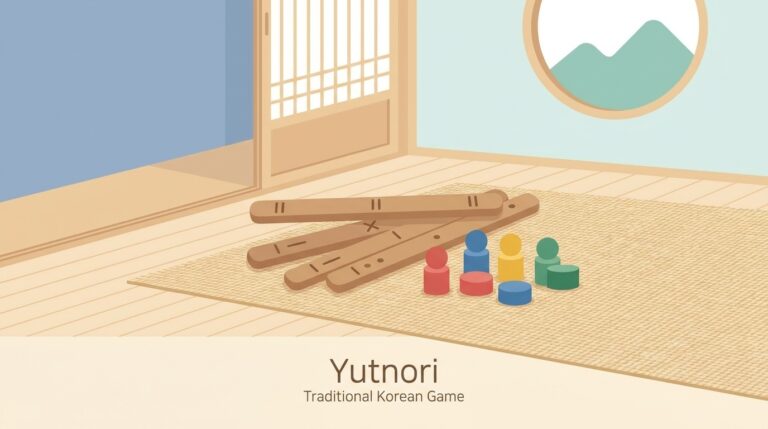
Phase 1: Empathy (Storytelling Opening)
안녕하세요! Every Korean friend’s favorite editor from Daily Hangul here!
Imagine this: You are invited to a Korean friend’s house during Seollal (Lunar New Year) or attending a Korean cultural center event. Everyone gathers on a cozy floor mat, tossing four wooden sticks into the air, yelling excited commands like “Do!”, “Gae!”, or “Mo!”. Suddenly, someone throws a stick, shouts “잡았다! (Jabatda!)”, and the room erupts in laughter and friendly chaos. You want to join the fun, but you are not quite sure when it is your turn, what those curved wooden sticks mean, or how to cheer along in Korean!
Don’t worry! Playing Yutnori (윷놀이) is one of the most heartwarming ways to connect with Koreans. You don’t need complicated grammar to play; you just need a few high-energy phrases and a basic understanding of the board. Based on real feedback from A2 learners who survived their first Seollal family gatherings, this guide will turn you from a silent observer into the life of the Yutnori party!
Phase 2: Core Expressions (3 Essential Expressions)
1. 한 번 더! (Han beon deo!)
- Pronunciation: [Han beon deo] (Sounds like: “Hahn bun duh!”)
- Meaning: “One more time!” / “One more turn!”
- K-Culture Moment: In Yutnori, if you roll a 윷 (Yut) or a 모 (Mo), or if you catch an opponent’s piece, you get an extra turn! This is when everyone chants: “한 번 더! 한 번 더!”
- Editor’s Insight: Beyond games, you can use this at a karaoke room (노래방) when demanding an encore, or at a restaurant when asking for another glass of water!
- Situation Spectrum:
- Casual (Friends/Game): ✅
한 번 더! - Semi-formal (Polite): ⚠️
한 번 더 해주세요. - Formal (Official): 🚫
한 번 더 진행하겠습니다.
- Casual (Friends/Game): ✅
- 🤔 Think About It: In English, we say “Go again!” or “One more turn!” How does chanting a simple rhythmic phrase like “Han beon deo!” build collective excitement in group activities?
2. 잡았다! (Jabatda!)
- Pronunciation: [Ja-bat-da] (Sounds like: “Jah-baht-dah!”)
- Meaning: “Caught you!” / “I got it!”
- K-Culture Moment: When your piece lands on the exact same square as your opponent’s piece, you sent their piece all the way back to the start! You yell “잡았다!” as you land on their space.
- Editor’s Insight: This comes from the verb
잡다(to catch/hold). In casual conversation, it expresses satisfaction when catching a mistake, catching a fish, or landing a hit in a game. - Situation Spectrum:
- Casual (Friends/Family): ✅
잡았다! - Semi-formal: ⚠️
잡았어요! - Formal: 🚫
잡았습니다.
- Casual (Friends/Family): ✅
- 🤔 Think About It: Why is it acceptable to drop formal honorifics during traditional games, even when playing with older family members?
3. 모 나왔다! (Mo nawatda!)
- Pronunciation: [Mo na-wat-da] (Sounds like: “Moh nah-waht-dah!”)
- Meaning: “A Mo came out!” / “We rolled a Mo!”
- K-Culture Moment: A 모 (Mo) happens when all four Yut sticks land flat-side up. It allows your piece to move 5 steps forward PLUS grants you an extra turn! Rolling a Mo usually turns the game around.
- Editor’s Insight:
나왔다comes from나오다(to come out). You will hear this phrase whenever rolling dice, drawing cards, or picking lottery numbers in Korea! - Situation Spectrum:
- Casual: ✅
모 나왔다! - Semi-formal: ⚠️
모 나왔어요! - Formal: 🚫
모가 나왔습니다.
- Casual: ✅
- 🤔 Think About It: Notice how Korean game exclamations focus on the result appearing (
나왔다) rather than the person doing the rolling (I rolled a Mo).
Phase 3: Textbook Korean vs. Real Korean
Situation 1: Throwing the Yut Sticks
- 📖 Textbook Korean: 윷을 던지세요. (Yut-eul deonjiseyo. – Please throw the Yut sticks.)
- 🗣️ Real Korean: 윷 던져요! / 윷 봐라! (Yut deonjeoyo! / Yut bwara! – Throw the Yut! / Check out this Yut throw!)
- 💡 Why the difference? Nobody speaks formally when tossing sticks mid-game! “윷 봐라!” is a playful, energetic shout used right as you throw the sticks onto the mat.
Situation 2: Catching an Opponent
- 📖 Textbook Korean: 상대방의 말을 잡았습니다. (Sangdaebang-ui mal-eul jabasseumnida. – I caught the opponent’s token.)
- 🗣️ Real Korean: 잡았다! / 걸렸다! (Jabatda! / Geollyeotda! – Caught you! / Got caught!)
- 💡 Why the difference? Board games are high-adrenaline moments. Koreans drop verb endings short for maximum dramatic effect.
Phase 4: K-Culture Deep Dive & Non-Verbal Etiquette
4-1. Nunchi (눈치) & Game Manners
- Mat Etiquette: Always throw the four Yut sticks so they land inside the blanket or mat (멍석/매트). If even one stick falls off the mat, it is called a 낙 (Nak – Foul), and your turn immediately ends with 0 moves!
- Floor Seating: Yutnori is played sitting on the floor. Maintain a friendly stance—sitting cross-legged (양반다리) is standard. Avoid pointing your feet directly at elders.
4-2. Culture Code: Holiday Bonding on Variety Shows
If you watch popular Korean variety shows like Running Man or 2 Days 1 Night, you’ve likely seen cast members play Giant Yutnori with huge foam sticks. Yutnori embodies the Korean concept of Jeong (정) and collective fun—it’s a game where comeback victories are frequent, and teamwork (combining pieces together) creates hilarious drama!
Phase 5: Interactive Roleplay Scenario
Setting: Lunar New Year’s Day at your Korean friend Minju’s (민주) house. You are sitting on a cozy floor mat around a Yut board (윷판).
- Turn 1 (Minju): 자, 이제 네 차례야! 윷 던져 봐!
(Ja, ije ne charye-ya! Yut deonjeo bwa!)
🎭 [Action] Minju hands you the four wooden Yut sticks with a bright smile.
(Translation: Okay, it’s your turn now! Try throwing the Yut!) -
Turn 2 (You): 알겠어! 윷 봐라!
(Algesseo! Yut bwara!)
🎭 [Action] You shake the sticks and toss them gently onto the blanket.
(Translation: Got it! Watch this Yut throw!) -
Turn 3 (Minju): 와! 모 나왔다! 5칸 가고 한 번 더!
(Wa! Mo nawatda! O-kan gago han beon deo!)
🎭 [Action] Minju claps her hands in excitement as all 4 sticks land flat-side up.
(Translation: Wow! A Mo came out! Move 5 spaces and go one more time!) -
Turn 4 (You): 대박! 한 번 더 던질게!
(Daebak! Han beon deo deonjilge!)
🎭 [Action] You pump your fist in the air triumphantly.
(Translation: Awesome! I will throw one more time!) -
Turn 5 (Minju): 이번엔 걸 나왔네. 3칸 앞으로 가면 내 말을 잡을 수 있어!
(Ibeonen Geol nawatne. Se-kan apeuro gamyeon nae mal-eul jabeul su isseo!)
🎭 [Action] Minju points at her token sitting 3 spaces ahead of yours.
(Translation: This time you got a Geol. If you go 3 steps forward, you can catch my piece!) -
Turn 6 (You): 진짜? 잡았다!
(Jinjja? Jabatda!)
🎭 [Action] You move your token 3 steps and playfully pick up Minju’s token.
(Translation: Really? Caught you!) -
Turn 7 (Minju): 아, 아깝다! 내 말이 처음으로 돌아가네~ 너 진짜 잘한다!
(A, akkapda! Nae mal-i cheo-eum-euro doragane~ Neo jinjja jalhanda!)
🎭 [Action] Minju sighs dramatically while laughing.
(Translation: Ah, so close! My piece goes back to the start~ You are really good at this!) -
Turn 8 (You): 고마워! 이대로 계속 해서 이길게!
(Gomawo! Idaero gyesok haeseo igilge!)
🎭 [Action] You smile confidently and prepare your next strategy.
(Translation: Thanks! I’ll keep going like this and win!)
🔀 Interactive Choice Point
Minju’s piece is right in front of yours. You rolled a 개 (Gae – 2 moves), but if you take a shortcut diagonal route, you might risk getting caught later. What do you do?
- Choice A: Shaking the sticks, you shout “한 번 더!” enthusiastically to build momentum.
- Choice B: Silently move your piece without saying anything to stay serious.
- Choice C: Throw the sticks so hard that two of them land outside the mat.
[Feedback Matrix]
- Choice A (BEST): Perfect! Yutnori is all about high energy and emotional shared fun. Chanting "한 번 더!" keeps the festive spirit alive!
- Choice B (BAD): A bit too quiet! Traditional Korean board games are meant to be noisy, cheerful social events.
- Choice C (RISK): Uh-oh! Sticks landing off the mat counts as a "낙 (Nak - Foul)". Your turn immediately ends without moving!
Phase 6: 10-Second Emotion Shadowing Drill
Practice these lines out loud with the indicated feeling and pause points (/):
[😊 Super Excited]
모 나왔다! / 한 번 더 / 던질게!
(Mo na-wat-da! / Han beon deo / deon-jil-ge!)-
[😈 Playful & Triumphant]
나한테 걸렸다! / 잡았다!
(Na-han-te geol-lyeot-da! / Ja-bat-da!) -
[🥺 Cute & Disappointed]
아, 아깝다… / 낙 나왔어…
(A, a-kkap-da… / Nak na-wat-seo…)
Phase 7: K-Culture Mini Dictionary
- 윷판 (Yutpan): The game board, traditionally drawn on paper or cloth, featuring 29 stations including short-cut diagonals.
- 말 (Mal): Literally means “horse”, but refers to the tokens or game pieces moved around the board.
- 빽도 (Bbaek-do / Back-Do): A special Yut stick marking that forces your token to move 1 step backward. It can be a curse or a tactical strategic masterpiece!
- 엎기 (Eopgi): Stacking your own pieces together when they land on the same spot. They move together as a unit, but if caught, ALL stacked pieces return to start!
Phase 8: Traveler’s Survival Kit
Top 3 Survival Phrases for Cultural Events
- 이거 어떻게 해요? (Igeo eotteokke haeyo?) – How do I do/play this?
- 같이 해요! (Gatti haeyo!) – Let’s play together!
- 차례가 누구예요? (Charyega nugu-yeyo?) – Whose turn is it?
Editor’s Travel Note
Want to experience traditional games in real life? Visit Namsangol Hanok Village or the National Folk Museum of Korea in Seoul during major holidays like Seollal or Chuseok. You can download the Naver Map App to search for “남산골한옥마을” and find free public traditional game zones where friendly volunteers will help you toss Yut sticks!
Phase 9: One Step Deeper (Reflection)
In many Western board games, players compete strictly individually with hidden hands or secretive strategies. Yutnori, however, is deeply rooted in 공동체 문화 (Community Culture). Teams usually play together, strategizing openly out loud. Even when an opponent catches your piece, everyone laughs together. This shared joy reflects how Korean traditions prioritize group harmony and festive togetherness over pure solo competition.
💬 Your Turn: Have you ever played a traditional board game from another culture that brought everyone together on the floor? Tell us in the comments below!
Phase 10: FAQ & Common Mistakes
Q: What are the 5 Yut rolls and their step counts?
A: They are 도 (Do – 1 step), 개 (Gae – 2 steps), 걸 (Geol – 3 steps), 윷 (Yut – 4 steps + extra turn), and 모 (Mo – 5 steps + extra turn).
Q: What happens if my piece lands on my own team’s piece?
A: You stack them together (엎기)! From the next turn, both pieces move together as one, doubling your efficiency.
Q: Is Yutnori only played during Lunar New Year?
A: While it is most famous during Seollal (Lunar New Year), Koreans play it year-round at school retreats, team-building trips (MT), and family gatherings!
🚨 Common Mistakes
- ❌ Throwing sticks too far: Throwing sticks off the blanket results in a foul (낙).
- ❌ Moving backward by mistake: Moving backward only happens if you explicitly roll a 빽도 (Back-Do) stick!
- ❌ Correct Action: Keep your throws gentle and inside the boundary, and celebrate out loud whenever someone rolls a Yut or Mo!
Phase 11: Action Mission
- 🥉 Bronze Mission: Practice saying the 5 moves (도, 개, 걸, 윷, 모) out loud three times.
- 🥈 Silver Mission: Watch a short YouTube clip of a Korean variety show playing Yutnori and identify when someone yells “잡았다!”.
- 🥇 Gold Mission: Visit a local Korean cultural center or gather friends during Seollal to play a live game of Yutnori using Korean game shouts!
🎮 K-Culture Mission: Look out for Yutnori references in K-Dramas during holiday special episodes!
Phase 12: Interactive Quiz Challenge
Test your knowledge before your first real game!
1. Which roll gives you 5 forward steps AND an extra turn?
– A) 도 (Do)
– B) 걸 (Geol)
– C) 모 (Mo)
2. What happens when your stick lands outside the blanket mat?
– A) You win instantly
– B) It is a foul (낙) and your turn ends
– C) You get 10 steps
3. True or False: Stacking your pieces together (엎기) means they travel together, but can also be caught together.
👉 Click to reveal Quiz Answers & Explanations!
- Answer: C) 모 (Mo) — Rolling a Mo (all 4 flat sides up) gives 5 moves and an extra throw!
- Answer: B) It is a foul (낙) — Always aim to keep your sticks on the mat!
- Answer: True — Stacking pieces is high reward, but high risk if your opponent catches you!







