

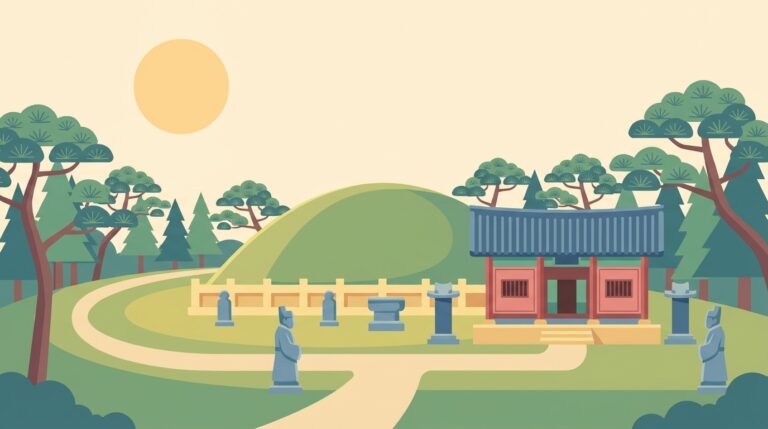
Walk Like a King: How to Visit Royal Tombs in Korea with Confidence
Phase 1: 공감 (스토리 몰입형 오프닝)
안녕하세요! 매일한글 에디터입니다. Imagine standing in the heart of bustling Seoul—surrounded by modern skyscrapers—and suddenly stepping into a serene forest where 600-year-old pine trees whisper legends of ancient kings. You are at a Joseon Royal Tomb (왕릉)! Many travelers buy a ticket, walk around, but feel anxious about breaking silent etiquette rules or missing out on the rich stories behind the sacred grass mounds. You might wonder: “Can I walk here? Can I take photos? Why is everyone talking so quietly?”
Don’t worry! Based on real learner feedback and my 10 years of experience guiding foreign friends through Seoul, this guide will turn your nervousness into cultural confidence. By the end of this lesson, you will know exactly what to say at the ticket booth, how to respect local customs without feeling awkward, and how to enjoy these beautiful UNESCO World Heritage sites like a true local!
Phase 2: 핵심 표현 3선 심층 분석
1. 입장료 얼마예요? (Ip-jang-ryo eol-ma-yeo-yo?)
- Pronunciation: [Eep-jang-ryo eol-mah-yeo-yo?] (Sounds like ‘Eep-jang’ + ‘ryo’ like ‘Rio’ + ‘eol-ma’ like ‘all-ma’ + ‘yeo-yo’)
- Meaning: Direct translation: “How much is the entrance fee?” / Real Niuance: A polite and direct way to ask ticket prices.
- K-Culture Moment: Seen at ticket offices of historic places like Gyeongbokgung Palace or Seonjeongneung Tombs.
- Editor’s Insight: ‘입장료’ means entrance fee. If you are under 24 or over 65, you might even get in for free, so asking this opens doors to discounts!
- Situation Spectrum: Casual ⚠️ | Semi-formal ✅ | Formal ✅
- 🤔 Think About It: How do ticket counters in your country handle age discounts compared to Korean historical sites?
2. 여기서 사진 찍어도 돼요? (Yeo-gi-seo sa-jin jjig-eo-do dwae-yo?)
- Pronunciation: [Yeo-gee-seo sah-jin jeeg-eo-doh dwae-yo?]
- Meaning: Direct translation: “Is it okay to take photos here?” / Real Niuance: Asking for permission politely before snapping pictures near sacred altars.
- K-Culture Moment: Asking the heritage guard near the Jeongjagak (Tomb Shrine) before setting up a tripod.
- Editor’s Insight: Photography is usually allowed in tomb parks, but flash or commercial equipment near sacred shrines might be restricted. Asking first shows great ‘Nunchi’ (cultural manners)!
- Situation Spectrum: Casual ⚠️ | Semi-formal ✅ | Formal ✅
- 🤔 Think About It: Why is it important to seek permission when photographing historic and sacred burial grounds?
3. 조용히 해야 돼요? (Jo-yong-hi hae-ya dwae-yo?)
- Pronunciation: [Joh-yong-hee hae-yah dwae-yo?]
- Meaning: Direct translation: “Do I need to be quiet?” / Real Niuance: Checking the sound atmosphere of a peaceful historical site.
- K-Culture Moment: Walking along the forested paths where locals quietly reflect and take peaceful walks.
- Editor’s Insight: Royal Tombs are sacred memorial sites, not amusement parks. Using a calm voice is appreciated by both guardians and visitors.
- Situation Spectrum: Casual ⚠️ | Semi-formal ✅ | Formal ✅
- 🤔 Think About It: How does your culture balance historic tomb sites as public parks versus sacred monuments?
Phase 3: 교과서 한국어 vs 진짜 한국어
Situation 1: Asking if tickets are needed
* 📖 교과서 한국어: “표를 구매해야 합니까?” (Pyo-reul gu-mae-hae-ya hap-ni-ka?)
* 🗣️ 진짜 한국어: “표 사야 돼요?” (Pyo sa-ya dwae-yo?)
* 💡 왜 다를까?: Native speakers rarely use formal textbook vocabulary like ‘구매하다’ (purchase) in everyday conversation; they prefer the natural verb ‘사다’ (buy).
Situation 2: Checking opening/closing time
* 📖 교과서 한국어: “몇 시에 관람이 종료됩니까?” (Myeot si-e gwan-ram-i jong-ryo-doep-ni-ka?)
* 🗣️ 진짜 한국어: “몇 시에 문 닫아요?” (Myeot si-e mun dad-a-yo?)
* 💡 왜 다를까?: Expressing closing time as “closing the door” (문 닫아요) is much more natural and spoken than the formal “exhibition ends” (관람 종료).
Phase 4: K-Culture 딥다이브 & 비언어적 매너
4-1. 눈치(Nunchi) & 제스처
When walking on the sacred stone pathways called Sindo (신도 – Spirit Road) and Eodo (어도 – King’s Road), look at the ground! The slightly raised pathway is traditionally for the spirits of the kings (Sindo). Visitors and kings walked on the lower pathway (Eodo). Stepping on the designated visitor paths shows instant cultural ‘Nunchi’. Also, hand over cash or credit cards at ticket booths using both hands as a sign of respect.
4-2. 문화 코드 분석 (Joseon Royal Tombs & UNESCO)
All 40 Joseon Royal Tombs located in South Korea are designated as UNESCO World Heritage sites. Unlike Western tombs built with heavy stone mausoleums, Korean royal tombs harmoniously blend natural hill terrain with Feng Shui (풍수지리) principles. Understanding that these mounds are active cultural heritage sites helps you appreciate why locals treat the grounds with peaceful respect.
Phase 5: 실전 롤플레이 시나리오
Setting: Ticket booth at Gangnam’s Seonjeongneung (선정릉) Tomb park.
Characters: You (Learner) & Ticket Agent (NPC Staff)
- Staff: 안녕하세요! 몇 분이세요? (Hello! How many people?) 🎭 [Smiles at ticket window]
- You: 안녕하세요! 어른 두 명이요. (Hello! Two adults, please.) 🎭 [Holds up two fingers politely]
- Staff: 네, 2,000원입니다. (Okay, that will be 2,000 won.) 🎭 [Taps payment terminal]
- You: 여기 카드 있어요. 입장료가 정말 싸네요! (Here is my card. The entrance fee is really cheap!) 🎭 [Hands card with two hands]
- Staff: 감사해요. 안쪽은 조용한 공원이에요. (Thank you. Inside is a quiet park area.) 🎭 [Hands back ticket and card]
- You: 여기서 사진 찍어도 돼요? (Can I take pictures here?) 🎭 [Points to camera around neck]
- Staff: 네, 플래시 없이 찍으시면 돼요. (Yes, as long as you don’t use flash.) 🎭 [Nods gently]
- You: 감사합니다! 잘 볼게요. (Thank you! I will enjoy my visit.) 🎭 [Bows slightly]
🔀 인터랙티브 분기점 (What would you say next?)
- Choice A: “드론 날려도 돼요?” (Can I fly a drone?)
- Choice B: “산책로가 어디예요?” (Where is the walking trail?)
- Choice C: “무덤 위에 올라가도 돼요?” (Can I climb on top of the tomb mound?)
Feedback:
* Choice A (Risk): Drones are strictly forbidden around historical sites in Seoul due to safety and security laws!
* Choice B (Best!): Excellent choice! Staff will happily point you to the scenic tree-lined walking paths.
* Choice C (Bad): Never climb or step onto the tomb mounds! They are sacred, protected areas.
Phase 6: 10초 감정 섀도잉 드릴
[😊 Friendly & Polite]안녕하세요! / 어른 두 명이요.
(An-nyeong-ha-se-yo! / Eeo-reun doo myeong-i-yo.)[🤔 Curious & Gentle]여기서 / 사진 찍어도 돼요?
(Yeo-gi-seo / sa-jin jjig-eo-do dwae-yo?)[🙏 Grateful & Bright]감사합니다! / 잘 볼게요.
(Gam-sa-ham-ni-da! / Jal bol-gae-yo.)
Phase 7: K-Culture 미니 사전
- 왕릉 (Wang-reung) | Royal Tomb | Refers specifically to burial mounds of Joseon kings and queens.
- 정자각 (Jeong-ja-gak) | T-shaped Shrine | The wooden shrine building located in front of royal tomb mounds where memorial rituals are held.
- 홍살문 (Hong-sal-mun) | Red Spike Gate | The red wooden gate marking the entrance to sacred tomb spaces.
- 신도 (Sin-do) | Spirit Pathway | The raised stone walkways reserved for ancestral spirits.
Phase 8: 여행자를 위한 생존 키트
TOP 3 Survival Phrases
- 화장실 어디예요? (Hwa-jang-sil eol-di-yeo-yo?) – Where is the restroom?
- 몇 시에 문 닫아요? (Myeot si-e mun dad-a-yo?) – What time do you close?
- 여기 쉬는 곳 있어요? (Yeo-gi swi-neun got is-seo-yo?) – Is there a resting area here?
💡 Editor’s Travel Note
Before heading to tomb sites like Seonjeongneung or Yeongneung, download the Naver Map App Download to check opening hours and walk paths. Most royal tombs charge only 1,000 to 2,000 KRW for entry and are closed on Mondays!
Phase 9: “한 발 더 깊이” (생각 질문)
Korean royal tombs are unique because they are not hidden away in distant mountains; they remain active green sanctuaries inside modern metropolitan cities. This reflects the Korean mindset of keeping history and ancestors close to daily life. When walking around royal tombs, Koreans blend historical reverence with peaceful daily relaxation.
💬 Your Turn: Do historical sites in your country double as quiet neighborhood green spaces? Share your thoughts in the comments below!
Phase 10: FAQ & 오해 방지
Q: Are foreign tourists allowed to enter the tomb grounds freely?
A: Yes! All Joseon Royal Tombs open to the public welcome international visitors. Ticket prices are equal for everyone.
Q: Can I bring food or picnic mats inside royal tombs?
A: Small water bottles are okay, but full picnics, alcohol, and large food setups are prohibited to keep the sacred environment clean.
Q: Is it okay to wear Hanbok when visiting royal tombs?
A: Absolutely! Wearing Hanbok is welcomed, and at many historic sites in Seoul, wearing Hanbok grants you free admission!
🚨 Common Mistakes TOP 3
- Mistake: Walking directly on the elevated left path (Sindo).
- Correct Action: Walk on the right/lower path (Eodo) intended for living visitors.
- Mistake: Shouting or playing loud music.
- Correct Action: Use headphones and speak in gentle voices.
- Mistake: Touching stone statues around the shrine.
- Correct Action: View the historic stone statues from outside the fenced boundary.
Phase 11: 액션 미션 & 참여 유도
- 🥉 Bronze Mission: Practice saying “입장료 얼마예요?” 3 times out loud today.
- 🥈 Silver Mission: Save this post and tag a friend you want to visit Seoul’s royal tombs with!
- 🥇 Gold Mission: On your next trip to Korea, buy a tomb ticket speaking 100% Korean at the window!
🎮 K-Culture Mission: Look out for Joseon Royal Tombs featured in historical K-Dramas like The King’s Affection or Kingdom and spot the Red Spike Gate (Hongsalmun)!
Phase 12: 인터랙티브 퀴즈 챌린지
**Q1. What is the polite Korean expression to ask







