

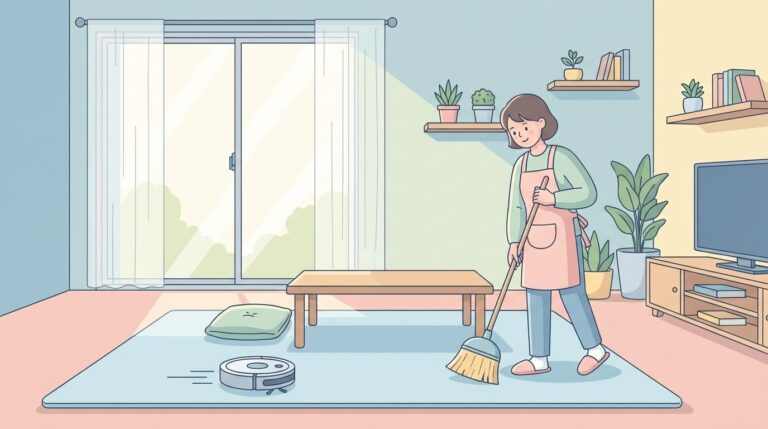
Phase 1: Empathy
안녕하세요! I’m your lead editor at Daily Hangul (매일한글).
Have you ever watched a K-drama scene where a character opens their door, gasps at a messy room, and immediately grabs a broom while shouting about cleaning up? Or maybe you’re living in Korea—or planning to host Korean friends—and suddenly realize you don’t know how to say simple everyday things like “I’m cleaning my room” or “Please throw away the trash” in Korean!
Housework (집안일) is one of the most practical topics you can learn as a beginner. When learning a new language, starting with your immediate environment gives you instant confidence. Today, based on real feedback from hundreds of A1 learners, we’ve designed a super easy, friendly guide to mastering basic Korean cleaning expressions. By the end of this lesson, you’ll be able to describe your simple daily cleaning routine in Korean without second-guessing yourself!
Phase 2: Top 3 Core Expressions
1. 방 청소해요 (Bang cheong-so-hae-yo)
- Pronunciation: [Bang cheong-so-hae-yo] (Sounds like: “Bahng chohng-so-hae-yo”)
- Meaning: “I am cleaning my room.” (Direct: Room cleaning-do)
- K-Culture Moment: Seen in almost every slice-of-life K-drama when a mom walks into a main character’s messy bedroom!
- Editor’s Insight: The word ‘방’ (bang) means room, and ‘청소해요’ (cheongsohaeyo) comes from ‘청소하다’ (to clean). It’s warm, soft, and polite for daily conversation.
- Situation Spectrum: Casual: ⚠️ (Use 방 청소해) / Semi-formal: ✅ (방 청소해요) / Formal: ✅ (방 청소합니다)
- 🤔 Think About It: In your native language, do you separate the words for cleaning a house vs. cleaning a specific room?
2. 쓰레기 버려요 (Sseu-re-gi beo-ryeo-yo)
- Pronunciation: [Sseu-re-gi beo-ryeo-yo] (Sounds like: “Ssoo-reh-gee buh-ryuh-yo”)
- Meaning: “I throw away the trash.” / “I’m taking out the trash.”
- K-Culture Moment: When roommates in K-dramas divide household chores using rock-paper-scissors!
- Editor’s Insight: ‘쓰레기’ (sseuregi) is trash, and ‘버려요’ (beoryeoyo) means to discard. It is essential when living in Korea because trash management is a big daily routine!
- Situation Spectrum: Casual: ⚠️ (쓰레기 버려) / Semi-formal: ✅ (쓰레기 버려요) / Formal: ✅ (쓰레기 버립니다)
- 🤔 Think About It: How important is waste sorting in your home country compared to Korea?
3. 먼지 털어요 (Meon-ji teo-reo-yo)
- Pronunciation: [Meon-ji teo-reo-yo] (Sounds like: “Muhn-jee tuh-ruh-yo”)
- Meaning: “I dust off / I wipe away dust.”
- K-Culture Moment: Spring cleaning scenes in variety shows where members clean blankets outdoors!
- Editor’s Insight: ‘먼지’ (meonji) means dust, and ‘털어요’ (teoreoyo) means to shake off or dust off. You’ll hear this a lot during seasonal cleaning.
- Situation Spectrum: Casual: ⚠️ (먼지 털어) / Semi-formal: ✅ (먼지 털어요) / Formal: ✅ (먼지 털갑습니다)
- 🤔 Think About It: Notice how Korean verbs often describe the specific physical action (shaking off dust) rather than just a general word!
Phase 3: Textbook Korean vs. Real Korean
Situation 1: Saying you will clean your room
- 📖 Textbook Korean: 방을 청소하겠습니다. (Bang-eul cheong-so-ha-get-seum-ni-da.)
- 🗣️ Real Korean: 방 좀 치울게요. (Bang jom chi-ul-ge-yo.)
- 💡 Why is it different? While the textbook phrase is very formal, real native speakers prefer ‘치우다’ (chi-u-da, to tidy up) with ‘좀’ (jom, a polite softener) in casual daily settings.
Situation 2: Asking someone to take out trash
- 📖 Textbook Korean: 쓰레기를 버리십시오. (Sseu-re-gi-reul beo-ri-sip-si-o.)
- 🗣️ Real Korean: 쓰레기 좀 버려 주세요. (Sseu-re-gi jom beo-ryeo ju-se-yo.)
- 💡 Why is it different? The textbook form sounds like an official command sign. Adding ‘주세요’ (please do for me) makes it friendly and polite.
Phase 4: K-Culture Deep Dive & Etiquette
4-1. Nunchi & Gestures
In Korea, taking off your shoes before entering a home is non-negotiable! When cleaning, Koreans usually wear light indoor slippers. When asking someone for help with chores, lowering your voice slightly and using a gentle hand gesture toward the object shows extra consideration (Nunchi).
4-2. Culture Code: Waste Sorting (분리수거)
Korea has a strict designated trash bag system called Jongryangje (종량제). Food waste, recyclables, and general waste must be separated carefully. When a Korean housemate says “쓰레기 버려요,” they often mean putting recyclables into their respective bins!
Phase 5: Real Roleplay Scenario
Setting: Minjun (Korean roommate) and Sarah (A1 Learner) are tidying up their shared living room on a Saturday morning.
- Turn 1 (Minjun): 오늘 같이 집안일 해요! (O-neul ga-chi ji-ban-il hae-yo!)
🎭 [Smiles and holds a broom]- Translation: Let’s do housework together today!
- Turn 2 (Sarah): 네, 좋아요! 뭐 할까요? (Ne, jo-a-yo! Mwo hal-kka-yo?)
🎭 [Nods eagerly]- Translation: Yes, sounds good! What shall we do?
- Turn 3 (Minjun): Sarah씨는 방 청소해요. (Sarah-ssi-neun bang cheong-so-hae-yo.)
🎭 [Points gently to Sarah's room]- Translation: Sarah, please clean your room.
- Turn 4 (Sarah): 네, 저는 방 청소해요! (Ne, jeo-neun bang cheong-so-hae-yo!)
🎭 [Thumbs up]- Translation: Yes, I’ll clean my room!
- Turn 5 (Minjun): 저는 먼지 털게요. (Jeo-neun meon-ji teol-ge-yo.)
🎭 [Holds a feather duster]- Translation: I will dust off.
- Turn 6 (Sarah): 쓰레기도 버릴까요? (Sseu-re-gi-do beo-ril-kka-yo?)
🎭 [Points to trash can]- Translation: Shall I throw away the trash too?
- Turn 7 (Minjun): 네, 쓰레기 버려 주세요! (Ne, sseu-re-gi beo-ryeo ju-se-yo!)
🎭 [Gives a thankful smile]- Translation: Yes, please throw away the trash!
- Turn 8 (Sarah): 알겠어요. 지금 해요! (Al-get-seo-yo. Ji-geum hae-yo!)
🎭 [Picks up trash bag cheerfully]- Translation: Got it. Doing it now!
🔀 Interactive Choice Point
Minjun asks: “쓰레기 버려 주세요!” How do you respond?
* Option A: 네, 지금 버려요! (Ne, ji-geum beo-ryeo-yo!) -> [Best Choice] Polite, natural, and clear!
* Option B: 싫어요. (Si-reo-yo.) -> [Bad Choice] Means “I don’t want to.” Too blunt and rude!
* Option C: 청소 안 해요. (Cheong-so an hae-yo.) -> [Risk Choice] Means “I don’t clean.” Might ruin roommate harmony!
Phase 6: 10-Second Emotion Shadowing Drill
Practice saying these out loud with rhythm and natural emotion:
[😊 Cheerful]방 / 청소해요! (Bang / cheong-so-hae-yo!)[🙋 Asking politely]쓰레기 / 버려 주세요? (Sseu-re-gi / beo-ryeo ju-se-yo?)[🧹 Enthusiastic]먼지 / 털어요! (Meon-ji / teo-reo-yo!)
Phase 7: K-Culture Mini Dictionary
- 청소 (Cheong-so) | Cleaning | Used whenever referring to tidying up spaces (e.g., 방 청소, 집 청소).
- 분리수거 (Bul-li-su-geo) | Recycling separation | Essential daily practice in Korean residential buildings.
- 종량제 봉투 (Jong-ryang-je bong-tu) | Official pay-per-trash bag | Government-mandated bags required for general waste disposal in Korea.
- 걸레 (Geol-le) | Cleaning rag / Mop cloth | Used for wiping floors or tables.
Phase 8: Traveler’s Survival Kit
TOP 3 Survival Phrases
- 방 청소해 주세요. (Bang cheong-so-hae ju-se-yo.) – Please clean my room (e.g., at a hotel).
- 쓰레기통 어디예요? (Sseu-re-gi-tong eo-di-ye-yo?) – Where is the trash can?
- 이거 버려 주세요. (I-geo beo-ryeo ju-se-yo.) – Please throw this away for me.
Editor’s Travel Note
When navigating Korean cities or managing your stays, installing local apps makes life easy. Make sure to check out our step-by-step guide on how to download Naver Maps app to locate public recycling spots and convenience stores nearby for trash bags!
Phase 9: One Step Deeper
In Korean culture, keeping communal spaces clean is closely linked to Jeong (정) and mutual respect for housemates or family members. Taking the initiative to clean up is seen as a warm sign of caring for others living under the same roof.
💬 Your Turn: What is your favorite housework chore? Do you prefer cleaning your room or dusting? Let us know in the comments below!
Phase 10: FAQ & Common Mistakes
Q: Can I use ‘청소해요’ for washing dishes?
A: No! Washing dishes is specifically called ‘설거지해요’ (seol-geo-ji-hae-yo).
Q: What is the difference between ‘치워요’ and ‘청소해요’?
A: ‘청소해요’ is general cleaning (sweeping, wiping). ‘치워요’ specifically means putting things back in place or clearing away clutter.
Q: Do I need special trash bags in Korea?
A: Yes! You must buy official ‘종량제 봉투’ at convenience stores or local supermarkets.
🚨 Common Mistakes TOP 3
- Mistake: Saying “trash clean” (쓰레기 청소해요).
- Correct Action: Say “쓰레기 버려요” (throw away trash).
- Mistake: Forgetting to add ‘주세요’ when asking for help.
- Correct Action: Say “청소해 주세요” to be polite.
- Mistake: Mixing up room cleaning with laundry.
- Correct Action: Laundry is ‘빨래해요’ (ppal-lae-hae-yo), not 청소해요!
Phase 11: Action Mission
- 🥉 Bronze: Say “방 청소해요” aloud 3 times in front of your mirror today!
- 🥈 Silver: Take a picture of your tidied desk and write “방 청소해요!” as your caption on social media.
- 🥇 Gold: Use one of today’s phrases with a Korean friend or tutor this week!
🎮 K-Culture Mission: Watch a clip of your favorite Korean drama and see if you can spot someone taking out the trash or dusting off furniture!
Phase 12: Interactive Quiz Challenge
Q1. What is the correct way to say “I clean my room”?
* A) 방 버려요
* B) 방 청소해요
* C) 먼지 버려요
Click to view Answer & Explanation
Answer: B) 방 청소해요! ‘방’ means room and ‘청소해요’ means to clean.
Q2. True or False: You can throw any trash bag into public trash bins in Korea.
Click to view Answer & Explanation
Answer: False! Korea uses specific regional waste bags called 종량제 봉투.







