

Phase 1: Empathy (Storyteller Opening)
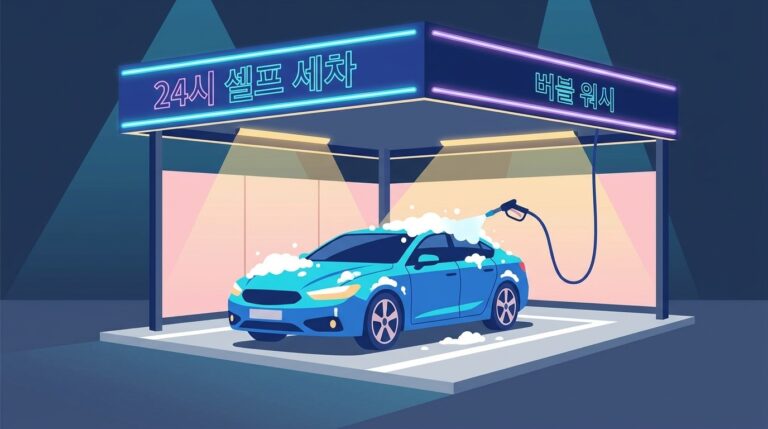
안녕하세요! 매일한글 에디터입니다. Have you ever rented a car for an amazing road trip through Jeju Island or driven along the scenic coastal routes of Gangwon-do, only to realize your car is covered in yellow dust (황사) or highway road grime? You pull up to a sleek Korean car wash station (세차장), but suddenly feel overwhelmed by the choice between high-tech automatic car washes (자동 세차) and busy self-service bays (셀프 세차). Should you buy a dedicated wash card? Do you brush the car yourself, or just spray high-pressure water?
Don’t worry! You’re not alone. Many intermediate learners know standard vocabulary like ‘차’ (car) or ‘깨끗하다’ (to be clean), but stumble when dealing with specific car care instructions and casual interactions at local service spots. Based on real feedback from foreign drivers living in Korea, this guide will equip you with authentic B2-level phrasing, practical etiquette, and cultural confidence so you can handle any Korean car wash like an experienced local driver.
Phase 2: Core Expressions Deep Dive
1. 자동 세차로 할게요 (jadong secharo halgeyo)
- Pronunciation: [ja-dong se-cha-ro hal-ge-yo] (Sounds like jah-dong say-chah-roh hal-geh-yo)
- Meaning: Literal: “I will do automatic car washing.” / Nuance: “I’d like to use the automatic tunnel wash, please.”
- K-Culture Moment: Frequently seen at gas stations (주유소) across K-dramas when characters pull up after long road trips to get a quick wash discount.
- Editor’s Insight: Adding the particle ‘-로’ indicates choosing a specific option from available choices. It’s polite yet natural for mid-tier formality.
- Situation Spectrum: Casual ⚠️ | Semi-formal ✅ | Formal ✅
- 🤔 Think About It: In English, you might say “I’ll take the drive-thru wash.” Why do Korean expressions focus on the mode of operation (‘자동’ – automatic) rather than the location?
2. 거품 솔로 문질러야 돼요? (geopum sollo munjilleoya dwaeyo?)
- Pronunciation: [geo-pum sol-lo mun-jil-leo-ya dwae-yo?] (Rhymes with guh-poom sol-loh moon-jill-ruh-yah dway-yo)
- Meaning: Literal: “Do I have to scrub with the foam brush?” / Nuance: “Should I scrub the vehicle manually using the soapy brush?”
- K-Culture Moment: Often heard in YouTube car maintenance vlogs when drivers debate avoiding scratches on custom paint jobs.
- Editor’s Insight: Uses the structure ‘-어야 돼요?’ (Do I have to…?). B2 learners should notice ‘문지르다’ (to scrub/rub) which irregular-conjugates to ‘문질러야’.
- Situation Spectrum: Casual ✅ | Semi-formal ✅ | Formal ⚠️
- 🤔 Think About It: Scrubbing your own car in a shared self-wash bay requires speed so you don’t hold up the line. How does ‘Nunchi’ affect car wash etiquette in Korea?
3. 물기 닦는 건 셀프예요 (mulgi ddangkneun geon selpeuyeyo)
- Pronunciation: [mul-gi dang-neun geon sel-peu-ye-yo] (Notice the nasalization: 닦는 sounds like dang-neun)
- Meaning: Literal: “Drying off the water is self-service.” / Nuance: “Wiping down the car is up to you in the drying zone.”
- K-Culture Moment: Attendants at gas station washes will hand you a microfiber towel or point towards the drying bay while saying this line.
- Editor’s Insight: ‘셀프’ (Self) is widespread Konglish meaning “self-service”. Here, modifier clause ‘물기 닦는 건’ turns the action into a topic seamlessly.
- Situation Spectrum: Casual ✅ | Semi-formal ✅ | Formal 🚫
- 🤔 Think About It: ‘셀프’ is used everywhere in Korea—from water in restaurants to towel-drying cars. What does this reveal about Korea’s efficiency-focused service culture?
Phase 3: Textbook Korean vs. Real Native Korean
Situation 1: Asking how the machine works
- 📖 Textbook Korean: 이 자동 세차 기계는 어떻게 작동합니까? (How does this automatic car wash machine operate?)
- 🗣️ Real Native Korean: 이거 버튼 누르면 바로 시작돼요? (Does it start right away when I press this button?)
- 💡 Why is it different? Native speakers prefer active, short questions centered around immediate actions rather than formal passive mechanical terms.
Situation 2: Inquiring about drying services
- 📖 Textbook Korean: 세차 후에 수건으로 차를 닦아 줍니까? (Do you wipe the car with a towel after washing?)
- 🗣️ Real Native Korean: 드라잉 존 가서 직접 닦아야 되죠? (I need to wipe it down myself at the drying zone, right?)
- 💡 Why is it different? Modern car wash stations rely heavily on English loanwords like ‘드라잉 존’ (Drying Zone) and expected self-service routines.
Phase 4: K-Culture Deep Dive & Non-Verbal Manners
4-1. Nunchi (눈치) & Car Wash Manners
When entering a self-car wash (셀프 세차장), Korean ‘Nunchi’ (situational awareness) is crucial:
1. Timer Management: Keep an eye on your countdown timer screen. Beeping signals 30 seconds remaining—have your next wash card tap or coins ready to avoid system reset.
2. Drying Zone Etiquette: Once done spraying water, move immediately to the ‘드라잉 존’ (Drying Zone) so the wash bay opens for waiting cars.
3. Vacuum & Air Gun Courtesy: Neatly coil hoses back onto their hooks after blowing water out of door jams.
4-2. The ‘Car Wash Date’ Culture (세차 데이)
Car maintenance in Korea isn’t just a chore—it’s a popular lifestyle trend! Young couples and car enthusiasts often go on “Car Wash Dates” (세차 데이) at night. High-end indoor self-service bays equipped with cafe-like lounge areas, high-pressure foam cannons, and ambient lighting are popular hangouts on Friday nights.
Phase 5: Practical Interactive Roleplay Scenario
Setting: A modern suburban self-and-auto combined car wash station in Gyeonggi-do.
Characters: Alex (You – Intermediate Driver), Min-soo (Attendant / NPC)
- Turn 1 (Min-soo): 🎭 (Welcoming with a hand signal toward the bay) “어서 오세요! 자동 세차 하실 건가요, 셀프 이용하실 건가요?”
(Welcome! Are you doing the automatic wash or using the self-service bay?) - Turn 2 (Alex): 🎭 (Pointing to the automatic tunnel) “자동 세차로 할게요. 기본 코스로 해 주세요.”
(I’ll do the automatic wash. Basic cycle, please.) - Turn 3 (Min-soo): 🎭 (Checking the gas receipt) “주유 할인 쿠폰 있으세요? 영수증 보여주시면 할인돼요.”
(Do you have a fuel discount coupon? Show me your receipt for a discount.) - Turn 4 (Alex): 🎭 (Handing over the paper receipt) “네, 여기 아까 주유한 영수증 있어요.”
(Yes, here is the receipt from refueling earlier.) - Turn 5 (Min-soo): 🎭 (Processing payment) “네, 3천 원 결제 도와드릴게요. 사이드 미러 접으시고 기어는 중립(N)으로 놓아주세요.”
(Okay, that will be 3,000 won. Fold your side mirrors and set your gear to Neutral.) - Turn 6 (Alex): 🎭 (Folding mirrors and putting gear in N) “알겠습니다. 세차 끝나고 물기 닦는 건 셀프예요?”
(Understood. Do I wipe off the water myself after the wash?) - Turn 7 (Min-soo): 🎭 (Gently tapping the windshield wiper) “네, 터널 나가셔서 오른쪽 드라잉 존 이용하시면 됩니다. 수건은 저쪽에 있어요.”
(Yes, exit the tunnel and use the drying zone on the right. Towels are over there.) - Turn 8 (Alex): 🎭 (Nodding politely) “감사합니다! 수건 사용하고 제자리에 두면 되죠?”
(Thank you! I should put the towels back after using them, right?)
🔀 Interactive Branching Choice
After exiting the washing tunnel, you notice three vehicles waiting behind you to enter the drying zone. What do you say to the attendant standing near the drying towels?
- Option A: “저기요, 시간 없는데 차 좀 대신 닦아주시면 안 돼요?” (Excuse me, I’m busy, can’t you wipe my car for me?)
- Option B: “드라잉 존 자리 나면 바로 이동해서 닦을게요!” (Once a spot opens in the drying zone, I’ll move over immediately!)
- Option C: “여기 입구에 차 세워두고 물기만 얼른 닦고 갈게요.” (I’ll just park here at the entrance and quickly wipe it down.)
Feedback:
* Option A (Bad): Rude and ignores local self-service conventions. Staff will feel put on the spot.
* Option B (Best): Demonstrates high situational awareness (눈치) and polite Korean grammar! Perfect B2 response.
* Option C (Risk): Blocking the entrance causes severe traffic backup and breaks car wash etiquette.
Phase 6: 10-Second Emotion Shadowing Drill
Practice reading these out loud with rhythm and authentic vocal tone!
[😊 Friendly & Confident]
자동 세차로 / 부탁드릴게요! / 영수증 할인 / 가능하죠?
(jadong secharo / 부탁드릴게요! / yeongsujeung hal-in / ganeung-hajyo?)-
[🤔 Curious & Mindful]
거품 솔로 / 직접 문질러야 돼요, / 아니면 / 자동으로 나와요?
(geopum sollo / jikjeob munjilleoya dwaeyo, / animyeon / jadong-euro nawayo?) -
[⚡ Quick & Polite]
드라잉 존으로 / 바로 이동할게요! / 수건은 / 어디에 반납해요?
(drying zone-euro / baro idong-halgeyo! / sugeon-eun / eodie bannap-haeyo?)
Phase 7: K-Culture Mini Dictionary
- 하부 세차 (Habu Secha) | Chassis / Underbody Wash
- Essential during Korean winters to rinse away corrosive road salt (제설제) applied on snowy streets.
- 고압수 (Go-apsu) | High-Pressure Water Spray
- High-powered water wand used in self-wash bays to blast off dirt before scrubbing.
- 버블폼 (Beobeulpom) | Thick Snow Foam Spray
- Dense soapy foam sprayed over the vehicle to break down dirt without scratching paint.
- 드라잉 존 (Drying Zone) | Dedicated Towel & Vacuum Area
- Designated parking stalls equipped with coin-operated air blowers and vacuum cleaners.
Phase 8: Traveler’s Survival Kit
Top 3 Survival Phrases
- 세차 카드 충전 어디서 해요? (Where do I recharge the car wash card?)
- Pro Tip: Most modern self-car washes use pre-paid IC cards rather than physical coins.
- 사이드 미러 접어야 돼요? (Do I need to fold the side mirrors?)
- Pro Tip: Crucial step before entering automated roller tunnels to prevent equipment damage.
- 매트 세척기 사용해도 돼요? (Can I use the floor mat washing machine?)
- Pro Tip: Great for cleaning carpet mats; avoid using them for leather or custom rubber mats.
Editor’s Travel Note
When navigating to local self-service spots, download and search via 네이버 지도 앱 다운로드 using search queries like ‘셀프세차장’ or ’24시 세차장’. Most stations accept Korean credit cards, but keeping 5,000 won cash handy for initial card issuance is recommended!
Phase 9: Deep Reflection (Thought-Provoking Essay)
In Korea, taking care of a car reflects personal diligence and respect for shared public spaces. Driving a visibly dirty vehicle is often viewed as neglectful toward passengers and neighbors. The rapid rise of clean, aesthetic indoor car washing facilities highlights how everyday maintenance tasks are transformed into social activities. Understanding these subtle cultural standards elevates your Korean proficiency from grammatical accuracy to cultural resonance.
💬 Your Turn: Have you ever visited a car wash in your home country that felt like a social hangout? How does car maintenance culture compare where you live? Leave a comment below in Korean!
Phase 10: FAQ & Common Mistakes
Q: Can I pay with an international credit card at automated car wash kiosks?
A: Yes, most automatic car wash kiosks at major gas stations (SK Energy, GS Caltex, S-Oil) accept international Visa/Mastercard credit cards, though contactless tap payment might be limited.
Q: Do I need to bring my own drying towels to a Korean self-car wash?
A: Many facilities offer complimentary microfiber towels in the drying zone, but enthusiasts usually bring their own high-grade towels to prevent micro-scratches.
Q: What should I do if the washing machine pauses mid-cycle?
A: Do not open your car doors or exit the vehicle! Stay inside and honk your horn once or press the emergency call button on the side panel.
🚨 Common Mistakes TOP 3
- Leaving the car gear in Drive (D) or Park (P) during automatic tunnel washes.
- Correct Action: Always shift to Neutral (N) so conveyor tracks can pull your vehicle safely.
- Using the foam brush (거품 솔) directly on dusty paint without spraying high-pressure water first.
- Correct Action: Always rinse dirt off with ‘고압수’ first to prevent sand particles from scratching your finish.
- Staying parked in the wash bay while wiping down water drop-by-drop.
- Correct Action: Immediately pull forward to the designated ‘드라잉 존’ so the driver behind you can begin washing.
Phase 11: Action Mission
- Bronze Level: Say “사이드 미러 접었어요” out loud 3 times with realistic pronunciation.
- Silver Level: Write a 2-sentence comment on a Korean car wash vlog on YouTube using terms like ‘고압수’ or ‘드라잉 존’.
- Gold Level: Visit a Korean car wash station in person or simulate a full interaction ordering an automatic wash with a native Korean speaker!
🎮 K-Culture Mission: Search Instagram or YouTube for #셀프세차 or #세차스타그램 and spot 3 tools mentioned in this lesson!
Phase 12: Interactive Quiz Challenge
Question 1: Situation Judgment
You are entering an automated wash tunnel. The attendant signals for you to prepare your vehicle. Which action should you NOT do?
A) Fold side mirrors
B) Keep wipers set to Auto mode
C) Shift gear to Neutral (N)
Check Answer & Explanation
Correct Answer: B
Explanation: Automatic wipers can activate mid-wash and break under heavy wash brushes! Always turn off automatic wipers, fold side mirrors, and set the transmission to Neutral (N).
Question 2: Fill in the Blank
세차 완료 후에 물기를 닦으려면 ________ 존으로 차를 이동해야 합니다.
A) 드라잉 (Drying)
B) 버블 (Bubble)
C) 주유 (Refueling)
Check Answer & Explanation
Correct Answer: A
Explanation: You must move your vehicle to the ‘드라잉 존’ (Drying Zone) after washing.
Question 3: True / False Culture Quiz
True or False: In Korea, it is considered polite to stay in the washing bay as long as you want to dry your car.
Check Answer & Explanation
Correct Answer: False
Explanation: Keeping others waiting in line breaks Nunchi etiquette. Move immediately to the drying area once spraying is complete!







