

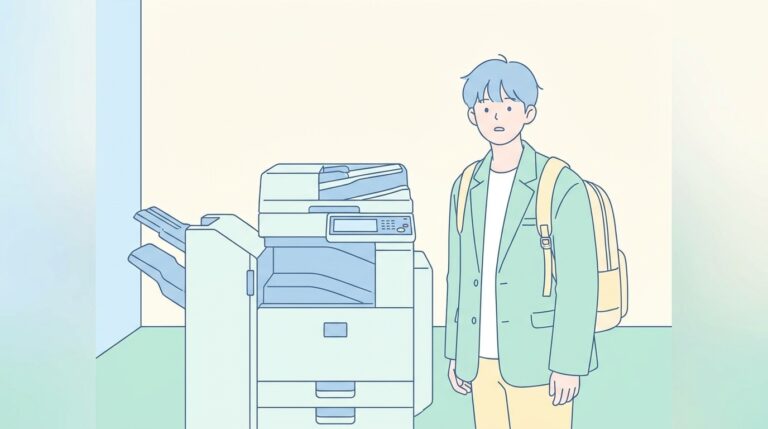
First Day at a Korean Office? Master the Copy Machine in 1 Minute
Phase 1: Empathy & Storytelling
안녕하세요! I’m your lead editor from Daily Hangul.
Imagine this: It’s your first week interning at a bustling marketing agency in Gangnam, Seoul. Your manager hands you a 10-page document and asks for five copies before the 2 PM strategy meeting. You confidently walk over to the giant, high-tech multi-function printer. But wait—the touch screen is entirely in Korean, and suddenly, a red flashing warning light turns on: “종이 걸림” (Paper Jam)!
You feel a cold sweat. Should you press random buttons? Run away? Call for help? Don’t panic! We’ve all been there. Office machinery in a foreign language can feel intimidating, but with just three simple Korean phrases, you can handle any printer crisis like a pro.
This guide is crafted based on real feedback from global expats and learners who survived their early days in Korean workplaces. By learning these simple A1-level expressions, you won’t just solve your printer problems—you’ll also impress your coworkers with smooth workplace manners!
Phase 2: Core Expressions Deep Dive
1. 이거 복사해 주세요 (Igeo boksa-hae juseyo)
- Pronunciation: E-go bok-sa-hae joo-seh-yo (Sounds like “E-go” + “Bok-sa” + “Hey” + “Juice-hey-yo”)
- Meaning: Direct: “Please copy this.” / Nuance: A polite, standard request to get documents copied.
- K-Culture Moment: Seen constantly in Korean office dramas like Misaeng when seniors hand stacks of paper to interns.
- Editor’s Insight: “이거” (Igeo) means “this”, “복사” (boksa) means “copy”, and “해 주세요” (hae juseyo) means “please do it for me”. It’s super versatile!
- Situation Spectrum: Casual ⚠️ | Semi-formal ✅ | Formal ✅
- 🤔 Think About It: In Korean culture, adding “해 주세요” turns a command into a polite request. How do you soften requests in your native language?
2. 종이가 걸렸어요 (Jong-iga geollyeosseoyo)
- Pronunciation: Jong-ee-gah geol-ryeoss-eo-yo (“Jong-ee” like paper + “Geol-ryeoss-eo-yo”)
- Meaning: Direct: “Paper is caught.” / Nuance: “The paper is jammed!”
- K-Culture Moment: The classic panic scene in Business Proposal right before a major presentation.
- Editor’s Insight: If the copy machine stops working and makes a weird beep, point to the tray and say this phrase to any nearby colleague!
- Situation Spectrum: Casual ✅ | Semi-formal ✅ | Formal ✅
- 🤔 Think About It: Notice how Korean states the passive situation (“paper caught”) directly rather than blaming anyone. Isn’t that neat?
3. 어떻게 써요? (Eotteohge sseoyo?)
- Pronunciation: Uh-tough-ge sseh-yo?
- Meaning: Direct: “How to use?” / Nuance: “How do I use this machine?”
- K-Culture Moment: Asking a friendly cubicle neighbor when facing a brand-new touch-screen printer.
- Editor’s Insight: You can point at literally any office gadget (coffee machine, scanner, laminator) and ask this exact phrase!
- Situation Spectrum: Casual ⚠️ | Semi-formal ✅ | Formal 🚫 (Use “어떻게 사용하나요?” for strictly formal settings)
- 🤔 Think About It: “써요” comes from “쓰다” (to use). Short 3-syllable phrases are your best friends in high-stress situations!
Phase 3: Textbook Korean vs. Real Native Korean
Situation 1: Asking someone to make copies
- 📖 Textbook Korean: 이것을 복사해 주시겠습니까? (Igeoseul boksa-hae jusigessseumnika?)
- 🗣️ Real Native Korean: 이거 복사 좀해 주세요! (Igeo boksa jom hae-juseyo!)
- 💡 Why is it different? Adding “좀” (jom – a little/please) makes your request sound warm, natural, and friendly, whereas textbook phrasing sounds like an automated robot.
Situation 2: The machine isn’t working
- 📖 Textbook Korean: 복사기가 고장 났습니다. (Boksagiga gojang nassseumnida.)
- 🗣️ Real Native Korean: 복사기 안 돼요. (Boksagi an dwaeyo.)
- 💡 Why is it different? Native office workers rarely use heavy words like “gojang” (broken) for simple paper jams. Saying “안 돼요” (It doesn’t work) is quick and practical!
Phase 4: K-Culture Deep Dive & Mannerisms
4-1. Nunchi (눈치) & Two-Handed Etiquette
When handing copies to your boss or senior colleague:
1. Two-Handed Delivery: Always hand paper over using both hands (or support your right wrist with your left hand).
2. Eye Contact & Nod: Make brief eye contact and give a soft head nod (목인사).
3. Nunchi Tip: If you notice a senior standing behind you waiting for the copier, offer them a quick polite bow and say “먼저 하세요” (Meonjeo haseyo – Please go ahead!).
4-2. The ‘Palli-Palli’ Culture & Office Jeong
Korea is famous for “빨리빨리” (Palli-palli / Hurry-hurry) speed. If a copier jams during peak morning hours, fixing it quickly or asking for help immediately is appreciated. Helping a struggling colleague clear a paper jam is a classic way to build 정 (Jeong – warm bonds) in a Korean company!
Phase 5: Real-Life Roleplay Scenario
Setting: Korean corporate office supply room.
Characters: You (New Intern) & Minjun (Friendly Senior Coworker / 선배님)
- Turn 1 (Minjun): 민준: 서연 씨, 오늘 회의 자료 복사해야 돼요. (Seoyeon-ssi, oneul hoei jaryo boksa-haeya dwaeyo. / Seoyeon, we need to copy today’s meeting materials.)
- Turn 2 (You): 당신: 🎭 (Nodding politely) 네, 선배님! 이거 복사해 주세요… 아, 아니, 제가 할게요! (Ne, seonbaenim! Igeo boksa-hae juseyo… ah, ani, jega halgeyo! / Yes, Sunbae! Please copy this… oh wait, I’ll do it!)
- Turn 3 (Minjun): 민준: 🎭 (Smiles) 복사기 사용법 알아요? (Boksagi sayongbeop arayo? / Do you know how to use the photocopier?)
- Turn 4 (You): 당신: 🎭 (Pointing at the screen with a puzzled look) 저… 이거 어떻게 써요? (Jeo… igeo eotteohge sseoyo? / Um… how do I use this?)
- Turn 5 (Minjun): 민준: 🎭 (Shows the start button) 여기에 종이 넣고 시작 버튼 누르면 돼요. (Yeogi-e jongi neohgo sijak beoteun nureumyeon dwaeyo. / Put paper here and press start.)
- Turn 6 (You): 당신: 🎭 (Presses button, machine beeps red) 어? 종이가 걸렸어요! (Eoh? Jong-iga geollyeosseoyo! / Oh? The paper is jammed!)
- Turn 7 (Minjun): 민준: 🎭 (Opens side door swiftly) 괜찮아요, 제가 빼줄게요. (Gwenchanayo, jega ppaejulgeyo. / It’s okay, I’ll pull it out for you.)
- Turn 8 (You): 당신: 🎭 (Bows with two hands together) 감사합니다, 선배님! (Gamsahamnida, seonbaenim! / Thank you so much, Sunbae!)
🔀 Interactive Choice Point
When the copier flashes RED, what do you do?
* Choice A: Walk away quietly and pretend nothing happened.
* Choice B: Turn to a nearby colleague and say softly: “선배님, 종이가 걸렸어요! 도와주세요!”
* Choice C: Hit the machine hard like an old TV.
- Feedback:
- Choice A (Risk 🚨): Leaving a jammed printer for your boss to find is an office nightmare!
- Choice B (Best 🎉): Asking for help politely shows honesty and great communication!
- Choice C (Bad ❌): Korean multi-function printers are expensive. Please don’t hit them!
Phase 6: 10-Second Emotion Shadowing Drill
Practice these lines out loud with feeling!
[😊 Polite & Friendly]저기요, / 이거 / 복사해 주세요! (Jeogiyo, / igeo / boksa-hae juseyo!)[😱 Panicked]어떡하지? / 종이가 / 걸렸어요! (Eotteokhaji? / Jong-iga / geollyeosseoyo!)[🥺 Asking for Help]선배님, / 이거 / 어떻게 써요? (Seonbaenim, / igeo / eotteohge sseoyo?)
Phase 7: K-Culture Mini Dictionary
- 복사기 (Boksagi) | Photocopier | The essential office print/scan hub.
- 선배님 (Seonbaenim) | Senior Colleague | Respectful title used for senior coworkers in Korea.
- 종이잼 (Jong-i-jaem) | Paper Jam | Casual office slang for stuck printer paper.
- 칼퇴 (Kal-toe) | Leaving work sharp on time | Direct translation: “Sword leave”. Leaving right at 6:00 PM!
Phase 8: Expat Survival Kit
Top 3 Survival Phrases
- 도와주세요! (Dowajuseyo!) = Please help me!
- 종이 있어요? (Jongi isseoyo?) = Is there paper?
- 감사합니다! (Gamsahamnida!) = Thank you!
Editor’s Travel & Expat Note
Finding your office or printing shops nearby? Be sure to complete the 네이버 지도 앱 다운로드 (Naver Map App Download) before navigating Korean city streets, as Google Maps often lacks walking directions in Korea!
Phase 9: One Step Deeper (Reflection)
In Korean corporate life, asking for help isn’t seen as weakness—it’s seen as a desire to learn! Korean workplaces operate heavily on team harmony. Showing modesty and using friendly honorifics builds strong trust fast.
💬 Your Turn: Have you ever faced a high-tech machine in a foreign language? How did you solve it? Share your funny store in the comments below!
Phase 10: FAQ & Common Mistakes
Q: Can I use “이거 복사해 주세요” to my direct boss?
A: Yes, but adding “팀장님” (Team Leader) or “부장님” (Department Head) at the beginning makes it even more polite! (e.g., “팀장님, 이거 복사해 주세요.”)
Q: What if I run out of paper in the copier tray?
A: Simply ask: “종이 어디 있어요?” (Jongi eodi isseoyo? / Where is the paper?).
Q: Is “선배님” appropriate for everyone older than me?
A: Use “선배님” for colleagues in the same company who have more experience than you.
🚨 Common Mistakes TOP 3
- Mistake: Handing printed copies with one hand.
👉 Correct Action: Always hand documents using both hands! - Mistake: Saying “너 어떻게 써?” to a senior.
👉 Correct Action: Never use “너” (you). Use “선배님, 이거 어떻게 써요?” - Mistake: Trying to yank jammed paper forcefully and tearing it inside.
👉 Correct Action: Say “종이가 걸렸어요” and ask for help!
Phase 11: Action Mission
- 🥉 Bronze Level: Repeat the phrase “종이가 걸렸어요” 3 times out loud.
- 🥈 Silver Level: Share this post on social media and tag a friend who loves Korean office dramas!
- 🥇 Gold Level: Use “이거 어떻게 써요?” at a Korean café, convenience store, or workplace this week!
🎮 K-Culture Mission: Watch Episode 1 of Misaeng or Business Proposal and spot the copy machine scenes!
Phase 12: Interactive Quiz Challenge
Q1. How do you tell a coworker the paper is jammed?
1) 종이가 걸렸어요
2) 종이가 예뻐요
3) 종이가 맛있어요
Click for Answer & Explanation
Answer: 1) 종이가 걸렸어요 (Jong-iga geollyeosseoyo)
Explanation: “걸렸어요” means caught or jammed. Option 2 means “paper is pretty” and Option 3 means “paper is delicious”!
Q2. Fill in the blank: “이거 _______ 주세요” (Please copy this).
1) 먹어
2) 복사해
3) 자가
Click for Answer & Explanation
Answer: 2) 복사해 (boksa-hae)
Explanation: “복사해 주세요” means “Please copy this”.
Q3. True or False: In Korea, handing documents with one hand to your senior coworker is considered polite.
Click for Answer & Explanation
Answer: False!
Explanation: You should always use both hands when giving or receiving documents in a Korean office.







