

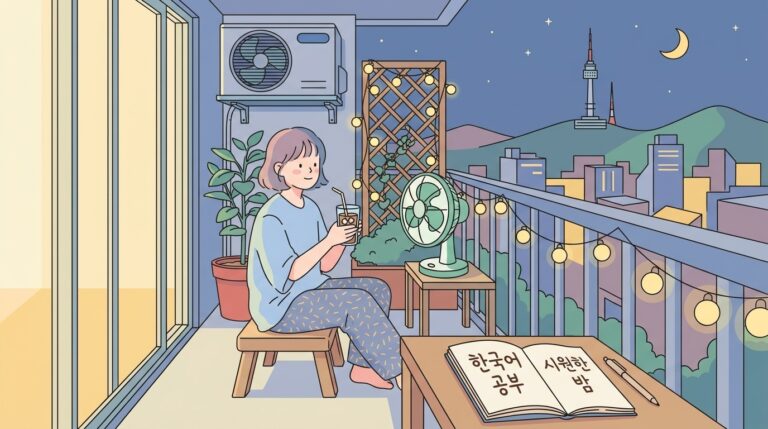
Beat the Korean Summer Heat: How to Survive Tropical Nights and AC Battles Like a Local
Phase 1: Empathy (Storytelling Opening)
안녕하세요! 매일한글 에디터입니다. (Hello! This is your Daily Hangul Editor.) Imagine this scene: It is 2:00 AM in late July in Seoul. You are tossing and turning in your apartment bed, sticky with humidity, while the digital thermometer outside reads 27°C (80°F). Welcome to 열대야 (Yeoldaeya)—Korea’s infamous summer tropical nights! You reach for the air conditioner remote, but you freeze. How do you tell your Korean roommate that you’re freezing from the AC without sounding demanding? Or how do you ask a café worker to turn down the blasting AC politely?
If you have ever felt hesitant to express summer climate discomfort in Korea, you are not alone! Many of our B2 intermediate learners tell us that while they know basic words like ‘덥다’ (hot) and ‘에어컨’ (AC), navigating real-life summer etiquette requires subtler, more nuanced phrasing. Mastering these expressions will instantly elevate your Korean from ‘textbook speaker’ to someone who understands the shared social rhythm of Korean daily life. Based on feedback from hundreds of expats in Korea, this guide gives you the exact tools to stay cool, comfortable, and polite all summer long!
Phase 2: Deep Dive into 3 Key Expressions
1. 열대야 때문에 잠을 설쳤어요. (Yeoldaeya ttaemune jameul seolchyeosseoyo.)
- Pronunciation: [Yeol-dae-ya ttae-mu-ne ja-meul seol-chyeos-seo-yo] (Sounds like “Yol-dae-yah” + “sehll-chyeoss-uh-yo”)
- Meaning: “I couldn’t sleep well because of the tropical night.” (Literal: I stirred up my sleep because of the tropical night.)
- K-Culture Moment: Seen in almost every summer K-drama episode where characters meet at a convenience store at 1 AM eating ice cups because their rooms are too hot.
- Editor’s Insight: ‘설치다’ means to do something incompletely or restlessly. Saying ‘잠을 설치다’ perfectly captures that groggy, half-awake state caused by intense humidity.
- Situation Spectrum: Casual: ✅ / Semi-formal: ✅ / Formal: ⚠️
- 🤔 Think About It: Does your language have a specific word for nights where the temperature stays above 25°C, or do you just say ‘it was hot night’? How does having a specific term like ‘열대야’ shape how people bond over shared weather complaints?
2. 에어컨 바람이 좀 세서 그런데, 온도 좀 올려주실 수 있나요? (Eoeakon barami jom seseo geureonde, ondo jom ollyeojusil su innayo?)
- Pronunciation: [E-eo-keon ba-ram-i jom se-seo geu-reon-de, on-do jom ol-lyeo-ju-sil su in-na-yo?]
- Meaning: “The AC breeze is a bit strong, so could you please turn up the temperature a bit?”
- K-Culture Moment: Asking a café barista or office colleague to adjust the shared air conditioning setting.
- Editor’s Insight: Notice the softener ‘~해서 그런데‘ (so, because of that…). Koreans rarely make direct requests like “Turn up the heat!” Adding ‘~해서 그런데’ cushions your request, making it smooth and polite.
- Situation Spectrum: Casual: ⚠️ / Semi-formal: ✅ / Formal: ✅
- 🤔 Think About It: Why is indirectness considered a sign of respect and consideration in Korean public spaces?
3. 실내외 온도 차 때문에 냉방병에 걸린 것 같아요. (Sillenaewoe ondo cha ttaemune naengbangbyeonge geollin geot gat-ayo.)
- Pronunciation: [Sil-nae-oe on-do cha ttae-mu-ne naeng-bang-byeong-e geol-lin geot gat-a-yo]
- Meaning: “I think I caught air-conditioning disease due to the temperature difference between inside and outside.”
- K-Culture Moment: Mentioned at workplace watercoolers during mid-August when someone has a slight runny nose or mild headache from constant AC exposure.
- Editor’s Insight: 냉방병 (Naengbangbyeong) is a widely recognized cultural-medical concept in Korea referring to heat-acclimatization fatigue, dry throat, and chills caused by excessive indoor cooling.
- Situation Spectrum: Casual: ✅ / Semi-formal: ✅ / Formal: ✅
- 🤔 Think About It: Do you have a phrase in your home country for feeling sick from artificial cold air?
Phase 3: Textbook Korean vs. Real-Life Korean
Situation 1: Asking someone to turn on or adjust the AC in a room
- 📖 Textbook Korean: “에어컨을 켜 주세요.” (Please turn on the air conditioner.)
- 🗣️ Real-Life Korean: “에어컨 좀 틀어주실 수 있으세요? / 에어컨 바람 좀 줄여도 될까요?”
- 💡 Why is it different? Native speakers use the verb 틀다 (to turn on/run a machine/water) instead of ‘켜다’ in daily speech, and add ‘좀’ (a little) to soften the tone.
Situation 2: Complaining about extreme heat
- 📖 Textbook Korean: “날씨가 매우 덥습니다.” (The weather is very hot.)
- 🗣️ Real-Life Korean: “오늘 날씨 진짜 찌는 듯이 덥네요! / 날씨가 미쳤어요.”
- 💡 Why is it different? 찌다 means ‘to steam’ (like dumplings). ‘찌는 듯이 덥다’ means it’s sweltering/steaming hot! Among friends, ‘날씨 미쳤다’ (the weather is crazy) is extremely common.
Phase 4: K-Culture Deep Dive & Non-verbal Manners
4-1. Nunchi (눈치) & AC Gestures
In shared spaces like offices or study cafés, turning down the AC without checking with others breaks ‘Nunchi’ etiquette. Before adjusting the remote:
1. Lightly glance around to see if others are rubbing their arms or fanning themselves.
2. Use a slight shivering gesture (hugging your upper arms) while saying gently: “혹시 좀 추우신가요?” (Is anyone feeling a bit cold?)
4-2. Summer Culture Code: Yeoldaeya Escapes
When 열대야 hits Seoul, Koreans don’t just stay home suffering. Thousands gather at the Han River Park (한강공원) around midnight with picnic mats, ordering delivery fried chicken (치맥) or buying ice cups (얼음컵) at convenience stores to cool off by the river breeze!
Phase 5: Practical Roleplay Scenario
Setting: Late afternoon at a shared office in Seongsu-dong. Roommate/Co-worker Min-jun is sitting near the AC remote.
- Min-jun: 🎭 (wiping sweat while typing) “아, 오늘 진짜 밖이 찌는 듯이 덥네요!”
(Ah, it’s steaming hot outside today!) - Learner: 🎭 (shivering slightly, pointing at the AC unit) “맞아요, 열대야 때문에 저도 어제 잠을 설쳤어요.”
(Right, I couldn’t sleep well yesterday due to the tropical night either.) - Min-jun: 🎭 (nods in sympathy) “맞죠? 그래서 제가 에어컨을 18도로 켜놨어요!”
(Right? So I set the air conditioner to 18°C!) - Learner: 🎭 (rubbing arms) “아, 그렇군요… 그런데 에어컨 바람이 좀 직빵이라서요.”
(Ah, I see… But the AC breeze is hitting me directly.) - Min-jun: 🎭 (looks surprised) “앗, 그래요? 혹시 많이 추우세요?”
(Oh, really? Are you feeling cold?) - Learner: 🎭 (smiling politely) “네, 실내외 온도 차 때문에 냉방병에 걸릴 것 같아요.”
(Yes, I feel like I’m going to get AC sickness from the indoor-outdoor temperature gap.) - Min-jun: 🎭 (picks up the remote) “이런, 진작 말씀하시지! 온도 좀 올려줄까요?”
(Oh no, you should’ve said sooner! Shall I turn up the temperature?) - Learner: 🎭 (nodding gratefully) “네, 24도 정도가 딱 좋을 것 같아요. 감사합니다!”
(Yes, around 24°C would be perfect. Thank you!)
🔀 Interactive Branching Point
Min-jun asks: “에어컨 끌까요, 아니면 온도를 올릴까요?” (Should I turn off the AC or turn up the temp?)
* Option A: “그냥 아예 꺼주세요. 너무 추워요!”
* Feedback (Bad): Turning off the AC completely in a shared hot room might make others uncomfortable.
* Option B: “온도 24도로 올리고, 날개 방향만 위로 바꿔주실 수 있으세요?”
* Feedback (Best): Perfect balance! You keep room climate cool for everyone while directing airflow away.
* Option C: “상관없으니까 마음대로 하세요.”
* Feedback (Risk): Might sound indifferent or slightly passive-aggressive depending on intonation.
Phase 6: 10-Second Emotion Shadowing Drill
[🥺 Uncomfortable & Tired]
“열대야 때문에 / 밤새 / 잠을 설쳤어요…”
(Yeoldaeya ttaemune / bamsae / jameul seolchyeosseoyo…)-
[😊 Polite & Mindful]
“에어컨 바람이 좀 세서 그런데 / 온도 좀 / 올려주실 수 있나요?”
(Eoeakon barami jom seseo geureonde / ondo jom / ollyeojusil su innayo?) -
[🤒 Groggy & Sniffling]
“에어컨을 너무 오래 쐬어서 / 냉방병에 걸린 것 같아요.”
(Eoeakon-eul neomu orae ssoe-eoseo / naengbangbyeonge geollin geot gat-ayo.)
Phase 7: K-Culture Mini Dictionary
- 열대야 (Yeol-dae-ya): Tropical Night phenomenon (nighttime temperature stays above 25°C/77°F).
- 냉방병 (Naeng-bang-byeong): AC sickness / Air conditioning syndrome caused by sudden indoor/outdoor temperature shifts.
- 겉옷 (Geot-ot): Outerwear/Cardigan brought during summer specifically to wear inside heavily air-conditioned cafés/subways.
- 얼음컵 (Eol-eum-cup): Plastic cup filled with ice sold at Korean convenience stores for 800-1000 KRW, essential for DIY summer drinks.
Phase 8: Traveler’s Survival Kit
TOP 3 Survival Phrases
- “에어컨 바람 좀 줄여주세요.” (Please lower the AC wind/fan strength.)
- “여기도 에어컨 켜져 있나요?” (Is the AC turned on here too?)
- “혹시 무릎덮개 있나요?” (Do you happen to have a lap blanket?)
Editor’s Travel Note
When taking the Seoul Subway during peak summer, look for the designated 약냉방차 (Weak Cooling Car)—usually Car 3 and 4 on Lines 1, 3, and 4! Also, remember to check weather alerts via 네이버 지도 앱 다운로드 for real-time indoor venue routing to stay out of the heat.
Phase 9: One Step Deeper (Korean Climate Mindset)
In Korea, summer temperature control in public places is often referred to as ‘에어컨 전쟁’ (AC War). Because Korean society highly values group harmony, directly complaining about temperature can feel confrontational. That’s why Koreans carry light cardigans (겉옷) and use indirect language. Understanding ‘눈치’ (Nunchi) during summer isn’t just about grammar—it’s about learning how Koreans gently care for mutual comfort in shared spaces.
💬 Your Turn: How do people in your home country negotiate room temperature in public or shared spaces? Drop a comment below!
Phase 10: FAQ & Mistake Prevention
Q: Can I use the word ‘추워요’ (I’m cold) directly in a cafe?
A: Yes, but it is much more natural to add context, such as “에어컨 때문에 조금 추운데, 자리 옮겨도 될까요?” (It’s a bit cold due to the AC, may I move seats?)
Q: What is the difference between 에어컨을 끄다 and 에어컨을 줄이다?
A: ‘끄다’ means to completely turn off the power. ‘줄이다’ usually means reducing fan speed or setting a warmer temperature.
Q: Is ‘열대야’ used for hot days as well?
A: No! ‘열대야’ is strictly for night temperatures. For sweltering daytime heat, use ‘폭염’ (heatwave) or ‘더위’ (the heat).
🚨 Common Mistakes TOP 3
- Mistake: Saying “에어컨을 내려주세요” to ask for lower temperature.
- Correct Action: Say “온도를 낮춰주세요” (lower temperature) or “바람을 줄여주세요” (lower fan speed). ‘에어컨을 내리다’ sounds like physically lowering the machine down.
- Mistake: Saying “에어컨을 열어주세요”.
- Correct Action: Machines are turned on using ‘틀다’ or ‘켜다’, not ‘열다’ (open).
- Mistake: Forgetting ‘좀’ when making a request.
- Correct Action: Always insert ‘좀’ (e.g., “온도 좀 올려주세요”) to sound friendly and polite.
Phase 11: Action Missions
- 🥉 Bronze Mission: Practice saying “열대야 때문에 잠을 설쳤어요” 3 times out loud with groggy emotion.
- 🥈 Silver Mission: Post a photo of your summer iced beverage on Instagram/X with the Korean caption: “오늘도 열대야! 얼음컵 필수 🧊”
- 🥇 Gold Mission: Next time you enter a cool Korean store or café, use “에어컨 바람이 시원하네요!” or request a temperature tweak using “에어컨 바람 좀 줄여주실 수 있으세요?”
🎮 K-Culture Mission: Watch a clip of a Korean summer vlog on YouTube and write down every time they say ‘덥다’, ‘찌다’, or ‘열대야’!
Phase 12: Interactive Quiz Challenge
- Situation Quiz: You are sitting under a direct AC breeze at a restaurant and feeling cold. What is the most polite phrase?
- A) 에어컨 당장 꺼주세요!
- B) 에어컨 바람이 좀 세서 그런데, 방향 좀 바꿔주실 수 있으세요?
- C) 왜 이렇게 에어컨을 세게 켜나요?
- Fill in the Blank: “어제 밤에 _______(이)가 너무 심해서 한 잠도 못 잤어요.”
- Choice: (열대야 / 냉방병)
- True / False: In Korea, ‘약냉방차’ on the subway refers to subway cars with maximum cooling power.
👉 Click to view Answers & Explanations!
- Correct Answer: B | Option B uses the indirect softener ‘~해서 그런데’ and politely asks to redirect airflow.
- Correct Answer: 열대야 | Tropical night phenomenon keeps you awake at night.
- Correct Answer: False | ‘약’ (弱) means weak—it is a car cooled slightly less (about 1-2°C higher) for people sensitive to cold air!







