

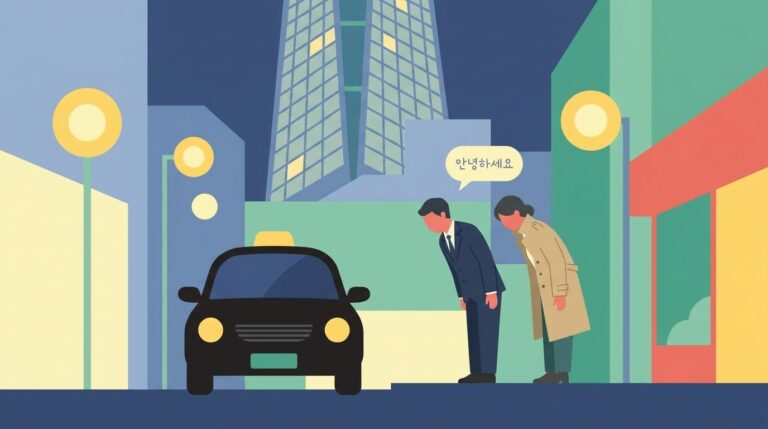
Master Korean Business Etiquette: How to See Off Clients and Hail a Taxi Like a Native
Phase 1: Empathy (스토리 몰입형 오프닝)
안녕하세요! This is your Daily Hangul chief editor and 10-year local culture navigator.
Picture this: You’ve just finished a fantastic dinner meeting in Gangnam with an important Korean corporate client. The food was great, the conversation flowed, and contract negotiations are looking bright. But now comes the moment that makes even seasoned expatriates sweat: the departure.
As you walk outside into the crisp Seoul evening, your client stands at the curb. Do you just say “안녕히 가세요” and walk away? Should you hail a taxi for them? How far should you walk them out? Standing awkwardly on the pavement while searching for a taxi on your phone with an icy silence hanging in the air is a nightmare scenario many intermediate Korean learners share with us.
In Korean business culture, how you say goodbye is just as important as how you say hello. In fact, seeing off a guest—known as bae-ung (배웅)—is considered the grand finale of Korean hospitality (jeop-dae, 접대). Mastering this art elevates your professional presence from a foreigner who speaks Korean to a respected business partner who truly understands nunchi (눈치) and Korean social etiquette. Based on feedback from hundreds of global professionals working in Korea, this guide will equip you with smooth, authoritative, yet deeply respectful B2-level Korean expressions to handle departures effortlessly!
Phase 2: Core Expressions Deep Dive (핵심 표현 3선 심층 분석)
1. 조심히 들어가세요 (Jo-sim-hi deul-eo-ga-se-yo)
- Pronunciation: [Jo-sim-hi deul-eo-ga-se-yo] (Sounds like: “Joe-seem-hee dul-uh-gah-say-yo” — imagine softly humming a reassuring tune at the end)
- Meaning: Literally “Please enter [your home] carefully,” but practically means “Get home safely” or “Have a safe journey back.”
- K-Culture Moment: You’ve definitely seen this in corporate K-dramas! At the end of an evening hoe-sik (team dinner), junior colleagues line up and bow at a 45-degree angle while chorusing this phrase as the VP gets into a chauffeured car.
- Editor’s Insight: Why “enter” (들어가다) instead of “go” (가다)? In Korean culture, your journey isn’t complete until you are safely inside your private sanctuary (home). Using this phrase shows genuine concern for their well-being beyond the business interaction.
- Situation Spectrum: Casual ⚠️ | Semi-formal ✅ | Formal ✅
- 🤔 Think About It: In English, we usually say “Have a good night” or “Safe travels.” How does shifting the focus to entering safely change the feeling of warmth between business associates?
2. 제가 택시 불러 드릴게요 (Je-ga taek-si bul-ler deu-ril-ge-yo)
- Pronunciation: [Je-ga taek-si bul-ler deu-ril-ge-yo] (Sounds like: “Cheh-gah taek-see bool-luh dew-reel-geh-yo”)
- Meaning: “I will call/hail a taxi for you.”
- K-Culture Moment: In a high-stakes business meeting scene, the hosting manager steps out onto the busy street 5 minutes early, holds up a Kakao T app, and points the client directly to the waiting car door while holding it open.
- Editor’s Insight: Notice the use of ~아/어 드릴게요 (honorific offer of service) instead of ~할게요. This emphasizes that hailing the ride is a service you are honored to perform for them, asserting control over the situation without being pushy.
- Situation Spectrum: Casual 🚫 | Semi-formal ✅ | Formal ✅
- 🤔 Think About It: Why is proactively offering transportation considered a key metric of attentiveness in Korean hospitality compared to Western self-reliance?
3. 편하게 가시도록 모범택시로 잡았습니다 (Pyeon-ha-ge ga-si-do-rok mo-beom-taek-si-ro ja-bat-seum-ni-da)
- Pronunciation: [Pyeon-ha-ge ga-si-do-rok mo-beom-taek-si-ro ja-bat-seum-ni-da]
- Meaning: “I caught a Deluxe Taxi (Mobeom Taxi) so you can ride back comfortably.”
- K-Culture Moment: Used in executive-level entertainment scenes when taking care of top VIPs or senior foreign clients to ensure high safety, spacious seating, and quiet service.
- Editor’s Insight: Mobeom Taxi (black taxis with yellow signs) are premium vehicles driven by accident-free veteran drivers. Mentioning 가시도록 (“so that you may go comfortably”) explicitly highlights your thoughtful preparation for their comfort.
- Situation Spectrum: Casual 🚫 | Semi-formal ⚠️ | Formal ✅
- 🤔 Think About It: How does choosing a specific tier of service communicate respect and prestige in Korean corporate heirarchy?
Phase 3: Textbook Korean vs. Real Native Korean (교과서 한국어 vs 진짜 한국어)
Situation 1: Offering to hail a ride at the curb
- 📖 Textbook Korean: 택시를 잡아 드리겠습니다. (Taek-si-reul jab-a deu-ri-get-seum-ni-da.)
- 🗣️ Real Native Korean: 제가 바로 택시 잡아드릴 테니 잠시만 기다려주세요! (Je-ga ba-ro taek-si jab-a-deu-ril te-ni jam-si-man gi-da-ryeo-ju-se-yo!)
- 💡 Why the difference? Textbook phrasing sounds robotic like a automated public announcement. Real native business speakers add softening particles like 바로 (right away) and ~을 테니 (since I will do X, please Y) to create a proactive, reassuring rhythm.
Situation 2: Final farewell as the taxi door closes
- 📖 Textbook Korean: 안녕히 가십시오. 내일 뵙겠습니다. (An-nyeong-hi ga-sip-si-o. Nae-il boep-get-seum-ni-da.)
- 🗣️ Real Native Korean: 편안히 가시고, 도착하시면 메시지 하나 부탁드립니다! (Pyeon-an-hi ga-si-go, do-chak-ha-si-myeon me-si-ji ha-na bu-tak-deu-rim-ni-da!)
- 💡 Why the difference? While formal greetings are acceptable, asking them to send a quick text upon safe arrival (도착하시면 메시지 하나…) strikes the perfect balance of B2 polish: deep care disguised as professional courtesy.
Phase 4: K-Culture Deep Dive & Non-Verbal Manners (비언어적 매너)
4-1. The Body Language of Bae-ung (배웅)
In Korea, non-verbal cues carry 50% of your message during a send-off. Keep these three physical gestures in mind:
1. The Two-Handed Door Hold: When opening the taxi door for your guest, hold the door frame with both hands (or keep one hand lightly near the top door frame to shield their head from bumping the roof).
2. The 45-Degree Bow Angle: Do not stop bowing the moment the taxi turns its wheels. Hold a respectable 30 to 45-degree bow until the taxi is at least 10–15 meters down the road.
3. Eye Contact & Nunchi: Read the room (nunchi). If the client looks tired, keep the final farewell brief. Do not drag out small talk at the vehicle curb.
4-2. Korean Transportation Culture in Business
Unlike in some Western countries where guests order their own Uber, in Korean business culture, the host is expected to coordinate transportation to the final destination. Using ride-hailing apps smoothly is considered a vital modern workplace skill.
Phase 5: Interactive Roleplay Scenario (실전 롤플레이 시나리오)
Setting: Outside a traditional upscale restaurant in Yeouido after dinner with Director Park (박 부장님).
Characters: You (Intermediate Biz Manager) & Director Park (Client NPC)
- Turn 1 (You): 부장님, 오늘 식사 즐거웠습니다. 제가 택시를 바로 불러드릴까요?
(Bu-jang-nim, o-neul sik-sa jeul-geowot-seum-ni-da. Je-ga taek-si-reul ba-ro bul-ler-deu-ril-kka-yo?)
(Director Park, I enjoyed our dinner today. Shall I hail a taxi for you right away?)
🎭 Gesture: Holding hands together politely at waist level, smiling. -
Turn 2 (Director Park): 아, 감사합니다! 오늘 도로가 많이 막힐 텐데 괜찮을까요?
(A, gam-sa-ham-ni-da! O-neul do-ro-ga ma-ni mak-hil ten-de gwaen-chan-eul-kka-yo?)
(Ah, thank you! Traffic seems heavy tonight, will it be okay?) -
Turn 3 (You): 네, 이미 앱으로 모범택시를 호출했습니다. 2분 뒤에 도착합니다.
(Ne, i-mi aeb-eu-ro mo-beom-taek-si-reul ho-chul-haet-seum-ni-da. 2-bun dwi-e do-chak-ham-ni-da.)
(Yes, I have already hailed a Deluxe Taxi via the app. It will arrive in 2 minutes.)
🎭 Gesture: Showing the app screen briefly with a professional confidence posture. -
Turn 4 (Director Park): 어휴, 역시 준비가 철저하시네요. 덕분에 편하게 가겠어요.
(Eo-hyu, yeok-si jun-bi-ga cheol-jeo-ha-si-ne-yo. Deok-bun-e pyeon-ha-ge ga-get-seo-yo.)
(My, you are so thoroughly prepared! Thanks to you, I’ll ride comfortably.) -
Turn 5 (You): 택시 들어오네요! 기사님께 목적지도 이미 입력해 두었습니다.
(Taek-si deul-eo-o-ne-yo! Gi-sa-nim-kke mok-jeok-ji-do i-mi im-ryeok-hae du-at-seum-ni-da.)
(Here comes the taxi! I’ve already set the destination in the app for the driver.)
🎭 Gesture: Stepping toward the curb and opening the car door gently. -
Turn 6 (Director Park): 아이구, 신경 많이 써줘서 고마워요. 조심히 돌아가세요!
(A-i-gu, sin-gyeong ma-ni sseo-jwo-seo go-ma-weo-yo. Jo-sim-hi dol-a-ga-se-yo!)
(Oh my, thank you for paying attention to all details. Go home safely yourself!) -
Turn 7 (You): 아닙니다. 조심히 들어가지고, 도착하시면 편하게 메시지 하나 남겨주세요!
(A-nip-ni-da. Jo-sim-hi deul-eo-ga-si-go, do-chak-ha-si-myeon pyeon-ha-ge me-si-ji ha-na nam-gyeo-ju-se-yo!)
(Not at all. Please get home safely, and feel free to drop me a message when you arrive!)
🎭 Gesture: Lowering head slowly into a deep bow. -
Turn 8 (Director Park): 그래요, 오늘 고생 많았어요. 들어가세요!
(Geu-rae-yo, o-neul go-saeng ma-nat-seo-yo. Deul-eo-ga-se-yo!)
(Alright, great job today. Head home!)
🔀 Interactive Branching Choice
Scenario: The taxi arrives, but the driver asks you where the guest is headed despite using the app.
* Choice A: Tell the driver directly in rapid Korean: “앱에 목적지 찍혔잖아요. 그냥 가주세요.”
* Choice B: Step closer to the window and politely confirm: “기사님, 판교역 아파트 단지로 모셔다 주시면 됩니다. 결제는 앱 결제입니다.”
* Choice C: Look at Director Park confusedly and ask: “부장님, 주소가 정확히 어디였죠?”
Feedback:
* Choice A (Risk – 🚫): Too blunt! It sounds rude to the driver in front of your client, ruining the hospitality atmosphere.
* Choice B (Best – ✅): Perfect! Reassures both driver and guest, confirming destination and auto-payment smoothly.
* Choice C (Bad – ⚠️): Undermines your thorough prep. Ask for destination addresses beforehand!
Phase 6: 10-Second Emotion Shadowing Drill (감정 섀도잉 드릴)
Practice saying these lines aloud with the indicated pause (/) and tone!
[😊 Proactive & Confident]
제가 / 택시를 바로 / 잡아드릴 테니 / 잠시만 기다려주세요!
(Je-ga / taek-si-reul ba-ro / jab-a-deu-ril te-ni / jam-si-man gi-da-ryeo-ju-se-yo!)-
[🤝 Warm & Caring]
편안히 가시고 / 도착하시면 / 메시지 하나 / 부탁드립니다!
(Pyeon-an-hi ga-si-go / do-chak-ha-si-myeon / me-si-ji ha-na / bu-tak-deu-rim-ni-da!) -
[🙇 Decisive & Respectful]
기사님 / 목적지 / 앱으로 결제 완료되었습니다 / 잘 부탁드립니다!
(Gi-sa-nim / mok-jeok-ji / aeb-eu-ro gyeol-je wan-ryeo-doe-at-seum-ni-da / jal bu-tak-deu-rim-ni-da!)
Phase 7: K-Culture Mini Dictionary (핵심 키워드 4개)
- 배웅 (Bae-ung) | Seeing off a guest
Usage: Walking a guest out to the elevator, lobby, or taxi curb to show remaining hospitality. - 모범택시 (Mo-beom-taek-si) | Deluxe Taxi
Usage: Black vehicles offering higher comfort and premium drivers, ideal for high-priority corporate VIPs. - 대리운전 (Dae-ri-un-jeon) | Designated Driver Service
Usage: If your business guest drove their own car to the restaurant after drinking alcohol, you call a dae-ri driver to drive them home in their own car. - 막차 (Mak-cha) | Last train / bus
Usage: In casual business gatherings, keeping track of mak-cha time shows great consideration for junior or commuting colleagues.
Phase 8: Survival Kit for Travelers (여행자를 위한 생존 키트)
Survival Expressions TOP 3
- 카카오 T로 택시 불러주실 수 있나요?
(Ka-ka-o T-ro taek-si bul-ler-ju-sil su in-na-yo?)
→ Could you help call a taxi for me using Kakao T? - [목적지]로 가주세요.
([Mok-jeok-ji]-ro ga-ju-se-yo)
→ Please take me to [Destination]. - 여기서 내려주시면 됩니다.
(Yeo-gi-seo nae-ryeo-ju-si-myeon doem-ni-da)
→ You can drop me off here.
Editor’s Travel Note:
Navigating Korean transit apps is essential! We strongly recommend setting up the [Kakao T App on Google Play / App Store] prior to your meetings. Make sure to select “Automatic Payment” (자동 결제) so your client doesn’t have to pull out their wallet when arriving at their destination.
Phase 9: A Step Deeper (생각 질문)
In Korean culture, hospitality doesn’t end when the transaction is paid; it ends when the guest is safely in their sanctuary. This stems from a deep community ethos where caring for a visitor’s full journey builds long-term jeong (정) and mutual trust. By taking care of the ride home, you signal that you view the client as a valued partner rather than just a commercial contract.
💬 Your Turn: How are business send-offs handled in your culture? Do hosts hail taxis, or is it expected for guests to arrange their own rides? Share your experiences in the comments below!
Phase 10: FAQ & Common Mistakes (FAQ & 오해 방지)
Q: Should I pay for the client’s taxi fare?
A: Yes! In Korean business hospitality, if you are the hosting party, paying for their ride home (via app payment or cash directly given to the driver) is standard etiquette.
Q: How long should I stand outside after the taxi leaves?
A: Stand on the curb and wave gently or keep a polite posture until the taxi turns the corner or disappears from view.
Q: What if the client refuses my offer to hail a taxi?
A: If they refuse twice politely (체면, saving face), ask if they have a preferred ride option (like subway or personal designated driver) and walk them at least to the station entrance.
🚨 Common Mistakes TOP 3
- Mistake: Closing the taxi door immediately and turning your back right away.
Correct Action: Close the door gently and bow until the car drives away. - Mistake: Saying “잘 가” (Jam-ga) to a business client.
Correct Action: Always use honorifics: “조심히 들어가세요” or “안녕히 가세요.” - Mistake: Forgetting to pre-set destination on the hailing app.
Correct Action: Set the exact building or apartment entry point in advance so the driver doesn’t bother your guest.
Phase 11: Action Mission (액션 미션)
- 🥉 Bronze Level: Practice saying “조심히 들어가세요” 5 times in front of a mirror with a natural 30-degree bow.
- 🥈 Silver Level: Download Kakao T, set up a test route from your hotel to Seoul Station, and practice entering destinations in Korean.
- 🥇 Gold Level: Use the expression “도착하시면 메시지 남겨주세요!” next time you see off a Korean colleague or friend.
🎮 K-Culture Mission: Watch Episode 3 or 4 of any business K-drama (e.g., Misaeng or Agency) and spot the exact moment a junior employee bows as a senior officer’s car leaves!
Phase 12: Interactive Quiz Challenge (인터랙티브 퀴즈 챌린지)
Q1. What is the most appropriate phrase when sending off a business client in a taxi?
A) 잘 가라!
B) 조심히 들어가시고, 도착하시면 연락 주세요.
C) 택시 탔으니까 먼저 갑니다.
🔍 Click to view Answer & Explanation
Correct Answer: B
Explanation: Option B combines polite honorific send-off with warm concern for their arrival. Option A is informal (banmal), and Option C is rude in a business context.
Q2. True or False: In Korea, you should immediately turn around and walk away the second the guest enters the taxi.
🔍 Click to view Answer & Explanation
Correct Answer: False
Explanation: Good etiquette requires waiting on the curb and bowing until the taxi drives away from view.







