

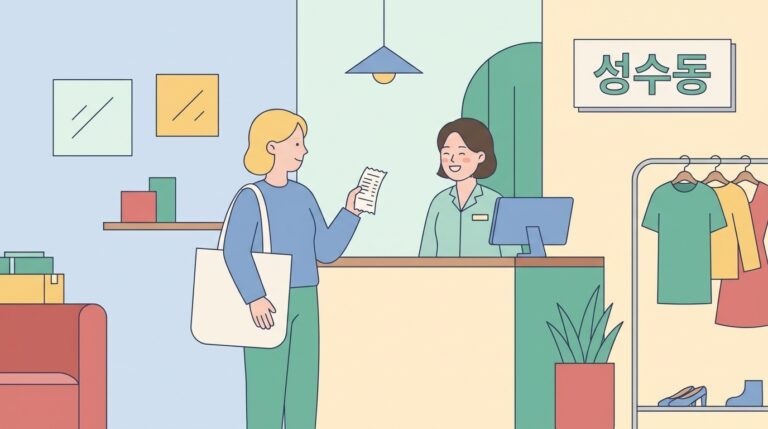
How to Exchange Items in Korea Like a Local Shopping Pro
안녕하세요! Welcome back to another lesson with your favorite Daily Hangul editor! Have you ever had that heartbreaking shopping moment in Hongdae or Seongsu? You bought a trendy jacket, brought it back to your hotel, tried it on in front of the mirror, and realized… oh no, the shoulders are way too broad, or the color doesn’t match your vibe at all. You panic a little. You rush back to the boutique with your receipt, but your mind goes completely blank. How do you ask the stylish clerk if you can switch it for another color or size without sounding rude or awkward?
Don’t worry! Exchanging items in Korea is actually a smooth and stress-free process once you master a few natural, polite phrases. Hundreds of our B1-level learners used to feel nervous in busy Korean stores, but after practicing this guide, they swapped clothes, accessories, and K-beauty items with total confidence. Let’s make sure your next shopping trip in Seoul is 100% regret-free!
Phase 2: Top 3 Essential Expressions Deep Dive
1. 다른 걸로 바꾸고 싶은데요. (Darean geol-ro bbakku-go sip-eun-de-yo.)
- Pronunciation: Dah-reun geol-ro bah-ggoo-go sheep-eun-deh-yo (Sounds like “Da-reun” + “girl-raw” + “bbak-goo-go” + “ship-eun-day-yo”)
- Meaning: Literal: “I want to change it to a different thing.” / Nuance: “I’d like to exchange this for something else, if possible.”
- K-Culture Moment: Imagine walking into a chic boutique in Dongdaemun. You present your shopping bag with a gentle smile and say this phrase to open the conversation smoothly.
- Editor’s Insight: Ending with
~는데요 (~nde-yo)softens your tone. It creates a gentle conversational buffer so you don’t sound overly demanding. - Situation Spectrum:
- Casual (Friends): 🚫 다른 걸로 바꿀래. (Darean geol-ro bbakkul-lae.)
- Semi-formal (Clerk): ✅ 다른 걸로 바꾸고 싶은데요. (Darean geol-ro bbakku-go sip-eun-de-yo.)
- Formal (Luxury Store): ✅ 다른 상품으로 교환하고 싶습니다. (Darean sangpum-euro gyohwan-hago sipsumnida.)
- 🤔 Think About It: Why do Korean speakers use ending softeners like
~는데요instead of direct demands like “Exchange this”? How does indirect speech reflect politeness in Korean society?
2. 혹시 다른 색상으로 교환 가능할까요? (Hoksi darean saeksang-euro gyohwan ganeung-hal-kka-yo?)
- Pronunciation: Hok-shi dah-reun saek-sang-euro gyo-hwan gah-neung-hal-gga-yo? (Like “Hok-shee” + “dah-reun” + “sake-sang-euro” + “gyo-hwan”)
- Meaning: Literal: “By any chance, is an exchange for a different color possible?” / Nuance: “Could I possibly swap this for another color?”
- K-Culture Moment: You see your dream sweater on display in cream white, but you accidentally bought beige. You approach the cashier politely using
혹시 (hoksi)to sound extra courteous. - Editor’s Insight: Adding
혹시 (hoksi - by any chance)at the beginning works magic in Korean retail. It makes your request sound tentative and humble. - Situation Spectrum:
- Semi-formal: ✅ 혹시 다른 색상으로 교환 가능할까요?
- Formal: ✅ 혹시 다른 색상으로 교환이 가능하십니까?
3. 사이즈를 변경할 수 있을까요? (Size-reul byeongyeong-hal su isseul-kka-yo?)
- Pronunciation: Sah-ee-jeu-reul byeon-gyeong-hal soo ees-seul-gga-yo?
- Meaning: Literal: “Can I change the size?” / Nuance: “Would it be possible to switch to a different size?”
- K-Culture Moment: Trying on oversized Korean apparel that turned out a bit too oversized. You want a Medium instead of Large.
- Editor’s Insight: While
바꾸다 (bbakkuda)is common daily Korean,변경하다 (byeongyeong-hada - to alter/change)sounds slightly more refined for retail contexts. - Situation Spectrum:
- Semi-formal: ✅ 사이즈 변경할 수 있을까요?
- Formal: ✅ 사이즈 변경 부탁드립니다.
Phase 3: Textbook Korean vs. Real-Life Korean
Situation 1: Asking to switch an item for another model
- 📖 Textbook Korean: 이 물건을 다른 상품으로 바꾸어 주십시오. (I mulgeon-eul darean sangpum-euro bbakdueo jusipsio.)
- 🗣️ Real-Life Korean: 저기요, 혹시 이거 다른 걸로 교환할 수 있어요? (Jeogiyo, hoksi igeo darean geol-ro gyohwan-hal su isseoyo?)
- 💡 Why the difference?: Textbook phrases sound like an imperative command from a manual! Real Koreans use
저기요 (Excuse me)and혹시 (by any chance)with~수 있어요?to keep it friendly and soft.
Situation 2: Checking if price differences can be paid/refunded
- 📖 Textbook Korean: 가격 차액을 계산해 주십시오. (Gagyeok cha-aek-eul gyesan-hae jusipsio.)
- 🗣️ Real-Life Korean: 혹시 더 비싼 걸로 바꾸면 차액만 더 내면 되나요? (Hoksi deo bissean geol-ro bbakakumyeon cha-aek-man deo naemyeon doenayo?)
- 💡 Why the difference?: Locals prefer conversational condition sentences (
~면 되나요? - is it okay if...?) over technical banking terms.
Phase 4: K-Culture Deep Dive & Non-Verbal Etiquette
4-1. Nunchi & Shopping Gestures
When requesting an exchange in Korea, hand gestures and body language carry half the polite weight! Hand over the receipt and the shopping bag holding them with both hands. Slightly nod your head (a mini bow of 15 degrees). Maintain soft eye contact, but avoid staring intensely. This demonstrates respect and instantly triggers helpful customer service!
4-2. Shopping Culture in Seongsu & Hongdae
In fashion hubs like Seongsu-dong or Hongdae popup stores, exchange policies are quite strict regarding clothing tags (택 – taek) and purchase timeframes (usually within 7 to 14 days with receipt). Additionally, white-colored tops or makeup-stained items are often non-exchangeable due to hygienic policies. Knowing these unwritten cultural norms will save you time and awkward moments!
Phase 5: Real-World Roleplay Scenario
Setting: A trendy fashion shop in Myeongdong. You are talking to a friendly store clerk (직원).
- Turn 1 (Clerk): 🎭 Smiling cheerfully 안녕하세요! 도우실 것 있으신가요? (Annyeonghaseyo! Dou-sil geot isseusingayo? – Hello! Need any help?)
- Turn 2 (You): 🎭 Holding shopping bag with both hands 안녕하세요. 저기, 혹시 이거 다른 걸로 교환 가능할까요? (Annyeonghaseyo. Jeogi, hoksi igeo darean geol-ro gyohwan ganeung-hal-kka-yo? – Hello. Um, by any chance, could I exchange this for something else?)
- Turn 3 (Clerk): 🎭 Checking the bag 네, 고객님! 영수증하고 상품 택 있으신가요? (Ne, gogaeg-nim! Yeongsujeung-hago sangpum taek isseusingayo? – Yes, customer! Do you have the receipt and product tag?)
- Turn 4 (You): 🎭 Handing over receipt 네, 여기 영수증이랑 옷에 택도 그대로 있어요. (Ne, yeogi yeongsujeung-irang ot-e taek-do geudaero isseoyo. – Yes, here is the receipt, and the tag is still attached.)
- Turn 5 (Clerk): 🎭 Inspecting item 네, 확인되셨습니다. 어떤 걸로 바꿔 드릴까요? (Ne, hwag-in-doeseos-seumnida. Eotteon geol-ro bbakakweo deuril-kka-yo? – Great, verified. Which item would you like to exchange it for?)
- Turn 6 (You): 🎭 Pointing at a sweater 이 디자인 M 사이즈로 교환하고 싶어요. (I dijain M size-ro gyohwan-hago sipeoyo. – I’d like to exchange it for Medium in this design.)
- Turn 7 (Clerk): 🎭 Scanning barcode 이 제품이 5,000원 더 비싼데, 차액 결제 도와드릴까요? (I jepum-i o-cheon-won deo bisseande, cha-aek gyeolje do-wa-deuril-kka-yo? – This item is 5,000 KRW more expensive. Shall I help you pay the difference?)
- Turn 8 (You): 🎭 Handing credit card 네, 카드로 결제할게요. 감사합니다! (Ne, kadeu-ro gyeolje-hal-geyo. Gamsahamnida! – Yes, I’ll pay by card. Thank you!)
🔀 Interactive Choice Point
What if the clerk says: “죄송하지만 흰색 옷은 교환이 안 됩니다.” (I’m sorry, white items cannot be exchanged.) How should you respond?
- Option A: “아, 몰랐어요. 그럼 혹시 다른 색상 옷으로는 교환 되나요?” (Oh, I didn’t know. Then can I exchange it for a different colored item?)
- 👉 Best Choice!: Polite, acknowledges store policy, and flexibly asks for an alternative solution.
- Option B: “왜 안 돼요? 그냥 바꿔 주세요!” (Why not? Just change it for me!)
- ⚠️ Bad Choice: Direct confrontation causes awkward tension in Korea and rarely works.
- Option C: “그럼 환불해 주세요.” (Then please give me a refund.)
- 💥 Risk Choice: If the item policy bans exchange due to color/fabric, refunding might also be restricted! Asking politely first is safer.
Phase 6: 10-Second Emotional Shadowing Drill
Practice these with exaggerated expression and timing!
[🥺 Polite & Asking]저기요… / 혹시 / 다른 걸로 / 바꾸고 싶은데요.
(Jeogiyo… / hoksi / darean geol-ro / bbakku-go sip-eun-de-yo.)[😊 Relieved & Friendly]영수증 / 여기 있어요! / 사이즈 변경 / 가능할까요?
(Yeongsujeung / yeogi isseoyo! / size byeongyeong / ganeung-hal-kka-yo?)[👍 Grateful & Satisfied]차액 결제해 주세요. / 감사합니다!
(Cha-aek gyeolje-hae juseyo. / Gamsahamnida!)
Phase 7: K-Culture Mini Dictionary
- 영수증 (Yeongsujeung) | Receipt | Essential proof for exchanges. Always say “영수증 주세용!” when buying.
- 택 (Taek) | Product Tag | Price/brand tag attached to apparel. Do NOT cut this off before trying on at home!
- 차액 (Cha-aek) | Price Difference | The extra amount you pay (or get back) when swapping items of different prices.
- 이월 상품 (Iwol sangpum) | Out-of-season / Outlet Goods | Items rolled over from previous seasons; often sold at heavy discounts with strict exchange policies.
Phase 8: Traveler’s Survival Kit
Survival Phrases TOP 3
- 이거 다른 사이즈 있어요? (Igeo darean size isseoyo?) – Do you have this in a different size?
- 영수증 버리지 마세요. (Yeongsujeung beoriji maseyo.) – Please don’t throw away the receipt.
- 차액 얼마예요? (Cha-aek eolmayeyo?) – How much is the price difference?
Editor’s Travel Note
Before shopping around Seoul, make sure to install local map services! Google Maps is often imprecise in Korea. Use Naver Map App Download to easily navigate trendy boutique lanes in Seongsu, Yeonnam, and Hannam-dong.
Phase 9: A Step Deeper (Korean Society Insights)
In Korean shopping culture, flexibility and polite negotiation (정 – Jeong) co-exist with strict corporate rules. Frontline staff in Korea are extremely fast and efficient, but they appreciate courteous honorifics. When you approach with soft phrases like 혹시~ and ~인데요, retail workers will often go out of their way to check back-room inventory or suggest popular alternative items for you.
💬 Your Turn: What is exchange etiquette like in your home country? Have you ever had a memorable shopping exchange experience while traveling? Tell us in the comments below!
Phase 10: FAQ & Common Mistakes
Q: Can I exchange an item without a physical paper receipt?
A: If you paid with a credit card, stores can sometimes look up your transaction history, but having the physical paper receipt (or mobile receipt) makes the process much faster and guaranteed.
Q: Is there a deadline for exchanges in Korean stores?
A: Generally, most streetwear and boutique stores allow exchanges within 7 days, while major department stores may allow up to 14 days.
Q: Can I get a cash refund for the price difference if the new item is cheaper?
A: If you paid by card, usually the store cancels the original purchase and re-charges the new amount. If you paid cash, they will give you cash back.
🚨 Common Mistakes TOP 3
- ❌ Cutting off the price tag immediately: Removing tags makes exchanges almost impossible.
- ❌ Saying “환불 (Refund)” when you mean “교환 (Exchange)”: Refunds have stricter rules than item exchanges!
- ❌ Using demanding non-honorifics: Don’t say “이거 바꿔!” (Switch this!). Always use polite endings like
~교환 가능할까요?.
Phase 11: Action Mission
- 🥉 Bronze Mission: Practice saying “혹시 다른 걸로 바꾸고 싶은데요” out loud 3 times in front of your mirror.
- 🥈 Silver Mission: Watch a scene from your favorite Korean shopping vlog or K-Drama and spot when people ask for receipts or items!
- 🥇 Gold Mission: Next time you visit Korea, successfully exchange an item or ask for a different size entirely in Korean!
🎮 K-Culture Challenge: Find a K-Pop album unboxing or streetwear haul video on YouTube and listen for the word 영수증 (receipt) or 택 (tag)!
Phase 12: Interactive Quiz Challenge
Test your knowledge before your next shopping spree!
- Situation Quiz: You want to ask if exchanging for a different color is possible. Which phrase is best?
- A) 이거 환불해 라!
- B) 혹시 다른 색상으로 교환 가능할까요?
- C) 영수증을 주세요.
- Fill in the Blank: “사이즈를 ________ 수 있을까요?” (Can I change the size?)
- A) 변경할
- B) 버릴
- C) 마실
- True / False Culture Quiz: In Korea, you can exchange white clothes with makeup stains as long as you have the receipt.
- A) True
- B) False
🔍 Click here to reveal the Answers & Explanations!
- Answer: B –
혹시 다른 색상으로 교환 가능할까요?is polite and precise! - Answer: A –
변경할 (to change/alter)fits perfectly in “사이즈를 변경할 수 있을까요?”. - Answer: B (False) – Clothes damaged or stained by cosmetics cannot be exchanged due to retail hygiene regulations in Korea!







