

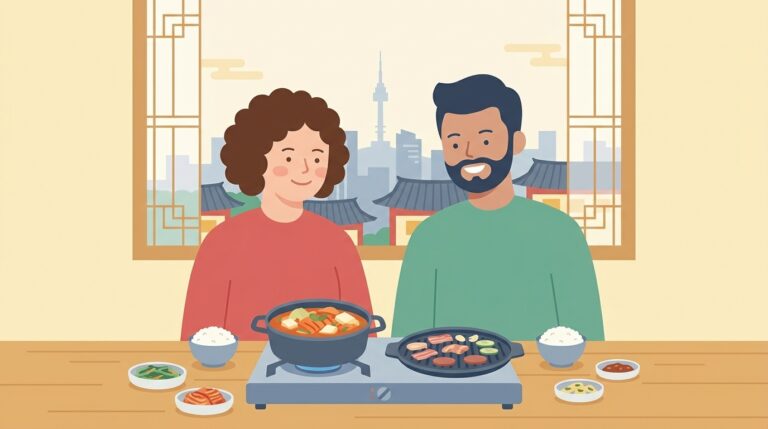
Master Kitchen Korean: How to Say Turn Off the Heat Like a Native
Phase 1: Empathetic Opening
Annyeonghaseyo! I’m your Daily Hangul editor and your best Korean buddy! Have you ever tried cooking delicious Samgyupsal or Kimchi Jjigae at a Korean BBQ restaurant or at home with Korean friends, only to panic when the grill started smoking? You want to yell “Turn off the heat!” but your mind goes completely blank. You know the word for fire (불, bul), but how do you combine it with “turn off” naturally without sounding like an instruction manual?
Don’t worry, you are definitely not alone! Last week, one of our A2 level students, Sarah, shared her hilarious story of accidentally shouting “Fire zero please!” at a Samgyupsal place in Hongdae. The waiter laughed kindly, but Sarah felt so embarrassed. That’s exactly why we created this practical cooking guide!
Mastering simple heat control expressions is a game-changer. It turns stressful cooking moments into confident bonding experiences. Based on feedback from hundreds of beginner learners, knowing just two or three natural phrases will instantly boost your cooking confidence in Korea. Let’s make sure you never burn your Dakgalbi again!
Phase 2: Deep Dive into 3 Essential Expressions
1. 불 꺼 주세요 (Bul kkeo ju-se-yo)
- Pronunciation: [Bul kkeo-joo-seh-yo] (Sounds like “Bull” + “Cup” without the ‘p’ + “Juice-A-Yo”)
- Meaning: Direct translation: “Please turn off the fire.” / Natural nuance: “Please turn off the stove/heat.”
- K-Culture Moment: You see this constantly in K-Dramas when characters eat K-BBQ or table-top hot pot (Jeongol) and the soup starts overflowing.
- Editor’s Insight: “불” (bul) means fire/heat, and “끄다” (kkeoda) means to turn off or extinguish. Adding “~주세요” (juseyo) makes it polite and warm.
- Situation Spectrum:
- Casual (Friends): 불 끄자! / 불 꺼! (✅)
- Semi-formal (Restaurants/Acquaintances): 불 꺼 주세요. (✅)
- Formal (Cooking Class/TV Show): 불을 꺼 주시기 바랍니다. (⚠️)
- 🤔 Think About It: In Korean, the word “불” (bul) refers to both physical fire and electric stove heat/light. How does your native language distinguish cooking heat from actual flame?
2. 불 좀 줄여 주세요 (Bul jom ju-ryeo ju-se-yo)
- Pronunciation: [Bul jom joo-ryuh joo-seh-yo] (Sounds like “Bull” + “Jom” as in Tom + “Joo-ryuh” + “Juice-A-Yo”)
- Meaning: Direct translation: “Please reduce the fire a little.” / Natural nuance: “Please turn down the heat.”
- K-Culture Moment: When boiling Tteokbokki at a street stall or table burner, the sauce gets thick fast. This is when you say this exact phrase!
- Editor’s Insight: The word “좀” (jom) means “a little” or “kindly.” Inserting “좀” instantly softens your tone from a command to a friendly request.
- Situation Spectrum:
- Casual: 불 좀 줄여봐! (✅)
- Semi-formal: 불 좀 줄여 주세요. (✅)
- Formal: 불을 약하게 조절해 주세요. (🚫 – Too stiff for normal cooking)
- 🤔 Think About It: Korean culture highly values soft requests. Why do you think adding a small word like “좀” (jom) makes such a huge polite difference?
3. 약불로 줄여 주세요 (Yak-bul-lo ju-ryeo ju-se-yo)
- Pronunciation: [Yak-bul-lo joo-ryuh joo-seh-yo] (Sounds like “Yack” + “Bull-low” + “Joo-ryuh”)
- Meaning: Direct translation: “Please reduce to weak fire.” / Natural nuance: “Please turn it down to low heat.”
- K-Culture Moment: Following a YouTube recipe for Korean stew (Jjigae) where the chef says “Simmer on low heat for 5 minutes.”
- Editor’s Insight: Heat levels in Korean recipes are simple: 강불 (Gang-bul = High heat), 중불 (Jung-bul = Medium heat), and 약불 (Yak-bul = Low heat).
- Situation Spectrum:
- Casual: 약불로 해! (✅)
- Semi-formal: 약불로 줄여 주세요. (✅)
- Formal: 약불로 조절하십시요. (⚠️)
- 🤔 Think About It: Korean culinary terms combine Sino-Korean roots (약 = weak, 강 = strong) with Native Korean words (불 = fire). Isn’t language logic fascinating?
Phase 3: Textbook Korean vs. Real-World Korean
Situation 1: Emergency! The soup is boiling over at a K-BBQ joint.
- 📖 Textbook Korean: 가스 불을 끄십시오. (Gaseu bureul kkeosipsio. – “Extinguish the gas fire.”)
- 🗣️ Real-World Korean: 어! 불 꺼 주세요! (Eo! Bul kkeo juseyo! – “Oh! Please turn off the heat!”)
- 💡 Why the difference?: Nobody uses formal imperatives like “~하십시오” at a restaurant table. Real Koreans use rapid, direct polite forms like “불 꺼 주세요!” to act fast before soup spills!
Situation 2: Simmering Kimchi Stew with a friend.
- 📖 Textbook Korean: 불의 세기를 약하게 만드세요. (Bureui segireul yakhage mandeuseyo. – “Make the intensity of the fire weak.”)
- 🗣️ Real-World Korean: 이제 약불로 줄이자! (Ije yakbullo jurija! – “Let’s lower it to low heat now!”)
- 💡 Why the difference?: Koreans prefer intuitive short compounds like 약불 (low heat) over long descriptive sentences about “fire intensity.”
Phase 4: K-Culture Deep Dive & Mannerisms
4-1. Nunchi & Non-verbal Gestures
When cooking together in Korea, table cooking is a shared communal effort. If you notice smoke or boiling soup:
1. Eye Contact & Hand Wave: Catch your friend’s eye, point gently at the stove dial, and make a downward pressing gesture with your hand while saying “불 좀 줄여 주세요~”.
2. Tone: Use a soft, rising-falling intonation at the end of “주세요~” to show appreciation rather than bossiness.
4-2. Cultural Code: Table-top Cooking Culture
In Korea, dining is often interactive. From Samgyupsal to Budae Jjigae, food cooks right in front of you. Taking initiative to turn down the heat when meat is getting overcooked shows high Nunchi (social tact). Korean friends will instantly praise you: “와, 한국 사람 다 됐네!” (Wow, you’ve become totally Korean!).
Phase 5: Real-World Roleplay Scenario
Setting: A lively Samgyupsal restaurant in Myeongdong. You are eating with your Korean friend, Minjun (민준).
- Turn 1 (Minjun): 🥩 고기 거의 다 익었다! 먹자! (Gogi geoei da igeotda! Meokja! / The meat is almost done! Let me eat!)
- Turn 2 (You): 😋 와, 진짜 맛있겠다! (Wa, jinjja masitgetda! / 🎭 Clapping hands with excitement / Wow, it looks so delicious!)
- Turn 3 (Minjun): 어? 그런데 불이 너무 강한 것 같아. (Eo? Geureonde buri neomu ganghan geot gata. / Uh? But I think the fire is too strong.)
- Turn 4 (You): 😅 맞아요, 연기가 많이 나요! (Majayo, yeongiga mani nayo! / 🎭 Waving hand to blow smoke away / You’re right, there’s a lot of smoke!)
- Turn 5 (Minjun): 네가 불 조절 좀 해 줄래? (Nega bul jojeol jom hae jullae? / Can you adjust the heat?)
- Turn 6 (You): 💡 네! 제가 불 꺼 줄게요. (Ne! Jega bul kkeo julgeyo. / 🎭 Reaching for the stove switch proudly / Yes! I’ll turn off the heat for you.)
- Turn 7 (Minjun): 아, 완전히 끄지 말고 약불로 줄여줘! (A, wanjeonhi kkeuji malgo yakbullo juryeojwo! / Ah, don’t turn it off completely, lower it to low heat!)
- Turn 8 (You): 🆗 아하! 약불로 줄일게요! (Aha! Yakbullo jurilgeyo. / 🎭 Nodding and turning dial down slightly / Aha! I will lower it to low heat!)
🔀 Interactive Choice Point
What do you do when the grill starts burning?
* Option A: Shout “불 끄지 마세요!” (Don’t turn off the heat!)
* Option B: Politeness check: Politely say “사장님, 불 좀 줄여 주세요!” to the server.
* Option C: Sit quietly and wait for the meat to turn into charcoal.
Feedback:
* 🏆 Best (Option B): Excellent! Requesting heat adjustment politely makes your dining experience smooth and tastier!
* ⚠️ Risk (Option A): Oops! “끄지 마세요” means DO NOT turn off. You might set the table on fire!
* 🚫 Bad (Option C): Oh no! Korean table cooking requires teamwork. Don’t be shy! Speak up!
Phase 6: 10-Second Emotion Shadowing Drill
Practice reading these out loud with full emotion!
[🔥 Panicked & Urgent]
어! / 불 좀 / 빨리 꺼 주세요! / (Eo! / Bul jom / ppalli kkeo juseyo! / Oh! Please turn off the heat fast!)-
[😊 Sweet & Polite]
여기요~ / 불 좀 / 줄여 주시겠어요? / (Yeogiyo~ / bul jom / juryeo jusigesseoyo? / Excuse me, could you please turn down the heat?) -
[🍳 Confident Chef Tone]
이제 / 약불로 / 줄일게요! / (Ije / yakbullo / jurilgeyo! / Now, I’ll lower it to low heat!)
Phase 7: K-Culture Mini Dictionary
- 약불 (Yak-bul) | Low Heat | Essential setting for simmer sauces and keeping grilled meat warm without burning.
- 중불 (Jung-bul) | Medium Heat | The standard setting for starting most stews and cooking vegetables.
- 강불 (Gang-bul) | High Heat | Used for rapid boiling or quick stir-frying (Sok-seong).
- 불판 (Bul-pan) | Grill Plate / Stove Top | The metal plate used at K-BBQ tables that holds your food over the fire.
Phase 8: Traveler’s Survival Kit
Survival Expressions TOP 3
- 불 꺼 주세요. (Bul kkeo juseyo.) – Turn off the heat.
- 불 줄여 주세요. (Bul juryeo juseyo.) – Lower the heat.
- 불판 바꿔 주세요. (Bulpan baggwa juseyo.) – Please change the grill plate.
Editor’s Travel Note
When eating at popular dining spots in Seoul, navigating restaurants and viewing menus in English is super easy if you use the Naver Map app download for smart navigation. Also, if your stove runs out of gas, just point at the table burner and say “가스 바꿔 주세요” (Gaseu baggwa juseyo / Please change the gas canister)!
Phase 9: A Step Deeper (Reflection)
In Korean culture, food is love, and cooking together is an act of affection. When someone controls the heat or clips meat for you at a restaurant, it’s a non-verbal expression of care. Controlling the stove isn’t just about cooking technicalities—it shows you care about everyone sharing the meal at the table.
💬 Your Turn: Have you ever had a funny or chaotic cooking experience while trying Korean food? Leave a comment below and let’s laugh together!
Phase 10: FAQ & Common Mistakes
Q: Can I use “불 끄다” for electric lights too?
A: Yes! In Korean, “불을 끄다” (bul-eul kkeoda) is used both for turning off cooking stoves/fires and turning off room lights.
Q: What is the difference between “줄이다” (jurida) and “끄다” (kkeoda)?
A: “줄이다” means to reduce/turn down (lower the flame), while “끄다” means to completely turn off/extinguish.
Q: Is it rude to adjust the table burner myself at a restaurant?
A: Not at all! In fact, servers appreciate customers who manage their own grill heat so the food doesn’t burn.
🚨 Common Mistakes TOP 3
- Mistake: Saying “불 죽여 주세요” (Kill the fire).
- Correct Action: Use “불 꺼 주세요” (Turn off) or “불 줄여 주세요” (Lower heat).
- Mistake: Confusing “불” (Fire) with “물” (Water).
- Correct Action: Remember Bul = Burn, Mul = Liquid!
- Mistake: Using formal imperative “끄시오” to restaurant staff.
- Correct Action: Always add “~주세요” (juseyo) for friendly politeness.
Phase 11: Action Mission
- 🥉 Bronze Level: Say “불 꺼 주세요” out loud 5 times in front of your mirror.
- 🥈 Silver Level: Record your voice saying “약불로 줄여 주세요” and post it on your Instagram story tagging @DailyHangul!
- 🥇 Gold Level: Order table cooking at a local Korean restaurant and adjust the heat while speaking Korean to the server or your friend!
🎮 K-Culture Mission: Watch a scene in a K-Drama where characters eat K-BBQ or hot pot, and spot when they adjust the burner heat!
Phase 12: Interactive Quiz Challenge
Quiz 1. Fill in the blank!
When your stew is boiling too hard and you want to lower the heat to low, you say: “_____로 줄여 주세요.”
🔍 Click to reveal Answer & Explanation
Answer: 약불 (Yak-bul)
Explanation: “약불” means low heat (weak fire). So “약불로 줄여 주세요” means “Please turn it down to low heat.”
Quiz 2. True or False?
In Korean, you use completely different verbs for turning off lights and turning off stove heat.
🔍 Click to reveal Answer & Explanation
Answer: False!
Explanation: Korean uses the same phrase “불을 끄다” (bul-eul kkeoda) for both turning off stove heat and turning off room lights!







