

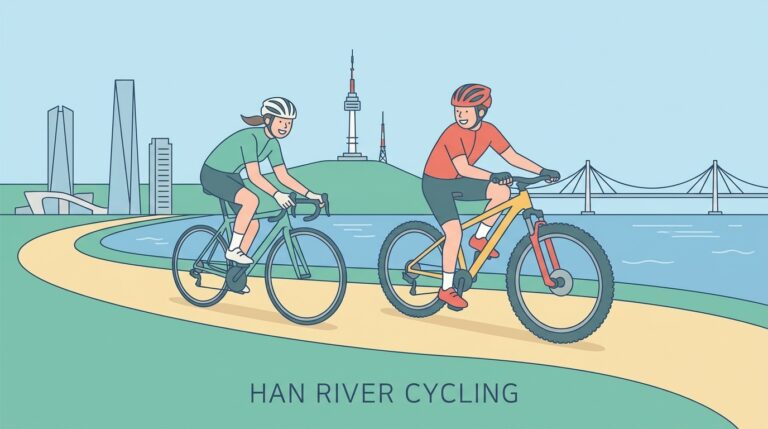
Riding in Korea: Road Bike vs. MTB Etiquette and Expressions
Phase 1: Empathy
안녕하세요! 매일한글 에디터입니다. Have you ever stepped onto the Han River bike paths in Seoul, ready for a relaxed weekend cruise, only to be overtaken by a sleek pack of cyclists in matching aerodynamic kits pushing 35 km/h? Or perhaps you signed up for a group ride expecting a gentle scenic tour, only to find yourself climbing a steep forest trail with mountain bike enthusiasts?
Navigating Korean cycling culture can be subtle. While cycling is immensely popular in South Korea—from the paved trails of the Han River (한강 자전거길) to the rugged mountain paths of Gangwon-do—the linguistic and social norms differ sharply depending on whether you ride a 로드 자전거 (Road Bike) or an MTB (Mountain Bike).
Our advanced C1 learners often tell us: “I know standard cycling vocabulary, but I miss the contextual slang and social cues used by native riders.” Mastering these expressions allows you to seamlessly integrate into local cycling clubs (자전거 동호회), respond appropriately on shared paths, and speak like a seasoned Korean rider. Let’s dive deep into the real language of Korean cycling!
Phase 2: Core Expressions Deep Dive
1. 임도를 타다 (Im-do-reul ta-da)
- Pronunciation: [Im-do-reul ta-da] (Sounds like “Eem-doh roll tah-dah”)
- Meaning: Literal: To ride on a forest/logging road. | Nuance: Specifically refers to off-road gravel or dirt trail riding typical for MTB enthusiasts in Korea’s mountainous terrain.
- K-Culture Moment: You will hear this frequently among weekend MTB groups meeting at suburban train stations (like Gapyeong or Yangpyeong) before heading up forestry trails (임도).
- Editor’s Insight: 임도 (林道) literally means “forest road.” In Korea, where 70% of the land is mountainous, 임도를 타다 represents the peak MTB experience, contrasting with riding on paved city riverbanks.
- Situation Spectrum: Casual ✅ | Semi-formal ✅ | Formal ⚠️
- 🤔 Think About It: How does geography shape slang in your native language compared to Korea’s mountain-centric cycling culture?
2. 케이던스를 유지하다 (Ke-i-deon-seu-reul yu-ji-ha-da)
- Pronunciation: [Ke-i-deon-seu-reul yu-ji-ha-da] (Sounds like “Kay-ee-deon-seuh roll yoo-jee-hah-dah”)
- Meaning: Literal: To maintain cadence. | Nuance: Used by road bike riders discussing efficient, long-distance endurance pedaling.
- K-Culture Moment: Featured in Korean cycling vlogs (자덕 브이로그) on YouTube, where road cyclists analyze their telemetry along the Seoul-to-Busan cross-country route.
- Editor’s Insight: Korean road cyclists heavily adopt English technical terms adapted into Loanwords (외래어). Saying 케이던스를 유지하다 demonstrates technical proficiency during group pace-line riding.
- Situation Spectrum: Casual ✅ | Semi-formal ✅ | Formal ✅
- 🤔 Think About It: Why do technical sports communities adopt loanwords over native terms in high-level discussions?
3. 샤방샤방 라이딩 (Sha-bang-sha-bang Ra-i-ding)
- Pronunciation: [Sha-bang-sha-bang ra-i-ding] (Sounds like “Shah-bahng shah-bahng rye-deeng”)
- Meaning: Literal: Glamorous/breezy riding. | Nuance: A casual, low-effort ride focused on scenery, cafes, and socializing rather than intense exercise.
- K-Culture Moment: A popular caption on Instagram for road cyclists stopping at scenic riverside cafes along the Namhan River.
- Editor’s Insight: 샤방샤방 comes from the mimetic word describing something bright or stylish. In cycling, it signals to group members that no fast pacing or aggressive climbing will occur.
- Situation Spectrum: Casual ✅ | Semi-formal ⚠️ | Formal 🚫
- 🤔 Think About It: Is there an equivalent term in your culture that distinguishes social leisure sports from competitive training?
Phase 3: Textbook Korean vs. Real Korean
Situation 1: Inviting someone for a relaxed bike ride
- 📖 교과서 한국어: “오늘 천천히 자전거를 타고 풍경을 감상합시다.”
- 🗣️ 진짜 한국어: “오늘 샤방하게 라이딩 한 바퀴 돌고 카페나 가죠!”
- 💡 왜 다를까?: Advanced speakers use 샤방하게 (chill/lightly) and 한 바퀴 돌다 (do a loop) to set a casual, friendly tone without sounding overly academic.
Situation 2: Warning a trailing rider about upcoming rough terrain
- 📖 교과서 한국어: “앞에 도로 상태가 좋지 않으니 주의하십시오.”
- 🗣️ 진짜 한국어: “앞에 노면 안 좋아요, 끌바 준비하세요!”
- 💡 왜 다를까?: On the trail, brevity is key. 끌바 (walking the bike) is standard vernacular among local riders when terrain gets too steep or hazardous.
Phase 4: K-Culture Deep Dive & Non-Verbal Manners
4-1. Nunchi & Cycling Etiquette
When riding in Korea, 눈치 (Nunchi – social awareness) is essential:
* Passing Etiquette: Always call out “지나갈게요!” (Passing on your left/right!) or use a subtle bell tap. High-speed passing without notification on shared paths like the Han River is considered impolite.
* Trail Greeting: On mountain trails (임도), MTB riders exchange nod greetings (목인사) or say “수고하십니다!” when passing oncoming riders.
4-2. Cultural Code: The Post-Ride Feast (풀코스 모임)
In Korea, cycling is deeply tied to food culture (자전거 먹방). Road cyclists often target famous local specialty restaurants (e.g., Chugyeok-gukbap or Makguksu in Yangpyeong) as their turnaround destination. MTB riders frequently gather for hearty Korean BBQ or pajeon after tackling mountain passes.
Phase 5: Interactive Roleplay Scenario
Setting: You join a local cycling club ride near the Han River, choosing between joining the Road Bike group or the MTB group.
NPC Character: Min-soo (Senior Club Leader, energetic road & trail cyclist)
- Min-soo: “오늘 로드팀은 팔당까지 속도 좀 낼 거고, MTB팀은 아차산 임도 타러 갑니다. 어느 쪽으로 가실래요?”
(Road team is pacing fast to Paldang, while the MTB team is taking the Achasan trail. Which way will you go?) - You: “저는 오늘 샤방샤방 타면서 풍경도 보고 싶은데, 로드팀 따라가도 될까요?”
(I want to ride chill and look at the scenery today, can I follow the road team?) - Min-soo: “아, 오늘 로드팀은 케이던스 90 이상 유지하면서 팩라이딩 할 거라 조금 힘드실 수도 있어요!”
(Ah, today’s road team is holding a cadence over 90 in a pack ride, so it might be tough!) - You: “아 그렇군요! 그럼 저는 MTB팀 따라서 임도 라이딩 경험해 보고 싶어요.”
(Ah I see! Then I’d love to follow the MTB team and experience trail riding.) - Min-soo: “좋은 선택이에요! 임도는 비포장도로라 끌바하는 구간도 있을 테니 조심히 타세요.”
(Great choice! The trail is unpaved so there will be bike-walking sections, ride safely.) - You: “네, 안전하게 따라가겠습니다. 혹시 중간에 쉬는 카페도 들르나요?”
(Yes, I’ll follow safely. Do we stop by a cafe along the way?) - Min-soo: “당연하죠! 정상 찍고 내려와서 유명한 막국수집 가기로 했습니다.”
(Of course! After hitting the summit, we’re going to a famous Makguksu place.) - You: “완벽하네요! 오늘 라이딩 정말 기대됩니다.”
(Perfect! I’m really looking forward to today’s ride.)
🔀 Interactive Choice Point
Min-soo asks: “경사가 너무 가파른데 타실 수 있겠어요?” (The incline is steep, can you ride it?)
* Option A: “문제없습니다, 끝까지 페달 밟겠습니다!” (I’ll push through!)
* Option B: “무리하지 않고 여기서 끌바 하겠습니다.” (I’ll walk my bike here without overexerting.)
* Option C: “포기하고 그냥 혼자 돌아갈게요.” (I give up, I’ll go back alone.)
Feedback:
* Best (Option B): Excellent! Demonstrates safety consciousness and natural cycling slang (끌바).
* Risk (Option A): Ambitious, but riding past physical limits on unpaved Korean terrain risks injury.
* Bad (Option C): Leaving a group ride abruptly without prior notice breaks group etiquette.
Phase 6: 10-Second Emotion Shadowing Drill
[😊 Excitingly]오늘 / 샤방하게 라이딩 한 바퀴 돌고 / 맛집 가요!
(Oneul / sabang-hage ra-i-ding han ba-kwi dol-go / mat-jip ga-yo!)[😮 Impressed]와, / 임도 경사가 엄청나네요! / 끌바 해야겠어요.
(Wa, / im-do gyeong-sa-ga eom-cheong-na-ne-yo! / kkeul-ba hae-ya-get-seo-yo.)[🚴♂️ Focused]팩라이딩 할 때는 / 간격을 유지하면서 / 안전하게 타세요!
(Paek-ra-i-ding hal ttae-neun / gan-gyeok-eul yu-ji-ha-myeon-seo / an-jeon-ha-ge ta-se-yo!)
Phase 7: K-Culture Mini Dictionary
- 자덕 (Ja-deok) | Cycling Enthusiast / Bike Nerd | Blend of 자전거 (bike) and 덕후 (geek). Used proudly by avid cyclists.
- 끌바 (Kkeul-ba) | Walking the Bike | Abbreviation of 끌고 가는 바이크. Standard term when climbing too steep hills.
- 잔차 (Jan-cha) | Ride / Bicycle | Informal slang shortening of 자전거, widely used in online cycling forums.
- 업힐 (Up-hill) | Uphill Climb | Loanword used specifically for challenging uphill cycling segments.
Phase 8: Traveler’s Survival Kit
Top 3 Survival Expressions
- 지나갈게요! (Ji-na-gal-ge-yo!) – Passing through! (Use on crowded paths)
- 자전거 도로가 어디예요? (Ja-jeon-geo do-ro-ga eo-di-ye-yo?) – Where is the bike path?
- 펑크 났어요. (Peong-keu nas-seo-yo.) – I got a flat tire.
Editor’s Travel Note
Before heading out, make sure to check route elevation using the KakaoMap app download for dedicated bicycle navigation routes across South Korea. Also, note that bikes are generally allowed on Seoul Metro Line 7 and 경의중앙선 (Gyeongui-Jungang Line) on weekends only!
Phase 9: A Deeper Look into Korean Society
In Korea, cycling is not merely an individual workout; it reflects the nation’s strong 동호회 (Club/Community) culture. Shared experiences—like overcoming steep hills together and sharing a meal afterward—foster tight social bonds. Understanding cycling slang is your key to unlocking genuine camaraderie with Korean outdoor enthusiasts.
💬 Your Turn: Do you prefer road cycling or mountain biking? Share your riding story in the comments below!
Phase 10: FAQ & Common Mistakes
Q: Can I bring my road bike on Korean subways anytime?
A: No. On most Seoul subway lines, bikes are only permitted on Saturdays, Sundays, and public holidays (usually restricted to the front and rear cars).
Q: What is the main structural difference in terms used between Road and MTB riders in Korea?
A: Road riders use terms derived from endurance racing like 팩라이딩 (pack riding) and 케이던스 (cadence), whereas MTB riders heavily use terrain terms like 임도 (forest road) and 싱글 (singletrack).
Q: Is helmet usage legally required in Korea?
A: Yes, safety helmet laws apply to all cyclists in South Korea, though enforcement varies; wearing one is expected in all organized rides.
🚨 Common Mistakes
- Using 걷기 instead of 끌바: Saying “자전거 걸어요” sounds awkward. Use 끌바 (walking the bike).
- Mispronouncing 외래어 (Loanwords): Pronounce 케이던스 as [Ke-i-deon-seu] rather than English cadence pronunciation.
- Silent Overtaking: Failing to call out 지나갈게요 when passing pedestrian-shared zones.
Phase 11: Action Mission
- Bronze Mission: Practice saying “지나갈게요!” 3 times out loud with clear pronunciation.
- Silver Mission: Search
#자덕or#샤방라이딩on Instagram and comment on a Korean cyclist’s post. - Gold Mission: Join a local Korean cycling ride on KakaoTalk Open Chat (카카오톡 오픈채팅) and participate in a 샤방라이딩 group ride.
🎮 K-Culture Mission: Watch a Korean cycling vlog on YouTube and identify at least two slang terms (자덕, 끌바, 업힐) used in the video!
Phase 12: Interactive Quiz Challenge
Q1. What does the expression “끌바” mean when riding in Korea?
A) Riding at top speed
B) Walking your bike on steep or unpaved terrain
C) Buying a new bicycle
Click to view answer & explanation
Answer: B
Explanation: “끌바” is a compound of 끌다 (to pull/drag) and 바이크 (bike), meaning walking your bicycle when riding is difficult.
**Q2. True or False:







