

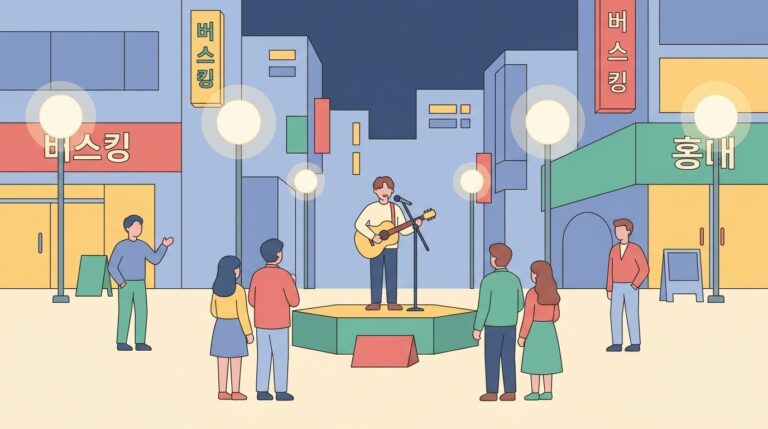
Master the Unwritten Rules of Hongdae Busking and Live Event Curation in Korean
안녕하세요! 매일한글 에디터입니다. Welcome back to another immersive deep-dive into Korean culture and language! If you’ve ever walked through the vibrant streets of Hongdae in Seoul on a breezy Friday evening, you know that street performances (버스킹) are not just impromptu street jams—they are meticulously curated cultural events. Today, we are stepping into the shoes of a Performing Arts Planner & Live Event Curator (공연 예술 기획자).
Planning a live street performance in Korea involves navigating real-time crowd dynamics, district compliance, sound check negotiations, and artist-audience chemistry. Many advanced learners tell us: “I know formal event terminology from textbooks, but when I step into a live outdoor venue in Seoul, native speakers use a totally different layer of professional jargon and nuanced idioms!” Don’t worry—this guide was crafted based on real field experiences and producer insights to equip you with authentic C1-level Korean expressions that will make you sound like a seasoned Korean showrunner.
Phase 2: Core C1 Expressions Breakdown
1. 관객과의 호흡을 유도하다 (Gwan-gyaek-gwa-ui ho-heub-eul yu-do-ha-da)
- Pronunciation: [Gwan-gyaek-gwa-ui ho-heub-eul yu-do-ha-da] (Think: “Gwan-gyack-gwa-we ho-hoob-eul yu-do-ha-dah”)
- Meaning: Literally “to induce breathing with the audience.” Figuratively, it means to build active stage rapport and drive crowd synergy during a live set.
- K-Culture Moment: On music curation shows like Begin Again, producers often praise acoustic buskers who effortlessly get passersby to sway and sing along by saying: “관객과의 호흡을 매끄럽게 유도하시네요!”
- Editor’s Insight: In Korean performing arts, performance isn’t a one-way street; it’s a shared emotional state. Using ‘호흡’ (breathing) highlights this mutual organic flow.
- Situation Spectrum: Casual ⚠️ | Semi-formal ✅ | Formal ✅
- 🤔 Think About It: How does the metaphor of “shared breathing” contrast with Western expressions like “engaging the crowd” or “reading the room”?
2. 현장 분위기를 장악하다 (Hyeon-jang bun-wi-gi-reul jang-ag-ha-da)
- Pronunciation: [Hyeon-jang bun-wi-gi-reul jang-ag-ha-da] (Think: “Hyeon-jang boon-wee-gee-reul jahng-ahk-hah-dah”)
- Meaning: Directly translates to “to seize the atmosphere of the site.” In live curation, it means to command total control over the energy of an outdoor stage.
- K-Culture Moment: When a dance crew in the Hongdae Busking Zone suddenly silences a chaotic street crowd before an explosive drop, commentators say: “현장 분위기를 완전 장악했어요!”
- Editor’s Insight: ‘장악하다’ carries a strong connotation of mastery and charisma. Use this when writing performance reviews or pitch proposals.
- Situation Spectrum: Casual ✅ | Semi-formal ✅ | Formal ✅
- 🤔 Think About It: What non-verbal cues contribute to “seizing the atmosphere” in an open street setting versus an enclosed concert hall?
3. 돌발 상황에 유연하게 대처하다 (Dol-bal sang-hwang-e yu-yeon-ha-ge dae-cheo-ha-da)
- Pronunciation: [Dol-bal sang-hwang-e yu-yeon-ha-ge dae-cheo-ha-da] (Think: “Dohl-bahl sahng-hwahng-eh yoo-yeon-hah-geh dae-chuh-hah-dah”)
- Meaning: Literally “to flexibly cope with sudden situations.” It signifies seamlessly managing live outdoor glitches, weather changes, or noise complaints.
- K-Culture Moment: When rain suddenly starts during an outdoor acoustic street gig and the artist smoothly switches to a umbrella-themed song while the crew covers speakers.
- Editor’s Insight: Outdoor busking in Korea is full of variables—from district noise meters to sudden power cuts. Demonstrating ‘유연한 대처’ is the ultimate sign of professional competence.
- Situation Spectrum: Casual ⚠️ | Semi-formal ✅ | Formal ✅
- 🤔 Think About It: Why is adaptability viewed as a crucial leadership trait in high-density Korean public spaces?
Phase 3: Textbook Korean vs. Real-World Korean
Situation 1: Checking sound levels with nearby store owners before a busking set
- 📖 Textbook Korean: “소음 크기가 괜찮습니까?” (Is the noise level acceptable?)
- 🗣️ Real-World Native Korean: “음량 체크 좀 진행할게요. 주변 상가 영업에 방해 안 되시게 톤 조절하겠습니다!” (We’ll run a quick sound check. We’ll adjust the tone so it won’t disturb your store’s business!)
- 💡 Why the Difference? Real event planners use action-oriented jargon like ‘음량 체크’ and proactively reassure nearby merchants about tone/decibel control before any complaint occurs.
Situation 2: Expressing amazement at a busker’s crowd control
- 📖 Textbook Korean: “공연 반응이 매우 좋습니다.” (The reaction to the performance is very good.)
- 🗣️ Real-World Native Korean: “관객 몰입도가 장난 아닌데요? 완전 현장을 찢으셨어요!” (The audience immersion is insane! They completely tore up the stage!)
- 💡 Why the Difference? While formal reviews use ‘관객 몰입도’, live industry pros frequently use colorful slang like ‘현장을 찢다’ (to tear up the stage/massacre the venue with talent).
Phase 4: K-Culture Deep Dive & Non-Verbal Manners
4-1. Nunchi (눈치) & Street Boundaries in Busking
In Korea’s street performance hubs (like Hongdae, Sinchon, and Yeouido Hangang Park), busking is strictly regulated by designated ‘버스킹 존’ (Busking Zones) managed by district offices (구청).
* The Nunchi of Decibels: Even if you have a valid permit, turning up amplifier bass near residential or commercial zones triggers immediate citizen complaints (민원). Professional planners always make visual contact with nearby shop owners, giving a polite nod (목인사) and a hand gesture indicating volume reduction before starting.
* Crowd Safety Line: Curators constantly read crowd density. If spectators spill onto pedestrian or bike paths, street planners use calm hand sweeping movements to create an arc barrier without interrupting the artist’s set.
4-2. Cultural Code: The ‘Begin Again’ Busking Aesthetic
Street performance in Korea has evolved from unsanctioned busking into an elevated art form. TV shows like Begin Again transformed public perception: busking is viewed as a vulnerable, raw dialogue between elite musicians and everyday citizens resting after work. True Korean busking curation balances spontaneous street energy with high visual and acoustic polish.
Phase 5: Real-World C1 Roleplay Scenario
Setting: You are working as a co-producer with Stage Manager Min-woo (민우 팀장) at a weekend outdoor arts festival in Hongdae Busking Zone #2.
- 민우 팀장: “에디터 씨, 지금 5분 뒤에 메인 버스킹팀 올라가야 하는데, 옆 구역 댄스팀 음량이 너무 커서 우리 쪽 아쿠스틱 사운드가 묻힐 것 같아요.”
(Editor, our main acoustic busking team goes up in 5 minutes, but the dance team in the adjacent zone is so loud that our acoustic sound will get drowned out.) - You: “🎭 [걱정스러운 표정으로 현장을 살피며] 아, 저쪽 앰프 베이스가 이쪽까지 울리네요. 제가 가서 상호 음량 조율을 부탁드리고 올까요?”
(Ah, the amp bass from that side is echoing all the way here. Shall I go over and request a mutual volume adjustment?) - 민우 팀장: “좋아요. 괜히 마찰 생기지 않게 톤 다운해서 잘 이야기해 주세요. 우리 타임스롯이 30분밖에 안 남았거든요.”
(Great. Please keep your tone polite so we don’t cause friction. We only have a 30-minute timeslot left.) - You: “🎭 [빠른 걸음으로 이동해 옆 팀 기획자에게 다가가며] 안녕하세요! 옆 구역 어쿠스틱 세션 진행하는 기획팀인데요, 현장 소음이 겹쳐서 서로 사운드가 뭉개지는 것 같습니다.”
(Hello! We are the planning team running the acoustic session in the next zone. It seems our sound ranges are overlapping and muddying both our sets.) - 옆 팀 기획자: “아, 그래요? 저희도 몰입도가 막 올라가는 단원이라 음량을 줄이기가 조금 난감한데…”
(Oh, really? We’re right at the high-immersion climax of our track, so it’s a bit tricky to lower our volume right now…) - You: “🎭 [상대방의 입장에 공감하며 미소를 띠고] 성곡적인 공연 만드시는 중인데 죄송합니다! 그럼 저희 어쿠스틱 하이라이트 곡 진행되는 10분만 EQ 저음역대를 살짝 낮춰주실 수 있을까요? 저희도 뒤이어 적극 보완해 드리겠습니다!”
(I apologize since you’re in the middle of a great show! Could you perhaps lower your amp’s low-frequency EQ just for 10 minutes during our acoustic highlight track? We’ll gladly return the favor during your next set!) - 옆 팀 기획자: “아, 10분 정도라면 괜찮습니다. EQ 바로 조절해 드릴게요!”
(Ah, if it’s just about 10 minutes, that’s fine. I’ll adjust the EQ right away!) - You: “🎭 [안도하며 감사 인사를 건네며] 정말 감사합니다! 덕분에 두 무대 모두 사운드 퀄리티를 살릴 수 있겠네요.”
(Thank you so much! Thanks to you, both our stages will keep high sound quality.)
🔀 Interactive Scenario Branching
If the adjacent stage manager hesitates, what is your next best action as a C1 curator?
- Choice A: Threaten to report them to the Mapo District Office (마포구청) for exceeding legal decibel limits immediately.
- Choice B: Offer a win-win time-sharing arrangement: offer to extend their final slot by 10 minutes if they pause sound checks briefly during your acoustic lead song.
- Choice C: Turn up your own venue’s main amplifier to maximum power to drown them out.
[Feedback Matrix]
- Choice A (Risk): ❌ Causes severe professional friction and damages networking in the tight-knit street performance industry.
- Choice B (Best): ✅ Demonstrates high-level negotiation skills, cultural tact (Nunchi), and mutual respect among arts professionals.
- Choice C (Bad):  ❌ Leads to immediate noise complaints (민원) from local residents and potential cancellation of both busking permits.
Phase 6: 10-Second Emotion Shadowing Drill
Practice these lines out loud with the indicated pauses (/) and emotional tone!
[🔥 열정적이고 카리스마 있게 / Passionate & Charismatic]
“이번 버스킹 무대는 / 관객과의 호흡을 최우선으로 두고 / 현장 분위기를 완전 장악해 보겠습니다!”
(Gwan-gyaek-gwa-ui ho-heub-eul choe-u-seon-eu-ro du-go / hyeon-jang bun-wi-gi-reul wan-jeon jang-ag-hae bo-ges-seum-ni-da!)-
[🤝 차분하고 협상하듯 / Calm & Professional]
“현장 돌발 상황에도 / 유연하게 대처하면서 / 주변 상가와 관객 모두 만족하는 공연을 만들겠습니다.”
(Hyeon-jang dol-bal sang-hwang-e-do / yu-yeon-ha-ge dae-cheo-ha-myeon-seo / ju-byeon sang-ga-wa gwan-gyaek mo-du man-jok-ha-neun gong-yeon-eul man-deul-ges-seum-ni-da.)
Phase 7: K-Culture Mini Dictionary
- 버스킹 존 (Busking Zone / Beo-seu-king Jon)
- Meaning: Designated outdoor public spaces managed by municipal authorities specifically assigned for street performances.
- Usage: “홍대 버스킹 존 3번 구역은 사전 예약이 필수입니다.”
- 떼창 (Tte-chang / Crowd Sing-Along)
- Meaning: The iconic Korean phenomenon where the entire audience sings along in unison with the performer.
- Usage: “잔나비의 버스킹 무대에서 관객들의 감동적인 떼창이 터져 나왔습니다.”
- 음량 규제 (Eum-ryang Gyu-je / Sound Regulations)
- Meaning: Decibel limit enforcement in outdoor performance spaces.
- Usage: “야간 버스킹은 음량 규제가 엄격하니 앰프 출력에 신경 써주세요.”
- 관객 몰입도 (Gwan-gyaek Mol-ip-do / Audience Engagement & Immersion)
- Meaning: The level of focus, emotional resonance, and attention a audience invests in a live set.
- Usage: “아티스트의 무대 매너 덕분에 관객 몰입도가 최고조에 달했습니다.”
Phase 8: Traveler’s Live Survival Kit
TOP 3 Street Event Survival Expressions
- “혹시 버스킹 공연 스케줄 어디서 확인하나요?”
(Hok-si beo-seu-king gong-yeon seu-ke-jul eo-di-seo hwa-gin-ha-na-yo?)- Pro Tip: Use this when asking street coordinators or venue info booths about upcoming busking lineups.
- “관객 라인 이쪽으로 살짝 정리해 드릴게요!”
(Gwan-gyaek ra-in i-jjok-eu-ro sal-jjak jeong-ri-hae deu-ril-ge-yo!)- Pro Tip: Perfect line when assisting staff to organize audience safety boundaries.
- “사운드 밸런스 아주 좋습니다!”
(Sa-un-deu bael-reons-eu a-ju joh-seum-ni-da!)- Pro Tip: Complimenting the sound engineer or performer on stage balance.
Editor’s Travel Note
Planning an outdoor popup or attending street gigs in Seoul? Always download Naver Map App Download to search for active cultural street zones like Hongdae Red Road (홍대 레드로드) or Yeouido Hangang Park Multi-Plaza. Checking local district notices guarantees you won’t encounter sudden venue relocations due to municipal events!
Phase 9: One Step Deeper (Humanities & Cultural Reflection)
In Korean culture, the traditional concept of ‘흥’ (Heung – collective joyful energy) and ‘정’ (Jeong – empathetic bond) meet dynamically on the busking street. Unlike traditional indoor concert halls where a rigid wall exists between stage and seating, street performances in modern Korea transform open concrete into a temporary democratic sanctuary of art. When a curator guides crowd flow or negotiates decibel levels with nearby shop owners, they aren’t merely enforcing rules; they are practicing ‘상생’ (Sang-saeng – harmonious coexistence) between commercial life and artistic expression.
💬 Your Turn: Have you ever watched or managed a street performance in your home country? How do outdoor sound regulations and crowd engagements differ from Korea? Share your experiences in the comments below!
Phase 10: FAQ & Common Mistakes
Q: Can anyone set up an amplifier and perform anywhere in Hongdae or Hangang Park?
A: No! Seoul enforces strict reservation systems for official busking zones through local district websites (e.g., Mapo-gu Culture & Tourism portal). Performing outside designated spots with an amp can result in fines due to noise complaints (민원).
Q: What is the difference between ‘버스킹’ (Busking) and ‘거리 공연’ (Geori Gong-yeon)?
A: ‘버스킹’ is widely used for youthful, music-centric, or dance-centric street gigs. ‘거리 공연’ is a broader formal arts term encompassing mime, street theater, traditional arts, and curated outdoor festival acts.
Q: How do I compliment an artist after a busking set professionally?
A: Instead of just saying “좋았어요” (It was good), say: “오늘 무대 연출과 관객 몰입도가 davvero 대단했어요!” (The stage atmosphere and audience immersion today were truly incredible!)
🚨 Common Mistakes Warning Board
- ❌ Mistake 1: Saying “소음을 줄이세요” (Lower your noise) to a street performer.
- Correct Action: Use professional industry terms like “앰프 음량을 살짝 조절해 주실 수 있나요?” (Could you slightly adjust the amp volume?)
- ❌ Mistake 2: Assuming street busking is totally informal and using casual 반말 (informal Korean) with event coordinators.
- Correct Action: Always maintain 존댓말 (polite speech) with sound technicians, district officers, and fellow curators.
- ❌ Mistake 3: Using textbook terms like “연주자” exclusively when referring to contemporary busking teams.
- Correct Action: Native curators usually say “버스커”, “아티스트”, or “공연팀”.
Phase 11: Action Mission
- 🥉 Bronze Mission (Solo Practice): Read the Phase 6 Emotion Shadowing sentences out loud 3 times, focusing on natural pauses at slashes
/. - 🥈 Silver Mission (SNS Sharing): Watch a YouTube street performance video in Hongdae and post a Korean comment using the expression: “현장 분위기를 완전 장악하셨네요!”
- 🥇 Gold Mission (Real-life Execution): Next time you visit Korea, locate an official Busking Zone in Mapo-gu using Naver Maps, watch a live set, and compliment the crew’s sound or energy using C1 expressions!
🎮 K-Culture Mission: Watch an episode of a Korean street music show like Begin Again or outdoor performance clips. Listen closely for when producers use the phrase “관객과의 호흡” and write down the scene context!
Phase 12: Interactive Quiz Challenge
Q1. Fill in the blank with the appropriate C1 performing arts expression:
“오늘 버스킹 아티스트는 뛰어난 무대 매너로 ______ 유도하여 street 무대를 활기차게 만들었다.”
1) 음량 소음
2) 관객과의 호흡을
3) 민원 신고를
Click for Answer & Explanation
Answer: 2) 관객과의 호흡을
Explanation: ‘관객과의 호흡을 유도하다’ means to seamlessly build dynamic rapport and crowd synergy during a live performance.
Q2. True or False?
“In Korea, you can set up high-powered amplifiers for street performances anywhere without checking local district regulations as long as it is during the daytime.”
Click for Answer & Explanation
Answer: False!
Explanation: Major busking hubs in Seoul require registration in official Busking Zones (버스킹 존) and compliance with strict local decibel limits to maintain harmony with residents and local businesses.







