

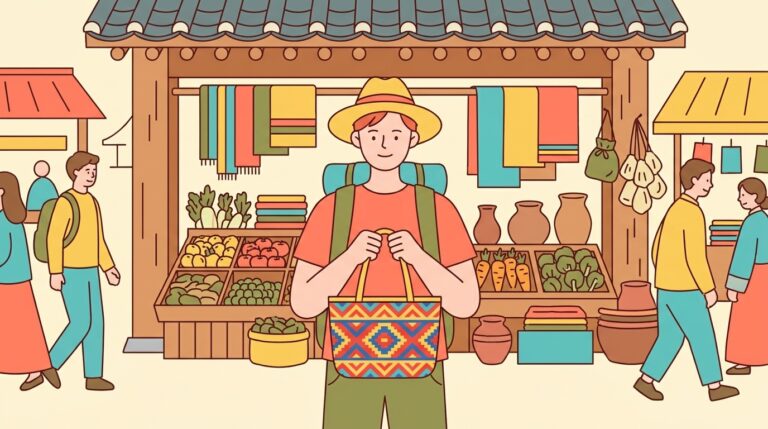
Mastering Market Shopping in Korea: How to Use Your Reusable Bag Like a Local
안녕하세요! (Hello!) I’m your Daily Hangul editor and your 10-year local culture guide. Have you ever stepped into a lively traditional market in Seoul, smelled the delicious freshly fried jeon (savory pancakes), and picked up sweet seasonal strawberries, only to get stuck when paying? You pull out your own tote bag, but you freeze—how do you tell the friendly stall owner (imo or sajangnim) that you brought your own bag and don’t need a plastic one?
Don’t worry at all! You are not alone. Many beginner Korean learners feel nervous about speaking on the spot in bustling environments. In Korea’s vibrant traditional markets, using your own shopping bag is not only eco-friendly, but it’s also a wonderful conversation starter that can earn you extra warm smiles—and sometimes even free extra food called deom (덤)! Based on real feedback from hundreds of our learners at Daily Hangul, this guide will give you the exact, simple phrases you need to shop confidently like a true local.
Phase 2: Core Expressions Deep Dive
1. 장바구니에 담아 주세요
- Pronunciation: [Jang-ba-gu-ni-e dam-a ju-se-yo] (Sounds like: Jang-bah-goo-nee-eh dahm-ah joo-say-yo)
- Meaning: “Please put it in my shopping bag.” (Literal: Shopping bag into put please)
- K-Culture Moment: You often see characters in heartwarming K-dramas carrying colorful woven market bags while chatting happily with street food vendors.
- Editor’s Insight: Jangbaguni means shopping basket or eco-bag. Saying this upfront shows you are prepared and eco-conscious!
- Situation Spectrum: Casual ✅ | Semi-formal ✅ | Formal ⚠️
- 🤔 Think About It: In your home country, do cashiers automatically pack your bag, or do you always pack it yourself?
2. 봉투는 안 주셔도 돼요
- Pronunciation: [Bong-tu-neun an ju-syeo-do dwae-yo] (Sounds like: Bong-too-neun ahn joo-syuh-doh dway-yo)
- Meaning: “You don’t need to give me a plastic bag.” (Literal: Bag as for, even if not give, it’s okay)
- K-Culture Moment: Seen in everyday vlogs where locals politely wave their hand while showing their tote bag at checkout.
- Editor’s Insight: Using ~do dwae-yo (“it’s okay even if…”) is a very soft, polite way to decline something in Korean without sounding blunt.
- Situation Spectrum: Casual ✅ | Semi-formal ✅ | Formal ✅
- 🤔 Think About It: Notice how Korean polite refusals focus on relieving the seller of extra effort!
3. 제가 넣을게요
- Pronunciation: [Je-ga neo-eul-ge-yo] (Sounds like: Jeh-gah nuh-eul-geh-yo)
- Meaning: “I will put it in myself.” (Literal: I will put inside)
- K-Culture Moment: When market vendors are busy rushing to serve multiple customers, saying this helps them out immediately.
- Editor’s Insight: Market sellers love helpful customers! Saying Je-ga neo-eul-ge-yo lets them move on to the next item quickly.
- Situation Spectrum: Casual ✅ | Semi-formal ✅ | Formal ⚠️
- 🤔 Think About It: How does taking small actions to help service workers change your interaction with them?
Phase 3: Textbook Korean vs. Real Korean
Situation 1: Declining a plastic bag
- 📖 Textbook Korean: 비닐봉투가 필요 없습니다. (Bi-nil-bong-tu-ga pil-yo eop-seum-ni-da. – I do not need a plastic bag.)
- 🗣️ Real Korean: 봉투는 괜찮아요! (Bong-tu-neun gwaen-chan-a-yo! – Bag is okay/unnecessary!)
- 💡 Why is it different? Textbook phrases sound like formal announcements. In real life, gwaen-chan-a-yo (it’s okay) paired with a soft smile is the most natural way to say “no thanks.”
Situation 2: Asking to put items in your eco-bag
- 📖 Textbook Korean: 이것을 제 가방 안에 넣어 주십시오. (I-geot-eul je ga-bang an-e neo-eo ju-sip-si-o. – Please insert this inside my bag.)
- 🗣️ Real Korean: 여기(에) 담아 주세요! (Yeo-gi-e dam-a ju-se-yo! – Please put it in here!)
- 💡 Why is it different? Real Korean relies heavily on context and pointing. Just pointing to your open bag and saying yeo-gi-e dam-a ju-se-yo is natural and friendly.
Phase 4: K-Culture Deep Dive & Non-verbal Manners
4-1. Nunchi & Body Gestures
When shopping in a Korean traditional market, body language speaks volumes! Hold your reusable bag open with both hands or hold it gently toward the seller. If you want to say “No thank you” to a plastic bag, give a light head nod combined with a soft hand wave side-to-side near your chest level. This non-verbal gesture (Nunchi in action) instantly communicates politeness without any awkward stiffness.
4-2. Culture Code: The Warmth of Market Jeong (정)
Traditional Korean markets thrive on Jeong (affectionate community connection). Unlike large supermarkets with automated self-checkouts, traditional market vendors build personal rapport. When you bring your own bag and speak a few polite phrases, vendors appreciate your respect for their routine—and they might reward you with extra fruit or discount a few hundred won!
Phase 5: Real Roleplay Scenario
Setting: Mangwon Traditional Market (망원시장). You are buying fresh apples from a friendly market vendor (Imo – auntie).
- Turn 1 (Vendor): 어서 오세요! 사과 싱싱해요. (Welcome! The apples are very fresh.)
- Turn 2 (You): [😊 Smiling] 안녕하세요! 사과 다섯 개 주세요. (An-nyeong-ha-se-yo! Sa-gwa da-seot gae ju-se-yo. / Hello! Five apples please.)
- Turn 3 (Vendor): 네~ 봉투에 담아 줄까요? (Sure~ Shall I put them in a plastic bag?)
- Turn 4 (You): 🎭 [Holding out your canvas tote bag] 아, 봉투는 괜찮아요! 여기에 담아 주세요. (A, bong-tu-neun gwaen-chan-a-yo! Yeo-gi-e dam-a ju-se-yo. / Ah, plastic bag is okay! Please put them in here.)
- Turn 5 (Vendor): 아이구, 장바구니 가져왔구나! 착해라. (Aigu, you brought a shopping bag! How nice.)
- Turn 6 (You): [😊 Handing cash with both hands] 네, 제가 넣을게요. 얼마예요? (Ne, je-ga neo-eul-ge-yo. Eol-ma-ye-yo? / Yes, I’ll pack them myself. How much is it?)
- Turn 7 (Vendor): 만 원이에요. 장바구니 챙겼으니까 덤으로 하나 더 줄게! (10,000 won. Since you brought your bag, I’ll give you one extra for free!)
- Turn 8 (You): [😮 Bright smile] 정말요? 감사합니당! (Jeong-mal-yo? Gam-sa-ham-ni-da! / Really? Thank you so much!)
🔀 Interactive Choice Point
The vendor asks: “봉투에 담아 줄까요?” (Shall I put them in a plastic bag?)
- Option A: “아니요, 봉투 싫어요.” (A-ni-yo, bong-tu sil-eo-yo.)
- Feedback (Risk ⚠️): Grammatically clear, but sil-eo-yo (“I dislike it”) sounds blunt and childish in public shopping contexts.
- Option B: “봉투는 괜찮아요! 장바구니에 담아 주세요.” (Bong-tu-neun gwaen-chan-a-yo! Jang-ba-gu-ni-e dam-a ju-se-yo.)
- Feedback (Best 🎉): Perfect! Polite, natural, and clearly states your eco-friendly intent.
- Option C: “비닐봉투 불필요합니다.” (Bi-nil-bong-tu bul-pil-yo-ham-ni-da.)
- Feedback (Bad 🚫): Too robotic and stiff for a cozy market stall!
Phase 6: 10-Second Emotion Shadowing Drill
Practice these lines aloud with the emotional cues and pause breaks (/):
- [😊 Cheerful & Polite] 봉투는 / 괜찮아요! (Bong-tu-neun / gwaen-chan-a-yo!)
- [🤝 Helpful & Friendly] 여기 / 장바구니에 / 담아 주세요. (Yeo-gi / jang-ba-gu-ni-e / dam-a ju-se-yo.)
- [✨ Enthusiastic] 제가 / 직접 / 넣을게요! (Je-ga / jik-jeop / neo-eul-ge-yo!)
Phase 7: K-Culture Mini Dictionary
- 장바구니 (Jang-ba-gu-ni): Reusable shopping bag or market basket. A staple item for eco-conscious Korean shoppers.
- 덤 (Deom): Free extra items given by traditional market vendors as a gesture of goodwill (Jeong).
- 이모 (Imo): Literally “maternal aunt,” but widely used to affectionately address female market stall owners or restaurant staff.
- 현금 (Hyeon-geum): Cash. While cards are accepted almost everywhere, having small cash at markets is appreciated!
Phase 8: Traveler’s Survival Kit
Top 3 Market Expressions
- 장바구니 있어요. (Jang-ba-gu-ni is-seo-yo.) = I have a shopping bag.
- 여기 담아 주세요. (Yeo-gi dam-a ju-se-yo.) = Please put it in here.
- 계산해 주세요. (Gye-san-hae ju-se-yo.) = Please bill/calculate this for me.
Editor’s Travel Note
Before heading out to explore Korean markets, make sure you download essential local navigation tools! Check out our guide on Naver Map App Download and Setup to find famous local markets like Gwangjang or Mangwon with ease. Keep 1,000 won and 5,000 won cash bills ready in your pocket for speedy transactions!
Phase 9: One Step Deeper
In modern Korea, eco-friendly policies strongly restrict single-use plastic bags in large supermarkets and convenience stores. In traditional markets, while small plastic bags are still available, bringing your own bag reflects mung-chi-neun ma-eum (community spirit). Showing respect for sustainability bridges the gap between traveler and local resident seamlessly.
💬 Your Turn: Have you ever used a reusable bag in another country? What is your favorite traditional market memory? Share your story in the comments below!
Phase 10: FAQ & Common Mistakes
Q: Can I use a regular tote bag or backpack as a shopping bag in Korea?
A: Yes, absolutely! Any personal bag works. Just hold it open and say “여기에 담아 주세요” (Please put it in here).
Q: Is plastic bag usage free at Korean markets?
A: At traditional markets, small plastic bags are often free, but at supermarkets, you must purchase them. Bringing your own bag saves money and protects the environment!
Q: What should I say if the vendor tries to give me a plastic bag anyway?
A: Wave your hand gently and say with a smile: “괜찮아요, 장바구니 있어요!” (Gwaen-chan-a-yo, jang-ba-gu-ni is-seo-yo! – It’s okay, I have a shopping bag!).
🚨 Common Mistakes Warning Board
- ❌ Mistake: Saying “봉투 필요 없어요!” in a sharp tone.
- ✅ Correct Action: Add “괜찮아요~” beforehand (“괜찮아요, 봉투는 없어도 돼요”) to keep it warm.
- ❌ Mistake: Throwing your reusable bag onto the counter.
- ✅ Correct Action: Hold the bag open with both hands so the vendor can easily slide items in.
- ❌ Mistake: Using formal textbook terms like “비닐주머니” (an outdated word for plastic bag).
- ✅ Correct Action: Simply use “봉투” (bong-tu).
Phase 11: Action Mission
- 🥉 Bronze Mission: Practice saying “봉투는 괜찮아요!” out loud 3 times in front of your mirror.
- 🥈 Silver Mission: Take a picture of your favorite tote bag and post it on social media with the hashtag
#DailyHangulEcoBag. - 🥇 Gold Mission: Use “여기에 담아 주세요” when ordering at a Korean grocery store or market in real life!
🎮 K-Culture Mission: Watch a clip of a Korean market food tour vlog and spot 2 times a local uses a reusable shopping bag!
Phase 12: Interactive Quiz Challenge
Q1. Situation Quiz
You are at Mangwon Market buying fruit. The seller reaches for a plastic bag. What is the most polite, natural response?
* A) 비닐을 버리세요! (Bi-nil-eul beo-ri-se-yo!)
* B) 봉투는 괜찮아요, 여기 담아 주세요! (Bong-tu-neun gwaen-chan-a-yo, yeo-gi dam-a ju-se-yo!)
* C) 봉투 싫다! (Bong-tu sil-ta!)
🔍 Click to see Answer & Explanation
Correct Answer: B
Explanation: Option B is friendly, natural, and polite for A2 learners! Option A means “Throw away the plastic!” (rude) and Option C is incomplete informal speech.
Q2. Fill-in-the-Blank Quiz
Complete the phrase: “장바구니에 ______ 주세요.” (Please put it in my shopping bag.)
* A) 사 (sa)
* B) 담아 (dam-a)
* C) 먹어 (meok-eo)
🔍 Click to see Answer & Explanation
Correct Answer: B
Explanation: Dam-a ju-se-yo comes from dam-da (to put inside a container/bag).
Q3. True or False Culture Quiz
True or False: Traditional market sellers in Korea dislike it when you bring your own shopping bag.
🔍 Click to see Answer & Explanation
Correct Answer: False!
Explanation: Market vendors love organized, eco-friendly shoppers and will often compliment your local-style preparation!







