

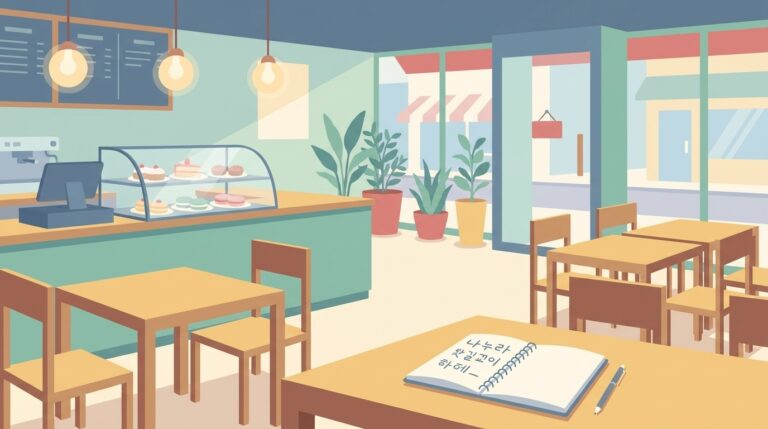
Dream Big in Korea: Expressing Your Hopes to Open Your Own Shop!
Phase 1: Empathy (Opening Story)
안녕하세요! This is your Daily Hangul editor!
Imagine walking down a trendy, sunlit street in Seongsu-dong or Yeonnam-dong. You see a cozy dessert cafe with minimalist wooden tables, the rich scent of freshly brewed espresso, and a crowd of happy customers snapping pictures of aesthetic pastries. You take a sip of your latte and think, “I really want to open my own little shop like this one day!”
If you have ever shared your big dreams with a Korean friend or colleagues, you might have felt a bit stuck. Knowing basic future verbs isn’t always enough to express the deep nuance of personal ambition, passion, and detailed planning. Should you sound confident or humble? How do you say “open a shop” without sounding like a textbook robot?
Don’t worry! This guide is created based on real learning experiences and feedback from learners just like you. By the end of this lesson, you will be able to share your future goals naturally, build rapport with native speakers, and describe your dream business with warmth and clarity.
Phase 2: Core Expressions Deep Dive
1. 가게를 차리다 (Gage-reul charida)
- Pronunciation: [Ga-gae-reul cha-ri-da] (Sounds like ‘kah-geh-rule cha-ree-dah’)
- Meaning: Literally “to set/prepare a store” vs. Actually “to open/start a shop or business.”
- K-Culture Moment: Seen in K-Dramas like Itaewon Class, where characters talk about starting their own pub or shop from scratch.
- Editor’s Insight: The verb 차리다 is also used in 상을 차리다 (to set the table) or 정신을 차리다 (to pull oneself together). It carries a nuance of carefully preparing and setting up everything from the ground up.
- Situation Spectrum:
- Casual: ✅ 가게 차리고 싶어.
- Semi-formal: ✅ 가게를 차리고 싶어요.
- Formal: ✅ 가게를 차리고자 합니다.
- Think About It: Why do you think Koreans use the same verb 차리다 for setting a dinner table and starting a business?
2. ~을/를 목표로 하고 있어요 (Eul/reul mok-pyo-ro ha-go iss-eo-yo)
- Pronunciation: [Mok-pyo-ro ha-go ee-sseo-yo] (Sounds like ‘mohk-pyoh-roh hah-goh ee-ssuh-yoh’)
- Meaning: Literally “I am making [X] my target” vs. Actually “My goal is to [X] / I am aiming to [X].”
- K-Culture Moment: Popular in startup interviews and reality shows when young entrepreneurs present their business plans.
- Editor’s Insight: This phrase strikes a great balance for B1 learners—it sounds humble yet professional and focused, perfect for discussing mid-to-long term goals.
- Situation Spectrum:
- Casual: ⚠️ 목표로 하고 있어.
- Semi-formal: ✅ 목표로 하고 있어요.
- Formal: ✅ 목표로 하고 있습니다.
- Think About It: Is stating a concrete goal seen as ambitious or overly direct in your native culture?
3. ~을/를 하고 싶어요 (~eul/reul ha-go sip-eo-yo)
- Pronunciation: [Ha-go shi-peo-yo] (Sounds like ‘hah-goh shee-puh-yoh’)
- Meaning: Literally “I want to do [X]” vs. Actually “I would love to do [X] / I dream of doing [X].”
- K-Culture Moment: Used constantly in daily vlogs and interview shows when stars share their personal hopes.
- Editor’s Insight: While basic, combining this with specific noun phrases elevated at the B1 level makes your speech warm and approachable.
- Situation Spectrum:
- Casual: ✅ 하고 싶어.
- Semi-formal: ✅ 하고 싶어요.
- Formal: ⚠️ 하고 싶습니다.
- Think About It: How does expressing personal desires softly help maintain harmony in Korean conversations?
Phase 3: Textbook Korean vs Real Korean
Situation 1: Expressing the intent to open a business
- 📖 Textbook Korean: 저는 미래에 제 점포를 개업하고 싶습니다. (Jeon-eun mi-rae-e je jeom-po-reul gae-eob-ha-go sip-seub-ni-da.)
- 🗣️ Real Korean: 나중에 제 가게 하나 차리는 게 꿈이에요! (Na-jung-e je ga-ge ha-na cha-ri-neun ge kkum-i-e-yo!)
- 💡 Why is it different? 점포 (store) and 개업 (opening business) are formal Sino-Korean business terms. In everyday conversations, native speakers naturally use 가게 and 차리다 paired with 꿈이에요 (it’s my dream) to sound warmer.
Situation 2: Explaining your specific plan
- 📖 Textbook Korean: 카페 사업 계획서를 작성하고 있습니다. (Ka-pe sa-eob gwae-hoek-seo-reul jak-seong-ha-go iss-seub-ni-da.)
- 🗣️ Real Korean: 예쁜 디저트 카페를 차려보려고 준비 중이에요. (Ye-ppeun di-jeo-teu ka-pe-reul cha-ryeo-bo-ryeo-go jun-bi jung-i-e-yo.)
- 💡 Why is it different? Real conversation prefers action-oriented grammar like ~으려고 준비 중이에요 (am in the middle of preparing to…) instead of heavy nouns like 사업 계획서 작성.
Phase 4: K-Culture Deep Dive & Non-verbal Manners
4-1. Nunchi & Gestures
When talking about your dream business in Korea, body language shows your enthusiasm and humility:
* Hand Gesture: When describing your dream shop, bring both hands slightly forward with open palms, as if presenting your dream gently to the listener.
* Eye Contact & Smile: Keep warm, steady eye contact with a soft smile. Avoid staring too intensely when sharing ambitious goals, as softening your posture shows respect (Nunchi).
* Modest Head Tilt: A subtle nod when receiving advice or encouragement shows that you value their opinion.
4-2. Culture Code: The Korean Cafe & Small Business Craze
In South Korea, starting a small business—especially a specialized dessert cafe, bakery, or lifestyle select shop—is a major dream for young adults. Seongsu-dong and Ikseon-dong are famed for creative concept stores. Sharing your desire to 가게를 차리다 connects you directly with this lively culture of entrepreneurship and creative self-expression!
Phase 5: Real-life Roleplay Scenario
Setting: A cozy coffee shop in Hongdae. You are chatting with your Korean friend, Min-jun (민준).
- Min-jun: 한국에서 오래 살고 싶은데, 나중에 무슨 일 하고 싶어요?
(Hanguk-eeseo orae sal-go sibeun-de, najung-e museun il hago sipeo-yo?)
🎭 (leaning forward with curiosity)
“You want to live in Korea for a long time—what kind of work do you want to do in the future?” -
You: 사실 나중에 한국에서 제 가게를 차리는 게 꿈이에요.
(Sasil najung-e hanguk-eeseo je ga-ge-reul chari-neun ge kkum-i-e-yo.)
🎭 (smiling gently with bright eyes)
“Actually, it’s my dream to open my own shop in Korea later on.” -
Min-jun: 와, 진짜요? 어떤 가게를 차리고 싶어요?
(Wa, jin-jja-yo? Eotteon ga-ge-reul chari-go sipeo-yo?)
🎭 (clapping hands together excitedly)
“Wow, really? What kind of shop do you want to open?” -
You: 작은 디저트 카페를 목표로 하고 있어요.
(Jageun di-jeo-teu ka-pe-reul mok-pyo-ro hago isseo-yo.)
🎭 (pointing toward a nice cake display softly)
“I am aiming for a small dessert cafe.” -
Min-jun: 대박! 준비는 잘 되고 있어요?
(Dae-bak! Jun-bi-neun jal doe-go isseo-yo?)
🎭 (giving a big thumbs up)
“Awesome! Is your preparation going well?” -
You: 아직은 레시피를 연구하면서 천천히 준비 중이에요.
(A-jik-eun re-si-pi-reul yeon-gu-ha-myeon-seo cheon-cheon-hi jun-bi jung-i-e-yo.)
🎭 (chuckling modestly)
“For now, I am taking it slow while researching recipes.” -
Min-jun: 멋지네요! 나중에 가게 열면 꼭 놀러 갈게요!
(Meot-ji-ne-yo! Na-jung-e ga-ge yeol-myeon kkok nol-leo gal-ge-yo!)
🎭 (raising his coffee cup for a toast)
“That’s awesome! When you open it, I will definitely visit!” -
You: 고마워요! 꼭 첫 번째 손님으로 오세요!
(Go-ma-wo-yo! Kkok cheot beon-jje son-nim-eu-ro o-se-yo!)
🎭 (nodding happily)
“Thank you! You must come as my very first customer!”
🔀 Interactive Choice Point
How would you reply if Min-jun asks: “메뉴는 결정했어요?” (Have you decided on the menu?)
- Option A: 네, 이미 완벽하게 다 준비했어요! (Yes, everything is completely ready!)
- Feedback (Risk): Sounds a bit overly confident for early-stage planning; might close the conversation quickly.
- Option B: 시그니처 디저트를 고민하고 있어요. (I’m pondering over a signature dessert.)
- Feedback (Best): Perfect B1 response! Shows active effort while keeping the discussion natural and engaging.
- Option C: 몰라요. 아직 생각 안 해봤어요. (I don’t know. Haven’t thought about it yet.)
- Feedback (Bad): Sounds indifferent or blunt.
Phase 6: 10-Second Emotion Shadowing Drill
Practice these lines out loud with feeling! Pay attention to the pauses (/).
[😊 Exciting & Hopeful]
나중에 / 제 가게를 / 차리는 게 꿈이에요!
(Na-jung-e / je ga-ge-reul / cha-ri-neun ge kkum-i-e-yo!)-
[🎯 Determined & Focused]
작은 디저트 카페를 / 목표로 하고 있어요.
(Ja-geun di-jeo-teu ka-pe-reul / mok-pyo-ro ha-go iss-eo-yo.) -
[🤝 Warm & Friendly]
가게 열면 / 꼭 첫 번째 손님으로 오세요!
(Ga-ge yeol-myeon / kkok cheot beon-jje son-nim-eu-ro o-se-yo!)
Phase 7: K-Culture Mini Dictionary
- 시그니처 (Si-geu-ni-cheo) | Signature item
- Essential word for modern cafes in Korea. Refers to the specialty food or drink unique to your store.
- 창업 (Chang-eob) | Startup / Business foundation
- Used when discussing official entrepreneurship, loans, or business setups.
- 인테리어 (In-te-ri-eo) | Interior design
- Huge topic in Korea! Cafe aesthetic is a core element of customer appeal.
- 핫플레이스 (Hat-ple-i-seu) | Hotspot / Trendy place
- Frequently abbreviated as 핫플 (Hat-ple). The ultimate dream location for your new shop!
Phase 8: Traveler’s Survival Kit
TOP 3 Expressions
- 여기 추천 메뉴가 뭐예요? (Yeo-gi chu-cheon me-nyu-ga mwo-ye-yo?)
- Pro Tip: Ask this at cafes when researching popular items!
- 나중에 저도 이런 가게 차리고 싶어요. (Na-jung-e jeo-do i-reon ga-ge cha-ri-go sip-eo-yo.)
- Pro Tip: Great compliment to store owners!
- 영업시간이 어떻게 돼요? (Yeong-eob-si-gan-i eot-teo-ke dwae-yo?)
- Pro Tip: Essential to check operating hours when visiting aesthetic spots.
Editor’s Travel Note
When exploring trendy areas for inspiration, download NAVER Map App for Navigation. It gives the most accurate bus and subway routes, store photos, and user reviews in Korea!
Phase 9: A Step Deeper (Thinking Corner)
In Korea, opening a shop isn’t just about financial independence; it’s deeply tied to creating a community space where people gather and share emotions (정 – Jeong). When someone says they want to open a shop, friends often offer active advice, share good locations, or promise to send celebratory flowers (화환). Expressing this dream opens up a warm circle of encouragement.
💬 Your Turn: What kind of shop do you dream of opening in Korea? Share your dream in Korean in the comments below!
Phase 10: FAQ & Common Mistakes
Q: What is the difference between 차리다 and 열다?
A: 열다 simply means “to open” (as in opening the door or beginning business hours for the day), whereas 차리다 means setting up or establishing the business entity itself.
Q: Can I use 만들다 for opening a shop?
A: 가게를 만들다 sounds like physically building the brick-and-mortar structure. Use 가게를 차리다 or 가게를 열다 instead.
Q: How do I express my future dream politely to elders?
A: Use formal phrasing: “나중에 제 가게를 차리는 것이 목표입니다.”
🚨 Common Mistakes TOP 3
- Mistake: 가게를 만들어 싶어요. ❌
- Correct Action: 가게를 차리고 싶어요. ⭕ (차리다 + ~고 싶어요)
- Mistake: 내 가게 개업 원해요. ❌
- Correct Action: 제 가게를 차리는 게 꿈이에요. ⭕
- Mistake: 카페를 시작하다 싶어요. ❌
- Correct Action: 카페를 시작하고 싶어요. ⭕
Phase 11: Action Mission
- 🥉 Bronze Mission: Say “제 가게를 차리고 싶어요” out loud 3 times in front of the mirror.
- 🥈 Silver Mission: Post a story on Instagram/X with a photo of your favorite local cafe and caption it in Korean: “나중에 이런 가게 차리고 싶어요!”
- 🥇 Gold Mission: Use the phrase with a Korean friend or online tutor during your next conversation practice!
🎮 K-Culture Mission: Watch a clip of Itaewon Class or a Korean Cafe Vlog, and spot every time they mention 가게, 메뉴, or 차리다!
Phase 12: Interactive Quiz Challenge
Question 1: Fill in the blank
“나중에 예쁜 카페를 ____________ 싶어요.”
* A) 차리고
* B) 만들고
* C) 사지고
🔍 Click to view Answer & Explanation
Answer: A) 차리고
Explanation: To open or start a shop, the natural Korean collocation is 가게/카페를 차리다.
Question 2: Culture True/False
In Korean, saying “~을/를 목표로 하고 있어요” sounds overly aggressive and polite native speakers never use it.
* A) True
* B) False
🔍 Click to view Answer & Explanation
Answer: B) False
Explanation: ~을/를 목표로 하고 있어요 is a polite, humble, and clear way to express medium-term goals in Korean at the B1 level.







