

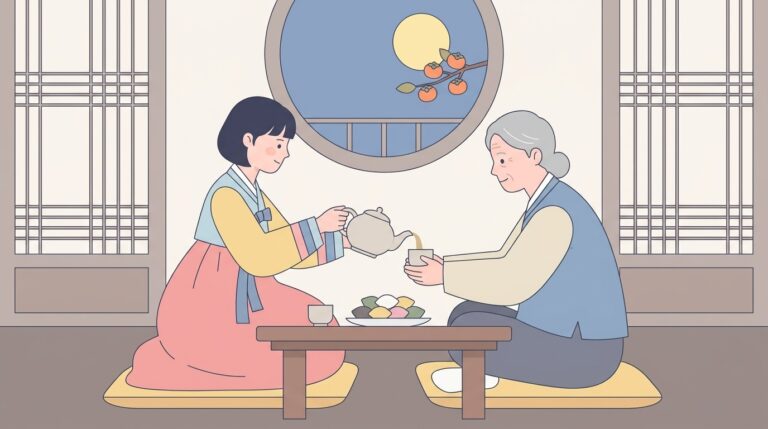
안녕하세요! 매일한글 에디터입니다.
Imagine this: You’re sitting around a table packed with delicious Korean holiday dishes like Jeon and Galbi-jjim during Chuseok or Seollal. The atmosphere is warm, until an older relative suddenly looks at you with deep ‘concern’ and asks: “When are you getting married?” or “Have you found a stable job yet?”
If you’ve spent any time in Korea or watched family-centered K-dramas like My Unfamiliar Family, you know this scenario all too well. This holiday cross-examination—known as 잔소리 (Jansori)—is a classic manifestation of the generation gap in Korean society. While elders view these intrusive questions as expressions of love and care, younger generations often feel stressed and cornered.
How do you handle these awkward holiday moments without being rude or starting a family drama? Today, we are sharing practical, culturally refined B2-level strategies tested by real international learners residing in Korea. Let’s master the art of graceful deflection!
1. 신경 써 주셔서 감사합니다
- Pronunciation: [Singyeong sseo jusyeoseo gamsahamnida] (Sounds like: Sin-gyeong sseo joo-syuh-suh gam-sa-ham-ni-da)
- Meaning: “Thank you for caring about me” (Literally: “Thank you for spending your attention on me”).
- K-Culture Moment: A polite character in a K-drama neutralizing an intrusive question from an elder with an innocent smile.
- Editor’s Insight: This is the ultimate defensive shield in polite Korean. It acknowledges their intent (care/concern) so they cannot get angry, while subtly signaling that you have heard enough.
- Situation Spectrum: Casual 🚫 / Semi-formal ⚠️ / Formal ✅
- 🤔 Think About It: In your culture, is unsolicited personal advice viewed as genuine affection or an invasion of privacy?
2. 다 때가 있는 법이죠
- Pronunciation: [Da ttaega inneun beobijyo] (Sounds like: Da ttae-ga in-neun bohb-ee-jyo)
- Meaning: “Everything happens in its own good time.” / “There’s a right time for everything.”
- K-Culture Moment: Often said over a family dinner when elders pressure someone about major life milestones like marriage or buying a house.
- Editor’s Insight: Instead of arguing about your personal schedule, this phrase uses traditional wisdom (a shared cultural belief in timing) to shut down further debate smoothly.
- Situation Spectrum: Casual ⚠️ / Semi-formal ✅ / Formal ✅
- 🤔 Think About It: How do older generations in your country express expectations about life timeline milestones?
3. 덕분에 잘되고 있어요
- Pronunciation: [Deokbune jaldoego issoyo] (Sounds like: Deok-boo-neh jal-doe-go is-so-yo)
- Meaning: “Thanks to your support/wishes, things are going well.”
- K-Culture Moment: Used when answering career or study questions politely while deflecting specific details.
- Editor’s Insight: By attributing your steady life progress to the elders’ support or blessing (덕분에), you flatter them while reassuring them that they don’t need to worry.
- Situation Spectrum: Casual ⚠️ / Semi-formal ✅ / Formal ✅
- 🤔 Think About It: Why do you think Korean place so much emphasis on collective contribution (덕분에) in personal success?
📖 교과서 한국어 (Textbook Korean)
“그런 질문은 하지 마세요. 제 사생활입니다.”
(Please don’t ask such questions. It is my private life.)
🗣️ 진짜 한국어 (Real-Life Korean)
“걱정해 주셔서 감사해요! 제 스타일대로 차근차근 잘 준비하고 있어요~”
(Thank you for worrying! I’m preparing step-by-step in my own style~)
💡 왜 다를까? (Why the difference?)
Directly setting boundaries like “that’s my private business” is considered extremely confrontational in traditional Korean collectivist culture. Expressing gratitude first and reassuring them with a gentle tone maintains family harmony while preserving your autonomy.
📖 교과서 한국어 (Textbook Korean)
“저는 아직 결혼할 생각이 없습니다.”
(I have no intention of getting married yet.)
🗣️ 진짜 한국어 (Real-Life Korean)
“요즘은 시기가 좀 늦어지는 추세잖아요~ 때가 되면 해야죠!”
(Nowadays the trend is starting a bit later~ I’ll do it when the time comes!)
💡 왜 다를까? (Why the difference?)
Saying “I won’t marry” invites endless lecturing (훈수). Referring to general societal trends (추세) shifts the focus away from your personal choice to a broad social topic.
4-1. 눈치 (Nunchi) & Non-verbal Gestures
When dealing with holiday nagging, your non-verbal cues are 70% of the defense:
* The Nod & Soft Smile: Keep a gentle smile and nod slowly. Showing annoyance instantly shifts you into the “rebellious/rude” category.
* Two-Handed Beverage Refill: The moment a question gets too personal, grab a tea teapot or drink bottle and offer a refill with two hands (“이모, 식기 전에 차 좀 더 드세요~”). This physically interrupts the conversation rhythm.
4-2. K-Culture Deep Dive: The Korean Holiday Paradigm Shift
In classic Korean dramas, holiday scenes often feature mothers-in-law and aunts gathering in the kitchen to make hundreds of Jeon, passing judgment on the younger family members. However, modern K-content (like social media web dramas) reflects a huge shift: young Koreans now book solo staycations (호캉스) or travel abroad during Seollal to avoid the stress known as 명절 증후군 (Holiday Syndrome).
Setting & Characters
- Location: Living room during Chuseok family reunion.
- Character: Aunt (이모) – Well-meaning but inquisitive relative.
- You: B2 Intermediate learner navigating holiday conversation.
Dialogue
- 이모: 어머, 우리 조카 왔네! 요즘 일은 잘되고 있지? 회사는 언제쯤 옮길 거니?
(Eomo, uri joka watne! Yojeum ireun jaldoego itji? Hoesaneun eonjejjeum omgil geoni?)
“Oh, my niece/nephew is here! Is work going well? When are you moving to a bigger company?” -
You: 🎭 (밝게 웃으며 두 손으로 차를 따라드리며)
네, 이모! 신경 써 주셔서 감사합니다. 지금 회사에서 많이 배우고 있어요.
(Ne, imo! Singyeong sseo jusyeoseo gamsahamnida. Jigeum hoesaeseo mani baeugo issoyo.)
“Yes, Auntie! Thank you for your concern. I am learning a lot at my current company.” -
이모: 그래~ 그래도 더 좋은 데 가야지. 그런데 연애는 하고 있구? 만나는 사람은 있어?
(Gurae~ geuraedo deo joheun de gayaji. Georeonde yeonaeneun hago itgu? Mannaneun sarameun isseo?)
“Right~ But still you should go to a better place. By the way, are you dating? Is there someone?” -
You: 🎭 (여유로운 미소를 지으며 차잔을 건넨다)
다 때가 있는 법이죠~ 좋은 사람 생기면 꼭 먼저 말씀드릴게요!
(Da ttaega inneun beobijyo~ Joheun saram saenggimyeon kkok meonjeo malseumdeurilgeyo!)
“Everything has its own time~ When I find a good person, I’ll be sure to tell you first!” -
이모: 나이가 몇인데~ 더 늦으면 안 돼!
(Naiga myeochinde~ deo neujeumyeon an dwae!)
“Look at your age~ You shouldn’t wait too long!” -
You: 🎭 (고개를 살짝 끄덕이며 공감하는 척)
요즘은 다들 좀 늦게 하는 추세더라고요. 그래도 이모 덕분에 힘내서 노력 중이에요!
(Yojeumeun dadeul jom neutge haneun chusaedeoragoyo. Geuraedo imo deokbune himnaeseo noryeok jungieyo!)
“Nowadays the trend seems to be marrying later. Still, thanks to your support, I’m trying hard!” -
이모: 에휴, 그래 그래. 차 맛이 좋네.
(Ehyu, geurae geurae. Cha masi johne.)
“Sigh, alright alright. This tea tastes good.” -
You: 🎭 (자연스럽게 화제를 전환하며)
맞죠? 이모, 이 전 진짜 맛있어요. 이모가 만드신 거예요?
(Matjyo? Imo, i jeon jinja masisseoyo. Imoga mandusin geoyeyo?)
“Right? Auntie, this savory pancake is delicious. Did you make this?”
🔀 Interactive Choice Point
How would you respond if an elder says: “남들은 벌써 과장인데, 너는 언제 승진하니?” (Others are already managers, when are you getting promoted?)
- Choice A: “남들이랑 비교하지 마세요!” (Don’t compare me with others!)
- Choice B: “저도 제 속도대로 잘하고 있으니 너무 걱정 마세요~” (I’m doing well at my own pace, so please don’t worry too much~)
- Choice C: “요즘 회사 사정이 안 좋아서 다들 힘들어요.” (The company situation is bad these days so everyone is struggling.)
Feedback:
- Choice A (Bad): ❌ Risk! Creates instant tension and marks you as defensive or disrespectful.
- Choice B (Best): ✅ Perfect! Polite yet assertive. It reassures them while establishing your own pace.
- Choice C (Risk): ⚠️ Warning! Gives them an excuse to pry deeper into your company’s financial health or stability.
Repeat these out loud with appropriate emotional inflection!
[😊 Gently and warm]
신경 써 주셔서 / 감사합니다~ / 잘 준비하고 있어요!
(Singyeong sseo jusyeoseo / gamsahamnida~ / jal junbihago issoyo!)-
[😌 Relaxed and confident]
다 때가 / 있는 법이죠~ / 너무 걱정하지 마세요!
(Da ttaega / inneun beobijyo~ / neomu geokjeonghaji maseyo!) -
[🤝 Complimenting and deflective]
이모 덕분에 / 잘되고 있어요! / 이 음식 정말 맛있네요~
(Imo deokbune / jaldoego issoyo! / i eumsik jeongmal masitneyeo~)
- 잔소리 (Jansori) | Nagging / Unsolicited advice disguised as concern.
- 명절 증후군 (Myeongjeol Jeunghugun) | Holiday Syndrome (stress experienced before/after traditional holidays).
- 눈치 (Nunchi) | Social tact / The ability to gauge others’ feelings and mood.
- 꼰대 (Kkondae) | Condescending older person who insists on outdated views.
Survival Phrases TOP 3
- 아~ 그렇군요! (Ah~ geureokgunyo!) – “Ah, I see!” (Use as a generic listening response to clear nagging).
- 음식이 정말 맛있어요! (Eumsigi jeongmal masisseoyo!) – “The food is delicious!” (The ultimate subject-changer).
- 제가 좀 더 노력해 볼게요! (Jega jom deo noryeokhae beolgeyo!) – “I will try harder!” (Ends the conversation smoothly).
Editor’s Travel Note
Navigating Korean holidays as a foreigner can be a quiet period in cities, as shops close. If you need to check open restaurants or navigate transportation during Chuseok, make sure to download the 네이버 지도 앱 다운로드 for real-time schedule updates.
In traditional Korean culture, questioning someone’s life milestones isn’t meant to cause emotional distress; historically, individual achievements reflected family security in tight-knit agricultural communities. However, as modern Korea shifts toward individualism, young adults are caught between honoring family harmony and pursuing self-actualization. Learning how to navigate Jansori gently allows you to respect cultural roots without compromising your boundaries.
💬 Your Turn: How do people in your country react when older relatives ask intrusive questions? Share your stories in the comments below!
Q: Is it considered rude to stay quiet when elders nag during holiday dinners?
A: Complete silence with a stern face can be interpreted as passive rebellion. Instead, use soft short responses like “네~” (Yes) or “그렇군요” (I see) while maintaining eye contact.
Q: Can I use informal Korean (반말) if I get very close with my Korean relatives?
A: Even if you become close, using 반말 to older generations during formal holiday gatherings is frowned upon. Stick to 존댓말 (polite Korean) to keep things smooth.
Q: What if an elder continues nagging despite my polite responses?
A: Excuse yourself politely to use the restroom or offer to help in the kitchen: “제가 설거지 좀 도와드릴게요!” (Let me help with the dishes!).
🚨 Common Mistakes
- Mistake: Responding with “내 인생이에요” (It’s my life).
- Correct Action: Shift to “제 스타일대로 해볼게요” (I’ll try it in my style).
- Mistake: Sighing heavily or rolling your eyes.
- Correct Action: Nod with a gentle smile and offer water or food.
- Mistake: Explaining complex modern career choices in technical detail.
- Correct Action: Keep explanations simple and highlight your efforts rather than the specifics.
- Bronze Mission: Practice saying “신경 써 주셔서 감사합니다” 3 times in front of a mirror with a soft smile.
- Silver Mission: Record your voice doing the 10-Second Shadowing Drill and listen to your tone.
- Gold Mission: Try using “다 때가 있는 법이죠” when a friend asks you a pressure-filled question!
- 🎮 K-Culture Mission: Watch a clip of a Korean family drama during Chuseok and identify 2 defensive phrases used by the characters!
Q1. What is the most polite way to deflect a personal question about marriage during a Korean holiday?
* A) “제 사생활이니까 묻지 마세요.”
* B) “다 때가 있는 법이죠~ 신경 써 주셔서 감사해요.”
* C) “결혼 안 할 건데요.”
See Answer & Explanation
Answer: B
Explanation: Option B acknowledges their concern politely while gently setting a boundary using traditional cultural logic.
Q2. Fill in the blank: “이모 ________ 잘되고 있어요! 걱정 마세요.”
* A) 때문에 (Because of – often negative)
* B) 덕분에 (Thanks to – appreciative)
* C) 비해서 (Compared to)
See Answer & Explanation
Answer: B
Explanation: “덕분에” expresses gratitude toward the elder, making the response warm and pleasant.
Q3. True or False: Direct confrontation (“Stop nagging me!”) is the standard cultural way young Koreans handle elders during Chuseok.
See Answer & Explanation
Answer: False
Explanation: Most young Koreans use tactful deflections (눈치), soft humor, or change the subject to preserve family harmony.







