

Master Sunbae & Hubae Dynamics: Speaking Natural Korean with Seniors!
안녕하세요! I’m your editor and cultural bestie from Daily Hangul. Have you ever watched a K-drama where a character suddenly switches their tone and asks, “Wait, are we close enough for me to drop honorifics?” Or maybe you met someone slightly older at a Korean meetup and froze, wondering: Should I use polite speech? Can I call them Sunbae?
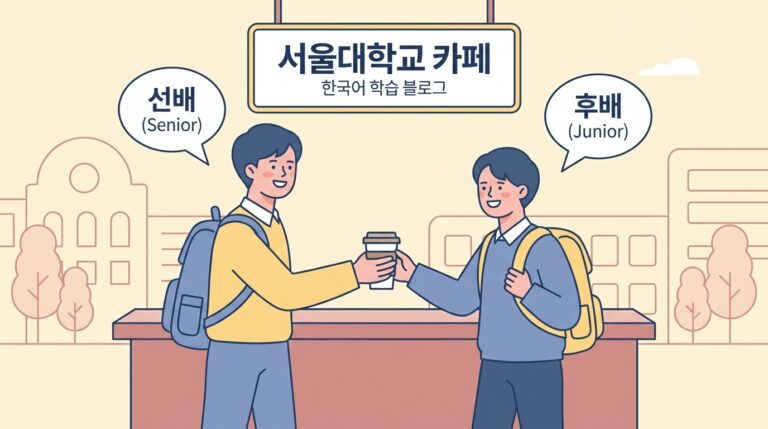
Don’t worry, you’re not alone! Navigating the Sunbae (선배, senior) and Hubae (후배, junior) dynamic can feel like a tricky puzzle. But once you unlock this cultural secret, you’ll bond with Korean friends instantly, sound amazingly natural, and never feel awkward again. Let’s break it down together step-by-step!
Phase 2: Top 3 Essential Expressions Deep Dive
1. 선배님, 질문이 있어요! (Seonbaenim, jilmuni issoyo!)
- Pronunciation: Sun-bae-nim, jeel-moon-ee ee-ssaw-yo! (Sounds like ‘Sun-bae’ + ‘nim’ like ‘team’)
- Meaning: Literal: “Senior, I have a question!” | Real Nuance: A polite, respectful way to get advice or help from someone with more experience.
- K-Culture Moment: Seen in university dramas when a freshman nervously approaches a helpful upperclassman in the library.
- Editor’s Insight: Adding -님 (-nim) shows high respect. It softens your approach instantly!
- Situation Spectrum: Casual 🚫 | Semi-formal ✅ | Formal ✅
- 🤔 Think About It: Does your native language have a specific title for someone who studied or worked at a place before you?
2. 제가 도와드릴게요. (Jega dowadeoorilgeyo.)
- Pronunciation: Je-ga do-wa-deu-reel-ge-yo. (Rhymes with ‘pay’ and ‘go’)
- Meaning: Literal: “I will offer you help.” | Real Nuance: “Let me help you out!” (Polite offer to a senior).
- K-Culture Moment: An eager junior offering to help carry heavy supplies during an office or campus event.
- Editor’s Insight: Using 드릴게요 (deoorilgeyo) instead of 줄게요 (julgeyo) shows humility as a Hubae.
- Situation Spectrum: Casual 🚫 | Semi-formal ✅ | Formal ✅
- 🤔 Think About It: How do you offer help to older colleagues in your culture without sounding overly pushy?
3. 편하게 말씀해 주세요. (Pyeonhage malssumhae juseyo.)
- Pronunciation: Pyeo-na-ge mal-ssum-hae joo-se-yo. (Sounds like ‘Pyun-ha-gae’)
- Meaning: Literal: “Please speak comfortably.” | Real Nuance: “Please feel free to speak comfortably (informally) with me!”
- K-Culture Moment: Over drinks at an after-work gathering (회식) when a junior invites a senior to relax their speech.
- Editor’s Insight: Juniors often say this to make seniors feel comfortable dropping formal language!
- Situation Spectrum: Casual ⚠️ | Semi-formal ✅ | Formal ✅
- 🤔 Think About It: Why do you think Koreans feel relieved when they get permission to speak comfortably?
Phase 3: Textbook Korean vs. Real Korean
Situation 1: Offering help to a senior
- 📖 Textbook: 제가 선배를 도와주겠습니다. (I will assist senior.)
- 🗣️ Real Korean: 선배님, 제가 도와드릴까요? (Sunbaenim, shall I help you out?)
- 💡 Why the difference? Directly calling someone ‘선배’ without ‘-님’ sounds cold. Using -드릴까요 creates a friendly yet polite vibe.
Situation 2: Asking if you can talk comfortably
- 📖 Textbook: 반말을 사용하십시오. (Use informal speech.)
- 🗣️ Real Korean: 말씀 편하게 하셔도 돼요! (You can speak comfortably!)
- 💡 Why the difference? Imperative forms sound like an order. Asking/permitting softly using -돼요 is modern and gentle.
Phase 4: K-Culture Deep Dive & Mannerisms
4-1. Nunchi (눈치) & Body Language
When speaking to a Sunbae, slight head nods, holding items with two hands when passing them, and avoiding aggressive eye contact show great courtesy!
4-2. Cultural Code: Coffee Culture & Teamwork
In Korea, seniors often buy coffee or meals for juniors (선배가 쏜다!). In return, juniors show appreciation by ordering enthusiastically and saying thank you warmly (잘 먹겠습니다!).
Phase 5: Interactive Roleplay Scenario
Setting: A campus coffee shop with Minjun (your upperclassman/Sunbae).
- Minjun: (Smiling warmly) 유진 씨, 대학 생활은 좀 어때요? (Yujin-ssi, how is university life?)
- You: [Choose your response below!]
🔀 Decision Point: How do you reply?
- Option A: 진짜 힘들어요. 공부하기 싫어요. (It’s so hard. I hate studying.)
- Option B: 선배님 덕분에 잘 적응하고 있어요! (Thanks to you, Sunbaenim, I’m adapting well!)
- Option C: 너는 어때? (How about you? – using casual ‘you’)
Feedback:
- Option A (Risk): Too blunt! Seniors might feel awkward.
- Option B (Best): Perfect! Super friendly, polite, and makes the senior feel appreciated!
- Option C (Bad): Never use ‘너’ (you) with a Sunbae! It can sound disrespectful.
Phase 6: 10-Second Emotion Shadowing Drill
Practice repeating these lines aloud with the correct emotion!
[😊 Warm & Respectful]선배님! / 오늘 / 커피 잘 마셨습니다! (Seonbaenim! / Onul / keopi jal masyeosseumnida!)[🥺 Polite & Helpful]혹시 / 제가 / 도와드릴까요? (Hoksi / jega / dowadeurilkollyo?)
Phase 7: K-Culture Mini Dictionary
- 선배 (Seonbae) | Senior at school or work with more experience.
- 후배 (Hubae) | Junior at school or work.
- 존댓말 (Jondaetmal) | Polite/formal language used to show respect.
- 반말 (Banmal) | Casual/informal language used with close friends or younger people.
Phase 8: Traveler’s Survival Kit
Top 3 Survival Phrases
- 감사합니다! (Gamsahamnida!) – Thank you! (Pro Tip: Nod slightly while saying it).
- 저기요! (Jeogiyo!) – Excuse me! (To call staff in restaurants).
- 조금만 천천히 말씀해 주세요. (Jogeumman cheoncheonhi malssumhae juseyo.) – Please speak a little slowly.
Editor’s Travel Note: Heading to Korea soon? Make sure to download navigation apps like Naver Map for smooth transit!
Phase 9: A Step Deeper (Thinking Corner)
Korean honorifics are not just about grammar; they reflect a social culture rooted in caring for relationships and mutual respect. Showing respect to a senior often builds a strong mentorship bond where seniors truly look after their juniors.
💬 Your Turn: How does your culture show respect to mentors or seniors? Tell us in the comments below!
Phase 10: FAQ & Common Mistakes
Q: Can I call an older stranger ‘Sunbae’?
A: No! Only use ‘Sunbae’ for someone in the same school, club, or company. For strangers, use standard polite terms like ‘저기요’.
Q: What if a senior asks me to use Banmal (casual speech)?
A: You can politely decline at first, or slowly transition to comfortable polite speech (요-form). Don’t jump straight to informal Korean right away!
🚨 Common Mistakes Alert!
- Mistake: Calling a senior ‘너’ (you).
- Correct Action: Replace ‘you’ with their title, e.g., ‘선배님’.
Phase 11: Action Mission
- 🥉 Bronze: Say “선배님, 안녕하세요!” aloud 3 times in front of a mirror.
- 🥈 Silver: Leave a comment below using one expression you learned today!
- 🥇 Gold: Use “선배님” in your next practice session with a Korean language exchange partner.
Phase 12: Interactive Quiz Challenge
Test your knowledge!
Q1: What is the polite title to call your senior?
A) 야 (Ya)
B) 선배님 (Seonbaenim)
C) 너 (Neo)
Click to see the answer!
Answer: B) 선배님! Always add ‘-님’ to sound polite and respectful.







