

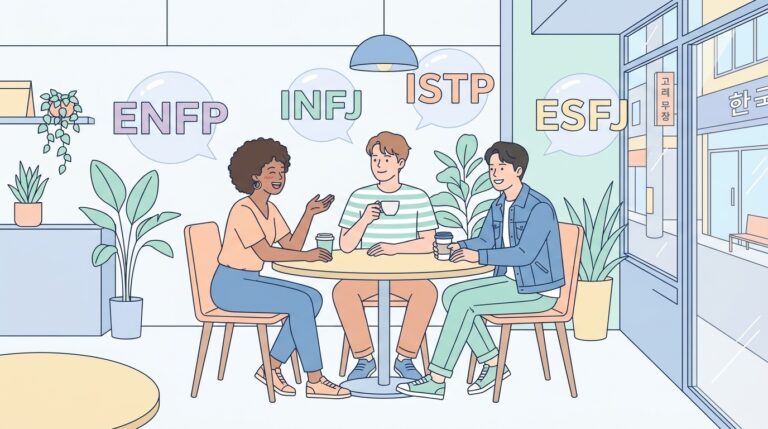
Phase 1: 공감 (Empathy Opening)
안녕하세요! I’m your Daily Hangul editor and cultural navigator! 💛 Have you ever been to a cafe in Seoul where someone immediately asked, “What’s your MBTI?” It feels like MBTI is the ultimate conversation starter in Korea right now! From dating shows to job interviews, everyone seems obsessed with those four letters.
But here is the catch: what happens when someone makes a total assumption about you just because you are an INFP or an ESTJ? Or what if you feel trapped by your own result? Knowing how to lightly push back against over-relying on personality types—without ruining the fun mood—is an essential skill in modern Korean social life.
Based on real feedback from learners living in Korea, mastering these expressions will save you from awkward labels and help you build far more authentic relationships. Let’s dive into how to talk about MBTI naturally while setting healthy boundaries!
Phase 2: 핵심 표현 3선 심층 분석 (Top 3 Key Expressions)
1. 너무 맹신하지 마세요 (Neomu maengsinhaji maseyo)
- Pronunciation: [Nuh-moo maeng-shin-ha-ji mah-seh-yo] (Sounds like “Maeng-shin” where ‘Maeng’ rhymes with ‘bang’ and ‘shin’ like ‘sheen’)
- Meaning: “Don’t blind-trust it too much” (Literally: Too much + Blind faith + Don’t do)
- K-Culture Moment: You’ll hear this on Korean reality dating shows like Heart Signal when a cast member makes a quick judgment about someone’s romantic habits based purely on their ‘T’ (Thinking) or ‘F’ (Feeling) type.
- Editor’s Insight: “맹신” (Maengshin) means blind or absolute faith. Using this word gently warns the other person that MBTI is just for fun, not a scientific absolute.
- Situation Spectrum:
- Casual: 너무 맹신하지 마! ✅
- Semi-formal: 너무 맹신하지 마세요. ✅
- Formal: 너무 맹신하지 않는 것이 좋습니다. ⚠️
- 🤔 Think About It: Does your native culture label people using personality tests often, or is this specific to Korean youth culture?
2. 재미로만 보세요 (Jaemiro-man boseyo)
- Pronunciation: [Jae-mi-ro-man boh-seh-yo] (Jae-mi sounds like ‘gemmy’, man means ‘only’)
- Meaning: “Just take it for fun” (Literally: For fun + only + look/see)
- K-Culture Moment: Used by K-pop idols during YouTube content when they take an MBTI re-test and get a completely different result than last year.
- Editor’s Insight: This is the polite, perfect phrase to de-escalate an over-serious MBTI debate. It preserves the cheerful vibe while reminding everyone not to take it seriously.
- Situation Spectrum:
- Casual: 재미로만 봐! ✅
- Semi-formal: 재미로만 보세요. ✅
- Formal: 재미로만 보시는 것이 좋겠습니다. 🚫 (Too stiff)
- 🤔 Think About It: How do you set boundaries in conversation when a fun topic turns into an absolute label?
3. 사람마다 달라요 (Saram-mada dallayo)
- Pronunciation: [Sah-ram-mah-dah dahl-lah-yo] (Saram = person, mada = every, dallayo = is different)
- Meaning: “Everyone is different / It depends on the person”
- K-Culture Moment: A classic phrase heard on Korean talk shows like You Quiz on the Block when discussing individual quirks versus broad stereotypes.
- Editor’s Insight: A versatile, essential daily phrase! Works for MBTI, nationality stereotypes, or personal preferences.
- Situation Spectrum:
- Casual: 사람마다 달라! ✅
- Semi-formal: 사람마다 달라요. ✅
- Formal: 사람마다 다릅니다. ✅
- 🤔 Think About It: Why is acknowledging individual differences so crucial in modern Korean community-oriented culture?
Phase 3: 교과서 한국어 vs 진짜 한국어 (Textbook vs Real Korean)
Situation 1: Saying “MBTI isn’t everything”
- 📖 교과서 한국어: MBTI는 정확하지 않습니다. (MBTI is not accurate.)
- 🗣️ 진짜 한국어: MBTI가 전부는 아니잖아요! (MBTI isn’t everything, right?)
- 💡 왜 다를까?: Saying “not accurate” sounds cold or overly academic. Adding “전부는 아니잖아요” acknowledges the fun while pointing out its obvious limit softly.
Situation 2: When someone says “You must be an F because you cry easily”
- 📖 교과서 한국어: 저는 성격이 선천적으로 감정적입니다. (My personality is inherently emotional.)
- 🗣️ 진짜 한국어: 그냥 상황마다 다른 거죠! (It just depends on the situation!)
- 💡 왜 다를까?: Native speakers prefer pragmatic expressions like “상황마다 다르다” (varies by situation) rather than heavy psychological words.
Phase 4: K-Culture 딥다이브 & 비언어적 매너 (K-Culture Deep Dive & Manner)
4-1. 눈치 (Nunchi) & Gestures
When telling someone not to over-trust MBTI, keep your body language light! A soft smile with hands lightly waving side-to-side (a gentle “no” gesture) prevents you from sounding argumentative. Maintain warm eye contact so they know you are enjoying the chat, not starting a debate.
4-2. Cultural Code Analysis: The MBTI craze in Korea
Why is Korea so obsessed with MBTI? In a fast-paced society where building relational harmony (눈치) is key, MBTI acts as a quick shortcut to understand someone’s communication style without asking overly intrusive personal questions. However, the overuse of MBTI typing has created small conflicts, leading to the slang phrase “MBTI 과몰입” (MBTI over-immersion).
Phase 5: 실전 롤플레이 시나리오 (Interactive Roleplay Scenario)
Setting: A trendy cafe in Hongdae with your Korean friend, Minjun (민준).
- Minjun: 너 T야? 왜 그렇게 이성적이야? (Neot T-ya? Wae geureohke iseongjeog-iya? / Are you a T? Why are you so logical?)
🎭 Pointing playfully with a smile - You: 에이, MBTI가 전부는 아니잖아! (Ei, MBTI-ga jeonbuneun anijana! / Hey, MBTI isn’t everything!)
🎭 Laughing softly - Minjun: 그래도 MBTI 보면 다 맞던데? (Guraedo MBTI bomeon da matdeonde? / But MBTI seems right every time!)
🎭 Looking surprised - You: 너무 맹신하지 마세요~ (Neomu maengsinhaji maseyo~ / Don’t blind-trust it too much~)
- Minjun: 하긴, 하도 많이 바뀌긴 하더라. (Hagin, hado mani bakkwigin hadeora. / True, it actually changes a lot.)
🎭 Nodding thoughtfully - You: 맞아요, 재미로만 보세요! (Majayo, jaemiro-man boseyo! / Right, just look at it for fun!)
- Minjun: 맞아, 사람마다 다른 건데 그치? (Maja, saram-mada dareun geonde geuchi? / True, everyone is different, right?)
- You: 당연하죠! 상황마다 달라요. (Dangyeonhajo! Sanghwan-mada dallayo. / Of course! It varies by situation.)
🎭 Clinking coffee cups
🔀 인터랙티브 분기점 (Interactive Choice)
Minjun asks: “너는 네 MBTI 결과 마음에 들어?” (Do you like your MBTI result?)
- Option A: “완전 별로예요. 그만 물어보세요.” (It’s terrible. Stop asking.)
- Feedback (Bad): Too blunt and mood-killing! 🚫
- Option B: “재미는 있는데, 너무 맹신하지는 않으려고요!” (It’s fun, but I try not to blind-trust it!)
- Feedback (Best): Perfect balance! Polite, clear, and maintains friendly energy. ✅
- Option C: “MBTI는 비과학적인 테스트입니다.” (MBTI is an unscientific test.)
- Feedback (Risk): A bit too academic for a casual cafe setting. ⚠️
Phase 6: 10초 감정 섀도잉 드릴 (10-Sec Shadowing Drill)
[😊 Playful & Relaxed]에이 / MBTI가 / 전부는 아니잖아요![💡 Friendly Warning]너무 / 맹신하지 마세요~ / 재미로만 보세요![🤝 Empathetic Nod]맞아요, / 사람마다 / 상황마다 / 완전히 달라요.
Phase 7: K-Culture 미니 사전 (Mini Dictionary)
- 과몰입 (Gwa-mor-ip) | Over-immersion / Being overly obsessed with a topic or trend.
- 케미 (Chemi) | Chemistry between friends, lovers, or co-stars.
- 손절 (Son-jeol) | Cutting ties with someone (used casually or seriously).
- 티발씨 (T-bal-C) | A trendy joke slang teasing someone who is excessively logical (“T”) and unsympathetic.
Phase 8: 여행자를 위한 생존 키트 (Survival Kit)
Survival Phrases TOP 3
- MBTI가 어떻게 되세요? (What is your MBTI?) – Standard conversation opener.
- 재미로만 봐요! (Let’s just look at it for fun!) – Lightens the mood.
- 상황마다 달라요. (It depends on the situation.) – Smooth answer to any hasty judgment.
Editor’s Travel Note
When traveling around Seoul, you’ll see MBTI pop-up shops, MBTI photo booths, and themed cocktails! Check out trending spots on Naver Maps to experience these fun pop-ups, but remember: it’s all just entertainment!
Phase 9: “한 발 더 깊이” (Deep Thinking Essay)
Korean society places great value on group cohesion and understanding social roles quickly. MBTI blew up partly because it gave people a comfortable framework to explain themselves without breaking social harmony. However, young Koreans today are also recognizing the danger of over-labeling and are learning to value individual uniqueness again.
💬 Your Turn: Has anyone ever judged your personality based on a test or zodiac sign? How did you respond in Korean?
Phase 10: FAQ & 흔한 실수 (FAQ & Common Mistakes)
Q: Is it rude to tell someone not to trust MBTI?
A: Not at all! As long as you use soft sentence endings like “~세요” or “~잖아요” with a friendly smile, Koreans will appreciate your balanced perspective.
Q: What does “과몰입 금지” mean?
A: It translates to “Over-immersion prohibited!” You’ll see this written as a fun warning tag on YouTube videos and MBTI memes.
Q: Is MBTI still popular in business contexts?
A: While some companies used it as a fun icebreaker, over-relying on it in professional settings is frowned upon today.
🚨 Common Mistakes
- ❌ Mistake: Saying “MBTI는 거짓말이에요” (MBTI is a lie).
- ⭕ Correct Action: Say “재미로만 보는 게 좋은 것 같아요” (I think it’s best to just see it for fun).
Phase 11: 액션 미션 & 참여 유도 (Action Mission)
- 🥉 Bronze: Say “재미로만 보세요” out loud 3 times with a smile.
- 🥈 Silver: Write your honest opinion on MBTI in the comment section below in Korean!
- 🥇 Gold: Next time a Korean friend asks your MBTI, reply: “전 ~인데요, 너무 맹신하지는 마세요!” (I’m [X], but don’t blind-trust it too much!)
🎮 K-Culture Mission: Watch a modern K-drama variety clip and spot how many times the letters ‘T’ or ‘F’ pop up on screen captions!
Phase 12: 인터랙티브 퀴즈 챌린지 (Interactive Quiz)
- What is the best phrase to gently remind someone not to take MBTI too seriously?
- A) MBTI 하지 마세요!
- B) 너무 맹신하지 마세요~
- C) 거짓말 마세요!
🔍 정답 및 해설 보기 (Click to expand answer)
Answer: B) 너무 맹신하지 마세요~
Explanation: Option B gently points out not to over-rely on tests while keeping the conversation friendly and warm!







