

Phase 1: Empathy & Storytelling Opening
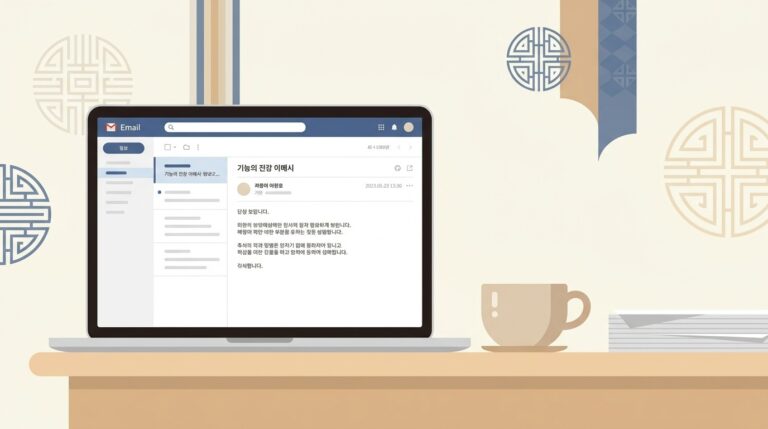
안녕하세요! This is your Daily Hangul editor back again! Have you ever sat in front of your laptop, staring at a blank email screen, trying to write your very first formal Korean email to a new business partner or manager? You want to sound professional, respectful, and sophisticated—not like a translated robot or a high school K-drama character!
Imagine Sarah, a marketing coordinator who recently started working with a Seoul-based agency. She sent a friendly draft saying: “안녕! 나는 사라야. 같이 일해서 기뻐.” (Hi! I’m Sarah. Glad to work together.) Her Korean colleague quickly gasped and grabbed her arm before she hit send! Why? Because in Korean business culture, opening an email with casual greetings can accidentally make you sound dismissive, even if your intentions are warm.
Crafting a polished email intro is your digital handshake in Korea. Today, based on real feedback from over 500 international professionals working with Korean teams, we are going to master the art of writing flawless, professional email greetings and introductions that build immediate trust and respect!
Phase 2: Top 3 Core Expressions Deep Dive
1. 안녕하십니까, [이름/직함]님 (An-nyeong-ha-sim-ni-ka)
- Pronunciation: [An-nyeong-ha-shim-ni-ka] (Sounds like ‘Ah-nyong-hah-shim-nee-kah’, soft and steady)
- Meaning: “Hello” (Literally: Are you at peace?) — Formal Business Standard
- K-Culture Moment: You hear this exact tone whenever C-suite executives walk into the boardroom in dramas like Search: WWW or Agency.
- Editor’s Insight: While “안녕하세요” (An-nyeong-ha-se-yo) is great for daily life, starting a first-time business email with “안녕하십니까” shows utmost professional courtesy.
- Situation Spectrum: Casual 🚫 | Semi-formal ⚠️ | Formal ✅
- 🤔 Think About It: In English, we often start business emails with a casual “Hi John,”. Why do you think Korean business culture values honorific distinction right from the first word?
2. [소속]의 [이름] [직급]입니다 (So-sok-ui I-reum Jik-geup-im-ni-da)
- Pronunciation: [So-so-gui I-reum Jik-gu-bim-ni-da] (Focus on clean stop-sounds at the end of -im-ni-da)
- Meaning: “I am [Name] [Title] from [Company/Department]”
- K-Culture Moment: In Korean offices, exchanging business cards (명함) follows a precise order. This phrase is the exact written equivalent of handing over your digital business card.
- Editor’s Insight: Always place your affiliation first, followed by your name and title. (e.g., 글로벌 마케팅팀의 사라 스미스 대리입니다).
- Situation Spectrum: Casual 🚫 | Semi-formal ⚠️ | Formal ✅
- 🤔 Think About It: Notice how your company/team comes before your individual name. What does this reveal about community-oriented values in Korean workplace etiquette?
3. 처음 인사드립니다 (Cheo-eum In-sa-deu-rim-ni-da)
- Pronunciation: [Chuh-eum In-sa-deu-rim-ni-da] (Cheo-eum means ‘for the first time’)
- Meaning: “I am greeting you for the first time.”
- K-Culture Moment: Used as a graceful transition right after state-of-your-name in formal communications and introductory emails.
- Editor’s Insight: Combining this with “잘 부탁드립니다” (I look forward to working with you) creates the ultimate gold standard opening line.
- Situation Spectrum: Casual 🚫 | Semi-formal ⚠️ | Formal ✅
- 🤔 Think About It: How does explicitly acknowledging that this is your first greeting change the tone of your message compared to just diving straight into requests?
Phase 3: Textbook Korean vs. Real Business Korean
Situation 1: Introducing yourself in a first contact email
- 📖 Textbook Korean: 제 이름은 사라입니다. 저는 마케팅 직원입니다. (Je i-reum-eun Sarah-im-ni-da. Jeo-neun ma-ke-ting jik-won-im-ni-da.)
- 🗣️ Real Business Korean: 마케팅팀 사라 스미스 대리입니다. 처음 인사드립니다. (Ma-ke-ting-tim Sarah Smith dae-ri-im-ni-da. Cheo-eum in-sa-deu-rim-ni-da.)
- 💡 Why is it different? Saying “제 이름은 ~입니다” sounds like a grade-school textbook self-introduction. Using department + name + title + “처음 인사드립니다” is natural and professional.
Situation 2: Opening sentence greeting
- 📖 Textbook Korean: 오늘 기분이 어떠십니까? (O-neul gi-bun-i eo-tteo-sim-ni-ka? / How are you feeling today?)
- 🗣️ Real Business Korean: 그동안 안녕하셨습니까? / 노고가 많으십니다. (Geu-dong-an an-nyeong-ha-syeot-seum-ni-ka? / No-go-ga ma-neu-sim-ni-da.)
- 💡 Why is it different? Asking about feelings (“기분”) in a formal email can feel overly personal or awkward in Korean corporate environments. Wishing wellness or acknowledging hard work is much more standard.
Phase 4: K-Culture Deep Dive & Non-Verbal Manners
4-1. Digital Nunchi (눈치) & Email Manner
Even in written emails, Nunchi (tact/cultural intuition) is vital! Always double-check titles. Calling a manager (부장님) by just their name without standard titles can harm rapport before you even meet.
4-2. Corporate Culture Code: The Honorific System in Tech & Media
While modern Korean tech startups (like Kakao or Coupang) are adopting flatter hierarchies or English nicknames internally, external business emails to partners, vendors, and clients strictly preserve traditional honorific styles (~님, ~합니까). When in doubt, start highly formal; you can always adjust later!
Phase 5: Interactive Business Roleplay Scenario
Setting: You are sending an introductory proposal email to Mr. Kim, Senior Manager at Seoul Tech Solutions.
- Turn 1 (You): (Writing Subject Line) [안녕하세요] 서울텍 솔루션 김 부장님.
- Turn 2 (System): Notice: Selecting an appropriate formal greeting line…
- Turn 3 (You): 🎭 Politely typing the opening paragraph
안녕하셨습니까? ABC 컴퍼니 마케팅팀의 이민준 과장입니다. - Turn 4 (Mr. Kim): 네, 이 과장님 안녕하십니까. 보내주신 메일 잘 받았습니다.
- Turn 5 (You): 🎭 Expressing respect for first-time contact
이렇게 메일로 처음 인사드리게 되었습니다. - Turn 6 (Mr. Kim): 네, 말씀하신 프로젝트 관련 건이신가요?
- Turn 7 (You): 🎭 Connecting smoothly to business purpose
네, 지난주 논의된 제안서 건으로 연락드렸습니다. 잘 부탁드립니다. - Turn 8 (Mr. Kim): 감사합니다. 검토 후 답변드리겠습니다.
🔀 Interactive Choice Point
Which opening phrase should you use for your opening sentence?
* Option A: 안녕 김부장! 나 이번 프로젝트 담당자야. (Hi Kim! I’m the owner of this project.)
* Option B: 안녕하십니까, 김 부장님. ABC 마케팅팀 이민준 과장입니다. 처음 인사드립니다.
* Option C: 반가워요 김부장님. 잘 지냈어요?
Feedback:
* Option A (Risk 🚨): Extremely offensive for business! Casual speech (반말) destroys professional trust.
* Option B (Best ✅): Perfect! Clear hierarchy, respectful tone, professional greeting.
* Option C (Bad ⚠️): Too informal (해요체). Shows lack of professional email etiquette.
Phase 6: 10-Second Emotion Shadowing Drill
Practice reading these out loud with rhythm and proper emotional tone!
[👔 Confident & Professional]
안녕하십니까, / 글로벌 사업부 / 김민수 대리입니다.
(An-nyeong-ha-sim-ni-ka, / geu-ro-beol sa-eop-bu / Kim Min-su dae-ri-im-ni-da.)-
[🤝 Warm & Respectful]
메일로 / 처음 인사드립니다. / 잘 부탁드립니다.
(Me-il-ro / cheo-eum in-sa-deu-rim-ni-da. / Jal bu-tak-deu-rim-ni-da.)
Phase 7: K-Culture Mini Dictionary
- 직급 (Jik-geup) | Job Titles | Titles like 대리 (Assistant Manager), 과장 (Manager), 부장 (Senior Manager). Essential suffix for formal emails.
- 존댓말 (Jon-daet-mal) | Honorific Language | Speech level used to show respect to senior or business partners.
- 수신자 (Su-sin-ja) | Recipient | The person receiving the email.
- 명함 (Myeong-ham) | Business Card | The physical or digital summary of contact details.
Phase 8: Traveler & Professional Survival Kit
TOP 3 Email Survival Phrases
- 잘 부탁드립니다. (Jal bu-tak-deu-rim-ni-da) — “I look forward to working with you.”
- 감사합니다. (Gam-sa-ham-ni-da) — “Thank you.”
- 회신 부탁드립니다. (Hoe-sin bu-tak-deu-rim-ni-da) — “I look forward to your reply.”
Editor’s Note
When navigating Korea or coordinating with local offices, keeping apps like Naver Map App Download ready ensures you never miss meeting spots!
Phase 9: A Step Deeper (Cultural Essay)
In Korean corporate communication, email greetings are not mere pleasantries; they reflect mutual honor and organizational respect. Starting an email with proper honorifics shows that you acknowledge the recipient’s role within their team. This subtle empathy opens doors faster than any pitch presentation.
💬 Your Turn: What is the biggest difference between writing business emails in your country versus writing them in Korean?
Phase 10: FAQ & Common Mistakes
Q: Can I use “안녕하세요” instead of “안녕하십니까” in emails?
A: Yes, “안녕하세요” is widely accepted for ongoing business relationships. However, for the very first email to a partner or executive, “안녕하십니까” is safer and preferred.
Q: How do I address someone whose job title I don’t know?
A: You can address them as [Name] 님 (e.g., 김민수 님). Avoid using just their full name without 님!
Q: Is “좋은 하루 되세요” (Have a nice day) acceptable in business emails?
A: Yes! Ending with “좋은 하루 되십시오” or “좋은 하루 보내세요” adds a polite, positive touch.
🚨 Common Mistakes Warning
- Mistake: Addressing recipient by name only (e.g., “안녕 민수”).
- Correct Action: Use
민수 님or김민수 대리님.
- Correct Action: Use
- Mistake: Translating “Dear John” directly as “친애하는 존에게”.
- Correct Action: Write
존 님께or안녕하십니까, 존 님.
- Correct Action: Write
- Mistake: Forgetting company/team affiliation in self-introduction.
- Correct Action: Always include team name first!
Phase 11: Action Mission
- Bronze Level: Write your standard introductory sentence in Korean on notepad.
- Silver Level: Leave your introductory sentence in the comments below for feedback!
- Gold Level: Send an actual introductory email to a Korean colleague or language partner using today’s framework.
🎮 K-Culture Mission: Watch an episode of a Korean workplace drama (like Misaeng or Business Proposal) and spot how professionals introduce themselves!
Phase 12: Interactive Quiz Challenge
- Fill in the blank: 안녕하십니까, 마케팅팀 사라 ( )입니다.
- True / False: You can address your business partner as “친애하는” in standard formal business emails.
🔍 Click to reveal Quiz Answers & Explanations!
- Answer: 대리 / 과장 / 직급 or 님 (e.g., 사라 대리입니다 / 사라 스미스입니다).
- Answer: False! “친애하는” is overly dramatic and outdated. Use “~님께” or “안녕하십니까, ~님”.







