

Phase 1: Empathy – The Unexpected Veranda Jungle Drama
안녕하세요! Editor here from Daily Hangul! 🌿
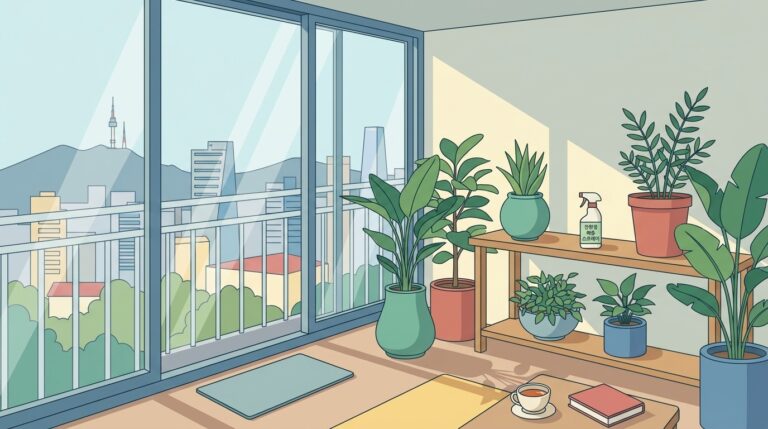
Imagine this: You’ve built your dream mini-oasis on your apartment balcony in Seoul. You’ve got lush monstera leaves, vibrant cherry tomatoes, and sweet basil. But suddenly, one morning, you notice tiny, unwelcome guests hovering around—pest infestation! You rush to a local Korean plant nursery or home center to buy an eco-friendly pest treatment, but your brain freezes. How do you describe pests subtly without sounding like you’re launching a chemical war? How do you ask for organic, child-and-pet-safe solutions at a C1 nuanced level?
Balcony gardening (베란다 가드닝) is a huge trend in Korean urban lifestyle. Navigating pest control without stressing your plants—or your Korean neighbors—requires precise, context-rich Korean expressions. In this guide, backed by real feedback from advanced Korean learners and urban plant lovers, you’ll master high-level natural phrases to save your green friends with pure confidence!
Phase 2: Core Expressions Deep Dive
1. 해충이 생기다 (Hae-chung-i saeng-gi-da)
- Pronunciation: [Hae-chung-i saeng-gi-da] (Sounds like ‘Ha-e’ as in ‘high’, ‘chung’ like ‘choong’, ‘saeng-gi-da’)
- Meaning: Literally “Pests are generated,” but practically means “To get a pest problem/infestation.”
- K-Culture Moment: In K-dramas featuring cozy apartment living, you’ll hear characters sighing about indoor plants: “요즘 베란다에 해충이 생겨서 고민이야” (I’m worried because I got pests on my veranda lately).
- Editor’s Insight: Instead of using violent verbs like “bugs invaded” (벌레가 침입했다), Koreans naturally use the passive-sounding ‘생기다’ (to occur/appear) to casually describe pest emergence.
- Situation Spectrum:
- Casual: ✅ | Semi-formal: ✅ | Formal: ✅
- 🤔 Think About It: Why does Korean often frame natural occurrences passively using ‘생기다’ rather than active blame?
2. 박멸하다 vs. 퇴치하다 (Bang-myeol-ha-da vs. Toe-chi-ha-da)
- Pronunciation: [Bang-myeol-ha-da / Toe-chi-ha-da]
- Meaning: 박멸하다 (Eradicate completely / wipe out) vs. 퇴치하다 (Repel / drive away / control).
- K-Culture Moment: Plant shops usually recommend ‘퇴치제’ (repellents/gentle spray) for indoor use rather than toxic ‘박멸제’ (exterminator grade) to protect eco-systems.
- Editor’s Insight: C1 speakers know that asking for ‘박멸’ sounds overly aggressive for delicate herbs. Asking for ‘퇴치’ shows you understand organic pest management.
- Situation Spectrum:
- Casual: ✅ | Semi-formal: ✅ | Formal: ✅
- 🤔 Think About It: How does choosing gentle repelling over destruction reflect eco-conscious trends in modern Seoul?
3. 친환경 천연 약제 (Chin-hwan-gyeong cheon-yeon yak-je)
- Pronunciation: [Chin-hwan-gyeong cheon-yeon yak-je]
- Meaning: Eco-friendly natural treatment / pesticide.
- K-Culture Moment: Highly popular at local flower markets like 양재꽃시장 (Yangjae Flower Market).
- Editor’s Insight: Using ‘약제’ (medicinal agent) instead of ‘약’ (medicine/chemical) gives a highly refined, knowledgeable impression when speaking to nursery experts.
- Situation Spectrum:
- Casual: ⚠️ | Semi-formal: ✅ | Formal: ✅
- 🤔 Think About It: Notice how Koreans refer to plant pest controls as ‘plant medicine’ (식물 약). What does this reveal about treating plants as living family members?
Phase 3: Textbook vs. Real Native Korean
Situation 1: Explaining you have spider mites on leaves
* 📖 Textbook Korean: 잎 뒤에 나쁜 벌레들이 너무 많이 있습니다. (There are too many bad bugs behind the leaves.)
* 🗣️ Real Native Korean: 잎 뒷면에 응애가 좀 꼬였더라고요. (Looks like some spider mites have gathered on the back of the leaves.)
* 💡 Why the difference? Native speakers use specific pest names like ‘응애’ (spider mites) or ‘진딧물’ (aphids) and the natural verb ‘꼬이다’ (to swarm/gather).
Situation 2: Asking for a non-toxic spray
* 📖 Textbook Korean: 독하지 않은 벌레 약을 주십시오. (Please give me pest medicine that is not strong.)
* 🗣️ Real Native Korean: 실내에서 쓸 거라 성분이 순한 친환경 퇴치제로 주시겠어요? (Since I’ll use it indoors, could you give me an eco-friendly repellent with gentle ingredients?)
* 💡 Why the difference? Native C1 speakers state the context (실내, indoor) and use refined terms like ‘성분이 순한’ (gentle ingredients).
Phase 4: K-Culture Deep Dive & Mannerisms
4-1. Nunchi & Gesture Guide
When describing pest issues to a nursery owner (사장님), show photos of the affected leaves on your phone. Point softly with your index finger while tilting your head slightly in concern. Saying “약간 진딧물 같은 게 생겼는데…” (It seems like some aphids appeared…) with a soft, inquiring tone demonstrates respect for their expertise.
4-2. Cultural Code: The ‘Urban Farmer’ Trend
Balcony gardening isn’t just a hobby in Korea; it’s healing therapy (힐링). With many Koreans residing in high-rise apartments, the balcony is a prized sanctuary. Using natural garlic or neem-oil remedies (자연 친화적 천연 난황유) is a hot topic on Korean lifestyle blogs like Naver Living.
Phase 5: Interactive Roleplay Scenario
Setting: A cozy plant sanctuary shop in Seongsu-dong, Seoul.
NPC: Owner (사장님), an experienced urban plant guru in her 50s.
- You: 사장님, 안녕하세요! 베란다에서 키우는 식물 때문에 문의 좀 드리려고요. (Hello boss! I’d like to ask about some plants I’m growing on my balcony.)
- NPC: 네, 어서 오세요! 무슨 일이 있으신가요? (Yes, welcome! What seems to be the problem?)
- You: 🎭 [Showing photo on phone] 잎 뒷면에 솜깍지벌레가 좀 꼬인 것 같아요. (It looks like mealybugs have gathered on the underside of the leaves.)
- NPC: 아이구, 깍지벌레는 방심하면 금방 번지는데! 실내 베란다인가요? (Oh dear, mealybugs spread fast if you let your guard down! Is it an indoor balcony?)
- You: 네, 환기를 시킨다고 했는데 통풍이 부족했나 봐요. (Yes, I tried to ventilate, but maybe airflow was insufficient.)
- NPC: 실내면 화학 약품은 기르기 꺼려지실 텐데, 천연 추출물로 된 퇴치제를 써보시겠어요? (Since it’s indoors, you might hesitate to use chemicals. Would you like to try a natural plant-extract repellent?)
- You: 네, 아이랑 반려동물도 있어서 성분이 순한 걸로 추천해 주세요. (Yes, I have kids and pets, so please recommend one with mild ingredients.)
- NPC: 이 난황유 기반 친환경 제품이 딱이겠네요. 3일에 한 번씩 잎 앞뒤로 꼼꼼히 뿌려주세요. (This eco-friendly egg-yolk-oil-based product will be perfect. Spray thoroughly on both sides of the leaves every 3 days.)
🔀 Interactive Branching Decision Point
The owner asks if you want a heavy-duty chemical spray instead for faster results. How do you respond?
- Option A:
Frequently Asked Questions (FAQ)
Q: What does "해충이 생기다 (Hae-chung-i saeng-gi-da)" mean in Korean and how do you pronounce it?
A: In Korean, "해충이 생기다 (Hae-chung-i saeng-gi-da)" is pronounced [Hae-chung-i saeng-gi-da] and means: Literally "Pests are generated," but practically means "To get a pest problem/infestation."
Q: What does "박멸하다 vs. 퇴치하다 (Bang-myeol-ha-da vs. Toe-chi-ha-da)" mean in Korean and how do you pronounce it?
A: In Korean, "박멸하다 vs. 퇴치하다 (Bang-myeol-ha-da vs. Toe-chi-ha-da)" is pronounced [Bang-myeol-ha-da / Toe-chi-ha-da] and means: 박멸하다 (Eradicate completely / wipe out) vs. 퇴치하다 (Repel / drive away / control).
Q: What does "친환경 천연 약제 (Chin-hwan-gyeong cheon-yeon yak-je)" mean in Korean and how do you pronounce it?
A: In Korean, "친환경 천연 약제 (Chin-hwan-gyeong cheon-yeon yak-je)" is pronounced [Chin-hwan-gyeong cheon-yeon yak-je] and means: Eco-friendly natural treatment / pesticide.







