

Master Korean Money: How to Count Won Like a Local (Without Panicking!)
Phase 1: Empathy (Welcome, Chingu!)
안녕하세요! (An-nyeong-ha-se-yo!) Welcome back to Daily Hangul, your cozy corner for mastering real-life Korean. I’m your lead editor and your personal cultural navigator.
Picture this: You’ve just walked into a dreamy convenience store in Seoul. You grab a delicious banana milk and a bag of honey butter chips. The cashier smiles and says, “만 오천원입니다 (Man-o-cheon-won-im-ni-da).”
Your mind goes blank. Man? Cheon? You look at the bills in your wallet, feeling the sweat start to form. We have all been there! Countless learners have told me, “I know how to count from 1 to 10, but as soon as I buy something in Korea, the big numbers sound like a secret code!”
Today, we are going to crack that code together. By the end of this guide, you will confidently hand over the exact cash at any market, cafe, or K-beauty shop. Let’s make you a Korean money pro! 💸
Phase 2: Top 3 Essential Money Words
To count money in Korea, we use Sino-Korean numbers (the system based on Chinese characters). Let’s master the three most important milestones you will hear on every shopping trip.
1. 천 (Cheon)
- Pronunciation: Chun (rhymes with the English word “fun”)
- Meaning: 1,000 (One Thousand)
- K-Culture Moment: You will hear this constantly at street food carts. A single stick of delicious Eomuk (fish cake) or a hotteok (sweet pancake) usually costs around 이천원 (I-cheon-won – 2,000 KRW) or 삼천원 (Sam-cheon-won – 3,000 KRW).
- Editor’s Insight: Think of 천 (cheon) as your base unit for small street snacks and bus fares.
- Situation Spectrum: Casual (✅) | Semi-formal (✅) | Formal (✅)
- 🤔 Think About It: In many Western countries, prices end in “.99”. In Korea, street food prices are almost always clean, rounded numbers like 1,000 or 2,000 won. Why do you think this is?
2. 만 (Man)
- Pronunciation: Mahn (rhymes with “con” or “pawn”)
- Meaning: 10,000 (Ten Thousand)
- K-Culture Moment: In K-Dramas, when friends split the bill for fried chicken and draft beer (치맥 – Chimaek), the total is often around 삼만 원 (Sam-man-won – 30,000 KRW).
- Editor’s Insight: This is the ultimate game-changer. While English groups large numbers by thousands (10,000 = ten thousand), Korean groups them by ten-thousands (만 – man). So, 10,000 isn’t “ten thousand”; it is simply 일만 (Il-man) or just 만 (Man).
- Situation Spectrum: Casual (✅) | Semi-formal (✅) | Formal (✅)
- 🤔 Think About It: How does shifting your brain from a “comma-every-three-digits” (1,000) system to a “four-digit-grouping” system change the way you look at prices?
3. 원 (Won)
- Pronunciation: Won (sounds like the English word “one”)
- Meaning: The Korean currency symbol (₩)
- K-Culture Moment: Seen on every price tag in Korea, from luxury department stores in Gangnam to local markets in Mapo.
- Editor’s Insight: In Korean, you must attach 원 (won) directly after the number. 1,000 is cheon, but 1,000 KRW is cheon-won.
- Situation Spectrum: Casual (✅) | Semi-formal (✅) | Formal (✅)
Phase 3: Textbook Korean vs. Real-Life Korean
Let’s look at how textbooks teach money versus how locals actually talk.
Scenario 1: Paying at a Cafe
- 📖 Textbook Style:
“오천원 이입니다.” (O-cheon-won-i-im-ni-da. – “It is 5,000 won.”) - 🗣️ Real-Life Local:
“오천원이요.” (O-cheon-won-i-yo. – “5,000 won!”) - 💡 Why the difference?
Locals prefer the softer, friendlier -이요 (-i-yo) ending over the ultra-formal -입니다 (-im-ni-da) when doing quick transactions in daily life.
Scenario 2: Asking for the Price
- 📖 Textbook Style:
“이것은 얼마입니까?” (I-geos-eun eol-ma-im-ni-kka? – “How much is this?”) - 🗣️ Real-Life Local:
“이거 얼마예요?” (I-geo eol-ma-ye-yo? – “How much is this?”) - 💡 Why the difference?
I-geos-eun is too literary. In spoken Korean, we shorten “이것” (this thing) to 이거 (i-geo) to keep the conversation flowing smoothly.
Phase 4: K-Culture Deep Dive & Non-Verbal Etiquette
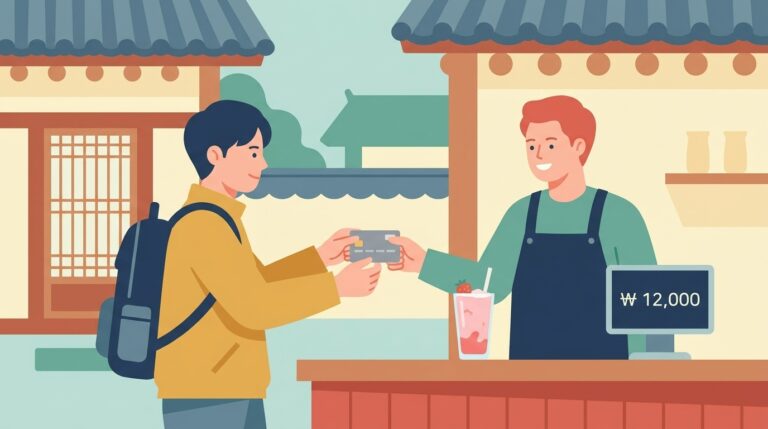
4-1. The “Two-Handed” Card Hand-Off (두 손 제스처)
In Korean culture, showing respect is everything, even during a quick payment! When handing over your cash or physical credit card to a cashier, never use one hand to carelessly toss or flick it. Instead:
1. Hold the card/cash with both hands, or
2. Hold it with your right hand while lightly supporting your right forearm with your left hand.
3. Accompany this with a polite nod of your head. This small gesture instantly marks you as a respectful, culturally aware traveler!
4-2. The “Self-Calculated” Street Food Vibe
If you visit a traditional market like Mangwon Market (망원시장), you might buy fish-shaped red bean bread (붕어빵 – bung-eo-ppang). Often, the stall owner is busy frying, so there will be a small basket of cash in front of the stall. Customers are trusted to put their money in and take their own change. It’s a beautiful display of community trust in Korea!
Phase 5: Interactive Roleplay Scenario
Let’s practice! You are at a trendy Hanok cafe in Bukchon Hanok Village. You want to buy a sweet Strawberry Latte.
Characters:
* 민지 (Min-ji): The super friendly student part-timer at the cafe.
* You: A thirsty traveler eager to practice Korean numbers.
민지: 어서 오세요! 주문하시겠어요?
      (Eo-seo o-se-yo! Ju-mun-ha-si-get-eo-yo?)
      🎭 [Smiling warmly, pointing at the menu]
      "Welcome! Would you like to order?"

You: 딸기 라떼 하나 주세요.
     (Dtal-gi ra-tte ha-na ju-se-yo.)
     🎭 [Pointing politely at the delicious strawberry latte picture]
     "One strawberry latte, please."

민지: 네, 딸기 라떼 하나요. 다른 건 필요 없으세요?
      (Ne, dtal-gi ra-tte ha-na-yo. Da-reun geon pil-yo eops-eu-se-yo?)
      🎭 [Tapping on the POS screen]
      "Okay, one strawberry latte. Do you need anything else?"

You: 아니요, 괜찮아요. 얼마예요?
     (A-ni-yo, gwen-cha-na-yo. Eol-ma-ye-yo?)
     🎭 [Shaking your head gently and reaching for your wallet]
     "No, thank you. How much is it?"

민지: 육천오백원이요.
      (Yuk-cheon-o-baek-won-i-yo.)
      🎭 [Showing the price of 6,500 KRW on the screen]
      "It's 6,500 won."

You: 네, 여기요.
     (Ne, yeo-gi-yo.)
     🎭 [Handing your card using both hands with a respectful nod]
     "Yes, here you go."

민지: 감사합니다! 잠시만 기다려 주세요.
      (Gam-sa-ham-ni-da! Jam-si-man gi-da-ryeo ju-se-yo.)
      🎭 [Receiving the card with both hands and bowing slightly]
      "Thank you! Please wait a moment."
🔀 Your Turn: Interactive Branching!
Min-ji hands back your card, but she accidentally charges you for two lattes (13,000 won instead of 6,500 won). What do you say?
- A) “이거 13,000원 아니에요?” (I-geo man-sam-cheon-won a-ni-e-yo? – “Isn’t this 13,000 won?”)
- B) “어… 육천오백원 아니에요?” (Eo… yuk-cheon-o-baek-won a-ni-e-yo? – “Uh… isn’t it 6,500 won?”)
- C) “돈 돌려주세요!” (Don dol-ryeo-ju-se-yo! – “Give me my money back!”)
Feedback:
- If you chose A: [Risk!] You mentioned 13,000 won, which might sound like you are agreeing to pay that amount. Try to focus on the correct price you expected.
- If you chose B: [Best! ⭐] Soft, polite, and accurate! Asking “Isn’t it 6,500 won?” points out the mistake gently and lets Min-ji fix it immediately with a blush and an apology.
- If you chose C: [Bad] This sounds very aggressive and demanding in Korean, which might ruin the friendly vibe of your cafe trip!
Phase 6: 10-Second Emotion Shadowing Drill
Let’s practice speaking with the right emotion. Pay attention to the pauses marked by /.
- [😊 Excited & Friendly]
- 딸기 라떼 / 하나 주세요!
- (Dtal-gi ra-tte / ha-na ju-se-yo!)
- “One strawberry latte / please!”
- [🥺 Shy & Softly Confused]
- 저기… / 이거 얼마예요?
- (Jeo-gi… / i-geo eol-ma-ye-yo?)
- “Excuse me… / how much is this?”
- [💖 Polite & Grateful]
- 네, / 여기 카드요!
- (Ne, / yeo-gi ka-deu-yo!)
- “Yes, / here is my card!”
Phase 7: K-Culture Mini Dictionary
- 현금 (Hyeon-geum) | Cash
- Usage: Useful at tiny street food carts where card readers might not be available.
- 카드 (Ka-deu) | Card (Credit/Debit)
- Usage: Used for 95% of transactions in Korea. Even taxi drivers prefer cards!
- 영수증 (Yeong-su-jeung) | Receipt
- Usage: Cashiers will ask “영수증 필요하세요?” (Yeong-su-jeung pil-yo-ha-se-yo? – “Do you need a receipt?”).
- 봉투 (Bong-tu) | Shopping Bag
- Usage: Plastic bags cost about 100~200 won. Say “봉투 주세요” (Bong-tu ju-se-yo) if you need one.
Phase 8: Traveler’s Survival Kit
Survival Phrases TOP 3
- 현금 영수증은 괜찮아요. (Hyeon-geum yeong-su-jeung-eun gwen-cha-na-yo.)
- Pro Tip: If paying cash, cashiers ask if you want a “tax-deductible receipt.” Just say this phrase to politely decline.
- 따로 계산해 주세요. (Dta-ro gye-san-hae ju-se-yo.)
- Pro Tip: Use this when you want to split the bill with your travel buddy!
- 깎아주세요! (Kkak-a-ju-se-yo!)
- Pro Tip: Use this playful phrase (“Please give me a discount!”) only at traditional markets when buying several items. Do not use it in convenience stores or brand shops!
Editor’s Travel Note
For navigating Korea like a local, make sure to download the Naver Map App for flawless directions, and grab a T-Money Card at any convenience store upon arrival to easily tap your way through buses and subways. (Note: App availability and transit fees may change over time.)
Phase 9:
Frequently Asked Questions (FAQ)
Q: What does "천 (Cheon)" mean in Korean and how do you pronounce it?
A: In Korean, "천 (Cheon)" is pronounced [Chun (rhymes with the English word "fun"] and means: 1,000 (One Thousand)
Q: What does "만 (Man)" mean in Korean and how do you pronounce it?
A: In Korean, "만 (Man)" is pronounced [Mahn (rhymes with "con" or "pawn"] and means: 10,000 (Ten Thousand)
Q: What does "원 (Won)" mean in Korean and how do you pronounce it?
A: In Korean, "원 (Won)" is pronounced [Won (sounds like the English word "one"] and means: The Korean currency symbol (₩)







