

Phase 1: Empathy (스토리 몰입형 오프닝)
안녕하세요! Daily Hangul Editor here, your ultimate K-Culture & Korean language bestie! 💖
Picture this: You are shopping in Myeongdong, Seoul. You bought a super trendy oversized knit sweater yesterday, but you get back to your hotel, try it on, and realize… the sleeves are way too long, even for the “baggy fit” aesthetic. You want to return it, and you fortunately kept the receipt (영수증). You walk back to the store, but suddenly your heart starts racing.
“How do I say ‘refund’ without sounding rude?”
“Should I show the receipt first or explain the reason first?”
Don’t worry! Getting a refund in Korea is incredibly common and straightforward, as long as you have your receipt and the item is unused. Today, we’re going to master the exact, polite phrases that native Koreans use to get a hassle-free refund. No awkward stuttering, no stressful Google Translate moments—just smooth, confident Korean! Let’s dive in! 🛍️✨
Phase 2: Deep Dive into 3 Key Expressions
1. 영수증 있는데 환불해 주세요. (yeongsujeung inneunde hwanbulhae juseyo.)
- Pronunciation: yung-su-jeung in-neun-de hwan-bul-hae ju-seh-yo (Sounds like: “Young-sue-jung in-noon-deh hwan-bull-hae joo-say-yo”)
- Meaning: “I have the receipt, so please give me a refund.”
- K-Culture Moment: You will hear this phrase in almost any K-Drama when a character goes back to a luxury store in Gangnam after a dramatic breakup to return an expensive gift.
- Editor’s Insight: The word -는데 (-neunde) acts as a soft background connector here. Instead of abruptly saying “Refund this,” saying “I have the receipt, and so…” softens your tone significantly, making it sound very polite and natural.
- Situation Spectrum: Casual: ⚠️ | Semi-formal: ✅ | Formal: ✅
- 🤔 Think About It: In your home country, do you show the receipt first, or do you explain why you are returning the item first? In Korea, showing the receipt immediately makes the process 10x faster!
2. 사이즈가 안 맞아사 환불하고 싶어요. (saijeuga an majaseo hwanbulhago sipeoyo.)
- Pronunciation: sigh-jeu-ga ahn mah-jah-seo hwan-bul-ha-go sip-uh-yo
- Meaning: “The size doesn’t fit, so I’d like a refund.”
- K-Culture Moment: Very common in Hongdae boutique shops where trying on clothes before purchasing isn’t always allowed due to makeup stains.
- Editor’s Insight: -아서/어서 (-aseo/eoseo) means “because / so.” You are giving a quick, polite reason (사이즈가 안 맞아서 – because the size doesn’t fit) before making your request, which Korean clerks highly appreciate.
- Situation Spectrum: Casual: ⚠️ | Semi-formal: ✅ | Formal: ✅
- 🤔 Think About It: Koreans value indirectness when expressing negative situations (like an item not fitting). Giving a brief reason helps maintain a harmonious interaction.
3. 결제했던 카드도 가져왔어요. (gyoljehaetteon kadeudo gajyeowasseoyo.)
- Pronunciation: gyuhl-jeh-haet-thun kah-deu-do gah-jyuh-wah-ssuh-yo
- Meaning: “I also brought the card that I used to pay.”
- K-Culture Moment: When buying K-Beauty products at Olive Young, the staff will always ask for the original payment card for a refund.
- Editor’s Insight: In Korea, if you paid by credit/debit card, the merchant must cancel the original transaction on the exact same card. Saying 카드도 가져왔어요 proactively saves you a step!
- Situation Spectrum: Casual: ⚠️ | Semi-formal: ✅ | Formal: ✅
- 🤔 Think About It: Why do you think Korean stores require the physical card instead of just giving cash back? It’s related to tax transparency and preventing card fraud!
Phase 3: Textbook Korean vs. Real-Life Korean
Let’s compare what dry textbooks teach you versus how Koreans actually talk in trendy stores.
Situation 1: Requesting a refund
- 📖 Textbook Korean: “환불을 요구합니다.” (hwanbuleul yoguhamnida. – “I demand a refund.”)
- 🗣️ Real-Life Korean: “이거 환불받을 수 있을까요?” (igeo hwanbulbadeul su isseulkayo? – “Could I get a refund for this?”)
- 💡 Why the difference? The textbook version sounds like a formal consumer complaint or a legal protest! The real-life version uses -을 수 있을까요? (“Is it possible to…?”) which is incredibly polite, soft, and effective.
Situation 2: Explaining a minor defect
- 📖 Textbook Korean: “제품에 하자가 있습니다.” (jepume hajaga isseumnida. – “There is a defect in the product.”)
- 🗣️ Real-Life Korean: “여기에 실밥이 좀 풀려 있어서요…” (yeogie silbabi jom pullyeo isseoseoyo… – “The stitching here is a bit unraveled, so…”)
- 💡 Why the difference? Saying “defect” (하자) sounds very aggressive and accusatory. Real-life Korean uses soft euphemisms like “the thread is a bit unraveled” (실밥이 좀 풀려 있어서요) to point out flaws politely.
Phase 4: K-Culture Deep Dive & Non-Verbal Etiquette
4-1. Nunchi (눈치) & Body Language for Refunds
When asking for a refund in Korea, body language does half the talking!
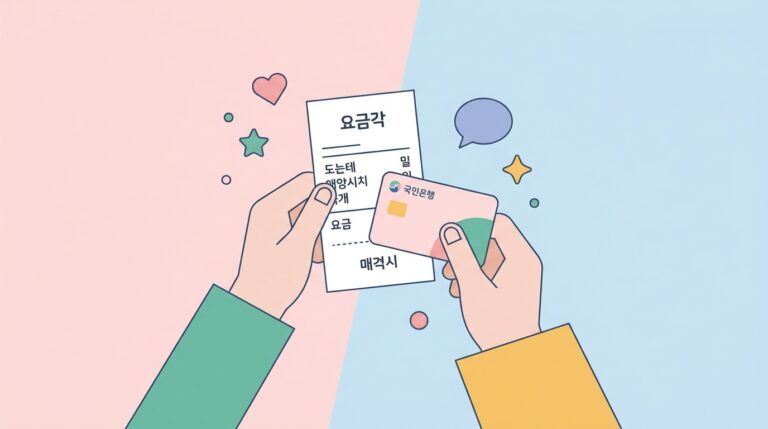
* The Two-Hand Handover: Always hand over the receipt (영수증) and your payment card (카드) with both hands. This is a crucial sign of respect.
* The Polite Head Nod: When explaining the reason, slightly tilt your head and look apologetic (even though you did nothing wrong!). It shows you are not trying to start a fight, which makes the clerk much more cooperative.
4-2. The Korean “7-Day” Refund Rule
In Korea, most major retail stores and department stores have a strict 7-day refund policy (7일 이내 환불). If you go beyond 7 days, they might only offer an exchange (교환) or store credit. Also, make sure the tag (택 – taek) is still attached!
Phase 5: Real-Life Roleplay Scenario
Setting: A trendy clothing boutique in Dongdaemun, Seoul.
Characters:
* You (민우/Minwoo) – A polite foreign tourist.
* Clerk (지수/Jisu) – An efficient but busy shop assistant.
- 지수 (Clerk): 어서 오세요! 도와드릴까요?
(eoseo oseyo! dowadeurilkayo?)
🎭 Greeting you with a quick bow
“Welcome! Can I help you?” -
민우 (You): 저기… 이거 환불하고 싶어서요.
(jeogi… igeo hwanbulhago sipeoseoyo.)
🎭 Handing over the shopping bag politely
“Excuse me… I’d like to get a refund for this.” -
지수 (Clerk): 아, 환불이요? 혹시 영수증 가지고 오셨나요?
(a, hwanburiyo? hoksi yeongsujeung gajigo osyeonnaya?)
🎭 Looking at the bag
“Ah, a refund? Did you happen to bring the receipt?” -
민우 (You): 네, 영수증 여기 있어요. 카드도요.
(ne, yeongsujeung yeogi isseoyo. kadudoyo.)
🎭 Handing both over with two hands
“Yes, here is the receipt. And the card too.” -
지수 (Clerk): 네, 확인해 드릴게요. 환불하시는 사유가 어떻게 되시죠?
(ne, hwaginhae deurilgeyo. hwanbulhasineun sayuga eotteoke doesijyo?)
🎭 Checking the system
“Okay, I’ll check it for you. What is the reason for the refund?” -
민우 (You): 집에 가서 입어 보니까 사이즈가 너무 작아서요.
(jibe gaseo ibeo bonikka saijeuga neomu jagaseoyo.)
🎭 Gesturing slightly to show it's small
“When I tried it on at home, the size was just too small.” -
지수 (Clerk): 아, 그러시군요. 택(tag) 제거 안 하셨죠? 잠시만요… 네, 처리해 드릴게요.
(a, geureosigunyo. taek jegoeon an hasyeotjyo? jamsimanyo… ne, cheorihae deurilgeyo.)
🎭 Checking the clothing tag
“Ah, I see. You didn’t remove the tag, right? One moment… Okay, I’ll process it for you.” -
민우 (You): 감사합니다. 수고하세요!
(gamsahamnida. sugohaseyo!)
🎭 Bowing head slightly as you receive your card back
“Thank you. Have a great day!”
🔀 Interactive Branching Point
The clerk asks you: “혹시 교환은 안 필요하세요?” (Would you like an exchange instead?)
- Choice A: “아니요, 그냥 환불해 주세요.” (No, just give me a refund.)
- Feedback: Best! Direct but polite. They will proceed with the refund immediately.
- Choice B: “싫어요. 환불 원해요.” (I hate it. I want a refund.)
- Feedback: Bad. This sounds extremely rude and confrontational in Korean.
- Choice C: “그럼 다른 사이즈로 교환할래요.” (Then, I’ll exchange it for a different size.)
- Feedback: Risk. Good if you actually want the item, but be ready to pick the correct size on the spot!
Phase 6: 10-Second Emotional Shadowing Drill
Practice speaking like a true local by mimicking the natural pauses (/) and emotional tone!
[🥺 Apologetic & Soft]
저기… / 이거 / 환불받을 수 / 있을까요?
(jeo-gi… / i-geo / hwan-bul-ba-deul su / is-seul-ka-yo?)-
[😊 Polite & Proactive]
여기 / 영수증이랑 / 카드 / 여기 있어요.
(yeo-gi / yeong-su-jeung-i-rang / ka-deu / yeo-gi is-seo-yo.) -
[😊 Cheerful Gratitude]
네, / 감사합니다! / 수고하세요!
(ne, / gam-sa-hap-ni-da! / su-go-ha-se-yo!)
Phase 7: K-Culture Mini Dictionary
- 영수증 (Yeongsujeung) | Receipt
- Usage: Essential for any financial transaction in Korea, especially tax refunds for tourists!
- 환불 (Hwanbul) | Refund
- Usage: Getting your actual money or card payment canceled.
- 교환 (Gyohwan) | Exchange
- Usage: Trading an item for a different size, color, or item of equal value.
- 택 (Taek) | Price Tag
- Usage: Loanword from “Tag.” Keeping this intact is the #1 rule of Korean shopping returns!
Phase 8: Survivor Kit for Travelers
Survival Phrases TOP 3
- 이거 취소해 주세요. (igeo chwisohae juseyo.)
- “Please cancel (refund) this.” (Simple and quick!)
- 다른 걸로 바꿀게요. (dareun geollo bakkulgeyo.)
- “I’ll change it to something else.” (Perfect for exchanges!)
- 영수증 버려주세요. (yeongsujeung beoryeojuseyo.)
- “Please throw away the receipt.” (Useful when making a fresh purchase and you don’t need a receipt.)
Editor’s Travel Note
- Tax Free Shopping: When buying items in shopping hubs like Myeongdong, you can often get an immediate tax refund. Download the Naver Map App to easily find designated “Tax-Free” shops in Seoul.
- Disclaimer: Refund policies may vary by store, and some promotional or clearance items may not be eligible for returns. Always double-check at the register!
Phase 9: “A Step Deeper” (Thoughtful Reflection)
In many Western cultures, a customer might return an item simply because they “changed their mind” without feeling any hesitation. In Korea, however, there is a subtle cultural layer of avoiding inconvenience (민폐 – minpye) to others. This is why Koreans usually apologize slightly or provide a very clear, objective reason (like “it doesn’t fit” or “it was a double purchase”) when asking for a refund. It is a way of showing respect to the business owner.
💬 Your Turn: How does this compare to your country? Let us know in the comments below!
Phase 10: FAQ & Common Mistakes
Q: Can I get a refund if I lost the paper receipt?
A: In major retail chains like Olive Young or department stores, they can sometimes look up your transaction if you have the exact credit card and remember the exact time of purchase. However, smaller boutique stores in areas like Hongdae or Ewha will almost certainly refuse a refund without the physical paper 영수증.
Q: What is the difference between 환불 (Hwanbul) and 반품 (Banpum)?
A: Both mean returning an item, but 반품 refers to the physical act of returning the merchandise, while 환불 refers to getting your money back. In daily shopping, they are used interchangeably, but “환불해 주세요” is the standard phrase for getting cash/card credit back.
Q: Can I get a refund on sale items?
A: Many small boutiques have signs that say “세일 상품 교환/환불 불가” (No exchange or refund on sale items). While legal consumer protections exist, it can be very difficult to argue this in small independent shops, so always ask before buying!
🚨 Common Mistakes Alert!
- Mistake 1: Handing the receipt with one hand.
- Correct Action: Use both hands to show politeness to the cashier.
- Mistake 2: Saying “리펀드 원해요” (Refund wonhaeyo).
- Correct Action: Say “환불해 주세요” (Hwanbulhae juseyo).
- Mistake 3: Removing the clothing tag and trying to return it.
- Correct Action: Keep the 택 perfectly attached until you are 100% sure you are keeping the item.
Phase 11: Action Mission
- Bronze Mission: Record yourself saying “영수증 여기 있어요” (Here is the receipt) 3 times with a polite smile.
- Silver Mission: Share this post on your social media and tag your Korean study buddies!
- Gold Mission: Next time you go shopping in Korea (or a Korean market), proactively ask for the receipt by saying: “영수증 주세요!” (Please give me the receipt!).
🎮 K-Culture Mission: Watch a modern K-Drama shopping scene. Spot if the characters hand over their cards with both hands or one hand!
Phase 12: Interactive Quiz Challenge
1. Which phrase means “I want a refund because the size is small”?
- A) 사이즈가 커서 교환할게요.
- B) 사이즈가 작아서 환불하고 싶어요.
- C) 영수증을 분실했어요.
Click for the Answer & Explanation
Correct Answer: B
* Explanation: 작아서 means “because it is small”, and 환불하고 싶어요 means “I want a refund”. Option A means “The size is big so I will exchange it.”
2. True or False: You should always use both hands when handing your card to the clerk in Korea.
- A) True
- B) False
Click for the Answer & Explanation
Correct Answer: A (True)
* Explanation: Using two hands is a fundamental sign of respect and politeness in Korean social etiquette.







