

Master the Noraebang Remote: How to Turn Off Scores and Adjust Echo Like a K-Entertainment Pro
Phase 1: Empathy (Welcome to the Real Korean Noraebang!)
안녕하세요! (Annyeonghaseyo!) It’s your K-Culture Navigator and favorite Korean bestie from Daily Hangul.
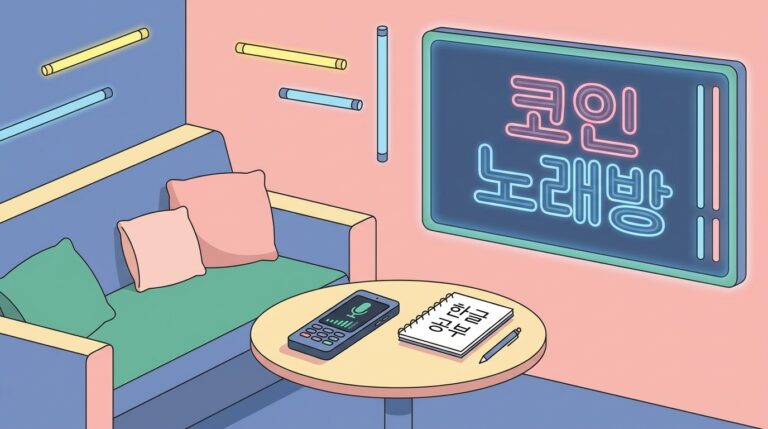
Picture this: You are in a neon-lit, private Noraebang (노래방) room in Hongdae with your Korean friends. The vibes are immaculate. You cue up your absolute favorite K-Pop ballad, ready to pour your heart out. But as soon as you breathe into the mic, you hear it—an echo so intense it sounds like you’re singing from the bottom of the Grand Canyon. Or worse, you finish a passionate, slightly out-of-tune rendition of a BTS song, and the screen violently flashes a cold, hard “43 POINTS” in front of everyone.
The horror.
Many of our intermediate learners have shared how intimidating the dreaded “Noraebang Score” can be, or how the “echo overload” ruins their vocal control. Today, we are going to fix that. By the end of this guide, you’ll know exactly how to navigate the complicated Noraebang remote control (리모컨) like a seasoned Seoulite, giving you ultimate control over your singing environment! Let’s dive in.
Phase 2: Deep Dive into 3 Essential Expressions
To master the remote control, you need to know what to press and how to ask for help if the remote is too confusing. Here are your three ultimate power-phrases.
1. 점수 제거해 주세요 (Jeom-su je-geo-hae ju-se-yo)
- Pronunciation: Jum-soo je-guh-hae joo-seh-yo (Sounds like “Jum-su” as in ‘jumping’ without the ‘p’, and “je-geo” like ‘Jell-O’ but with a ‘g’)
- Meaning: Please turn off/remove the scoring system.
- K-Culture Moment: You are with co-workers during a hoesik (회식 – company dinner). You want to sing a slow, emotional song without the mood-killing robotic score screen popping up at the end.
- Editor’s Insight: While
제거(je-geo) literally means “removal” or “elimination,” in Noraebang slang, people also simply say “점수 꺼 주세요” (Jeom-su kkeo ju-se-yo – Please turn off the score). Both work perfectly, but using je-geo shows you have a sleek, precise vocabulary. - Situation Spectrum:
- Casual (Friends): ✅ (점수 좀 꺼봐 / Jeom-su jom kkeo-bwa)
- Semi-formal (Co-workers): ✅ (점수 제거해 주세요)
- Formal (Boss/Elderly): ⚠️ (Typically, you let them sing first, but if they ask, you can say this politely.)
- 🤔 Think About It: In many Western singing spots, singing is purely about let-loose fun without numerical judgment. Why do you think Korean Noraebangs default to scoring every song? (Hint: Koreans love a friendly competition, even during leisure!)
2. 에코 좀 줄여 주세요 (E-ko jom ju-ryeo ju-se-yo)
- Pronunciation: Eh-ko jom joo-ryuh joo-seh-yo (The ‘jom’ is like ‘gym’ but with an ‘o’ sound, meaning ‘a little bit’)
- Meaning: Please turn down the echo a bit.
- K-Culture Moment: You are trying to sing a fast rap song (like BLACKPINK or Agust D), but the echo is making your words overlap and sound muddy.
- Editor’s Insight: Noraebang remotes have dedicated physical buttons for 에코 (Echo), 마이크 (Mic Volume), and 반주 (Music Accompaniment Volume). If you want to raise it instead of lowering it, swap ju-ryeo (decrease) with 키워 (ki-wo – increase/turn up).
- Situation Spectrum:
- Casual: ✅ (에코 좀 줄여줘 / E-ko jom ju-ryeo-jwo)
- Semi-formal: ✅ (에코 좀 줄여 주세요)
- Formal: 🚫 (Avoid ordering changes unless you are the one holding the remote for the group.)
3. 리모컨 조절이 잘 안 돼요 (Ri-mo-keon jo-jeor-i jal an dwae-yo)
- Pronunciation: Ree-mo-keun jo-jurl-ee jal an dwae-yo
- Meaning: The remote control isn’t working/adjusting properly.
- K-Culture Moment: You try to press the ‘Score’ button repeatedly, but the machine doesn’t respond. You need to call the front desk or ask a friend for help.
- Editor’s Insight: Koreans love clipping foreign words. ‘Remote control’ becomes 리모컨 (Ri-mo-keon). If something doesn’t work, adding ~이/가 잘 안 돼요 (is not working well) is a polite, indirect way to complain without sounding aggressive.
- Situation Spectrum:
- Casual: ✅ (리모컨 이거 잘 안 된다 / Ri-mo-keon i-geo jal an doen-da)
- Semi-formal: ✅ (리모컨 조절이 잘 안 돼요)
- Formal: ✅
Phase 3: Textbook Korean vs. Real-Life Korean
Let’s compare what textbooks teach you versus how Koreans actually talk when they are huddled around the song-book.
Situation 1: Asking to mute the score
- 📖 Textbook: “점수 기능을 비활성화해 주시겠습니까?” (Jeom-su gi-neung-eul bi-hwal-seong-hwa-hae ju-si-get-seum-ni-ka? – “Would you mind deactivating the scoring function?”) -> Too robotic and excessively formal!
- 🗣️ Real Life: “점수 좀 꺼줘!” (Jeom-su jom kkeo-jwo! – “Turn off the score!”) or “점수 없애자.” (Jeom-su eop-sae-ja. – “Let’s get rid of the score.”)
- 💡 Why the difference? Noraebang is an intimate, high-energy space. Speaking like a textbook makes you sound like a software manual. Keep it punchy and casual!
Situation 2: Complaining about the heavy echo
- 📖 Textbook: “반향 효과가 너무 강하여 조절이 필요합니다.” (Ban-hyang hyo-gwa-ga neo-mu gang-ha-yeo jo-jeor-i pil-yo-ham-ni-da. – “The reverberation effect is too strong, so adjustment is required.”) -> Sounds like a physics lab report.
- 🗣️ Real Life: “에코 너무 심하지 않아?” (E-ko neo-mu sim-ha-ji an-ah? – “Isn’t the echo too intense/severe?”)
- 💡 Why the difference?
심하다(sim-hada – to be extreme/too much) is the go-to word for anything that is “too much” in daily Korean life, whether it’s traffic, rain, or a crazy echo.
Phase 4: K-Culture Deep Dive & Non-Verbal Etiquette
4-1. The “Nunchi” (눈치) of the Remote Control
In Korea, the person holding the remote control is the “DJ” of the room.
* The Etiquette: Never grab the remote and change the settings (like skipping a song or turning off scores) without asking the room first. Doing so shows a lack of Nunchi (tact/social situational awareness). Always ask: “점수 꺼도 돼?” (Is it okay if I turn off the score?) before hitting the button.
4-2. The “Service” (서비스) Culture
If you go to a traditional Noraebang, you might notice your remaining time suddenly jumps from 5 minutes back to 30 minutes. Don’t panic! This is 서비스 (Seo-bi-seu – free bonus time) given by the generous owner. Giving a thumbs-up or waving politely to the front counter on your way out is the ultimate local manner.
Phase 5: Real-Life Roleplay Scenario
Setting: A trendy Coin Noraebang (코인노래방) in Sinchon. You are with your Korean classmate, Minho (민호), who is a passionate but slightly tone-deaf singer.
Minho: 아, 노래방 진짜 오랜만이다! 너 뭐 부를 거야?
       (Ah, noraebang jin-cha o-raen-man-i-da! Neo mwo bu-reul geo-ya?)
       "Ah, it's been so long since I went to a noraebang! What are you gonna sing?"

You: (Shyly smiling) 난 아이유 노래 부를 건데... 에코가 너무 세서 부끄러워.
     (Nan A-i-yu no-rae bu-reul geon-de... e-ko-ga neo-mu se-seo bu-kkeu-reo-wo.)
     🎭 [Fidgeting with the microphone cover]
     "I want to sing an IU song, but... the echo is too strong, I'm embarrassed."

Minho: 아, 에코? 이거 리모컨으로 조절하면 돼. 내가 해줄까?
       (Ah, e-ko? I-geo ri-mo-keon-eu-ro jo-jeol-ha-myeon dwae. Nae-ga hae-jul-kka?)
       "Ah, the echo? You can adjust it with this remote. Want me to do it?"

You: 응! 에코 좀 많이 줄여줘. 목소리가 웅웅 울려.
     (Eung! E-ko jom man-i ju-ryeo-jwo. Mok-so-ri-ga ung-ung ul-ryeo.)
     🎭 [Mimicking an echoing sound with your hands]
     "Yes! Please turn the echo down a lot. My voice is vibrating/booming."

Minho: (Presses buttons) 오케이, 에코 한 칸만 남기고 다 줄였어. 근데 점수는 켜둘까?
       (O-kei, e-ko han kan-man nam-gi-go da ju-ryeot-eo. Geun-de jeom-su-neun kyeo-dul-kka?)
       "Okay, I turned it down leaving just one bar of echo. But should we keep the score on?"

You: 아니, 점수 제거해 줘! 점수 나오면 괜히 긴장돼서 못 부르겠어.
     (A-ni, jeom-su je-geo-hae jwo! Jeom-su na-o-myeon gwaen-hi gin-jang-dwae-seo mot bu-reu-get-seo.)
     🎭 [Laughing and shaking your head dramatically]
     "No, turn off the score! If the score shows up, I get nervous for no reason and can't sing."

Minho: 하하, 맞아. 점수 은근히 신경 쓰이지. 자, 제거 완료!
       (Ha-ha, ma-ja. Jeom-su eun-geun-hi sin-gyeong sseu-i-ji. Ja, je-geo wan-ryo!)
       "Haha, true. The score secretly gets on your nerves. There, removal complete!"

You: 고마워! 이제 마음 편하게 부를 수 있겠다. 시작한다!
     (Go-ma-wo! I-je ma-eum pyeon-ha-ge bu-reul su it-get-da. Si-jak-han-da!)
     🎭 [Holding the mic with both hands, ready to hit the high note]
     "Thanks! Now I can sing with peace of mind. Starting now!"
🔀 Interactive Choice Point
At this moment, Minho hands you the mic. How do you respond to build a closer friendship?
* A: “너 먼저 불러! 난 노래 못해.” (You sing first! I’m bad at singing.)
* B: “서비스 시간 끝날 때까지 우리 절대 안 쉬는 거다?” (We are not resting until the bonus service time ends, okay?)
* C: “리모컨 조절법 알려줘서 고마워, 다음 곡은 내가 넣어줄게!” (Thanks for teaching me how to use the remote, I’ll reserve the next song for you!)
Selection Feedback:
- Choice A (Risk): While polite, being too hesitant can lower the energy in a casual Korean setting. It’s okay to make mistakes!
- Choice B (Bad): Might feel a bit too intense/exhausting if Minho just wanted a relaxed session. Read the room first!
- Choice C (Best – 100% Core Korean!): Super friendly and shows great social reciprocity. Offering to reserve (예약) the next song for someone is the ultimate sign of a great Noraebang partner!
Phase 6: 10-Second Emotion Shadowing Drill
Practice saying these out loud with the exact emotional tone of a native speaker. The / marks indicate where you should pause briefly.
- [🥺 Shy and worried]
- “에코가 / 너무 심해서 / 노래하기가 / 부끄러워요.”
- (E-ko-ga / neo-mu sim-hae-seo / no-rae-ha-gi-ga / bu-kkeu-reo-wo-yo.)
- “The echo / is so strong / that singing / is embarrassing.”
- [😊 Bright and pleading]
- “저기요, / 우리 점수 나오는 거 / 꺼주시면 안 돼요?”
- (Jeo-gi-yo, / u-ri jeom-su na-o-neun geo / kkeo-ju-si-myeon an dwae-yo?)
- “Excuse me, / for us, turning off the score / could you do that for us?”
Phase 7: K-Culture Mini-Dictionary
- 코노 (Ko-No) | Abbreviation of 코인노래방 (Coin Noraebang). Pay-per-song booths popular with Gen Z for solo singing or quick 3-song sessions.
- 예약 (Ye-yak) | Reservation. Used when you queue up a song on the remote control.
- 간주 점프 (Gan-ju Jeom-peu) | Interlude Jump. Hitting this button skips the long instrumental bridge of a song straight to the next verse. A major time-saver!
- 취소 (Chwi-so) | Cancel. The red button on the remote to stop a song immediately when someone accidentally queues the wrong track.
Phase 8: Traveler’s Survival Kit
Survival Phrases TOP 3
- “마이크 소리 좀 키워주세요.” (Ma-i-keu so-ri jom ki-wo-ju-se-yo) – Please turn up the mic volume.
- “템포 좀 낮춰줘.” (Tem-po jom nat-chweo-jwo) – Please lower the tempo/speed.
- “이 방 템버린 어디 있어요?” (I bang tem-beo-rin eo-di it-seo-yo?) – Where are the tambourines for this room?
Editor’s Travel Note 🗺️
If you want to find the cleanest, most foreigner-friendly Coin Noraebangs, download the Naver Map App (never use Google Maps in Korea, as it’s not fully updated!). Search for “코인노래방” near major university areas like Hongdae, Sinchon, or Hyehwa. Most modern machines accept both credit cards and cash!
Phase 9:
Frequently Asked Questions (FAQ)
Q: What does "점수 제거해 주세요 (Jeom-su je-geo-hae ju-se-yo)" mean in Korean and how do you pronounce it?
A: In Korean, "점수 제거해 주세요 (Jeom-su je-geo-hae ju-se-yo)" is pronounced [Jum-soo je-guh-hae joo-seh-yo (Sounds like "Jum-su" as in 'jumping' without the 'p', and "je-geo" like 'Jell-O' but with a 'g'] and means: Please turn off/remove the scoring system.
Q: What does "에코 좀 줄여 주세요 (E-ko jom ju-ryeo ju-se-yo)" mean in Korean and how do you pronounce it?
A: In Korean, "에코 좀 줄여 주세요 (E-ko jom ju-ryeo ju-se-yo)" is pronounced [Eh-ko jom joo-ryuh joo-seh-yo (The 'jom' is like 'gym' but with an 'o' sound, meaning 'a little bit'] and means: Please turn down the echo a bit.
Q: What does "리모컨 조절이 잘 안 돼요 (Ri-mo-keon jo-jeor-i jal an dwae-yo)" mean in Korean and how do you pronounce it?
A: In Korean, "리모컨 조절이 잘 안 돼요 (Ri-mo-keon jo-jeor-i jal an dwae-yo)" is pronounced [Ree-mo-keun jo-jurl-ee jal an dwae-yo] and means: The remote control isn't working/adjusting properly.







