

How to Get and Receive ‘Seobiseu’ (Freebies) in Korea: The Magic of ‘Jeong’
안녕하세요! (Annyeonghaseyo!) It’s your favorite Korean bestie and Daily Hangul’s Senior Editor here!
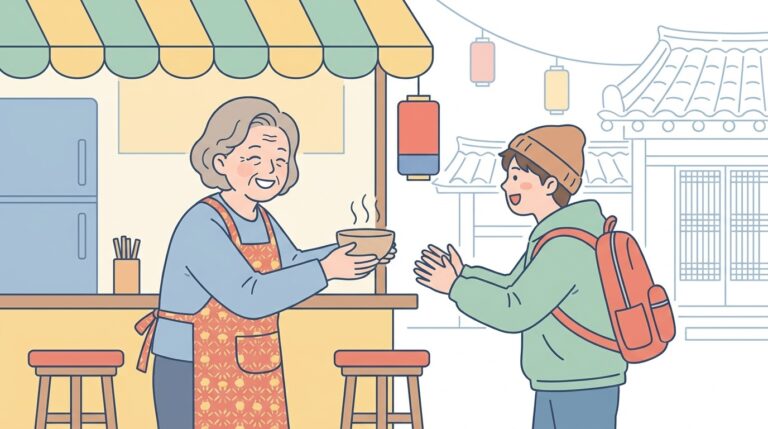
Imagine this: You’re sitting in a cozy, family-run Korean barbecue restaurant. You’ve finished your meal, and suddenly, the warm-hearted owner (often called 이모 – Imo, meaning auntie) slides a steaming plate of savory potato pancakes or a cold can of sweet Shikhye onto your table.
Before you can reach for your wallet, she waves her hand with a warm smile and says, “서비스예요!” (Seobiseu-yeyo!).
Your heart melts, but you freeze. Wait, did I order this? Am I being charged? How do I say thank you without sounding like a stiff textbook?
This is the beautiful world of 정 (Jeong)—Korea’s unique culture of deep, warm, and unconditional connection. In this guide, we’ll teach you how to navigate this cultural superpower like a local, so you can receive (and ask for!) those lovely freebies with perfect A2-level Korean. Let’s dive in!
Phase 2: Core Expressions (핵심 표현 3선)
1. 서비스예요 (Seobiseu-yeyo!)
- Pronunciation: Seo-bi-seu-ye-yo (Sounds like “service-ye-yo”)
- Meaning: “It’s a service!” (Actual meaning: “This one is on the house!” / “It’s a freebie!”)
- K-Culture Moment: You will hear this in K-Dramas when characters visit local food stalls (Pojangmacha) or neighborhood beauty salons. It’s the ultimate verbal gift-wrap.
- Editor’s Insight: In English, “service” means helpful work. In Korea, it is a Konglish term that strictly means “free of charge” given as a gesture of kindness. Never try to pay for something when a host says this!
- Situation Spectrum: Casual ✅ | Semi-formal ✅ | Formal ⚠️
- 🤔 Think About It: Does your culture have a specific word for giving free things just to build a relationship, rather than as a marketing trick?
2. 서비스 많이 주세요 (Seobiseu mani juseyo!)
- Pronunciation: Seo-bi-seu mah-ni joo-seh-yo
- Meaning: Please give me lots of freebies/service.
- K-Culture Moment: Usually said playfully when ordering a large amount of food with friends at a local chicken shop or buying multiple items at a traditional market (Sijang).
- Editor’s Insight: Be careful with your tone! Say this with a bright, cute smile. If said too flatly, it might sound demanding. Think of it as a friendly flirtation with the shop owner.
- Situation Spectrum: Casual ✅ | Semi-formal ✅ | Formal 🚫
- 🤔 Think About It: Why do you think Korean culture allows customers to playfully ask for free items? How does this show closeness?
3. 우와, 정이 넘치네요! (Uwa, jeong-i neomchineyo!)
- Pronunciation: Oo-wah, jung-ee num-chee-neh-yo
- Meaning: Wow, ‘Jeong’ is overflowing!
- K-Culture Moment: When a market vendor stuffs an extra handful of fresh strawberries into your bag, this is the perfect reaction to show you truly understand Korean culture.
- Editor’s Insight: This is a high-level compliment for an A2 learner! It shows you understand 정 (Jeong). Hearing this makes local shop owners incredibly proud and happy.
- Situation Spectrum: Casual ✅ | Semi-formal ✅ | Formal ⚠️
- 🤔 Think About It: How does acknowledging someone’s kindness change your relationship with them from “customer-seller” to “neighbor-friend”?
Phase 3: Textbook Korean vs. Real Korean
Situation 1: Expressing gratitude for a free drink
- 📖 Textbook Korean: 감사합니다. (Gamsahabnida.) – “Thank you.” (A bit plain and distant.)
- 🗣️ 진짜 (Real) Korean: 우와, 진짜 감사해요! 잘 마실게요! (Uwa, jinjja gamsahaeyo! Jal masilgeyo!) – “Wow, thank you so much! I will enjoy drinking this!”
- 💡 Why the difference? Real Korean speakers express active anticipation. Saying “I will drink/eat this well” (Jal meogkesseumnida / Jal masilgeyo) shows you appreciate the specific gift, not just the transaction.
Situation 2: Asking for a free refill of side dishes (Banchan)
- 📖 Textbook Korean: 반찬 더 주세요. (Banchan deo juseyo.) – “Give me more side dishes.” (Sounds like a command.)
- 🗣️ 진짜 (Real) Korean: 이모, 이거 너무 맛있어요! 조금만 더 주실 수 있어요? (Imo, igeo neomu masisseoyo! Jogeumman deo jusil su isseoyo?) – “Auntie, this is so delicious! Could I please have just a little bit more?”
- 💡 Why the difference? Complimenting the food first (neomu masisseoyo) softens the request, making the owner want to give you even more out of pure pride!
Phase 4: K-Culture Deep Dive & Non-Verbal Manners
4-1. The “Jeong” Body Language
When receiving Seobiseu, your body language speaks louder than your words!
1. The Double-Hand Receive: Always accept the free item with both hands. Keep your elbows slightly tucked or support your right forearm with your left hand. This shows deep respect.
2. The 15-Degree Head Nod: Give a gentle, appreciative bow while smiling. Avoid stiff eye contact; a soft, warm gaze is much better.
3. The Sincere React-Reaction: Don’t just say thank you. Show delight! A soft “Omo!” (Oh my!) or “Uwa!” makes the giver feel amazing.
4-2. The “Jeong” in Traditional Markets (Sijang)
In Korea, supermarket chains are convenient, but traditional markets (Sijang) are the beating heart of Jeong. Vendors don’t use precise scales to measure everything; they use 덤 (Deom)—the act of throwing in an extra potato, an extra rice cake, or a handful of green onions for free. It’s their way of saying, “I like you, come back again!”
Phase 5: Real-Life Roleplay Scenario
Setting: A bustling, smoky street-food stall (Pojangmacha) in Mapo, Seoul.
NPC: 이모 (Imo – Auntie), a warm, energetic woman wearing a colorful apron.
- Imo: (Placing a plate of spicy rice cakes on your table with a loud thud)
자, 여기 순대하고 떡볶이 나왔어요! 맛있게 드세요!
(Ja, yeogi sundae hago tteokbokki nawasseoyo! Masitge deuseyo!)
“Here are your blood sausages and spicy rice cakes! Enjoy!” - You: (Receiving with both hands)
우와, 맛있겠다! 잘 먹겠습니다, 이모!
(Uwa, masitgetda! Jal meokgetseumnida, Imo!)
“Wow, looks delicious! Thank you, Auntie, I’ll eat well!” - Imo: (Watching you eat happily)
매운 거 잘 먹네! 아주 예뻐!
(Maeun geo jal meokne! Aju yeppeo!)
“You eat spicy food so well! So lovely!” - You: (Wiping sweat but smiling)
조금 매운데 진짜 맛있어요! 완전 제 스타일이에요!
(Jogeum maeunde jinjja masisseoyo! Wanjeon je seutail-ieyo!)
“It’s a bit spicy but really delicious! It’s totally my style!” - Imo: (Beaming with pride, suddenly places a small bowl of fish cake soup on your table)
자, 이거 서비스! 국물 마시면서 먹어!
(Ja, igeo seobiseu! Gungmul masimyeonseo meogeo!)
“Here, this is on the house! Drink some broth while you eat!” - You: (Eyes wide with surprise)
우와, 서비스예요? 대박! 정이 정말 넘치네요!
(Uwa, seobiseu-yeyo? Daebak! Jeong-i jeongmal neomchineyo!)
“Wow, is this a freebie? Awesome! Your ‘Jeong’ is really overflowing!” - Imo: (Laughing loudly, pats your shoulder)
아유, 말도 예쁘게 하네! 다음에 또 와!
(Ayu, maldo yeppeuge hane! Daame tto wa!)
“Oh my, you speak so beautifully! Come again next time!” - You: (Nodding happily)
네! 단골손님 될게요! 감사합니다!
(Ne! Dangol-sonnim doelgeyo! Gamsahabnida!)
“Yes! I’ll become a regular customer! Thank you!”
🔀 Interactive Choice Point
How do you respond when Imo brings you the free fish cake soup?
- A) “이거 안 시켰어요.” (Igeo an sikyeosseoyo. – I didn’t order this.)
- B) “우와, 진짜요? 감동이에요!” (Uwa, jinjja-yo? Gamdong-ieyo! – Wow, really? I’m so touched!)
- C) “다음에는 만두 서비스로 주세요.” (Da-eum-eneun mandu seobiseu-ro juseyo. – Next time, give me dumplings as a freebie.)
Feedback:
- Choice A (Risk): While honest, this breaks the warm atmosphere. Imo might feel embarrassed. Korean Jeong is about accepting kindness gracefully!
- Choice B (Best): Perfect! “Gamdong-ieyo” (I’m touched) expresses genuine emotional gratitude, which is the ultimate reward for someone showing you Jeong.
- Choice C (Bad): Too greedy! Asking for a specific future freebie right away destroys the organic nature of Jeong. Keep it playful, not demanding.
Phase 6: 10-Second Emotion Shadowing Drill
Practice speaking like a native! Follow the pauses (/) and mimic the emotional cues:
- [😊 Bright & Excited]
우와! / 진짜 / 서비스예요? / 대박!
(Uwa! / Jinjja / seo-bi-seu-ye-yo? / Dae-bak!)
“Wow! / Really / is it a freebie? / Awesome!” -
[🥺 Soft & Deeply Grateful]
이모, / 너무 맛있어요… / 잘 먹을게요.
(Imo, / neomu masisseoyo… / jal meogeulgeyo.)
“Auntie, / it’s so delicious… / I will enjoy eating this.”
Phase 7: K-Culture Mini Dictionary
- 이모 (Imo) | Auntie
- Usage: Literally means mother’s sister, but used affectionately to call middle-aged female restaurant or tavern owners.
- 단골 (Dangol) | Regular Customer
- Usage: Showing loyalty to a shop guarantees you infinite Seobiseu. Tell them “단골 될게요” (I’ll become a regular!).
- 덤 (Deom) | Extra/Bonus
- Usage: The traditional market term for Seobiseu. It’s the physical extra item added to your purchase.
- 대박 (Daebak) | Awesome/Jackpot
- Usage: A super common casual exclamation used when you get unexpected free stuff.
Phase 8: Survivor’s Kit for Travelers
Survival Expressions TOP 3
- 물 좀 더 주실 수 있나요? (Mul jom deo jusil su innayo?) – “Could I please have some more water?”
- 이거 서비스예요? (Igeo seobiseu-yeyo?) – “Is this a freebie/on the house?”
- 추천해 주세요! (Chucheon-hae juseyo!) – “Please recommend something!” (Great way to start a conversation with the owner)
Editor’s Travel Note
When hunting for authentic food spots filled with Jeong, skip the mega-malls. Use the Naver Map App to find highly-rated, small local restaurants in neighborhoods like Mangwon-dong or Mullae-dong. Note: Local market stalls may prefer cash or local bank transfers over international credit cards.
Phase 9: “A Step Deeper” (Reflecting on Jeong)
In Western capitalism, everything has a strict price tag. If you get something extra, it’s often because of a “Buy 1 Get 1” corporate coupon. But in Korea, Jeong defies strict calculation. It is a warm, social glue that says, “We are not just strangers making a deal; we are human beings sharing a meal.” When you accept Seobiseu with a warm smile, you are participating in a centuries-old social contract of mutual kindness.
💬 Your Turn: Have you ever experienced a moment of unexpected kindness or “freebies” in your country? Let’s talk in the comments below!
Phase 10: FAQ & Avoiding Mistakes
Q: Can I demand ‘Seobiseu’ at high-end, luxury restaurants in Gangnam?
A: No. Seobiseu and Jeong are informal and relationship-based. High-end, formal restaurants have strict corporate menus. Asking for freebies there is considered impolite.
Q: Is ‘Seobiseu’ really 100% free?
A: Yes! You do not need to worry about hidden fees on your final bill when an owner explicitly says “서비스” (Seobiseu).
Q: What should I do if I cannot eat the free item because of an allergy?
A: Smile, show great appreciation, and gently say: “너무 감사한데, 제가 알레르기가 있어서 못 먹어요. 정말 죄송해요!” (Neomu gamsahande, jega alleleugi-ga isseoseo mot meogeoyo. Jeongmal joesonghaeyo!)
🚨 Common Mistakes Warning Board
- Mistake: Paying for the freebie during checkout.
- Correct Action: Just say “잘 먹었습니다” (I ate well!) with a bow.
- Mistake: Screaming “Hey!” to get the owner’s attention.
- Correct Action: Softly raise your hand and say “저기요~” (Jeogiyo) or “이모~” (Imo).
- Mistake: Expecting freebies on your very first, small order.
- Correct Action: Let Jeong happen naturally as you build a connection!
Phase 11: Action Mission
- Bronze Mission (Solo): Record yourself saying “이모, 진짜 맛있어요!” (Imo, jinjja masisseoyo!) using the 10-Second Emotion Shadowing drill.
- Silver Mission (Social): Share a photo of your favorite Korean food on Instagram, tag
@DailyHangul, and use the hashtag#JeongCulturein your caption. - Gold Mission (Real Life): Next time you visit a Korean restaurant, use both hands to receive your dishes and compliment the owner using “잘 먹겠습니다!”
Phase 12: Interactive Quiz Challenge
1. What does “서비스” (Seobiseu) mean in a Korean restaurant?
a) High-quality customer service
b) Free food or drink given as a gesture of kindness
c) A delivery charge
2. True or False: You should always use both hands when accepting a freebie from an elder owner.
🔍 Reveal Answers & Explanations
- Correct Answer: b) In Korea, “Seobiseu” means free of charge!
- Correct Answer: True! Using both hands is a vital non-verbal sign of respect and appreciation in Korean culture.







