

Master Ethereum Smart Contracts in Korean: Beyond the Blockchain Hype
Phase 1: Empathy (Welcome, Crypto Pioneers! 👋)
안녕하세요! (An-nyeong-ha-se-yo!) Your trusty Daily Hangul editor is back!
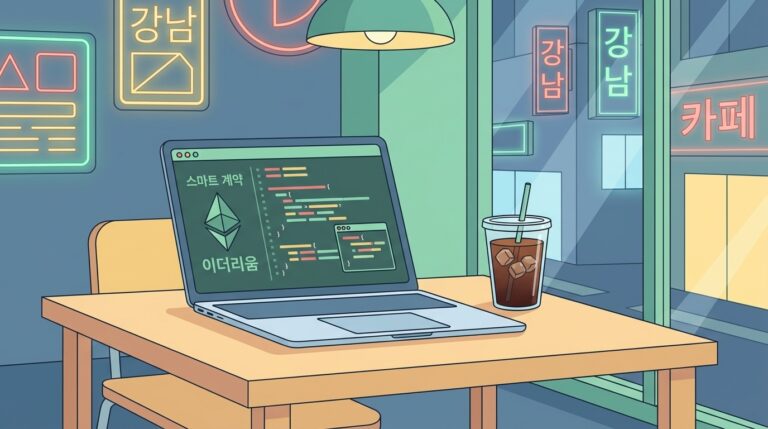
Imagine this: You are sitting in a sleek, neon-lit cafe in Gangnam, meeting a brilliant Korean blockchain developer to discuss a decentralized application (dApp) partnership. You’ve got your Solidity code down pat, but as soon as they start talking about “스마트 컨트랙트” (Smart Contracts) and gas fees, you realize textbook Korean didn’t prepare you for the raw, fast-paced jargon of the Seoul crypto scene.
You want to sound like an industry insider who understands the delicate balance of trustless automation, not just someone translating English crypto terms literally. Today, we are diving deep into the advanced, high-level Korean vocabulary used in the actual trenches of Web3 and Ethereum development. Let’s make sure your next pitch in Seoul is as bulletproof as a multisig wallet!
Phase 2: Deep-Dive into Top 3 Core Expressions
1. 계약을 이행하다 (Gye-yak-eul i-haeng-ha-da)
- Pronunciation: Gyeh-yahg-eul ee-haeng-hah-dah (Think of “ee-haeng” as “e-hang” like an airplane taking off smoothly to complete its journey)
- Meaning: To execute/fulfill a contract
- K-Culture Moment: In high-stakes tech thriller K-Dramas, characters often slam a tablet on the table and demand, “계약을 이행하세요!” (Fulfill the contract!). In blockchain, this refers to the self-executing nature of code once conditions are met.
- Editor’s Insight: While “실행하다” (sil-haeng-ha-da) means simply running a program, “이행하다” carries a heavy legal and moral weight of fulfilling an obligation or promise. In smart contracts, because code is law, we describe the automated trigger as 이행.
- Situation Spectrum: Casual: 🚫 | Semi-formal: ⚠️ | Formal: ✅
- 🤔 Think About It: How does your culture view contract execution? Is it purely clinical like code, or does it require human relationships (인간관계) to seal the deal?
2. 가스비가 폭등하다 (Ga-seu-bi-ga pok-deung-ha-da)
- Pronunciation: Gah-seu-bee-gah pohk-deung-hah-dah (Make sure to emphasize the “pok” with a sharp puff of air, mimicking an explosion)
- Meaning: Gas fees are skyrocketing (literally “exploding upwards”)
- K-Culture Moment: Korean crypto communities on platforms like DC Inside or Kakao open chats are notorious for using dramatic economic terms. When Ethereum congestion hits, the chats overflow with crying emojis and the word “폭등” (skyrocketing/explosion).
- Editor’s Insight: “폭등” is a highly expressive Hanja-based word (暴騰). It is much more dramatic than “오르다” (to rise) and perfectly captures the frustration of trying to mint an NFT while gas prices are soaring.
- Situation Spectrum: Casual: ✅ | Semi-formal: ✅ | Formal: ⚠️
- 🤔 Think About It: Why do you think Koreans prefer high-intensity words like “폭등” (explosion-rise) over simple neutral descriptions in financial contexts?
3. 무신뢰성 (Mu-sil-roe-seong)
- Pronunciation: Moo-sheel-pweh-seong (“Mu” sounds like “moo” from a cow, “sil-roe” rhymes with “will-way”)
- Meaning: Trustlessness (literally “no-trust-nature”)
- K-Culture Moment: During tech conferences in Dongdaemun Design Plaza (DDP), speakers constantly emphasize that the beauty of Ethereum is not having to trust a central authority—which they refer to as 무신뢰성의 미학 (the aesthetics of trustlessness).
- Editor’s Insight: In Korean, “신뢰” means trust. Adding the prefix “무-” (non/without) creates “무신뢰”. Be careful: in general life, “신뢰가 없다” means a lack of integrity, but in blockchain, “무신뢰성” is a highly positive technical attribute representing security.
- Situation Spectrum: Casual: 🚫 | Semi-formal: ⚠️ | Formal: ✅
- 🤔 Think About It: How hard is it to explain to non-crypto friends that “trustlessness” (무신뢰성) actually means something is more secure and reliable?
Phase 3: Textbook Korean vs. Real-Deal Korean
Scenario 1: Discussing transaction speeds and congestion
- 📖 Textbook Korean: “네트워크가 혼잡하여 전송이 지연되고 있습니다.” (The network is congested, so the transmission is being delayed.)
- 🗣️ 진짜 Korean: “지금 트랜잭션이 밀려서 가스비 장난 아니에요.” (Transactions are backed up right now, so the gas fees are no joke.)
- 💡 Why the difference? Textbooks use formal telecommunication terms, whereas real Web3 professionals use English loanwords like “트랜잭션” (transaction) paired with expressive native slang like “밀리다” (backed up) and “장난 아니다” (no joke/insane).
Scenario 2: Asking if a smart contract has been deployed
- 📖 Textbook Korean: “스마트 계약 프로그램의 배포가 완료되었습니까?” (Has the deployment of the smart contract program been completed?)
- 🗣️ 진짜 Korean: “컨트랙트 메인넷에 올리셨어요?” (Did you upload the contract to the mainnet?)
- 💡 Why the difference? Developers rarely say “스마트 계약 프로그램의 배포”. Instead, they shorten it to “컨트랙트” and use the casual yet highly active verb “올리다” (to upload/put up) to describe deploying to a network.
Phase 4: K-Culture Deep-Dive & Non-Verbal Etiquette
4-1. The “Gangnam Tech” Meeting Etiquette (눈치 & Gestures)
When negotiating smart contract audits or joint dApp ventures in Korea, body language speaks louder than code:
* The Two-Handed Phone Show: When showing a smart contract transaction, deployment hash, or wallet address on your phone, hold the phone with both hands or support your right wrist with your left hand. It shows immense respect.
* Modest Pride: If your contract is highly secure, don’t brag aggressively. Instead, bow slightly and say, “아직 부족하지만 보안에 신경을 많이 썼습니다” (It still has room for improvement, but we paid a lot of attention to security). This display of humility (겸손) builds deeper business trust.
4-2. Web3 Culture in Seoul: Coffee and Coding
Korea runs on fast internet and faster coffee. If you are meeting a dev team, never show up empty-handed. Showing up at a tech incubator in Pangyo (Korea’s Silicon Valley) with a tray of iced Americanos (아아 – Ah-Ah) immediately establishes you as a member of the tribe. In Korea, crypto discussion is fueled entirely by caffeine!
Phase 5: Real-World Roleplay Scenario
Setting: A sleek conference room in Yeouido (Seoul’s financial hub).
Characters:
* Min-jun (민준): Lead Blockchain Architect at a major Korean gaming guild.
* You (유): Visiting Ethereum Developer looking to integrate smart contracts for in-game assets.
민준: 이번 프로젝트에서 이더리움 메인넷을 쓰기에는 가스비가 너무 부담스럽지 않나요?
      (Min-jun: Isn't using the Ethereum mainnet for this project a bit too burdensome in terms of gas fees?)

You: 🎭 (Confidently pointing to the architecture diagram)
     그래서 저희는 레이어 2 솔루션을 사용해 스마트 컨트랙트를 이행하려고 합니다.
     (You: That's why we plan to use a Layer 2 solution to execute the smart contracts.)

민준: 아, L2를 쓰시는군요. 그럼 사용자 무신뢰성은 어떻게 보장하나요?
      (Min-jun: Oh, you're using L2. Then how do you guarantee user trustlessness?)

You: 🎭 (Nodding professionally with a subtle smile)
     롤업 기술을 통해 이더리움 메인넷의 보안성을 그대로 가져가기 때문에 무신뢰성은 완전히 유지됩니다.
     (You: Because we leverage the Ethereum mainnet's security through rollup technology, trustlessness is fully maintained.)

민준: 오, 준비를 많이 하셨네요. 혹시 코드 오딧(Audit)은 받으셨나요?
      (Min-jun: Oh, you're very well prepared. By the way, have you received a code audit?)

You: 🎭 (Reaching for your tablet to show the PDF)
     네, 국내 유명 보안 업체에서 이미 검증을 완료했고, 취약점은 전부 해결했습니다.
     (You: Yes, a famous domestic security firm has already completed verification, and all vulnerabilities have been resolved.)

민준: 좋습니다. 그럼 다음 주에 바로 테스트넷에 배포하고 검토해 보죠.
      (Min-jun: Great. Let's deploy it to the testnet next week and review it.)

You: 🎭 (Slightly bowing in appreciation)
     감사합니다. 잘 부탁드립니다!
     (You: Thank you. I look forward to working with you!)
🔀 Interactive Choice Point
How would you respond if Min-jun suddenly asked: “혹시 갑자기 가스비가 폭등하면 사용자들에게 보전해 주나요?” (If gas fees suddenly skyrocket, do you compensate the users?)
- Option A: “그건 저희 책임이 아닙니다.” (That is not our responsibility.)
- 🚫 Risk: Too blunt. It breaks the harmonious business vibe (기분) and might make you look uncaring.
- Option B: “가스비가 폭등할 경우를 대비해 수수료 대납(Meta-transaction) 컨트랙트를 준비했습니다.” (We have prepared a meta-transaction contract to pay fees on behalf of users in case gas fees skyrocket.)
- 🏆 Best: Proactive, highly professional, and showcases advanced Web3 engineering capability in flawless Korean.
- Option C: “죄송하지만 가스비는 어쩔 수 없습니다.” (Sorry, but we can’t help gas fees.)
- ⚠️ Bad: Passive. While honest, it doesn’t offer a constructive solution for the partnership.
Phase 6: 10-Second Emotion Shadowing Drill
Practice saying these lines out loud with the correct emotional delivery. Pay attention to the pauses (/)!
- [😎 Confident & Direct]
- 스마트 컨트랙트의 핵심은 / 계약을 자동으로 / 이행하는 것입니다.
- Seu-ma-teu keon-traek-teu-ui hae-sim-eun / gye-yak-eul ja-dong-eu-ro / i-haeng-ha-neun geos-im-ni-da.
- “The core of smart contracts / is automatically / executing the contract.”
- [😱 Shocked & Stressed]
- 아니, / 갑자기 가스비가 / 왜 이렇게 폭등했어요?
- A-ni, / gap-ja-gi ga-seu-bi-ga / wae i-reo-ke pok-deung-haess-eo-yo?
- “Wait, / why did the gas fees / suddenly skyrocket like this?”
Phase 7: K-Culture Mini-Dictionary
- 가스비 (Ga-seu-bi) | Gas Fee
- The transaction fee paid to miners/validators on Ethereum. In Korea, “비” (fee) is attached to many daily terms, making “가스비” sound both like utility bills (natural gas) and blockchain gas.
- 오딧 (O-dit) | Smart Contract Audit
- Derived from the English “audit”. Korean blockchain companies exclusively use this loanword when discussing security reviews.
- 탈중앙화 (Tal-jung-ang-hwa) | Decentralization
- Literally “escaping the center”. A vital concept for discussing blockchain structures in Korean.
- 메인넷 (Me-in-net) | Mainnet
- The actual live blockchain network. Developers use this constantly to separate theory from production reality.
Phase 8: Traveler’s Survival Kit for Tech Nomads
Survival Expressions TOP 3
- “여기 와이파이 비밀번호가 뭐예요?” (Yeo-gi wa-i-pa-i bi-mil-beon-ho-ga mwo-yae-yo?)
- Pro Tip: Absolutely crucial if you need to access your Web3 wallet immediately in a cafe.
- “콘센트 있는 자리 있어요?” (Kon-sen-teu in-neun ja-ri is-seo-yo?)
- Pro Tip: Korea uses “콘센트” (from concentric plug) to mean electrical outlets. Essential for long laptop coding sessions.
- “테스트넷에서는 잘 돌아갑니다.” (Te-seu-teu-net-e-seo-neun jal dol-a-gap-ni-da.)
- Pro Tip: The ultimate developer’s defense: “It works fine on the testnet!”
Editor’s Travel Note
When heading to Seoul for a crypto meetup, download the Naver Map App to navigate the complex subway exits of Gangnam. Don’t rely on global maps; local mapping apps are far more accurate for finding hidden basement blockchain lounges! Note: App store terms and services are subject to change over time.
Phase 9: “Going One Step Deeper” (Cultural Reflection)
In Korean culture, trust (신뢰) is traditionally built through physical presence, dining together (회식), and shared experiences. Blockchain’s core value proposition, 무신뢰성 (trustlessness), initially sounds incredibly cold and suspicious to traditional Korean business minds. However, the younger generation of tech entrepreneurs in Seoul has beautifully married these two concepts: they write bulletproof, trustless smart contracts while still building incredibly warm, relational communities on Telegram and in person. To succeed in Korea’s crypto ecosystem, you must master both—the cold logic of code, and the warm culture of Korean connection.
💬 Your Turn: Do you think smart contracts can completely replace social trust in business? Let us know in the comments below!
Phase 10: FAQ & Common Mistakes
Q: Can I use “스마트 계약” instead of “스마트 컨트랙트”?
A: Yes, both are grammatically correct. However, in professional Web3 developer circles in Korea, almost everyone prefers the transliterated English term “스마트 컨트랙트” or simply “컨트랙트”. Using “계약” sounds a bit too legalistic and old-fashioned.
Q: What is the difference between “이행” and “실행”?
A: “실행” (execution/run) is used for running code, software, or plans (e.g., 프로그램을 실행하다). “이행” (fulfillment) is specifically used for legal, moral, or programmatic promises and contracts (e.g., 계약을 이행하다).
Q: Is “가스비” used for household gas bills too?
A: Yes! In daily life, “가스비” is the monthly utility bill for cooking and heating. In crypto contexts, it refers to Ethereum transaction fees. The context will prevent any confusion!
🚨 Common Mistakes Warning Board
- Saying “가스 요금” instead of “가스비” in tech chats:
- Correct Action: While “요금” means fee, blockchain devs always say “가스비” or “가스 수수료”.
- Pronouncing “스마트” with a heavy English accent:
- Correct Action: Flatten the pronunciation to Korean phonetics: Seu-ma-teu.
- Using “신뢰가 없다” to mean trustless blockchain:
- Correct Action: Use “무신뢰성” (technical trait). Saying “신뢰가 없다” sounds like you are accusing the team of being untrustworthy liars!
Phase 11: Action Mission & Engagement
Action Mission
- Bronze Medal 🥉: Speak “이더리움 스마트 컨트랙트” out loud five times, mimicking the sharp Korean “트” endings.
- Silver Medal 🥈: Share a screenshot of your favorite crypto transaction on social media and caption it: “가스비가 폭등했다! 😭”
- Gold Medal 🥇: Create a dummy contract on Sepolia testnet and send a Korean blockchain enthusiast a message saying: “테스트넷에서 계약을 이행해 보세요!”
🎮 K-Culture Mission
Watch a tech-related Korean drama (like Start-Up on Netflix) and listen carefully to how they pitch software deployments. Note down any time they say “배포” (deployment) or “실행” (execution)!
Phase 12: Interactive Quiz Challenge
Test your knowledge with these three quick questions! (Click the toggles to check your answers)
1. Which Korean word best represents the concept of blockchain’s “trustlessness”?
Reveal Answer & Explanation
Answer: 무신뢰성 (Mu-sil-roe-seong)
Explanation: “무” means non/without, and “신뢰성” means reliability/trustworthiness. Together, they create the technical term for trustlessness.
2. Fill in the blank: “가스비가 너무
( )해서 지금 전송하면 손해예요.”
(Gas fees are skyrocketing so sending now is a loss.)
Reveal Answer & Explanation
Answer: 폭등 (pok-deung)
Explanation: “폭등” is the most natural term to express a sudden, violent rise in fees or prices in crypto environments.
3. True or False: “이행하다” is used to describe running a simple web browser on your phone.
Reveal Answer & Explanation
Answer: False
Explanation: Running a browser is “실행하다”. “이행하다” is strictly reserved for fulfilling agreements, obligations, or smart contracts.







