

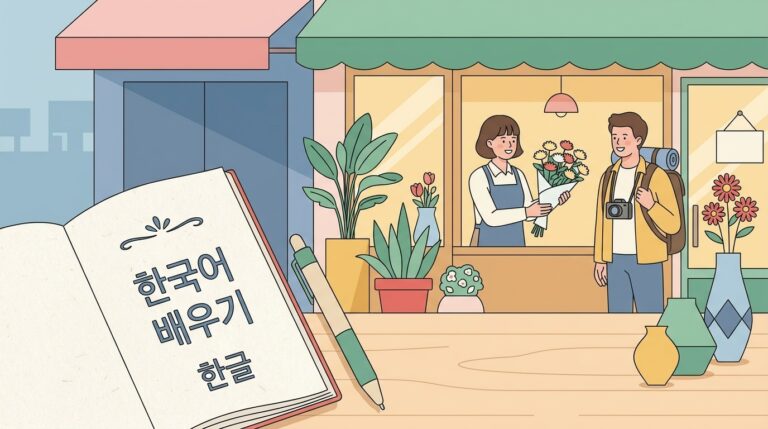
How to Ask for Long-Lasting Flowers at a Korean Florist (A2 Level)
Phase 1: Empathy (Your Korean Flower Shop Adventure)
안녕하세요! (An-nyeong-ha-se-yo!) I’m your Daily Hangul editor and your personal cultural navigator.
Imagine this: You are walking down a cozy street in Hongdae or Garosu-gil, and you spot a gorgeous, pastel-toned flower shop. You want to buy a beautiful bouquet for your friend’s housewarming party, or maybe just to brighten up your own Airbnb room. But there’s a catch—you want these flowers to survive the week, not wilt by tomorrow morning!
Many of our learners tell us, “I know how to say ‘flower’ (꽃 – kkot), but when I want to ask for something that actually lasts long, my mind goes blank!” Don’t worry. Today, we’ll learn the exact, natural phrases to ask Korean florists for their hardiest, most beautiful blooms. Let’s dive in!
Phase 2: Deep Dive into 3 Key Expressions
1. 오래가는 꽃으로 추천해 주세요. (O-rae-ga-neun kkot-eu-ro chu-cheon-hae ju-se-yo.)
- Pronunciation: Oh-rae-gah-neun kkot-eu-roh choo-cheohn-hae joo-seh-yo. (Sounds like: “Oh-ray-gah-noon cot-oo-row…”)
- Meaning: “Please recommend flowers that last a long time.”
- K-Culture Moment: In the K-drama Crash Landing on You, characters often express deep, long-lasting feelings. When you ask for “오래가는 꽃” (long-lasting flowers), you are asking for blooms that symbolize that same enduring strength!
- Editor’s Insight: “오래” means “for a long time,” and “가다” here means “to last/keep going.” Combined, “오래가다” is the perfect natural verb for durability.
- Situation Spectrum: Casual (⚠️) / Semi-formal (✅) / Formal (✅)
- 🤔 Think About It: In Korea, giving gifts that last long (like potted plants or hardy flowers) is seen as a sign of practical care and thoughtfulness. How does this compare to flower-giving customs in your country?
2. 어떤 꽃이 제일 오래가요? (Eo-tteon kkot-i je-il o-rae-ga-yo?)
- Pronunciation: Uh-tteon kkot-ee jeh-il oh-rae-gah-yo?
- Meaning: “Which flowers last the longest?”
- K-Culture Moment: You walk into a trendy flower market in Yangjae-dong. The florist is busy trimming stems. You point to a few options and ask this question to get the real expert opinion.
- Editor’s Insight: “제일” (jeh-il) means “the most” or “best.” This is a super handy, friendly, and direct way to ask for the florist’s top recommendation.
- Situation Spectrum: Casual (⚠️) / Semi-formal (✅) / Formal (✅)
3. 관리하기 쉬운 꽃 있어요? (Gwan-ri-ha-gi swi-un kkot is-seo-yo?)
- Pronunciation: Gwan-ree-hah-gee shee-oon kkot eet-suh-yo?
- Meaning: “Are there flowers that are easy to care for?”
- K-Culture Moment: Perfect for busy students or travelers living in a guesthouse who don’t have fancy vases or flower food.
- Editor’s Insight: “관리” (gwan-ri) means “management” or “care.” “쉬운” (swi-un) means “easy.” Use this when you want low-maintenance beauty.
- Situation Spectrum: Casual (⚠️) / Semi-formal (✅) / Formal (✅)
Phase 3: Textbook vs. Real Korean
Situation 1: Asking for durable flowers
- 📖 Textbook Korean: 수명이 긴 화초를 보여주십시오. (Su-myeong-i gin hwa-cho-reul bo-yeo-jup-si-o. – “Please show me plants with long lifespans.”)
- 🗣️ Real Korean: 오래가는 꽃 어떤 거 있어요? (O-rae-ga-neun kkot eo-tteon geo is-seo-yo? – “What kind of long-lasting flowers do you have?”)
- 💡 Why the difference?: Textbook Korean uses heavy Sino-Korean words like “수명” (lifespan) and “화초” (plants/vegetation), which sound like a science lab! Real Koreans use conversational, light phrasing like “오래가는 꽃” (flowers that go long).
Situation 2: Asking for care tips
- 📖 Textbook Korean: 이 식물의 재배 방법을 설명해 주시겠습니까? (I sik-mul-ui jae-bae bang-beop-eul seol-myeong-hae ju-si-get-seup-ni-ka? – “Would you explain the cultivation method of this plant?”)
- 🗣️ Real Korean: 물은 어떻게 줘요? (Mul-eun eo-tteoh-ge jwo-yo? – “How should I water it?”)
- 💡 Why the difference?: Unless you are a professional botanist, “물 어떻게 줘요?” (How do I give water?) is the absolute gold standard for practical everyday care.
Phase 4: K-Culture Deep Dive & Non-Verbal Manners
4-1. Nunchi & Gestures
When entering a Korean florist boutique, it is polite to greet them with a slight bow of your head. When pointing to flowers, use your whole hand open rather than pointing with one index finger, which can sometimes look a bit demanding. When they recommend a flower, nodding slowly while saying “아~ (Ah~)” shows that you appreciate their professional expertise!
4-2. Korean Flower Aesthetics
Korean flower arrangements often focus on soft, pastel colors (beige, pale pink, lavender) and airy, natural structures. “Lesser-known” wildflowers and greens like eucalyptus are incredibly popular. Florists pride themselves on their wrapping paper styles (often using high-quality wax paper and delicate ribbons).
Phase 5: Real-Life Roleplay Scenario
Setting: “Deurim Flower Shop” (드림 꽃집) in Mapo-gu. The florist, Min-ji (민지), is organizing fresh carnations.
- Min-ji (Florist): 🎭 Friendly smile 어서 오세요! 어떤 꽃 찾으세요? (Eo-seo o-se-yo! Eo-tteon kkot chat-eu-se-yo? / Welcome! What kind of flowers are you looking for?)
- You: 안녕하세요! 선물할 꽃을 사고 싶어요. (An-nyeong-ha-se-yo! Seon-mul-hal kkot-eul sa-go sip-eo-yo. / Hello! I want to buy flowers for a gift.)
- Min-ji (Florist): 🎭 Nods 아, 선물용이요! 특별히 원하시는 종류가 있으세요? (Ah, seon-mul-yong-i-yo! Teuk-byeol-hi won-ha-si-neun jong-ryu-ga is-seo-yo? / Oh, for a gift! Is there a specific kind you want?)
- You: 특별한 건 없는데, 오래가는 꽃으로 추천해 주세요. (Teuk-byeol-han geon eop-neun-de, o-rae-ga-neun kkot-eu-ro chu-cheon-hae ju-se-yo. / Nothing specific, but please recommend flowers that last a long time.)
- Min-ji (Florist): 🎭 Points to white and pink blooms 그러면 백합이나 소국이 오래가고 예뻐요! (Geu-reo-myeon baek-hap-i-na so-guk-i o-rae-ga-go yeop-peo-yo! / In that case, lilies or spray mums last long and are pretty!)
- You: 좋네요! 소국으로 할게요. 이건 물 어떻게 줘요? (Joh-ne-yo! So-guk-eu-ro hal-ge-yo. I-geon mul eo-tteoh-ge jwo-yo? / Great! I’ll go with the spray mums. How should I water these?)
- Min-ji (Florist): 🎭 Handing over the vase tip card 화분에 심은 거니까, 흙이 마르면 듬뿍 주세요! (Hwa-bun-e sim-eun geo-ni-ka, heulk-i ma-ryeo-myeon deum-ppuk ju-se-yo! / Since it’s potted, water it thoroughly when the soil is dry!)
- You: 네, 감사합니다! (Ne, gam-sa-ham-ni-da! / Yes, thank you!)
🔀 Interactive Choice Point!
What will you say next to complete your purchase?
* A: “이걸로 포장해 주세요.” (I-geol-ro po-jang-hae ju-se-yo. – “Please wrap this one for me.”)
* B: “너무 비싸요! 깎아주세요!” (Neo-mu bi-ssa-yo! Kkak-a-ju-se-yo! – “Too expensive! Give me a discount!”)
* C: “그냥 안 살래요.” (Geu-nyang an sal-rae-yo. – “I just won’t buy it.”)
Feedback:
- Choice A (Best): Perfect! It’s polite, clear, and leads straight to beautiful gift wrapping.
- Choice B (Risk): While bargaining happens in traditional flea markets, it is considered impolite in modern, boutique flower shops where prices are fixed.
- Choice C (Bad): While you have the right to change your mind, saying “I just won’t buy it” directly after a long consultation can feel a bit cold. A softer “다음에 올게요” (I’ll come back next time) is better.
Phase 6: 10-Second Emotion Shadowing Drill
Practice saying these like a real local! Pay attention to the pauses (/) and the emotional cues.
[😊 With a bright, hopeful smile]- 오래가는 / 꽃으로 / 추천해 주세요!
- O-rae-ga-neun / kkot-eu-ro / chu-cheon-hae ju-se-yo!
[🤔 Curious and seeking advice]- 어떤 꽃이 / 제일 / 오래가요?
- Eo-tteon kkot-i / je-il / o-rae-ga-yo?
[🥺 Asking for an easy option, slightly cute tone]- 관리하기 / 쉬운 꽃 / 있어요?
- Gwan-ri-ha-gi / swi-un kkot / is-seo-yo?
Phase 7: K-Culture Mini Dictionary
- 꽃다발 (Kkot-da-bal) | Bouquet | Literally “flower bunch.” This is what you ask for when you want a beautifully wrapped handheld arrangement.
- 화분 (Hwa-bun) | Flowerpot / Potted Plant | Best choice if you want the gift to last for months, not just weeks!
- 꽃말 (Kkot-mal) | Language of Flowers / Flower Meaning | Koreans love checking the hidden meaning of flowers before gifting them (e.g., yellow roses can sometimes mean jealousy!).
- 소국 (So-guk) | Spray Mums / Chrysanthemums | Small, charming flowers known in Korea as one of the hardiest, longest-lasting species.
Phase 8: Survivor Kit for Travelers
Survival Expressions TOP 3
- 선물용이에요. 포장해 주세요. (Seon-mul-yong-i-e-yo. Po-jang-hae ju-se-yo.)
- Meaning: “It’s for a gift. Please wrap it.”
- Pro Tip: This signals the florist to make the wrapping extra gorgeous!
- 이거 얼마예요? (I-geo eol-ma-yeo?)
- Meaning: “How much is this?”
- Pro Tip: Simple, essential, and polite.
- 메시지 카드 쓸 수 있어요? (Me-si-ji ka-deu sseul su is-seo-yo?)
- Meaning: “Can I write a message card?”
- Pro Tip: Most Korean florists will provide a small card for free or a tiny fee so you can write a handwritten note.
Editor’s Travel Note
If you want to find the most affordable and diverse flowers in Seoul, download the Naver Map App and search for “양재꽃시장” (Yangjae Flower Market) or “고속터미널 꽃시장” (Express Bus Terminal Flower Market). Going early in the morning is a sensory overload in the best way possible! Note: Market operating hours may vary, so always check Naver Maps before traveling.
Phase 9: A Step Deeper (Reflection)
In Korea, gifting flowers is not just reserved for romantic anniversaries. People gift flowers for graduations, promotions, moving into a new home, or simply to cheer up a friend on a regular Tuesday. The emphasis on “오래가는 것” (that which lasts long) reflects a cultural value of longevity and lasting relationships. When you give someone a flower that stays fresh for weeks, it shows your warm wishes will remain in their space for a long time.
💬 Your Turn: Have you ever bought flowers in another country? What is your favorite flower, and does it last long? Let us know in the comments below!
Phase 10: FAQ & Avoiding Mistakes
Q: Can I buy a single stem of a flower in Korea?
A: Absolutely! You can say “한 송이만 포장해 주세요” (Han song-i-man po-jang-hae ju-se-yo / Please wrap just one stem). It’s a very common and affordable gift.
Q: Are flowers expensive in Korea?
A: Prices vary. Small boutique shops in tourist areas might be slightly pricier, but local neighborhood florists and wholesale markets offer incredible beauty at very reasonable rates.
Q: How do I ask for flower food?
A: You can ask: “꽃 보존제 있어요?” (Kkot bo-jon-je is-seo-yo? / Do you have flower preservative?). Many shops will include a small packet for free.
🚨 Common Mistakes Alert!
- Saying “오래 살다” (o-rae sal-da) instead of “오래가다” (o-rae-ga-da):
- Mistake: “이 꽃 오래 살아요?” (Does this flower live long?)
- Why: “살다” is used for people or animals. For cut flowers, use “오래가다” (to last long).
Phase 11: Action Mission!
- Bronze Mission: Read the expression “오래가는 꽃으로 추천해 주세요” out loud 3 times using our Phase 6 shadowing guide.
- Silver Mission: Write down your favorite flower in the comments using its Korean name (e.g., 장미 – rose, 백합 – lily, 튤립 – tulip).
- Gold Mission: Next time you pass by a flower shop (or in your next Korean practice session), use the phrase “관리하기 쉬운 꽃 있어요?” to ask for recommendations!
Phase 12: Interactive Quiz Challenge
1. Which phrase means “Please recommend flowers that last a long time”?
- A) 물 많이 주세요.
- B) 오래가는 꽃으로 추천해 주세요.
- C) 꽃이 너무 비싸요.
🔍 Click here for the Answer!
Correct Answer: B
* Explanation: B directly asks for long-lasting flower recommendations. A means “Give me lots of water,” and C means “The flowers are too expensive.”
2. True or False: You should use “살다” (to live) when asking if a cut bouquet of flowers lasts long.
- A) True
- B) False
🔍 Click here for the Answer!
Correct Answer: B (False)
* Explanation: You should use “오래가다” (to last long) instead of “살다” (to live) for cut flowers!







