

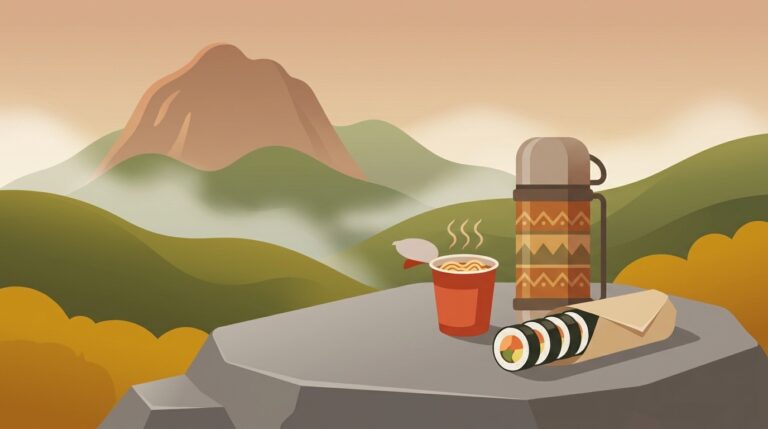
Mountain Top Magic: Why Kimbap and Cup Ramen Taste Best at the Peak of Korea
안녕하세요! (Annyeonghaseyo!) It’s your K-Culture Navigator and favorite Korean bestie from Daily Hangul.
Have you ever climbed a mountain in Korea? If you have, you might have noticed something incredible. When you finally sweat your way to the summit, you aren’t just met with breathtaking, misty views of Seoul or Seoraksan. You are met with a heavenly scent: spicy, steamy shin ramyun and toasted sesame oil.
In Korea, hiking isn’t just cardio—it’s a full-on culinary pilgrimage. Today, we’re diving into the absolute peak (pun intended!) of Korean hiking culture: 정상에서 먹는 컵라면과 김밥 (eating cup ramyun and kimbap at the summit). We’ll learn how to talk about this mouth-watering experience like a true local, avoid common mountain-top blunders, and master the cultural code of the Korean trail.
Phase 2: Top 3 Must-Know Hiking Expressions
Here are three essential expressions you will hear—and absolutely need to use—on a Korean trail.
1. 금강산도 식후경 (Geumgangsando sikhugyeong)
- Pronunciation: Geum-gang-san-do sik-hu-gyeong (Rhymes with “sick-who-young”)
- Meaning: “Even Mt. Geumgang is best viewed after eating.” (Literal) / “Food comes first!”
- K-Culture Moment: You’ll hear this in variety shows like 1 Night 2 Days (1박 2일) whenever the cast arrives at a beautiful location but insists on eating first.
- Editor’s Insight: Mt. Geumgang is historically known as Korea’s most beautiful mountain. This ancient proverb means that no matter how magnificent the scenery is, you can’t truly appreciate it on an empty stomach.
- Situation Spectrum: Casual ✅ | Semi-formal ✅ | Formal ⚠️
- 🤔 Think About It: Does your culture have a saying that links beautiful nature or art directly to having a full stomach?
2. 꿀맛이에요 (Kkul-mat-i-e-yo)
- Pronunciation: Kkul-ma-shi-e-yo (Think of “cool” but with a tense ‘k’ sound: kk-ool + mah-shi-eh-yo)
- Meaning: “It tastes like honey!” (Literal) / “It’s absolutely delicious!”
- K-Culture Moment: Used constantly by food vloggers when taking that first piping-hot bite of food after a hard workout.
- Editor’s Insight: While “맛있어요” (delicious) is standard, calling food “꿀맛” (honey-taste) specifically conveys that deep, satisfying sweetness/flavor that comes when you eat something while exhausted.
- Situation Spectrum: Casual ✅ | Semi-formal ✅ | Formal 🚫
- 🤔 Think About It: Why do you think Koreans use the word ‘honey’ to describe the ultimate savory experience?
3. 정상 찍었어요! (Jeongsang jjigeosseoyo!)
- Pronunciation: Jeong-sang jjee-gutt-uh-yo (“Jeong-sang” like the name, “jjee-gutt-uh-yo” like “cheeg-hut-uh-yo”)
- Meaning: “I stamped/marked the summit!” (Literal) / “I made it to the top!”
- K-Culture Moment: The caption hikers post on Instagram alongside a selfie next to the summit stone (정상석).
- Editor’s Insight: The verb 찍다 (to stamp/print) is used here to show that you didn’t just walk up; you successfully marked your achievement.
- Situation Spectrum: Casual ✅ | Semi-formal ✅ | Formal 🚫
- 🤔 Think About It: How does “stamping” the top feel different from just “arriving” at the top?
Phase 3: Textbook Korean vs. Real Korean
Let’s look at how textbooks teach hiking conversations versus how real Koreans actually talk on the trail.
Situation 1: Expressing exhaustion on the trail
- 📖 Textbook Korean: “등산이 아주 힘듭니다.” (Deungsani aju himdeumnida.) – “Hiking is very difficult.”
- 🗣️ Real Korean: “와, 진짜 다리가 풀렸어요.” (Wa, jinjja dariga pullyeosseoyo.) – “Wow, my legs have literally turned to jelly/untied.”
- 💡 Why is it different? Koreans love physical, sensory metaphors. “다리가 풀리다” literally means your legs have unraveled or untied like a shoelace, perfectly describing that shaky, weak-kneed feeling during a steep hike.
Situation 2: Suggesting it’s time to eat
- 📖 Textbook Korean: “이제 점심을 먹읍시다.” (Ije jeomsimeul meogeupsida.) – “Let us eat lunch now.”
- 🗣️ Real Korean: “슬슬 라면 물 올릴까요?” (Seulseul ramyun mul ollilkkayo?) – “Shall we slowly start boiling the water for the ramen?”
- 💡 Why is it different? “슬슬” (seul-seul) is an onomatopoeia for doing something gently or slowly. Asking to “put the water on” is the ultimate, cozy invitation to stop hiking and start enjoying the summit picnic.
Phase 4: K-Culture Deep Dive & Non-verbal Manners
4-1. The Art of “Jeong” (정) on the Mountain
When hiking in Korea, you are never truly alone. Korean hikers, especially the older generation (Ahjussi and Ajumma), carry an incredible warmth known as 정 (Jeong).
- The Greeting: If you make eye contact on a narrow trail, it is polite to nod slightly and say “안녕하세요” (Annyeonghaseyo) or “힘내세요!” (Himnaeseyo! – Hang in there!).
- The Shared Feast: If you sit down near the summit to eat your kimbap, don’t be surprised if a group next to you offers you a cup of hot tea, a slice of frozen pear, or a pour of Makgeolli (Korean rice wine). The Rule: Always accept with two hands, bow slightly, and say “감사히 먹겠습니다” (Gamsahi meokgessnida – I will eat this gratefully).
4-2. The “Summit Holy Trinity”: Kimbap, Cup Ramen, and Thermos
How do you get hot cup ramen at the top of a mountain with no electricity?
Korean hikers are master planners. They buy 컵라면 (cup ramyun) and 김밥 (kimbap) at a convenience store at the base of the mountain, but they pack a heavy, high-quality 보온병 (thermos flask) filled with boiling water. By the time they reach the peak, the water is still hot enough to cook the noodles perfectly.
Safety Tip: Setting up portable gas stoves is strictly illegal on most Korean mountains due to forest fire risks. The thermos is your only savior!
Phase 5: Real-Life Roleplay Scenario
Setting: Bukhansan Mountain (북한산) Summit in Seoul. The wind is chilly, and you are sitting on a flat rock with Min-jun (민준), your hiking partner.
Dialogue (B1 Level)
- 민준: (이마의 땀을 닦으며) 🎭 와, 드디어 정상 찍었네요! 진짜 수고하셨어요.
(Wa, deudeo jeongsang jjigeosneyo! Jinjja sugohasyeosseoyo.)
“Wow, we finally hit the summit! Great job!” -
You: 🎭 (헐떡이며 웃음) 저도 다리가 풀렸어요. 그런데 경치가 진짜 대박이네요.
(Jeodo dariga pullyeosseoyo. Geureonde gyeongchiga jinjja daebagineyo.)
“My legs have turned to jelly, too. But the view is seriously awesome.” -
민준: 🎭 (가방을 열며) 금강산도 식후경인데, 슬슬 라면 물 올릴까요?
(Geumgangsando sikhugyeonginde, seulseul ramyun mul ollilkkayo?)
“Food comes first, shall we start getting the water ready for the ramen?” -
You: 🎭 (눈이 동그래지며) 우와! 보온병에 뜨거운 물을 싸왔어요?
(Uwa! Bo-on-byeong-e tteu-geo-un mul-eul ssa-wass-eo-yo?)
“Whoa! Did you pack hot water in a thermos?” -
민준: 🎭 (어깨를 으쓱하며) 당연하죠! 산 정상에서 먹는 컵라면이랑 김밥은 진짜 꿀맛이에요.
(Dangyeonhajo! San jeongsangeseo meokneun keobramyeon-irang gimbabeun jinjja kkulmasieyo.)
“Of course! Cup ramyun and kimbap eaten at the mountain summit are literally honey-taste.” -
You: 🎭 (라면을 한 젓가락 먹고) 와… 대박! 집에서 먹는 거랑 비교가 안 돼요. 진짜 꿀맛이에요!
(Wa… daebak! Jibeseo meokneun georang bigyoga an dwaeyo. Jinjja kkulmasieyo!)
“Wow… amazing! It doesn’t even compare to eating at home. It really tastes like honey!” -
민준: 🎭 (김밥을 건네며) 라면 국물에 김밥 찍어 먹어 봐요. 이게 한국 등산의 정석이에요.
(Ramyun gungmure gimbap jjigeo meogeo bwayo. Ige hanguk deungsanui jeongseogiyeyo.)
“Try dipping the kimbap in the ramen broth. This is the classic textbook way to do Korean hiking.” -
You: 🎭 (엄지손가락을 치켜세우며) 최고예요! 다음에도 등산 또 와요.
(Choegoyeyo! Daeumeudo deungsan tto wayo.)
“This is the best! Let’s go hiking again next time.”
🔀 Interactive Choice Points
How would you respond to Min-jun when he offers you some of his home-packed side dishes?
- Choice A: “배불러요. 괜찮아요.” (Baebulleoyo. Gwaenchanhayo.) – “I’m full. It’s okay.”
- Choice B: “우와, 감사히 먹겠습니다! 등산 와서 먹으니까 더 맛있네요.” (Uwa, gamsahi meokgessnida! Deungsan waseo meogeunikka deo masinneyo.) – “Wow, thank you! Eating it while hiking makes it taste even better.”
- Choice C: “이거 매워요? 저 매운 거 못 먹어요.” (Ige maewoyo? Jeo maeun geo mot meogeoyo.) – “Is this spicy? I can’t eat spicy things.”
Feedback on Choices
- Best (Choice B): Perfect! It shows deep gratitude, utilizes the cultural concept of Jeong, and compliments the context of outdoor eating.
- Risk (Choice C): Honest, but a bit blunt. It is better to accept gratefully first, or gently say “제가 매운 걸 잘 못 먹어서 아쉽네요” (It’s a pity I can’t eat spicy things well) to soften the rejection.
- Bad (Choice A): Too cold. Rejecting offered food bluntly on a mountain peak can break the warm atmosphere of the hike.
Phase 6: 10-Second Emotion Shadowing Drill
Let’s practice speaking with real Korean emotion. Pay attention to the pauses (/) and the emotional cues!
- [🥺 Weary but amazed]
“와… / 진짜 다리가 풀렸는데 / 경치가 대박이에요.”
(Wa… / jinjja dariga pullyeonneunde / gyeongchiga daebagineyo.) -
[😋 Hungry and excited]
“산 정상에서 먹는 / 라면은 / 진짜 꿀맛이에요!”
(San jeongsangeseo meokneun / ramyeoneun / jinjja kkulmasieyo!) -
[🙌 Highly satisfied & proud]
“드디어 / 정상 찍었어요! / 우리 다음에도 / 또 와요!”
(Deudeo / jeongsang jjigeosseoyo! / Uri daeumeudo / tto wayo!)
Phase 7: K-Culture Mini-Dictionary
- 보온병 (Bo-on-byeong) | Thermos Flask | Essential for carrying boiling water up the mountain to cook cup ramen.
- 정상석 (Jeongsang-seok) | Summit Stone | The large stone marker at the peak of a mountain. Waiting in line to take a photo with this stone is a must!
- 하산 (Hasan) | Descending the mountain | The act of walking down. Pro-tip: Koreans often celebrate ‘Hasan’ with savory pancakes (Pajeon) and Makgeolli at the base of the mountain.
- 등산 크루 (Deungsan Crew) | Hiking Clubs/Crews | Social youth groups in Korea that meet up weekly to hike and eat together.
Phase 8: Traveler’s Survival Kit
Survival Expressions TOP 3
- 이 근처에 화장실이 어디에 있나요? (I geuncheoe hwajangsiri eodie innayo?)
- Pro Tip: Use this at the trailhead before you start ascending, as toilets are rare near the summit!
- 정상까지 얼마나 걸려요? (Jeongsangkkaji eolmana geollyeoyo?)
- Pro Tip: “How long to the summit?” Ask descending hikers this. They will usually smile and say “Almost there!” even if it’s 1 hour away!
- 뜨거운 물 어디서 얻을 수 있나요? (Tteugeoun mul eodiseo eodeul su innayo?)
- Pro Tip: “Where can I get hot water?” If you are at a mountain shelter (대피소), they sometimes have hot water dispensers.
Editor’s Travel Note
Before climbing, download the KakaoMap App to check trail difficulties. Also, remember to carry a small plastic bag in your backpack. In Korea, you must pack out all your trash, including empty cup ramen containers and leftover soup. Dumping soup in the mountain soil is strictly prohibited to protect the local ecosystem.
Phase 9: “A Step Deeper” (Thoughtful Reflection)
In many Western cultures, hiking is viewed as an individualistic sport, focused on pacing, fitness, and conquering the peak. In Korea, however, hiking is deeply communal. It is a shared ritual of labor and reward. Slipping on steep rocks together, sharing heavy thermoses, and gathering at the peak to eat simple convenience-store food creates a profound sense of equality and connection. When we eat kimbap and ramen at the summit, we are eating the taste of community.
💬 Your Turn: Would you rather hike alone in silence, or hike with a lively group of Korean friends sharing food at the top? Tell us in the comments below!
Phase 10: FAQ & Common Mistakes
Q: Can I buy cup ramen at the top of the mountain?
A: Generally, no. While some extremely famous mountains like Hallasan used to sell them, most national parks have banned sales at the top to preserve nature. You must pack your own cup ramen, kimbap, and hot water!
Q: Is it okay to drink alcohol on the mountain?
A: Drinking large amounts of alcohol is illegal on Korean mountain trails and can lead to fines due to safety concerns. However, a small, polite cup of Makgeolli at the picnic site is a common, tolerated cultural practice among older hikers—just keep it safe and minimal!
Q: Can I throw away organic trash (like apple peels or ramen crumbs) on the mountain?
A: Absolutely not. Many wild animals get sick from eating salted Korean foods. Always bring everything back down with you.
🚨 Common Mistakes Warning Board
- Mistake 1: Buying ramen but forgetting a thermos of hot water. (You’ll end up chewing raw noodles!)
- Mistake 2: Hiking in smooth-soled running shoes. (Korean mountains are notoriously rocky and slippery; wear shoes with good grip.)
- Mistake 3: Not bringing cash or a card. (You’ll need it to buy kimbap and snacks at the base stores.)
Phase 11: Action Mission!
- 🥉 Bronze: Say “금강산도 식후경!” (Geumgangsando sikhugyeong!) out loud before your next meal.
- 🥈 Silver: Take a picture of your favorite snack outside and post it on Instagram with the caption: “진짜 꿀맛이에요!” (#DailyHangul)
- 🥇 Gold: Go to a Korean convenience store, buy a roll of Kimbap and a small Cup Ramen, sit at an outdoor table, and eat them together using the dipping method (김밥 찍어 먹기).
Phase 12: Interactive Quiz Challenge
1. Which expression best describes the feeling of your legs turning to jelly after a hard walk?
- A) 머리가 아파요 (Meoriga apayo)
- B) 다리가 풀렸어요 (Dariga pullyeosseoyo)
- C) 눈이 침침해요 (Nuni chimchimhaeyo)
Reveal Answer & Explanation
Correct Answer: B
* Explanation: “다리가 풀렸어요” (My legs are untied/unraveled) is the perfect native expression for weak, shaky legs. A means “I have a headache” and C means “My eyes are blurry.”
2. True or False: It is perfectly fine to cook ramen using a portable gas stove at the peak of Bukhansan.
- A) True
- B) False
Reveal Answer & Explanation
Correct Answer: B (False)
* Explanation: Cooking with open fire/gas stoves is strictly illegal on Korean mountains to prevent forest fires. You must bring hot water in a thermos (보온병)!







