

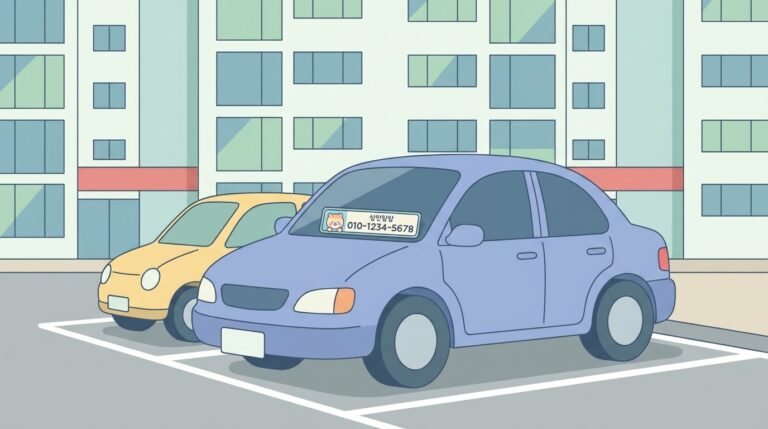
Survived the Korean Apartment Parking Maze? Master the Art of Double Parking (이중 주차) Like a Local!
안녕하세요! (Annyeonghaseyo!) Hello there, my dear K-community! It’s your favorite local navigator and Daily Hangul Editor, back with another essential guide to surviving—and thriving—in South Korea.
Imagine this: You’ve just moved into a beautiful high-rise Korean apartment (아파트). It’s 7:30 AM, you’re sipping your iced Americano, fully ready for work. You walk down to the parking lot, only to find another car parked directly in front of yours, blocking you completely. No space to squeeze out. Your heart drops.
Don’t panic! You haven’t been targeted by a rude neighbor. In Korea, this is a completely normal, highly organized daily ritual known as 이중 주차 (Ijung Jucha – Double Parking). Because land is scarce and car ownership is high, Koreans have developed an unspoken social contract to handle this parking war with extreme politeness. Today, we’re going to unlock the exact survival phrases and cultural codes so you can handle this like a native. No awkwardness, just pure Korean Nunchi (눈치) power!
Phase 2: Top 3 Essential Expressions for the Parking War
1. 차 좀 빼주실 수 있을까요? (Cha jom pae-ju-sil su isseu-kkal-yo?)
- Pronunciation: “Cha jom ppeh-joo-sheel soo eet-sseul-kkah-yo?” (Sounds like: “Cha” as in charm + “jom” like ‘gem’ but with an ‘o’ + “pae” like pen without ‘n’)
- Meaning: “Could you please move your car for me?”
- K-Culture Moment: You will hear this exact polite phrase in almost every K-drama slice-of-life scene where a character is rushing to an important morning meeting.
- Editor’s Insight: The word 좀 (jom) literally means “a little,” but here it acts as a magical politeness buffer. Without “좀”, it might sound like an aggressive command: “Move your car.” Adding “좀” instantly softens the request, showing you respect their time.
- Situation Spectrum: Casual ⚠️ | Semi-formal ✅ | Formal ✅
- 🤔 Think About It: In your home country, blocking someone’s car might result in towing or a huge fight. Why do you think Korean society relies on mutual trust and calling each other directly instead?
2. 기어 중립으로 해두셨나요? (Gieo jung-nib-eureo hae-du-syeot-na-yo?)
- Pronunciation: “Gee-uh joong-neeb-eu-roh hae-doo-shyeot-nah-yo?” (Note: jung-nib shifts in pronunciation to sound like joong-neeb due to Korean nasalization!)
- Meaning: “Did you leave your gear in neutral?”
- K-Culture Moment: Usually asked when you are calling a neighbor who double-parked, hoping you don’t actually have to make them come down to push it themselves.
- Editor’s Insight: This is the golden rule of Korean double parking. If you double-park, you must leave your car in Neutral (N) and disengage the parking brake so others can literally push your car out of the way!
- Situation Spectrum: Casual ✅ | Semi-formal ✅ | Formal ✅
- 🤔 Think About It: Would you feel comfortable letting strangers push your car in your home country? How does this reflect the Korean concept of community trust?
3. 금방 내려가겠습니다! (Geumbang naeryeo-gaget-seumnida!)
- Pronunciation: “Geum-bahng nae-ryuh-gah-get-seum-nee-dah!”
- Meaning: “I will come down immediately!” (Literally: “I’m coming down in a moment!”)
- K-Culture Moment: Said by the apologetic neighbor who accidentally left their parking brake on or parked in a tricky spot, rushing out in their indoor slippers.
- Editor’s Insight: Speed is courtesy in Korea. Saying “금방” (very soon/immediately) reassures the waiting person that you are prioritizing their urgent schedule.
- Situation Spectrum: Casual ⚠️ | Semi-formal ✅ | Formal ✅
Phase 3: Textbook Korean vs. Real-Life Korean
Let’s compare what textbooks teach you versus what Koreans actually say in the parking lot.
Situation 1: Asking someone to move their car
- 📖 Textbook Korean: “차를 이동해 주세요.” (Cha-reul i-dong-hae ju-se-yo. / “Please move the vehicle.”)
- Why it feels unnatural: Sounds like a robotic automated announcement or an official parking warden.
- 🗣️ Real-Life Korean: “혹시 차 좀 빼주실 수 있으세요?” (Hoksi cha jom pae-ju-sil su isseu-se-yo? / “Excuse me, but could you possibly move your car for me?”)
- 💡 Why it’s better: Starting with “혹시” (by any chance/perhaps) adds a layer of gentle politeness that instantly defuses any potential morning frustration.
Situation 2: When you are on your way down to move your car
- 📖 Textbook Korean: “제가 곧 가겠습니다.” (Je-ga got ga-get-seumnida. / “I will go soon.”)
- Why it feels unnatural: Sounds like a formal military promise.
- 🗣️ Real-Life Korean: “아고, 죄송해요! 지금 바로 내려갈게요!” (Ago, joesong-haeyo! Jigeum baro naeryeo-gal-geyo! / “Oh, I’m so sorry! I’m heading down right now!”)
- 💡 Why it’s better: Using “아고” (Oops/Oh dear) shows genuine empathy and immediate action.
Phase 4: K-Culture Deep Dive & Non-Verbal Etiquette
4-1. The Silent Language of Apology (Nunchi & Gestures)
When you meet the driver who had to wait for you, or when you are asking someone to move, words are only half the battle.
* The 15-degree Bow: When approaching the driver who waited, do a quick, polite head nod or a 15-degree bow while saying “죄송합니다” (I am sorry).
* The ‘Thank You’ Hand Raise: If you are driving away after someone pushed a car for you, or if they quickly backed up to let you out, raise your right hand slightly near the rearview mirror to say “Thank you/Sorry” visually.
* The Hazard Light Salute (비상등): If you quickly block someone momentarily to drop off groceries, keep your hazard lights flashing. It’s the universal Korean car gesture for “I’m so sorry for the inconvenience, I will be right back!”
4-2. The “Phone Number on the Windshield” Culture
In Korea, every car has a small phone number plate (주차 알림판) on the dashboard near the front windshield. This is so neighbors can call or text you directly if your car is blocking them. Not putting your number there is considered a major social taboo!
Phase 5: Real-Life Roleplay Scenario
Setting: The underground parking lot of “Haneul Apartment” at 8:00 AM on a rainy Tuesday.
Your Character: You (B1 learner) need to get to work, but a sleek black SUV is blocking your sedan.
NPC Neighbor (Min-ho): A busy office worker who double-parked but forgot to release his handbrake.
The Dialogue
- You: (Calling the number on the SUV’s windshield)
“여보세요? 안녕하세요. 103동 입주민인데요…”
(Yeoboseyo? Annyeonghaseyo. Baek-sam-dong ip-ju-min-inde-yo…)
“Hello? Hi. I’m a resident of building 103…” -
Min-ho: “아, 네! 안녕하세요. 무슨 일 있으신가요?”
(Ah, ne! Annyeonghaseyo. Museun il isseu-sin-gayo?)
“Ah, yes! Hello. Is there something going on?” -
You: “아, 네. 제 차 앞에 이중 주차를 해두셔서요. 혹시 차 좀 빼주실 수 있을까요?”
(Ah, ne. Je cha ape ijung jucha-reul hae-du-syeo-seo-yo. Hoksi cha jom pae-ju-sil su isseu-kkal-yo?)
“Ah, yes. Your car is double-parked in front of mine. Could you perhaps move your car?” -
Min-ho: “어머, 죄송해요! 제가 기어를 중립으로 안 해놨나 봐요!”
(Eomeo, joesong-haeyo! Jega gieo-reul jung-nib-euro an hae-nwat-na bwayo!)
“Oh my, I’m so sorry! I guess I didn’t put the gear in neutral!” -
You: “아, 밀어보려고 했는데 안 밀려서 전화드렸어요.”
(Ah, mireo-boryeogo haet-nunde an mil-lyeoseo jeonhwa-deuryeot-seoyo.)
“Ah, I tried pushing it, but it wouldn’t budge, so I called.” -
Min-ho: “정말 죄송합니다! 제가 지금 바로 내려갈게요! 2분만 기다려 주세요!”
(Jeongmal joesong-hamnida! Jega jigeum baro naeryeo-gal-geyo! I-bun-man gidaryeo juseyo!)
“I am truly sorry! I’ll head down right now! Please wait just two minutes!” -
You: “네, 알겠습니다. 천천히 내려오세요.”
(Ne, al-get-seumnida. Cheoncheonhi naeryeo-oseyo.)
“Okay, I understand. Take your time coming down.” -
Min-ho: (Running out of the elevator)
“많이 기다리셨죠? 진짜 죄송합니다! 얼른 뺄게요!”
(Manhi gidaryeot-jyo? Jinjja joesong-hamnida! Eolleun pael-geyo!)
“Did you wait long? I’m so sorry! I’ll move it immediately!”
🔀 Interactive Choice Point
Min-ho is bowing and hurriedly getting into his car to move it. How do you respond?
* A. “빨리 좀 빼주세요. 지각하겠어요.” (Palli jom pae-juseyo. Jigak-haget-seoyo.)
* B. “괜찮습니다! 비가 오는데 천천히 하세요.” (Gwenchansumnida! Biga oneunde cheoncheonhi haseyo.)
* C. “다음부터는 기어 중립 꼭 확인해 주세요.” (Daeum-buteoneun gieo jung-nib kkok hwagin-hae juseyo.)
Selection Feedback
- Best Choice: B — Super friendly and highly empathetic! Acknowledging the rain (“비가 오는데”) shows warm community spirit and builds wonderful neighborly relations.
- Bad Choice: A — While you might be frustrated, saying “Hurry up, I’m going to be late” breaks the harmony (Hwa) and will make future encounters in the elevator incredibly awkward.
- Risk Choice: C — Technically correct, but sounds slightly parental and passive-aggressive. Use only if this is the 5th time Min-ho has blocked you this month!
Phase 6: 10-Second Emotion Shadowing Drill
To speak like a true native, you need the right rhythm, pauses (/), and emotional tones. Try practicing these out loud!
- [🥺 Apologetic and rushed]
“아고, / 죄송합니다! / 제가 / 지금 / 바로 / 내려갈게요!”
(Ago, / joesong-hamnida! / je-ga / ji-geum / ba-ro / nae-ryeo-gal-geyo!) -
[😊 Patient and reassuring]
“괜찮으니까 / 천천히 / 내려오세요!”
(Gwen-chan-eu-ni-kka / cheon-cheon-hi / nae-ryeo-o-se-yo!)
Phase 7: K-Culture Mini Dictionary
- 이중 주차 (Ijung Jucha) | Double Parking. The act of parking parallel to already parked cars due to space limits.
- 기어 중립 (Gieo Jung-nib) | Neutral Gear (N). Crucial for double-parking so others can physically push your car.
- 입주민 (Ip-ju-min) | Apartment Resident. Use this when calling a neighbor to identify yourself politely.
- 손전화 번호 (Parking Phone Number) | Usually referred to as 연락처 (Yeollakcheo) on a car dashboard. A must-have accessory for driving in Korea.
Phase 8: Survivor Kit for Travelers & Expats
Survival Phrases TOP 3
- “차 좀 밀어도 될까요?” (Cha jom mireodo doel-ka-yo?)
- Translation: “May I push your car a bit?” (Great to ask a security guard if you are unsure).
- “사이드 브레이크가 잠겨 있어요.” (Sa-i-deu beu-re-i-keu-ga jam-gyeot-seo-yo.)
- Translation: “The parking brake is engaged.” (When you can’t push the car and need to call the owner).
- “죄송한데 차 한 대만 지나갈게요.” (Joesong-hande cha han dae-man jina-gal-geyo.)
- Translation: “Sorry, but could you let just one car pass through?”
Editor’s Travel Note
If you plan to rent a car or live in Korea, downloading local navigation apps is vital. Don’t rely on global maps, which don’t update well in Korea. Instead, look for Naver Map on App Store or KakaoMap to navigate tricky apartment complexes and narrow alleyways easily!
Phase 9:
Frequently Asked Questions (FAQ)
Q: What does "차 좀 빼주실 수 있을까요? (Cha jom pae-ju-sil su isseu-kkal-yo?)" mean in Korean and how do you pronounce it?
A: In Korean, "차 좀 빼주실 수 있을까요? (Cha jom pae-ju-sil su isseu-kkal-yo?)" is pronounced ["Cha jom ppeh-joo-sheel soo eet-sseul-kkah-yo?" (Sounds like: "Cha" as in charm + "jom" like 'gem' but with an 'o' + "pae" like pen without 'n'] and means: "Could you please move your car for me?"
Q: What does "기어 중립으로 해두셨나요? (Gieo jung-nib-eureo hae-du-syeot-na-yo?)" mean in Korean and how do you pronounce it?
A: In Korean, "기어 중립으로 해두셨나요? (Gieo jung-nib-eureo hae-du-syeot-na-yo?)" is pronounced ["Gee-uh joong-neeb-eu-roh hae-doo-shyeot-nah-yo?" (Note: jung-nib shifts in pronunciation to sound like joong-neeb due to Korean nasalization!] and means: "Did you leave your gear in neutral?"
Q: What does "금방 내려가겠습니다! (Geumbang naeryeo-gaget-seumnida!)" mean in Korean and how do you pronounce it?
A: In Korean, "금방 내려가겠습니다! (Geumbang naeryeo-gaget-seumnida!)" is pronounced ["Geum-bahng nae-ryuh-gah-get-seum-nee-dah!"] and means: "I will come down immediately!" (Literally: "I'm coming down in a moment!")







