

Master the Midnight Red-Cart Magic: Your Ultimate Guide to Korean Street Tteokbokki and Sundae
Phase 1: Empathy (An Immersive Late-Night Warm-Up)
안녕하세요! (Annyeonghaseyo!) It is your trusted Korean bestie and Daily Hangul Senior Editor.
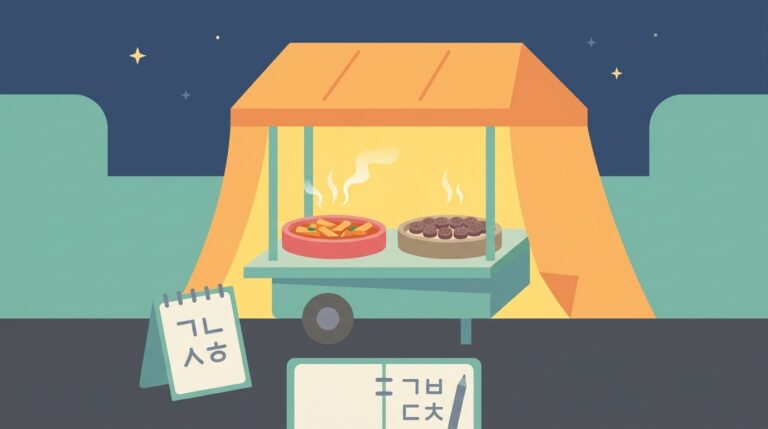
Imagine this: It’s 11:30 PM in Seoul. The crisp night air hits your face as you walk down a neon-lit alleyway in Mapo. Your stomach rumbles, craving something warm, spicy, and deeply comforting. Suddenly, like a culinary oasis, you spot it—a glowing orange tarpaulin tent (Pojangmacha, 포장마차). Inside, steam billows from massive metal trays filled with simmering, ruby-red tteokbokki (떡볶이) and plump, steaming rolls of sundae (순대, Korean blood sausage).
But as you step closer, a wave of hesitation hits you. The menu has no English. Regulars are standing around, pointing at mysterious items, chatting casually with the Imo (이모, “Auntie”—the owner), and slurping down a savory broth from tiny paper cups. How do you order without looking like a clueless tourist? How do you ask for that free delicious broth? How do you request your sundae with or without those exotic-looking offal pieces?
Don’t worry! This is a very common pain point for our advanced learners. Our C1 learners often tell us: “I know the dictionary words, but I feel so awkward standing at the actual cart trying to customize my street food order!” Today, we are moving past textbook robotic phrases and diving into the nuanced, high-level conversational flow that will make the Imo treat you like a local regular. Let’s dig in!
Phase 2: Deep-Dive into 3 Essential Expressive Terms
To master street food culture, you need to master these three key phrases. They contain subtle cultural nuances that textbooks rarely explain.
1. 섞어서 주세요 (Seok-eoseo juseyo)
- Pronunciation: [Suck-uh-suh Joo-seh-yo] (Rhymes with “Suck a sir, please give me”)
- Meaning: “Please mix them together for me.”
- K-Culture Moment: You will hear this constantly in street-food vlogs or K-Dramas when someone orders sundae (순대). Instead of just getting the blood sausage, the owner will ask, “Do you eat the liver and offal too?” Your answer? “Suck-uh-suh juseyo!”
- Editor’s Insight: Ordering sundae in Korea is a package deal. It usually comes with gan (간, pork liver) and 허파 (heopa, pork lungs). Saying “섞어서 주세요” signals that you are a true foodie who appreciates the diverse textures of traditional Korean street food.
- Situation Spectrum: Casual ✅ | Semi-formal ✅ | Formal 🚫
- 🤔 Think About It: In many Western cultures, meat parts are strictly segregated on a plate. Why do you think Korean street food culture embraces “mixing” everything together in a single hearty portion?
2. 국물 좀 적셔주실 수 있나요? (Gukmul jom jeoksyeo-jusil su innayo?)
- Pronunciation: [Gook-mool jom juk-shuh-joo-shil soo een-nah-yo] (Soft ‘j’ sounds, like the ‘g’ in “genre”)
- Meaning: “Could you drench it in the (tteokbokki) sauce for me?”
- K-Culture Moment: In K-Dramas like Let’s Eat, character foodies argue over the perfect way to eat fried items (twigim, 튀김) or sundae. The ultimate move is 찍먹 (jjikmeok, dipping) vs 부먹 (bumeok, pouring). This phrase is the ultimate bumeok request.
- Editor’s Insight: Jeoksida (적시다) literally means “to wet” or “to drench.” Using this instead of the basic “소스 주세요” (Give me sauce) shows an advanced understanding of food texture and culinary slang. It sounds incredibly natural and warm.
- Situation Spectrum: Casual ✅ | Semi-formal ✅ | Formal ⚠️
- 🤔 Think About It: How does your native language describe “drenching” or “smothering” food in gravy or sauce? Does it carry the same mouth-watering nuance?
3. 국물은 셀프인가요? (Gukmureun selpeu-ingayo?)
- Pronunciation: [Goong-moo-reun Sell-peu-een-gah-yo] (Note: ‘Gukmul’ assimilates phonetically to ‘Goong-mool’)
- Meaning: “Is the fishcake broth self-service?”
- K-Culture Moment: You stand at a cart. There’s a giant vat of steaming eomuk (어묵, fishcake) broth. You want some, but you don’t see cups nearby. Instead of awkwardly pointing, you ask this.
- Editor’s Insight: “Self” (셀프) is a Konglish (Korean-English) word meaning self-service. Asking if the broth is “self” shows you understand the unspoken rule of Korean street food: the savory eomuk broth is almost always free and unlimited, but you often have to scoop it yourself!
- Situation Spectrum: Casual ✅ | Semi-formal ✅ | Formal 🚫
- 🤔 Think About It: Why does Korea have such a generous culture of offering free, unlimited soup/broth compared to Western fast-food spots where every condiment costs extra?
Phase 3: Textbook Korean vs. Real-Life Native Korean
Let’s compare the sterile sentences from standard grammar books with what actually comes out of a native speaker’s mouth.
Scenario A: Customizing your Sundae (순대) order
- 📖 Textbook Korean: “순대와 내장을 같이 주세요.” (Sundae-wa naejang-eul gati juseyo.) – “Please give me blood sausage and organs together.”
- 🗣️ Real-Life Native Korean: “순대 내장 섞어서 넉넉히 주세요!” (Sundae naejang seok-eoseo neongneokhi juseyo!) – “Mix the sausage and organs, and please give me a generous portion!”
- 💡 Why the difference? The textbook sentence is grammatically correct but feels clinical, like ordering medical supplies. Real Koreans use the word neongneokhi (넉넉히, generously/plentifully) to tap into Jeong (정, warm affection), which often prompts the owner to scoop an extra piece of liver for you!
Scenario B: Getting Tteokbokki sauce on your Sundae
- 📖 Textbook Korean: “순대를 떡볶이 소스에 찍어 먹고 싶어요.” (Sundae-reul tteokbokki soseu-e jjigeo meokgo sipeoyo.) – “I want to dip the sundae in the tteokbokki sauce.”
- 🗣️ Real-Life Native Korean: “순대에 떡볶이 국물 좀 묻혀주세요.” (Sundae-e tteokbokki gukmul jom muthyeo-juseyo.) – “Could you smear some tteokbokki sauce onto the sundae?”
- 💡 Why the difference? Instead of explaining why you want it, you directly ask the owner to perform the action using the verb muthida (묻히다, to smear/apply). It’s fast, efficient, and sounds like a seasoned local.
Phase 4: K-Culture Deep-Dive & Non-Verbal Etiquette
4-1. Nunchi (눈치) & Red-Cart Gestures
Street food carts are small, fast-paced spaces. To blend in seamlessly, master these non-verbal cues:
* The Broth Cup Protocol: Do not wait for the owner to serve you the broth. Look around for a stack of small paper cups or plastic ladles. Scoop a small amount of the hot fishcake broth (eomuk gukmul, 어묵 국물) to sip while waiting for your food.
* The Stand-And-Eat Stance: Most pojangmacha are standing-only. Lean slightly forward over the metal counter to prevent spicy tteokbokki sauce from dripping onto your clothes. It’s a polite gesture showing you care about keeping their clean counter clean too!
4-2. The Soul Food Code: Tteok-Twi-Sun (떡튀순)
In Korea, tteokbokki (떡), twigim (튀, deep-fried items), and sundae (순) are rarely eaten in isolation. They form a holy trinity known by the abbreviation 떡튀순 (Tteok-Twi-Sun). If you are eating with a friend, never order just one. Order the trinity, and use the spicy tteokbokki sauce as a dipping sauce for both the fried items and the sausage. This is the ultimate comfort food culture depicted in countess K-Dramas, from Weightlifting Fairy Kim Bok-joo to Reply 1988.
Phase 5: Real-Life Roleplay Scenario
Setting: A bustling street cart near Sinchon Station at midnight. The air is thick with savory steam.
The NPC: Sinchon Imo (신촌 이모) — A warm but extremely busy street-food veteran who values efficiency and friendly customers.
1. Imo: 어서 와요! 뭐 드릴까? 아가씨, 총각?
   (Eoseo wayo! Mwo deurikka? Agassi, chonggak?)
   🎭 [Welcoming with a loud, raspy voice, holding a giant metal spatula]
   "Welcome! What can I get you? Missy? Young man?"

2. You: 이모, 여기 떡볶이 1인분하고 순대 1인분 주세요.
   (Imo, yeogi tteokbokki irinbun-hago sundae irinbun juseyo.)
   🎭 [Smiling, pointing politely with two fingers at the trays]
   "Auntie, one serving of tteokbokki and one serving of sundae here, please."

3. Imo: 순대에 내장도 섞어줄까? 간이랑 허파 먹어?
   (Sundae-e naejang-do seokkeo-julka? Gan-irang heopa meogeo?)
   🎭 [Knife hovering over a steaming roll of sundae, looking up for your preference]
   "Should I mix in the organs too? Do you eat liver and lungs?"

4. You: 네, 내장 다 섞어서 주세요! 간 많이 주시면 감사해요.
   (Ne, naejang da seok-eoseo juseyo! Gan mani jusimyeon gamsahaeyo.)
   🎭 [Nodding enthusiastically, showing you are a true culinary adventurer]
   "Yes, please mix in all the organs! I'd appreciate it if you could give me a lot of liver."

5. Imo: 아이고, 먹을 줄 아네! 떡볶이 소스 순대에 좀 얹어줄까?
   (Aigo, meogeul jul ane! Tteokbokki soseu sundae-e jom eonjeo-julka?)
   🎭 [Chuckling warmly, impressed by your local palate]
   "Oh, you know how to eat! Should I splash some tteokbokki sauce over the sundae?"

6. You: 아, 네! 순대에 떡볶이 국물 꼭 좀 적셔주세요!
   (Ah, ne! Sundae-e tteokbokki gukmul kkok jom jeoksyeo-juseyo!)
   🎭 [Slightly bowing head in appreciation with hands clasped]
   "Ah, yes! Please definitely drench the sundae in that tteokbokki sauce!"

7. Imo: 오케이, 뜨거우니까 조심해서 먹어. 여기 오뎅 국물은 저기 컵에다 떠다 먹고!
   (Okei, tteugeounikka josimhaeseo meogeo. Yeogi odeng gukmureun jeogi keobe-da tteoda meokgo!)
   🎭 [Handing over a heavy plate loaded with red, steaming deliciousness]
   "Okay, it's hot so eat carefully. Help yourself to the fishcake broth over there in those cups!"

8. You: 와, 맛있겠다! 감사합니다, 이모. 잘 먹겠습니다!
   (Wa, masitgetda! Gamsahabnida, Imo. Jal meokgetseumnida!)
   🎭 [Inhaling the rich aroma, bowing slightly before picking up a toothpick]
   "Wow, looks amazing! Thank you, Auntie. Bon appétit!"
🔀 Interactive Choice Point
After eating, you want to try the fried sweet potatoes (goguma twigim, 고구마 튀김). How do you ask the Imo to make them crispy again?
- A. “이모, 고구마 튀김 차가워요. 데워주세요.” (Imo, goguma twigim chagawoyo. dewojuseyo.)
- B. “이모, 고구마 튀김 한번만 다시 튀겨주실 수 있어요?” (Imo, goguma twigim hanbeonman dasi twigyeo-jusil su isseoyo?)
- C. “튀김 뜨겁게 해라.” (Twigim tteugeopge haera.)
Choice Feedback:
- A (Risk): Grammatically correct, but “차가워요” (It’s cold) can sound slightly critical or complaining to a busy owner.
- B (Best): Fantastic! Asking to “fry it one more time” (dasi twigyeo-juda) is the standard way to get hot, extra-crispy fried items. It shows high-level fluency.
- C (Bad): Extremely rude. This is a flat, non-honorific command (반말, Banmal) that will surely ruin your relationship with the Imo.
Phase 6: 10-Second Emotion Shadowing Drill
Practice these high-frequency emotional phrases with the exact intonation. Follow the / pause marks and match the emotional cues!
-
[😊 Pleased and hungry]
이모! / 떡볶이 1인분하고요, / 순대 / 내장 섞어서 주세요!
(Imo! / Tteokbokki irinbun-hagoyo, / sundae / naejang seok-eoseo juseyo!)
Tip: Keep your tone bright and lively to catch the busy owner’s attention. -
[🥺 Earnest and mouth-watering]
순대에 / 떡볶이 국물 / 꼭 좀 / 적셔주세요!
(Sundae-e / tteokbokki gukmul / kkok jom / jeoksyeo-juseyo!)
Tip: Put extra stress on “꼭 좀” (kkok jom, “definitely/please”) to show your intense craving.
Phase 7: Late-Night Street Food Mini-Dictionary
- 꼬불이 (Kkoburi) | Twisted Fishcakes | The wavy, ribbon-like fishcakes folded onto wooden skewers, a favorite texture among locals.
- 염통 (Yeomtong) | Pork/Chicken Hearts | A chewy, iron-rich organ meat often served alongside sundae or as grilled skewers.
- 야끼만두 (Yakkimandu) | Deep-Fried Glass Noodle Dumplings | Crispy, hollow dumplings that are absolutely heavenly when soaked in spicy tteokbokki sauce.
- 범벅 (Beombeok) | Sauce Medley / Smothered | A cooking style where fried items and sausages are tossed and mixed directly into the sweet-spicy tteokbokki tray.
Phase 8: Survivor’s Kit for Midnight Explorers
Survival Phrases TOP 3
- **
Frequently Asked Questions (FAQ)
Q: What does "섞어서 주세요 (Seok-eoseo juseyo)" mean in Korean and how do you pronounce it?
A: In Korean, "섞어서 주세요 (Seok-eoseo juseyo)" is pronounced [Suck-uh-suh Joo-seh-yo] and means: "Please mix them together for me."
Q: What does "국물 좀 적셔주실 수 있나요? (Gukmul jom jeoksyeo-jusil su innayo?)" mean in Korean and how do you pronounce it?
A: In Korean, "국물 좀 적셔주실 수 있나요? (Gukmul jom jeoksyeo-jusil su innayo?)" is pronounced [Gook-mool jom juk-shuh-joo-shil soo een-nah-yo] and means: "Could you drench it in the (tteokbokki) sauce for me?"
Q: What does "국물은 셀프인가요? (Gukmureun selpeu-ingayo?)" mean in Korean and how do you pronounce it?
A: In Korean, "국물은 셀프인가요? (Gukmureun selpeu-ingayo?)" is pronounced [Goong-moo-reun Sell-peu-een-gah-yo] and means: "Is the fishcake broth self-service?"







