

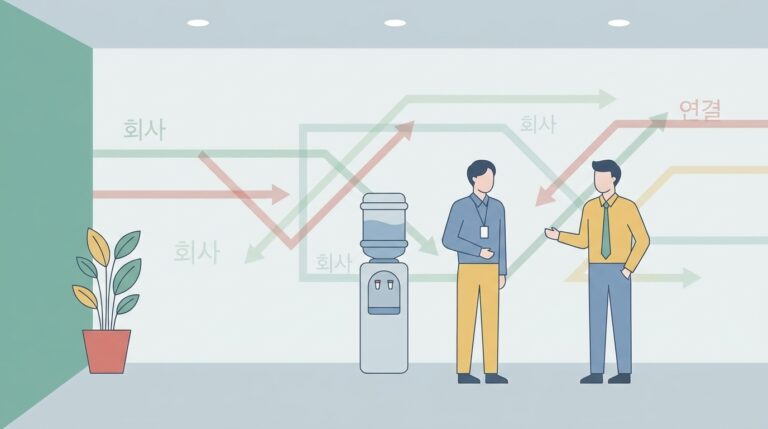
Navigating ‘Line-Riding’ (라인 타기): The Art and Perils of Korean Workplace Politics
안녕하세요! Daily Hangul‘s Chief Editor and your ultimate K-Culture Navigator is here. If you’ve been working in a Korean office, or watching realistic corporate K-dramas like Misaeng (미생) or Queen of Tears, you’ve probably noticed a silent, powerful undercurrent shaping everyone’s career paths. It’s not just about how hard you work; it’s about who you stand with.
Today, we are diving deep into the high-stakes world of Korean workplace politics, focusing on the notorious concept of ‘Line-Riding’ (라인 타기). This is a highly nuanced C2-level masterclass designed to help you decode the subtle social maneuvers in Korean corporate life, so you can protect your career while maintaining your professional integrity.
Phase 2: Deep-Dive into 3 Essential Corporate Politics Expressions
1. 라인을 타다 (Line-eul ta-da)
- Pronunciation: Line-eul ta-da (Sounds like “Line” + “ool” + “tah-dah” as in riding a roller coaster)
- Meaning: Literally “to ride a line.” It refers to aligning oneself with a powerful executive or faction within the company to secure promotions and safety.
- K-Culture Moment: Think of Misaeng, where department heads openly scramble to align with the Executive Director. Choosing the wrong “line” can derail a career overnight when a high-ranking executive falls from grace.
- Editor’s Insight: This goes beyond simple networking. It implies active, sometimes risky, political alignment. If your “line leader” (라인장) gets promoted, you fly high; if they get sidelined, you might get exiled to a branch office.
- Situation Spectrum: Casual: ✅ | Semi-formal: ⚠️ | Formal: 🚫 (Avoid using this in front of HR or executives! It is an open secret, but highly informal.)
- 🤔 Think About It: How does this compare to “climbing the corporate ladder” or “factions” in your home country? Is corporate loyalty in your culture tied to the company itself, or to a specific supervisor?
2. 눈치를 보다 (Nunchi-reul bo-da)
- Pronunciation: Noon-chi-reul bo-da (Noon-chee-reul bo-dah)
- Meaning: Literally “to read/gaze at the vibes.” In a political context, it means constantly assessing the atmosphere, power dynamics, and facial expressions of superiors before making a move.
- K-Culture Moment: When a senior manager suddenly laughs at a terrible joke made by the director, and everyone else pauses for half a second before joining in—that split second is pure, high-stakes nunchi.
- Editor’s Insight: Nunchi is the survival instinct of Korean office life. It is not just about being polite; it’s about anticipating conflict and understanding the unspoken hierarchy without anyone saying a word.
- Situation Spectrum: Casual: ✅ | Semi-formal: ✅ | Formal: ⚠️
- 🤔 Think About It: Does your native language have a word that captures this exact blend of emotional intelligence, situational awareness, and hierarchical survival?
3. 줄을 서다 (Jul-eul seo-da)
- Pronunciation: Jool-eul seo-dah (Jewel-ool suh-dah)
- Meaning: Literally “to stand in line.” Politically, it means choosing which faction or powerful figure to support when a corporate power struggle begins.
- K-Culture Moment: When a new CEO is appointed, major restructuring occurs. Managers must decide whether to “stand in line” with the new reformist faction or stick with the conservative old guard.
- Editor’s Insight: While 라인을 타다 is the action of riding the wave of power, 줄을 서다 is the crucial, stressful decision-making point of choosing your allegiance.
- Situation Spectrum: Casual: ✅ | Semi-formal: ⚠️ | Formal: 🚫
- 🤔 Think About It: In a highly collective society, remaining neutral can sometimes be interpreted as being uncooperative. How do you balance neutrality with team integration?
Phase 3: Textbook Korean vs. Real-World Korean
Situation 1: Expressing that corporate politics are stressful
- 📖 Textbook Korean: “회사 내의 파벌 싸움 때문에 스트레스를 많이 받습니다.” (I receive a lot of stress due to factional fighting within the company.)
- 🗣️ 진짜 한국어 (Real-World): “맨날 눈치 싸움에 라인 타기 바쁘니까 일할 맛이 안 나요.” (Since everyone is busy playing mind games and riding lines every day, I have no motivation to work.)
- 💡 Why the difference? Textbook phrases sound like an HR manual. Real-world Korean utilizes expressions like 일할 맛이 안 나다 (to lose the “taste” or motivation to work) and 눈치 싸움 (vibe-reading warfare) to convey emotional exhaustion.
Situation 2: Advising a colleague to stay out of trouble
- 📖 Textbook Korean: “사내 정치에 관여하지 마십시오.” (Do not get involved in company politics.)
- 🗣️ 진짜 한국어 (Real-World): “그냥 중립 지키면서 조용히 묻어가는 게 상책이에요.” (Just maintaining neutrality and quietly blending in is the best policy.)
- 💡 Why the difference? 묻어가다 (to blend in/tag along quietly) and 상책 (the best policy/move) are highly idiomatic terms used by seasoned Korean professionals to advise survival over active political combat.
Phase 4: K-Culture Deep-Dive & Non-Verbal Manners
4-1. The Non-Verbal Art of Corporate Survival
In the Korean office, your body language speaks louder than your resume. When navigating power dynamics:
* The Angle of the Bow: When a VIP from a specific “line” passes, the angle of your bow and the speed at which you stand up send immediate signals. A slight lag in standing up can be perceived as passive-aggressive.
* The Drinking Glass Angle: At a Hoesik (회식 – company dinner), when clinking glasses with someone from a rival faction, keep your glass slightly lower to show respect, regardless of your personal political stance. This neutralizes hostility.
4-2. The K-Drama Mirror: Misaeng and Agency
In dramas like Agency (대행사), we see how “line-riding” creates toxic echo chambers. Characters who rely solely on their “line” eventually face downfall when their patron is dismissed. The cultural takeaway? While “lines” exist, relying only on them without building real competence (실력) is considered a fatal career mistake in modern Korea.
Phase 5: Interactive Roleplay Scenario
Setting: A local chicken-and-beer (Chimaek) joint after a grueling day. You are having a private drink with Manager Min (민 과장), your trusted, cynical mentor who has survived 12 years at the company.
Dialogue
- 민 과장 (Manager Min): (Sighing, pouring beer) “너 요즘 김 본부장님이랑 부쩍 자주 점심 먹더라? 라인 타려는 거야?”
(You’ve been having lunch with Executive Director Kim quite often lately. Are you trying to ride his line?) - You: (Laughing nervously) “아니에요, 과장님. 그냥 업무 피드백 주신다고 하셔서 가볍게 먹은 거예요.”
(No, Manager Min. He just wanted to give me some work feedback, so we had a casual lunch.) - 민 과장 (Manager Min): (Shaking his head) “남들 눈에는 절대 그렇게 안 보여. 벌써 박 상무님 쪽 사람들이 너 경계하는 눈치던데?”
(It definitely doesn’t look that way to others. It seems Executive Director Park’s people are already on guard against you.) - You: “정말요? 전 그냥 제 일만 열심히 하면 되는 줄 알았어요.”
(Really? I thought I just needed to work hard at my job.) - 민 과장 (Manager Min): (Leaning in, whispering) “한국 회사에서 일만 잘하면 뭐 하냐? 줄을 잘 서야지. 근데 김 본부장님, 이번 분기 실적 안 좋아서 위태위태해.”
(What’s the use of just working hard in a Korean company? You have to stand in the right line. But Director Kim’s performance this quarter is shaky; he’s on thin ice.) - You: “아… 그럼 저는 이제 어떻게 처신해야 할까요?”
(Ah… then how should I behave from now on?) - 민 과장 (Manager Min): “너무 한쪽으로 치우치지 마. 박 상무님 라인 기획서도 조용히 도우면서, 발을 양쪽에 다 걸쳐 놔.”
(Don’t lean too much to one side. Quietly help with Director Park’s line proposals too, and keep your feet in both camps.) - You: “알겠습니다. 적을 만들지 않고 중립을 지키라는 말씀이시죠?”
(Understood. You mean I should maintain neutrality and not make any enemies, right?)
🔀 Interactive Choice
How do you respond to Manager Min’s final advice?
- [Option A] “과장님 말씀대로 양쪽 다 잘 지내면서 눈치껏 행동할게요.” (I’ll follow your advice, stay on good terms with both, and act tactfully.)
- [Option B] “저는 라인 타는 거 싫습니다. 그냥 제 실력으로만 승부하겠습니다.” (I hate line-riding. I will succeed purely on my own merit.)
- [Option C] “그럼 박 상무님 쪽 사람들과 친해질 수 있는 술자리를 만들어 주실 수 있나요?” (Then, could you arrange a drinking session for me to get close to Director Park’s people?)
Feedback:
- Best Choice (Option A): This shows high Nunchi and a realistic understanding of Korean corporate survival. You acknowledge the advice without committing to risky political behavior.
- Bad Choice (Option B): Too idealistic. While noble, stating this too bluntly might make you look naive or uncooperative to a senior mentor.
- Risk Choice (Option C): Too aggressive. Moving too fast to the rival camp can make you look like an untrustworthy opportunist (박쥐 – bat/turncoat).
Phase 6: 10-Second Emotional Shadowing Drill
Practice speaking with the realistic, anxious, yet tactful tone of a seasoned corporate professional.
- Sentence: “사내 정치 신경 안 쓰고 / 제 일만 하고 싶은데, / 라인 타는 분위기라 / 너무 숨 막혀요.”
- Pronunciation Guide: Sanae jeongchi singyeong an sseugo / je il-man hago sipeunde, / line taneun bunwigira / neomu sum mak-hyeoyo.
- Emotional Guide:
[🥺 With a heavy, exhausted sigh]“I don’t want to care about company politics and just want to do my job, but because of this line-riding atmosphere, I feel so suffocated.”
Phase 7: K-Culture Mini-Dictionary
- 처신 (Cheo-sin) | Behavior/Demeanor
- How one conducts oneself in social or professional hierarchies. Often used as “처신을 잘하다” (to behave wisely in tricky political situations).
- 낙하산 (Nak-ha-san) | Parachute (Nepotism hire)
- An employee who was hired or promoted due to personal connections (parachuted in), bypassing standard competitive processes.
- 눈새 (Nun-sae) | Vibe-killer (Short for 눈치 없는 새끼)
- A highly colloquial slang term for someone who completely lacks nunchi and constantly ruins the mood or makes political blunders.
- 안테나를 세우다 (Antenna-reul se-u-da) | To raise one’s antenna
- To stay highly alert to rumors, executive movements, and organizational changes within the company.
Phase 8: Survivor’s Kit for Working in Korea
Survival Expressions TOP 3
- “일단 지켜보는 게 좋겠어요.” (Ildan jikyeoboneun ge jokess-eoyo.)
- Pro Tip: Use this when asked to take a side. It neutrally translates to “It’s best to wait and see for now.”
- “제가 감히 끼어들 자리가 아닌 것 같습니다.” (Jega gamhi kkieodeul jari-ga anin geot gatseumnida.)
- Pro Tip: A polite, formal way to escape a political conversation: “I don’t think it is my place to intervene.”
- “어느 쪽이든 회사를 위한 결정이겠죠.” (Eoneu jjok-ideun hoesa-reul wi-han gyeoljeong-igettjyo.)
- Pro Tip: The ultimate diplomatic response: “Whichever side it is, I’m sure it’s a decision for the good of the company.”
Editor’s Travel & Work Note
When navigating the Korean corporate landscape, official documentation is crucial, but real decisions often happen during casual coffee breaks. Use the Naver Map App (네이버 지도) to find quiet cafes near your office for sensitive, one-on-one professional chats away from the gossip-heavy office pantry.
Phase 9: “Going One Step Deeper” (Cultural Reflection)
In Western corporate cultures, individual performance metrics and clear job descriptions often dictate career progression. In Korea, however, the corporate structure heavily reflects Confucian collectivism. Historically, protecting the community meant aligning with strong leaders. While modern Korean millennials and Gen Z are actively fighting against this “line-riding” culture, the legacy of relational hierarchy still runs deep.
💬 Your Turn: Have you ever experienced a similar factional dynamic in your own workplace? How did you handle it? Leave a comment below and let’s discuss!
Phase 10: FAQ & Common Mistakes
Q: Is it absolutely impossible to survive in a Korean company without joining a ‘line’?
A: It is entirely possible, especially in tech, global, or startup environments. However, even if you don’t join a line, having excellent Nunchi (situational awareness) is mandatory to avoid becoming collateral damage in other people’s political battles.
Q: Can I use the word ‘라인 타기’ directly to my team leader?
A: Absolutely not. It is a cynical, informal term. If you want to discuss organizational dynamics formally, use terms like “부서 간 협조” (inter-departmental cooperation) or “조직 내 소통” (communication within the organization).
Q: What should I do if my supervisor explicitly asks me to support their stance against another department?
A: Avoid direct opposition. Frame your support around “data and company-wide goals” rather than personal loyalty to keep yourself safe if leadership changes.
🚨 Common Mistakes Alert!
- Mistake 1: Complaining about your boss to a colleague over work messenger. (Korean corporate IT monitors messengers like KakaoTalk or Line installed on work PCs!)
- Mistake 2: Ignoring the corporate Hoesik (dinners) entirely. (Declining every social event is often politically interpreted as a declaration of non-alignment.)
- Mistake 3: Treating everyone with equal informality. (Failing to adjust your honorifics based on hierarchy can instantly brand you as rude.)
Phase 11: Action Mission & K-Culture Challenge
- Bronze Mission: Write down the expression “눈치를 보다” on a post-it note and practice saying it out loud whenever you feel a tense vibe in a meeting.
- Silver Mission: Watch one episode of a corporate K-drama (like Misaeng or Agency) and try to identify which character is “riding a line” (라인을 타다).
- Gold Mission: In your next Korean conversation, use the phrase “중립을 지키다” (to maintain neutrality) when discussing a sensitive topic.
Phase 12: Interactive Quiz Challenge
1. What does “라인을 타다” mean?
- A) To take the subway to work.
- B) To align oneself with a powerful corporate faction.
- C) To write clean code.
👉 Click to see the answer
Answer: B. It refers to the political act of aligning with influential figures for career advancement.
2. True or False: “눈치” is only used to describe negative political behavior.
- True
- False
👉 Click to see the answer
Answer: False. Nunchi is a neutral, essential social skill representing empathy, emotional intelligence, and quick situational reading.







