

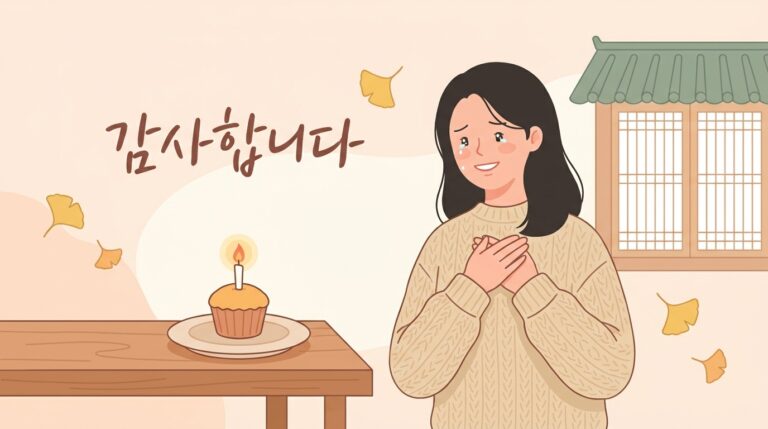
Everyday Korean with Daily Hangul: Expressing Warm Feelings
안녕하세요! (Annyeonghaseyo!) Hello! I’m your Daily Hangul editor and your personal Korean culture guide.
Have you ever watched a K-drama where a friend prepares a surprise birthday soup, or a stranger helps find a lost wallet, and the main character places a hand over their heart with watery eyes? They want to say “I’m so touched” or “My heart is warmed,” but they don’t just say “I am happy.” They use a very special, warm word: 감동받았어요 (Gamdong-badasseoyo).
Expressing gratitude and being touched is a huge part of Korean culture. Today, we will learn how to express these warm, positive emotions easily, even if you are an absolute beginner (A1)! Let’s dive in!
Phase 1: Why “Thank You” is Not Enough
When someone does something incredibly sweet for you—like your Korean friend bringing you hot tea when you are sick—simply saying “Gomasupnida” (Thank you) feels a bit too plain.
In Korea, sharing deep feelings (Jeong, 정) is what connects people. Saying “I am touched” shows that you appreciate their heart, not just their action. Let’s learn how to say this like a real local!
Phase 2: Top 3 Heart-Warming Expressions
1. 감동받았어요 (Gamdong-badasseoyo)
- Pronunciation: Gam-dong-ba-da-sseo-yo (Sounds like “Gam-dong” + “bah-dah-suh-yo”)
- Meaning: I am touched / moved.
- K-Culture Moment: When a K-pop idol receives a massive forest of glowing lightsticks from fans and says, “정말 감동받았어요” (I am truly touched).
- Editor’s Insight: Gamdong (감동) means “emotion/impression,” and badasseoyo (받았어요) means “received.” You literally “received a moving emotion.”
- Situation Spectrum: Casual (⚠️ Gamdong-badasseo), Semi-formal (✅ Gamdong-badasseoyo), Formal (✅ Gamdong-badasseumnida)
- 🤔 Think About It: In English, we say “I am touched” (passive). In Korean, we “receive” the touch. How does this show the connection between two people?
2. 눈물 날 것 같아요 (Nunmul nal geot gat-ayo)
- Pronunciation: Noon-mool nal geot ga-ta-yo
- Meaning: I feel like crying (tears might come out).
- K-Culture Moment: When a friend gives you a hand-written letter in a cute cafe.
- Editor’s Insight: Use this when something is so sweet that you are playfully (or deeply) close to happy tears!
- Situation Spectrum: Casual (✅ Nunmul na), Semi-formal (✅ Nunmul nal geot gat-ayo), Formal (⚠️)
3. 마음이 따뜻해져요 (Maeumi ttatteuthae-jeoyo)
- Pronunciation: Ma-eum-ee tah-teut-hae-jyeo-yo
- Meaning: My heart becomes warm.
- K-Culture Moment: Hearing a heartwarming story on a cold winter day while eating hot street food.
- Editor’s Insight: Maeum means heart/mind. This is a beautiful, poetic way to describe cozy happiness.
- Situation Spectrum: Casual (✅), Semi-formal (✅), Formal (⚠️)
Phase 3: Textbook Korean vs. Real Korean
Let’s compare stiff textbook sentences with what Koreans actually say!
Situation 1: Receiving a small surprise gift
- 📖 Textbook: 저는 아주 기쁩니다. (Jeoneun aju gippeumnida. – “I am very glad.” – Too formal and robotic!)
- 🗣️ Real Korean: 와, 감동이에요! (Wa, gamdong-ieyo! – “Wow, it’s a touching moment!” – Natural and warm!)
- 💡 Why? Real Koreans love using “Noun + 이예요 (it is)” for quick, enthusiastic reactions!
Situation 2: When someone helps you carry heavy bags
- 📖 Textbook: 감사합니다. (Gamsahamnida. – “Thank you.” – Good, but lacks deep emotion.)
- 🗣️ Real Korean: 진짜 감동받았어요. (Jinjja gamdong-badasseoyo. – “I am really touched.”)
- 💡 Why? Adding “진짜” (Jinjja – Really) makes your appreciation sound 100% genuine.
Phase 4: K-Culture & Manners
4-1. The “Hand on Heart” Gesture
When saying “감동받았어요,” lightly place one or both hands over your heart and tilt your head slightly with a soft smile. Avoid big, loud high-fives. Soft eye contact is key!
4-2. The Culture of ‘Jeong’ (정)
Korean society values mutual care. When someone gives you something, expressing that you are “touched” acknowledges their Jeong (warm feeling of attachment). It makes the giver feel incredibly happy!
Phase 5: Live Roleplay Challenge
Scenario: You are celebrating your birthday in Seoul. Your Korean friend, Minji, surprises you with a small cake with a candle!
- Minji 👩: 짜잔! 생일 축하해요! (Jjajan! Saeng-il chukha-haeyo! – Ta-da! Happy Birthday!) 🎭 Smiling widely and holding a cake
- You 🧑: 와! 이게 뭐예요? (Wa! Ige mwo-yeoyo? – Wow! What is this?) 🎭 Eyes wide open
- Minji 👩: 작은 케이크예요. 불을 끄세요! (Jageun keikeu-yeyo. Bureul kkeuseyo! – It’s a small cake. Blow out the candle!) 🎭 Leaning closer
- You 🧑: (You blow the candle) 후~! (Hoo~!)
- Minji 👩: 생일 축하해요. 선물도 있어요! (Saeng-il chukha-haeyo. Seonmul-do isseoyo! – Happy birthday. I have a present too!) 🎭 Hands you a cute card
- You 🧑: 진짜… 너무 감동받았어요. (Jinjja… neomu gamdong-badasseoyo. – Really… I am so touched.) 🎭 Placing hand on heart
- Minji 👩: 마음에 들어요? 다행이다! (Ma-eume deureoyo? Dahaeng-ida! – Do you like it? I’m so glad!)
- You 🧑: 네, 마음이 따뜻해져요. 고마워요. (Ne, maeumi ttatteuthae-jeoyo. Gomawoyo. – Yes, my heart becomes warm. Thank you.) 🎭 Giving a warm smile
🔀 Your Turn: Choose Your Next Response!
Minji asks: “Would you like to eat the cake now?”
* Option A: “아니요, 배불러요.” (Aniyo, baebulleoyo. – No, I’m full.)
* Option B: “네! 진짜 먹고 싶어요!” (Ne! Jinjja meokgo sipeoyo! – Yes! I really want to eat it!)
* Option C: “너무 예뻐서 못 먹겠어요!” (Neomu yeppeoseo mot meokgesseoyo! – It’s too pretty to eat!)
Feedback:
- Option A (Bad ❌): Too blunt! It might kill the happy birthday mood.
- Option B (Good 😊): Friendly and enthusiastic!
- Option C (Best ⭐): Pure gold! Saying something is “too pretty to eat” is a classic Korean compliment that will make Minji beam with pride.
Phase 6: 10-Second Shadowing Drill
Practice speaking with real feeling! Follow the pause marks (/) and emotional cues:
[🥺 Deeply touched and soft voice]
진짜 / 감동받았어요.
(Jinjja / gam-dong-ba-da-sseo-yo.)-
[😊 Cheerful and surprised]
와, / 진짜요? / 감동이에요!
(Wa, / jinjja-yo? / gam-dong-ee-eyo!)
Phase 7: Mini K-Culture Dictionary
- 감동 (Gamdong) | Emotion / Deep Impression | Used to describe books, movies, or warm actions.
- 진짜 (Jinjja) | Really / Truly | The ultimate conversational lubricant used before adjectives.
- 마음 (Maeum) | Heart / Mind / Soul | Refers to emotional feelings rather than the physical organ.
- 선물 (Seonmul) | Gift / Present | Giving gifts is a common way to build social bonding in Korea.
Phase 8: Traveler’s Survival Kit
Survival Expressions for Touching Moments:
- 눈물 나요! (Nunmul nayo!) – “I’m tearing up!” (Use when eating amazingly delicious food too!)
- 최고예요! (Choegoyeyo!) – “You are the best!”
- 감사합니다! (Gamsahamnida!) – “Thank you!”
Editor’s Travel Note: To find the sweetest local cafes and souvenir shops in Seoul to surprise your friends, make sure to download the Naver Map App instead of Google Maps, as it is much more accurate in Korea!
Phase 9: A Step Deeper: The Power of “Jeong”
In many Western cultures, independence is highly praised. However, Korean culture thrives on interdependence. When someone goes out of their way to make you feel comfortable, acknowledging it with “감동받았어요” shows that you accept their care and are now connected to them. It breaks down walls instantly.
💬 Your Turn: Have you ever felt touched while watching a K-drama or listening to a K-pop song? Tell us about it in the comments below!
Phase 10: FAQ & Avoiding Common Mistakes
Q: Can I use “감동받았어요” to describe a movie?
A: Yes! If a movie made you cry or feel warm, you can say: “영화가 정말 감동적이었어요” (The movie was very touching) or simply “감동받았어요” (I was moved by it).
Q: Is “감동” the same as “행복” (happiness)?
A: Not quite. “행복” (Haengbok) is general happiness. “감동” (Gamdong) specifically means your emotions were stirred or moved by something someone did or something you experienced.
Q: Can I say “감동 받았어” to an older person?
A: No! Dropping the “요” (yo) makes it casual (banmal). Always add “요” to show respect to older people or strangers: “감동받았어요.”
🚨 Common Mistakes Alert!
- Mistake: Saying “감동해요” (Gamdong-haeyo).
- Why it’s wrong: It sounds like you are actively trying to touch yourself emotionally.
- Correct Action: Say 감동받았어요 (I received the emotion) or 감동이에요 (It is an emotional touch).
Phase 11: Daily Action Missions
- Bronze Medal 🥉: Say “감동받았어요” out loud to yourself 3 times in front of a mirror with a hand on your heart!
- Silver Medal 🥈: Type “감동이에요!” under your favorite Korean creator’s Instagram or YouTube post.
- Gold Medal 🥇: Next time a friend does something nice, use “진짜 감동받았어요” instead of just “고마워요”!
Phase 12: Interactive Quiz
Test your knowledge!
1. Which expression means “My heart becomes warm”?
- A) 눈물 날 것 같아요
- B) 마음이 따뜻해져요
- C) 감동받았어요
See Answer
Correct Answer: B
마음이 따뜻해져요 literally means “My heart becomes warm.” (A means “I feel like crying,” and C means “I am touched.”)
2. True or False: You should say “감동받았어” to your Korean boss.
See Answer
Correct Answer: False
To your boss, you must use polite honorifics. You should say 감동받았습니다 (Gamdong-badasseumnida) or 감동받았어요 (Gamdong-badasseoyo).







