

안녕하세요! Welcome to Daily Hangul!
Are you ready to dive into the bubbling, spicy, and sweet world of Korean street food? Today, we are heading to a bustling Korean traditional market (전통시장 – Jeontongsijang).
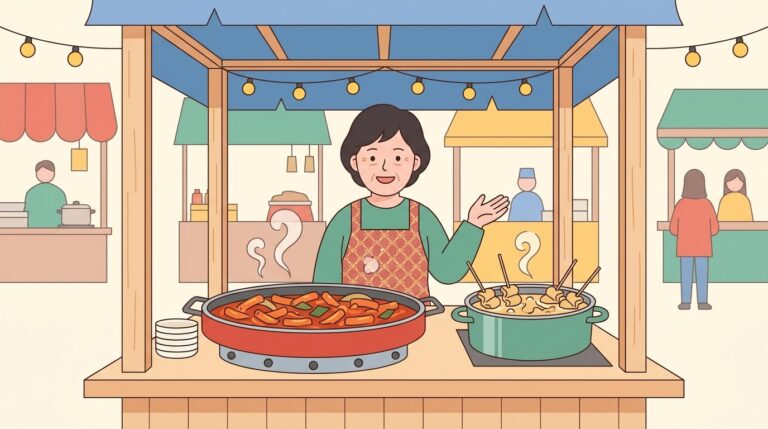
Imagine the steam rising from a hot grill, the smell of savory broth in the air, and a friendly vendor (Imo, meaning auntie) smiling at you. Your mission? Ordering a delicious plate of 떡볶이 (Tteokbokki)!
Many of our beginner students have told us, “I know the word Tteokbokki, but when I stand in front of the stall, my mind goes blank! What if they ask me something I don’t understand?”
Don’t worry! Your Korean bestie is here to guide you. By the end of this guide, you will be ordering Tteokbokki like a local, with confidence and a big smile! Let’s get started!
Phase 2: Key Expressions for Tteokbokki Lovers
Let’s learn the 3 most important phrases you need to order food at a traditional market. These are simple, natural, and highly effective!
1. 떡볶이 1인분 주세요 (Tteokbokki irinbun juseyo)
- Pronunciation: Tteok-bok-ki ee-rin-boon joo-seh-yo (Think of “irinbun” as ee + rin + boon)
- Meaning: “Please give me one serving of Tteokbokki.”
- K-Culture Moment: You see this in every K-Drama when characters stop by a street cart (Pojangmacha) after work to vent about their day over a plate of spicy rice cakes.
- Editor’s Insight: 1인분 (irinbun) means “one serving” or “one person’s portion.” If you are with a friend, just change the number: 2인분 (i-inbun) for two servings, 3인분 (saminbun) for three!
- Situation Spectrum: Casual ✅ | Semi-formal ✅ | Formal ⚠️
- 🤔 Think About It: In Korean culture, food is often measured by “servings for people” (인분) rather than plates or grams. It shows how deeply sharing and people-centered Korean food culture is!
2. 덜 맵게 해 주세요 (Deol maepge hae juseyo)
- Pronunciation: Deol maep-ge hae joo-seh-yo (Think of “deol” sounding like “dull” but with a softer ‘u’)
- Meaning: “Please make it less spicy.”
- K-Culture Moment: Many foreigners love the red look of Tteokbokki but struggle with the heat. Saying this phrase is a lifesaver!
- Editor’s Insight: 덜 (deol) means “less,” and 맵게 (maepge) means “spicily.” Even if the Tteokbokki is already cooked in a big pan, the vendor might add a bit of broth or water to tone down the heat for your individual portion if you ask nicely!
- Situation Spectrum: Casual ✅ | Semi-formal ✅ | Formal ⚠️
- 🤔 Think About It: Koreans love spicy food, but they also appreciate when you try your best! Don’t be shy to ask for “deol maepge”—your stomach will thank you.
3. 여기 먹고 갈게요 (Yeogi meokgo galgeyo)
- Pronunciation: Yeo-gi meok-go gal-geh-yo (“Yeogi” as in yuh-gi, “meokgo” as in muk-go)
- Meaning: “I will eat here.”
- K-Culture Moment: Traditional market stalls have tiny plastic stools where you can sit and eat. It’s the ultimate local experience!
- Editor’s Insight: 여기 (yeogi) means “here,” 먹고 (meokgo) means “eat and,” and 갈게요 (galgeyo) means “will go.” Literally, “I will eat here and then go.”
- Situation Spectrum: Casual ✅ | Semi-formal ✅ | Formal ⚠️
- 🤔 Think About It: If you want to take it to your hotel, you can say 포장해 주세요 (Pojang-hae juseyo), which means “Please wrap/pack it up.”
Phase 3: Textbook Korean vs. Real-Life Korean
Let’s compare what dry textbooks teach you versus how real Koreans actually talk at the market!
Situation 1: Ordering Food
- 📖 Textbook: “떡볶이를 주문하고 싶습니다.” (Tteokbokki-reul jumun-hago sipseumnida. – I would like to order Tteokbokki.)
- 🗣️ Real Korean: “이모, 떡볶이 일인분만 주세요!” (Imo, tteokbokki irinbun-man juseyo! – Auntie, just one serving of Tteokbokki, please!)
- 💡 Why the difference? Traditional markets are warm and friendly. Using “주문하고 싶습니다” sounds too corporate. Calling the female vendor 이모 (Imo – Auntie) instantly breaks the ice!
Situation 2: Asking for Soup/Broth
- 📖 Textbook: “어묵 국물을 주시겠습니까?” (Eomuk gungmul-eul jusigesseumnika? – Would you give me some fish cake broth?)
- 🗣️ Real Korean: “이모, 국물 좀 주실 수 있어요?” (Imo, gungmul jom jusil su isseoyo? – Auntie, can I get some broth?)
- 💡 Why the difference? In traditional markets, fish cake broth (eomuk gungmul) is usually free and unlimited. Asking casually with 좀 (jom – a little/please) sounds polite yet friendly.
Phase 4: K-Culture Deep Dive & Non-Verbal Manners
4-1. Nunchi (눈치) & Body Language
- Eye Contact & Smile: When you walk up to a stall, make warm eye contact with the vendor and nod with a smile. Traditional markets run on human connection!
- Handing over Money/Card: Always use two hands when giving your card or cash to the vendor, and when receiving your food. It is a sign of deep respect in Korea.
4-2. The Soul of Street Food: Tteokbokki & Eomuk
Tteokbokki is the ultimate soul food for Koreans. When you order Tteokbokki, you will notice a large pot of 어묵 (Eomuk – Fish cakes) boiling next to it. Local tip: You can grab a cup, scoop some hot fish cake broth for free, and drink it while waiting for your spicy rice cakes!
Phase 5: Real-Life Roleplay Scenario
Meet 이모 (Imo), the friendly owner of “Seoul Tteokbokki” at Mangwon Market. She is warm, loud, and loves welcoming foreigners!
- Scene: Standing in front of a steaming hot food stall at a traditional market.
- 이모 (Imo): (Smiling warmly) 어서 와요! 뭐 드릴까?
(Eoseo wayo! Mwo deurilkka? / Welcome! What can I get you?) - You: (Politely bowing) 안녕하세요! 이모, 떡볶이 1인분 주세요.
(Annyeonghaseyo! Imo, tteokbokki irinbun juseyo. / Hello! Auntie, one serving of Tteokbokki, please.) - 이모 (Imo): (Nodding) 매운 거 잘 먹어요? 우리 집 떡볶이 좀 매워!
(Maeun geo jal meogeoyo? Uri jip tteokbokki jom maewor! / Can you eat spicy food well? Our Tteokbokki is a bit spicy!) - You: (Smiling nervously) 아, 조금요. 덜 맵게 해 주실 수 있어요?
(Ah, jogeum-yo. Deol maepge hae jusil su isseoyo? / Ah, a little bit. Can you make it less spicy?) - 이모 (Imo): (Laughing) 오케이, 소스 조금 덜 묻혀서 줄게! 여기서 먹고 갈 거지?
(Okay, soseu jogeum deol muthyeoseo julge! Yeogi-seo meokgo gal geoji? / Okay, I’ll put less sauce on it! You’re eating here, right?) - You: 네, 여기 먹고 갈게요!
(Ne, yeogi meokgo galgeyo! / Yes, I will eat here!) - 이모 (Imo): (Handing over the plate with both hands) 자, 맛있게 먹어요! 국물도 가져다 먹고!
(Ja, masitge meogeoyo! Gungmul-do gajyeoda meokgo! / Here, enjoy! Get some broth to drink too!) - You: (Receiving with both hands) 와, 감사합니다! 잘 먹겠습니다!
(Wa, gamsahannida! Jal meogesseumnida! / Wow, thank you! I will eat well!)
🔀 Interactive Choice Point!
What will you say next?
- A) “이모, 계산해 주세요!” (Imo, gyesan-hae juseyo!) -> You want to pay now.
- B) “이모, 포장해 주세요.” (Imo, pojang-hae juseyo.) -> You suddenly changed your mind and want to take it home.
- C) “이모, 맛없어요.” (Imo, mateopseoyo.) -> You want to say it tastes bad (Oh no!).
Feedback on your choice:
- Best (A): Great job! This is the perfect way to ask for the bill at a street market. “Auntie, please check me out!”
- Risk (B): Fine, but since she already put it on a plate for you to eat here, she might have to pack it up in a plastic bag. It’s doable, but try to decide before she plates it!
- Bad (C): Oh dear! “맛없어요” means “It is tasteless/bad.” This will break Imo’s heart! Avoid this at all costs.
Phase 6: 10-Second Emotion Shadowing Drill
Practice speaking like a native by adding real emotions to your voice! Pay attention to the pauses (/).
- [😊 Friendly & Exciting]
- 이모, / 떡볶이 일인분 / 주세요!
- Imo, / tteokbokki irinbun / juseyo!
- [🥺 Polite & Begging]
- 아, / 조금 덜 맵게 / 해 주세요.
- Ah, / jogeum deol maepge / hae juseyo.
- [😋 Excited & Grateful]
- 우와, / 정말 맛있겠다! / 잘 먹겠습니다!
- Uwa, / jeongmal masitgetda! / Jal meogesseumnida!
Phase 7: K-Culture Mini Dictionary
- 이모 (Imo) | Auntie | Literally means mother’s sister, but widely used to call middle-aged female restaurant or market owners in a friendly way.
- 튀김 (Twigim) | Deep-fried snacks | Crispy fried squid, sweet potatoes, or vegetables. They taste amazing when dipped in Tteokbokki sauce!
- 순대 (Sundae) | Korean blood sausage | A popular street food partner of Tteokbokki. Usually steamed and dipped in salt or spicy sauce.
- 현금 (Hyeongeum) | Cash | While cards are widely accepted now, some small traditional market stalls still prefer cash.
Phase 8: Survivor Kit for Travelers
Survival Expressions TOP 3
- 카드 돼요? (Kadeu dwaeyo?)
- Can I pay by card? (Pro Tip: Keep some cash just in case, but most places in Seoul accept cards now!)
- 이거 얼마예요? (Igeo eolmayeyo?)
- How much is this?
- 물은 어디에 있어요? (Mureun eodie isseoyo?)
- Where is the water? (Pro Tip: Water is almost always self-service in Korean street stalls!)
Editor’s Travel Note
When traveling in Seoul, download Naver Map to find traditional markets like Mangwon Market (망원시장) or Gwangjang Market (광장시장) easily. Google Maps does not work perfectly for walking directions in Korea.
Disclaimer: Market operating hours may vary, so check Naver Map before visiting!
Phase 9: “Go Deeper” – Cultural Reflection
In Western cultures, calling a stranger “Auntie” (이모) might feel overly personal or even rude. But in Korea, it is a sign of affection and community. Korean society values connection, and calling someone “Imo” immediately turns a cold transaction into a warm, family-like interaction. Try using it next time—you might even get extra fried snacks (Service – 서비스) for free!
💬 Your Turn: What is your favorite street food in your country, and how do you order it? Let us know in the comments below!
Phase 10: FAQ & Common Mistakes
Q: Can I share one serving of Tteokbokki with my friend?
A: Yes! Portions in traditional markets are usually quite generous. However, if you sit at a table, it is polite to order at least one item per person (e.g., one Tteokbokki and one plate of fried snacks).
Q: What if the Tteokbokki is too spicy even after asking for “deol maepge”?
A: Grab some free fish cake broth (eomuk gungmul) or buy a sweet drink like 식혜 (Sikhye – sweet rice drink) nearby to soothe your tongue!
Q: Is tipping required at traditional markets?
A: No, tipping is not a part of Korean culture. In fact, trying to leave a tip might confuse the vendor, who might run after you to return your “forgotten” money!
🚨 Common Mistakes Alert!
- Saying “아줌마” (Ajumma) loudly: While “Ajumma” means middle-aged woman, it can sometimes sound a bit harsh or old-fashioned. Use “이모” (Imo) instead—it sounds much sweeter!
- Using formal “Sumnida” endings: Saying “떡볶이를 먹고 싶습니다” sounds like you are writing a business report. Stick to the polite “Yo” form (~요) for a natural flow.
- Throwing trash on the street: Traditional markets don’t have many public trash cans. Hand your wooden stick or cup back to the vendor where you bought it, and they will gladly discard it for you.
Phase 11: Action Mission!
- Bronze Mission: Speak “떡볶이 1인분 주세요!” aloud 3 times in front of your mirror with a big smile.
- Silver Mission: Take a screenshot of our Shadowing Drill (Phase 6) and share your practice on Instagram. Tag us
@DailyHangul! - Gold Mission: Visit a local Korean supermarket or a traditional market in Korea, order Tteokbokki using “덜 맵게 해 주세요,” and enjoy your delicious meal!
Phase 12: Interactive Quiz Challenge
1. What does “덜 맵게 해 주세요” mean?
- A) Please make it spicier.
- B) Please make it less spicy.
- C) Please give me more soup.
Click to view Answer & Explanation
Correct Answer: B
* 덜 (deol) means “less” and 맵게 (maepge) means “spicily.” If you want it spicier, you can say 더 맵게 해 주세요 (Deo maepge hae juseyo)!
2. True or False: Tipping is a great way to show respect in Korean traditional markets.
- A) True
- B) False
Click to view Answer & Explanation
Correct Answer: B (False)
* There is no tipping culture in Korea. Just a warm smile, using both hands to pay, and a loud “감사합니다! (Gamsahannida!)” are the best ways to show respect!







