

Chilling Outside: Master the Art of the Korean Convenience Store ‘Pyeonsul’ (편술)
안녕하세요! (Annyeonghaseyo!) It’s your favorite K-culture navigator and Daily Hangul editor. Have you ever watched a K-drama where the characters wind down after a long, stressful day by cracking open a cold beer at a plastic table right outside a convenience store?
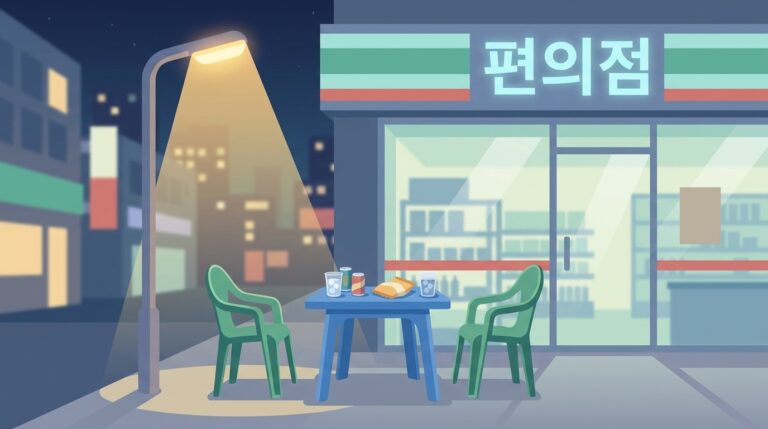
That magical, breezy, and deeply comforting vibe has a name: 편술 (Pyeon-sul)—a mashup of 편의점 (convenience store) and 술 (alcohol).
But for many intermediate learners, actually ordering, setting up, and enjoying this experience in real life brings a wave of social anxiety. “Can I just open the beer here?” “How do I ask the staff for an opener or ice?” “What are the unwritten rules of the plastic table?” Today, we are going to conquer those fears. By the end of this guide, you’ll be ordering and lounging like a true Seoulite.
Phase 2: Deep-Dive into 3 Essential Expressions
1. 야외 테이블에서 마셔도 돼요? (Ya-oe te-i-beul-e-seo ma-syeo-do dwae-yo?)
- Pronunciation: Ya-oe te-i-beul-e-seo ma-syeo-do dwae-yo? (Sounds like: “Ya-weh table-ess-oh mah-shuh-doh deh-yo?”)
- Meaning: “Is it okay to drink at the outdoor table?”
- K-Culture Moment: You find a perfect convenience store next to the Han River, but there are no cups on the plastic table. You ask the clerk inside this polite question before bringing your drinks out.
- Editor’s Insight: The pattern -아/어/여도 돼요? (Is it okay to…?) is a B2-level lifesaver. While many municipal laws technically restrict drinking outside in certain zones, most convenience stores with set-up tables allow it. Asking this beforehand shows supreme manners.
- Situation Spectrum: Casual (⚠️) | Semi-formal (✅) | Formal (🚫)
- 🤔 Think About It: In your home country, is drinking alcohol outside a convenience store legal or socially acceptable? How does this reflect the differences in public safety and community trust between cultures?
2. 네 캔에 만 원짜리 행사하는 거 어디 있어요? (Ne kaen-e man won-jja-ri haeng-sa-ha-neun geo eo-di isseo-yo?)
- Pronunciation: Ne kaen-e man won-jja-ri haeng-sa-ha-neun guh uh-di ee-ssuh-yo? (Sounds like: “Neh ken-eh mahn-won-jah-ree heng-sah-hah-noon guh uh-dee ee-so-yo?”)
- Meaning: “Where are the beers that are on the ‘4 cans for 10,000 won’ promotion?”
- K-Culture Moment: The holy grail of Korean convenience stores is the imported beer promotion. Although inflation has bumped the price up to 11,000 or 12,000 won recently, locals still affectionately call this deal ‘네 캔에 만 원’ (4 cans for 10k).
- Editor’s Insight: 행사 (haeng-sa) usually means an ‘event’ or ‘festival’, but in retail, it means ‘promotion’ or ‘sale’. Saying ‘행사하는 거’ (the promotional one) makes you sound incredibly natural.
- Situation Spectrum: Casual (✅) | Semi-formal (✅) | Formal (⚠️)
- 🤔 Think About It: Why do you think group promotions (like 2+1 or 4-for-10k) are so much more popular in Korea than simple single-item discounts?
3. 쓰레기는 어디에 버려야 해요? (Sseu-re-gi-neun eo-di-e beo-ryeo-ya hae-yo?)
- Pronunciation: Sseu-re-gi-neun eo-di-e buh-ryuh-ya heh-yo? (Sounds like: “Sue-reh-ghee-noon uh-dee-eh buh-ryuh-yah-heh-yo?”)
- Meaning: “Where should I throw away the trash?”
- K-Culture Moment: You’ve finished your beers and snacks. Leaving your trash on the table is the ultimate social crime in Korea. Asking the clerk where to sort your recyclables is highly respected.
- Editor’s Insight: Korea has a strict recycling system called 분리수거 (bun-ri-su-geo). Convenience stores have separate bins for cans (캔), plastic (페트/플라스틱), and food waste (음식물 쓰레기).
- Situation Spectrum: Casual (✅) | Semi-formal (✅) | Formal (✅)
- 🤔 Think About It: How does a country’s waste disposal system reflect its civic consciousness and collective responsibility?
Phase 3: Textbook Korean vs. Real-Life Korean
Situation 1: Asking for a bottle opener
- 📖 Textbook Korean: “병따개를 빌려주실 수 있습니까?” (Byeong-tta-gae-reul bil-ryeo-ju-sil su is-seup-ni-ka? / May I borrow a bottle opener?)
- 🗣️ Real-Life Korean: “혹시 오프너나 병따개 있어요?” (Hok-si o-peu-neo-na byeong-tta-gae isseo-yo? / By any chance, do you have an opener or bottle opener?)
- 💡 Why the difference? The textbook version is grammatically flawless but sounds overly robotic, like you’re asking a royal guard. Starting with 혹시 (by any chance) instantly softens your tone and makes it sound polite yet natural.
Situation 2: Proposing to drink outside
- 📖 Textbook Korean: “편의점 밖에서 맥주를 마십시다.” (Pyeon-ui-jeom bak-eo-seo maek-ju-reul ma-sip-si-da. / Let’s drink beer outside the convenience store.)
- 🗣️ Real-Life Korean: “날도 좋은데 편술 한잔 어때요?” (Nal-do jo-eun-de pyeon-sul han-jan eo-ttae-yo? / The weather is so nice, how about a quick drink outside the convenience store?)
- 💡 Why the difference? Real Koreans use 편술 (pyeon-sul) to capture the vibe, and they always tie it to the weather (날도 좋은데… – Since the weather is nice too…).
Phase 4: K-Culture Deep-Dive & Non-Verbal Manners
4-1. The Art of ‘Nunchi’ (눈치) at the Plastic Table
- The Clean Table Rule: When you sit at the plastic table, you might find some water or condensation from previous guests. It is customary to grab a wet wipe or tissue from inside the store and wipe the table yourself before and after you sit down.
- The Two-Hand Pour: If you are drinking with someone older or someone you aren’t extremely close with, always pour and receive drinks with both hands. It shows respect even in a casual outdoor setting.
4-2. The ‘Pyeonsul’ Culture Code
In dramas like Our Beloved Summer or Work Later, Drink Now, the convenience store outdoor table is a therapeutic space. It’s cheaper than a bar, offers a breeze, and serves as a low-pressure environment for deep, late-night conversations. It represents the “democratic comfort” of Korean urban life.
Phase 5: Real-Life Roleplay Scenario
Setting: A GS25 convenience store near the Han River on a warm Friday evening. You are with Ji-hoon (지훈), a Korean colleague.
- Ji-hoon: 날씨 진짜 좋네요! 시원한 맥주 당기지 않아요?
(Nal-ssi jin-jja jon-ne-yo! Si-won-han maek-ju dang-gi-ji an-a-yo?)
🎭 Loosening his tie, looking excited
“The weather is amazing! Aren’t you craving a cold beer?” -
You: 맞아요! 저기 편의점 야외 테이블에서 마실까요?
(Ma-ja-yo! Jeo-gi pyeon-ui-jeom ya-oe te-i-beul-e-seo ma-sil-kka-yo?)
🎭 Pointing at the blue plastic table
“Exactly! Shall we drink at that outdoor table over there?” -
Ji-hoon: 좋죠! 들어가서 맥주 골라와요. 제가 테이블 닦아 놓을게요.
(Jo-chyo! Deul-eo-ga-seo maek-ju gol-ra-wa-yo. Je-ga te-i-beul dakk-a no-eul-ge-yo.)
🎭 Pulling out a tissue to wipe the table
“Sounds great! Go inside and grab some beers. I’ll wipe down the table.” -
You (To the Store Clerk): 저기요, 사장님! 맥주 네 캔 행사하는 거 어디 있어요?
(Jeo-gi-yo, sa-jang-nim! Maek-ju ne kaen haeng-sa-ha-neun geo eo-di isseo-yo?)
🎭 Walking up to the counter politely
“Excuse me, boss! Where are the beers on the ‘4 cans’ promotion?” -
Clerk: 안쪽 안개 쇼케이스 아래 칸에 있습니다. 국산 맥주도 교차 구매 가능해요.
(An-jjok an-gae syo-ke-i-seu a-rae kan-e is-seup-ni-da. Guk-san maek-ju-do gyo-cha gu-mae ga-neung-hae-yo.)
🎭 Pointing to the back cooler
“In the inner cooler, bottom shelf. You can mix and match domestic beers too.” -
You (Returning to Ji-hoon with beers and cups): 수입 맥주 네 캔 사 왔어요! 얼음컵도 샀는데 같이 마셔요.
(Su-ip maek-ju ne kaen sa wass-eo-yo! Eo-reum-keop-do san-neun-de gat-i ma-syeo-yo.)
🎭 Handing over an ice cup
“I bought four cans of imported beer! I also got ice cups, let’s drink together.” -
Ji-hoon: 센스 대박! 자, 시원하게 한잔합시다! 건배!
(Sen-seu dae-bak! Ja, si-won-ha-ge han-jan-hap-si-da! Geon-bae!)
🎭 Clinking the ice cups enthusiastically
“Wow, you have amazing sense! Let’s have a refreshing drink! Cheers!” -
You (After finishing): 사장님, 쓰레기는 어디에 버려야 해요?
(Sa-jang-nim, sseu-re-gi-neun eo-di-e beo-ryeo-ya hae-yo?)
🎭 Holding the empty cans and cups
“Excuse me, where should I throw away the trash?”
🔀 Interactive Branching Decision
Now, the clerk points toward the corner. How do you handle your leftover trash?
- Choice A: Leave everything on the table because you saw some tissues left there earlier.
- Choice B: Walk up to the recycling bins inside/outside the store, separate the plastic cups, aluminum cans, and throw away any remaining liquids in the designated sink.
- Choice C: Put everything into one big plastic bag and drop it in the general waste bin inside the store.
💡 Feedback on Your Choice:
- Choice A (Bad – Social Death): ❌ Oh no! This is called ‘먹튀’ (eat and run). Leaving trash on convenience store tables ruins the experience for everyone and makes the busy clerk’s life miserable. Avoid this at all costs!
- Choice B (Best – The Local Expert): Perfect! Separating the liquids, throwing plastic in 플라스틱, and cans in 캔 makes you a gold-standard global citizen. The clerk might even say “감사합니다” with a genuine smile.
- Choice C (Risk – Not Quite Clean): ⚠️ Putting mixed recyclable trash into a single bin is highly frowned upon in Korea due to strict recycling laws. You got points for trying, but take 10 more seconds to separate them!
Phase 6: 10-Second Emotional Shadowing Drill
To sound native, you need the right rhythm and emotion. Let’s practice with pauses (/) and emotional cues!
[😊 Excited and Breezy]
날씨도 / 좋은데 / 편술 한잔 / 어때요?
(Nal-ssi-do / jo-eun-de / pyeon-sul han-jan / eo-ttae-yo?)-
[🤔 Polite and Inquiring]
혹시 / 야외 테이블에서 / 마셔도 돼요?
(Hok-si / ya-oe te-i-beul-e-seo / ma-syeo-do dwae-yo?) -
[🙏 Respectful and Helpful]
사장님, / 쓰레기는 / 어디에 / 버려요?
(Sa-jang-nim, / sseu-re-gi-neun / eo-di-e / beo-ryeo-yo?)
Phase 7: K-Culture Mini-Dictionary
- 편술 (Pyeon-sul) | Convenience store drinking. The act of buying alcohol and drinking it casually at outdoor convenience store tables.
- 얼음컵 (Eo-reum-keop) | Ice cup. A plastic cup filled with ice sold separately (usually around 800~1,000 KRW). Essential for pouring beers or pouch drinks on hot days.
- 네 캔에 만 원 (Ne kaen-e man won) | “4 cans for 10,000 won”. The legendary beer promotion. Even though prices have slightly risen, the phrase remains a cultural icon for cheap beer hunting.
- 분리수거 (Bun-ri-su-geo) | Separate trash recycling. The deeply ingrained Korean practice of sorting trash by material (plastic, vinyl, paper, glass, can, food).
Phase 8: Traveler’s Survival Kit
Survival Expressions TOP 3
- 빨대 하나만 주세요. (Ppal-dae ha-na-man ju-se-yo.)
- Meaning: “Please give me a straw.” (Great for drinking pouch drinks or beers quietly).
- 카드 여기 있습니다. (Ka-deu yeo-gi is-seup-ni-da.)
- Meaning: “Here is my card.” (Polite way to hand over your payment).
- 영수증은 버려주세요. (Yeong-su-jeung-eun beo-ryeo-ju-se-yo.)
- Meaning: “Please throw away the receipt for me.”
Editor’s Travel Note 🗺️
If you want to find the ultimate scenic ‘Pyeonsul’ spot, don’t rely on global map apps which don’t update well in Korea. Download the Naver Map App or KakaoMap App. Search for **
Frequently Asked Questions (FAQ)
Q: What does "야외 테이블에서 마셔도 돼요? (Ya-oe te-i-beul-e-seo ma-syeo-do dwae-yo?)" mean in Korean and how do you pronounce it?
A: In Korean, "야외 테이블에서 마셔도 돼요? (Ya-oe te-i-beul-e-seo ma-syeo-do dwae-yo?)" is pronounced [Ya-oe te-i-beul-e-seo ma-syeo-do dwae-yo? (Sounds like: "Ya-weh table-ess-oh mah-shuh-doh deh-yo?"] and means: "Is it okay to drink at the outdoor table?"
Q: What does "네 캔에 만 원짜리 행사하는 거 어디 있어요? (Ne kaen-e man won-jja-ri haeng-sa-ha-neun geo eo-di isseo-yo?)" mean in Korean and how do you pronounce it?
A: In Korean, "네 캔에 만 원짜리 행사하는 거 어디 있어요? (Ne kaen-e man won-jja-ri haeng-sa-ha-neun geo eo-di isseo-yo?)" is pronounced [Ne kaen-e man won-jja-ri haeng-sa-ha-neun guh uh-di ee-ssuh-yo? (Sounds like: "Neh ken-eh mahn-won-jah-ree heng-sah-hah-noon guh uh-dee ee-so-yo?"] and means: "Where are the beers that are on the '4 cans for 10,000 won' promotion?"
Q: What does "쓰레기는 어디에 버려야 해요? (Sseu-re-gi-neun eo-di-e beo-ryeo-ya hae-yo?)" mean in Korean and how do you pronounce it?
A: In Korean, "쓰레기는 어디에 버려야 해요? (Sseu-re-gi-neun eo-di-e beo-ryeo-ya hae-yo?)" is pronounced [Sseu-re-gi-neun eo-di-e buh-ryuh-ya heh-yo? (Sounds like: "Sue-reh-ghee-noon uh-dee-eh buh-ryuh-yah-heh-yo?"] and means: "Where should I throw away the trash?"







