

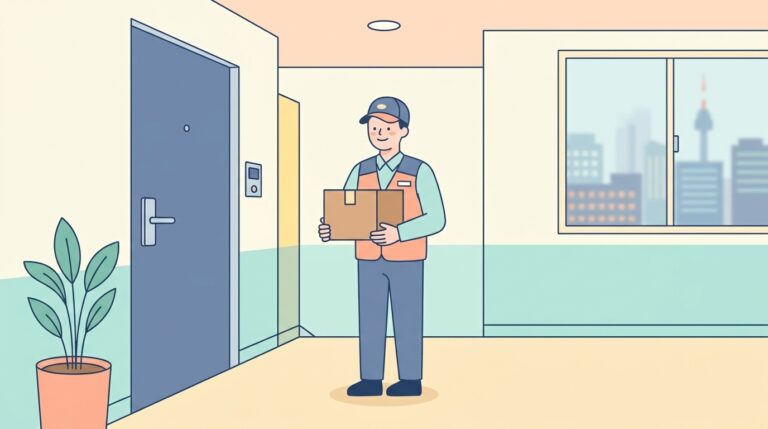
Hello! Welcome Back to Daily Hangul!
안녕하세요! (An-nyeong-ha-se-yo!) I’m your friendly neighborhood editor and Korean culture navigator at Daily Hangul.
Have you ever been waiting for a beautiful K-beauty haul or a rare K-pop album to arrive at your guesthouse or shared apartment in Seoul, only for the delivery driver to say words that sound like a spell?
“Chak-bul-im-ni-da!”
You stand there blinking. You’ve already paid for the item online! Why is the driver holding the box hostage?
Don’t panic! You aren’t being scammed. This is a very common Korean delivery system called 착불 (Chak-bul) – Cash on Delivery (COD) for shipping fees. Today, we are going to unlock this survival skill so you can receive your packages like a true local, without any awkward sweating. Let’s dive in!
Phase 2: Top 3 Must-Know Expressions for “Cash on Delivery”
Here are the three golden expressions you need when dealing with pay-on-delivery packages.
1. 착불입니다 (Chak-bul-im-ni-da)
- Pronunciation: Chak-bool-im-nee-da (Sounds like “Chuck-bull” + “im-nee-da”)
- Meaning: “It is cash on delivery (for the shipping fee).”
- K-Culture Moment: You hear this when the courier rings your doorbell or calls your phone before dropping off a heavy box of delicious home-made Kimchi sent by a friendly Korean acquaintance.
- Editor’s Insight: Chak (착) means arrive, and Bul (불) means payment. It means you pay the shipping fee upon arrival.
- Situation Spectrum: Casual (⚠️) / Semi-formal (✅) / Formal (✅)
- 🤔 Think About It: In many Western countries, prepaying everything is the absolute norm. Why do you think Korea still keeps the cash-on-delivery system for shipping fees alive and well? (Hint: It is highly convenient for peer-to-peer secondhand trading!)
2. 배송비 얼마예요? (Baesongbi olmayeyo?)
- Pronunciation: Bae-song-bee-ol-mah-yeh-yo? (Sounds like “Pay-song-bee” + “ul-mah-yeh-yo”)
- Meaning: “How much is the shipping fee?”
- K-Culture Moment: Asking this when a friendly local courier holds your box and waits for you to transfer the money.
- Editor’s Insight: Baesongbi (배송비) is “delivery fee”. It’s the most important word to know when you need to prepare your cash or transfer money.
- Situation Spectrum: Casual (⚠️) / Semi-formal (✅) / Formal (✅)
3. 계좌번호 보내주세요 (Gyejwabeonho bonaejuseyo)
- Pronunciation: Gye-jwa-beon-ho bo-nae-ju-se-yo (Sounds like “Gyey-jwa-bun-ho” + “bo-nae-joo-seh-yo”)
- Meaning: “Please send me the bank account number.”
- K-Culture Moment: Modern Korean couriers rarely carry actual cash change. They prefer you send the 3,000 KRW directly to their bank account via a quick mobile transfer!
- Editor’s Insight: Don’t worry if you don’t have cash! Just ask for their Gyejwabeonho (bank account number) and do a quick bank transfer.
- Situation Spectrum: Casual (🚫) / Semi-formal (✅) / Formal (✅)
Phase 3: Textbook Korean vs. Real-Life Korean
Let’s compare how textbooks teach this versus how real Koreans actually talk!
Situation 1: Asking for the delivery price
- 📖 Textbook Korean: 배송 요금이 얼마입니까? (Baesong yogumi olmaimnikka? – How much is the delivery charge?)
- 🗣️ Real-Life Korean: 배송비 얼마예요? (Baesongbi olmayeyo? – How much is the shipping fee?)
- 💡 Why is it different?: Nobody uses the formal yogum (charge) in daily casual talk. Real people use Baesongbi because it sounds softer and more natural.
Situation 2: Choosing how to pay
- 📖 Textbook Korean: 현금으로 결제하겠습니다. (Hyeongumeuro gyeoljehagessumnida. – I will pay with cash.)
- 🗣️ Real-Life Korean: 계좌이체 해드릴게요. (Gyejwa-iche hae-deuril-ge-yo. – I’ll do a bank transfer.)
- 💡 Why is it different?: Korea is virtually a cashless society. It’s much faster to say “I’ll transfer to your account” than to look for coins in your pocket!
Phase 4: K-Culture Deep Dive & Non-Verbal Manners
4-1. The “Fast, Fast!” Culture (빨리빨리 – Ppalli-Ppalli)
Korean delivery drivers are among the hardest working and fastest people in the world.
* Non-verbal tip: When they say Chak-bul-im-ni-da, don’t take 10 minutes looking for your wallet. Have your phone ready for a quick transfer, or prepare exact cash.
* The Head Bow: Always give a slight head bow and say “감사합니다! (Gam-sa-ham-ni-da)” even if you are stressed about paying. A little kindness goes a very long way!
Phase 5: Real-Life Roleplay Scenario
Meet Mr. Kim, the speediest delivery courier in Mapo-gu, Seoul. You are standing at the door of your Airbnb.
Mr. Kim: (Knocks fast) 택배 왔습니다!
         [Taek-bae wat-seum-ni-da!]
         (🎭 Holding a box, looking busy but friendly)
         "Delivery is here!"

You: 감사합니다!
     [Gam-sa-ham-ni-da!]
     (🎭 Smiling warmly, taking the box halfway)
     "Thank you!"

Mr. Kim: 아, 이거 착불입니다.
         [Ah, i-geo chak-bul-im-ni-da.]
         (🎭 Pointing to the receipt on the box)
         "Ah, this is Cash on Delivery."

You: 아, 진짜요? 배송비 얼마예요?
     [Ah, jin-jja-yo? Bae-song-bi ol-ma-ye-yo?]
     (🎭 Looking slightly surprised but keeping calm)
     "Oh, really? How much is the shipping fee?"

Mr. Kim: 삼천오백 원입니다.
         [Sam-cheon-o-baek won-im-ni-da.]
         (🎭 Checking his phone screen)
         "It is 3,500 Won."

You: 제가 현금이 없어서요. 계좌번호 보내주세요.
     [Je-ga hyeon-geum-i eop-seo-seo-yo. Gye-jwa-beon-ho bo-nae-ju-se-yo.]
     (🎭 Patting your pockets showing no cash)
     "I don't have cash right now. Please send me the account number."

Mr. Kim: 네, 문자로 보내드릴게요.
         [Ne, mun-ja-ro bo-nae-deu-ril-ge-yo.]
         (🎭 Typing fast on his phone)
         "Yes, I will send it to you by text message."

You: 네, 바로 보낼게요. 감사합니다!
     [Ne, ba-ro bo-nael-ge-yo. Gam-sa-ham-ni-da!]
     (🎭 Bowing head politely)
     "Yes, I will send it right away. Thank you!"
🔀 Interactive Choice Point!
What would you do if you don’t have a Korean bank account to transfer the money?
* A) Say “No money!” and shut the door.
* Feedback: 🚨 Risk! The driver might take the box back, and you won’t get your package!
* B) Ask a Korean friend or your Airbnb host to transfer it for you, and pay them back later.
* Feedback: 🌟 Best! Ask the driver for the account text, forward it to your host, and say “제 친구가 보낼 거예요 (My friend will send it).”
* C) Try to pay him with a foreign credit card.
* Feedback: ⚠️ Bad. Most local delivery hand-terminals do not accept international credit cards for small COD shipping fees.
Phase 6: 10-Second Emotion Shadowing Drill
Let’s practice speaking with real Korean feelings! Pay attention to the / pauses.
- [🥺 Worried & Confused]
- 아… / 이거 / 착불이에요?
- Ah… / i-geo / chak-bul-i-e-yo?
- (Oh… is this cash on delivery?)
- [😊 Bright & Solved]
- 계좌번호 / 문자로 / 보내주세요!
- Gye-jwa-beon-ho / mun-ja-ro / bo-nae-ju-se-yo!
- (Please send the account number by text!)
Phase 7: K-Culture Mini-Dictionary
- 택배 (Taek-bae) | Delivery / Package | Korea’s famous super-fast delivery system.
- 착불 (Chak-bul) | Pay on Delivery | Pay shipping when it arrives.
- 선불 (Seon-bul) | Prepaid | Paid in advance (the best kind!).
- 계좌이체 (Gye-jwa-i-che) | Bank Transfer | The ultimate way to pay for almost anything in Korea.
Phase 8: Survivor’s Travel Kit
Survival Phrases TOP 3
- 문 앞에 두고 가세요. (Mun ap-e du-go ga-se-yo.)
- Pro Tip: “Please leave it in front of the door.” (Use this if you are too shy to meet the driver!).
- 경비실에 맡겨주세요. (Gyeong-bi-sil-e mat-gyeo-ju-se-yo.)
- Pro Tip: “Please leave it with the security office.”
- 착불 얼마예요? (Chak-bul ol-ma-ye-yo?)
- Pro Tip: “How much is the cash on delivery fee?”
📌 Editor’s Travel Note:
To trace your package like a pro, use the Naver Map App or download local delivery tracker apps. Always keep your Korean phone number active to receive texts from couriers!
Phase 9: One Step Deeper
In Korea, trust is a huge part of daily life. Delivery couriers will often leave expensive packages outside your door for hours without fear of theft. Because of this high-trust society, paying Chak-bul via a text message bank transfer after the driver has already left is extremely common and built on mutual trust!
💬 Your Turn: Have you ever received a package in Korea? Leave a comment below with your funny stories!
Phase 10: FAQ & Common Mistakes
Q: Can I pay ‘Chak-bul’ with my foreign visa card?
A: Generally, no. Most local delivery hand-terminals only accept domestic Korean cards or cash/direct bank transfers. It is always safest to do a mobile bank transfer.
Q: What happens if I am not at home when a Chak-bul package arrives?
A: The courier will text you their bank account. Once you transfer the money, they will leave the package at your door or in the apartment lobby!
Q: Is ‘Chak-bul’ the same as paying for the item itself?
A: No! Chak-bul almost always refers to just paying the shipping fee (usually 3,000 to 5,000 KRW) when the item itself was already paid online.
🚨 Common Mistakes Alert!
- Mistake: Handing over a 50,000 KRW bill for a 3,000 KRW fee.
- Correct Action: The driver won’t have change! Use 계좌이체 (Bank transfer) instead.
Phase 11: Action Missions!
- 🥉 Bronze: Say “착불입니다” out loud 5 times in front of your mirror.
- 🥈 Silver: Next time you order something in Korea, check if the option is 선불 (Prepaid) or 착불 (COD) before clicking buy!
- 🥇 Gold: Show off your Korean skills! If a driver calls, confidently say: “계좌번호 문자 주세요!” (Please text me the account number!)
Phase 12: Interactive Quiz Challenge!
Test your skills below!
1. What does “착불” (Chak-bul) mean?
👉 Click to see the Answer
Answer: Cash on Delivery (specifically for the shipping fee upon package arrival).
2. True or False: Korean couriers prefer cash over bank transfers for Chak-bul.
👉 Click to see the Answer
Answer: False! They prefer quick bank transfers (계좌이체) as it’s faster and cashless.







