

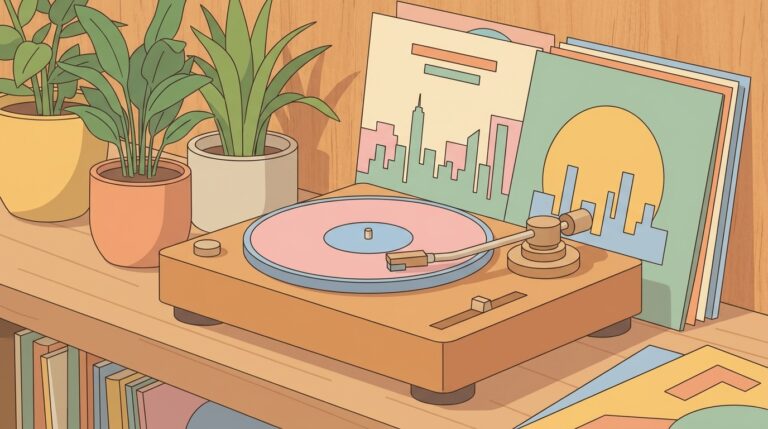
Spinning Nostalgia: The Ultimate Guide to Seoul’s Vinyl & Turntable Scene
Phase 1: Empathy (Welcome, Fellow Audiophile!)
안녕하세요! Welcome back to Daily Hangul, your premium Korean tutoring spot. I’m your chief editor and local cultural navigator!
Imagine this: You’re walking down a quiet, neon-lit alleyway in Euljiro (을지로)—affectionately dubbed “Hip-jiro” by Seoul’s trendsetters. You step into a dimly lit bar, and instead of a digital playlist, your ears are met with the warm, crackling embrace of a physical LP spinning on a vintage turntable. In Korea, we call this ‘Newtro’ (뉴트로)—a fusion of New and Retro that has taken the youth culture by storm.
Perhaps you are an avid record collector looking to dig for rare Korean city pop gems (like Kim Hyun-chul or Light & Salt), or maybe you are planning to purchase your very first turntable setup in the bustling electronics markets of Yongsan (용산). But when you step into these shops, you might feel a bit overwhelmed. “How do I ask if a record is vintage or a reissue?” “How do I negotiate a bundle deal for audio gear in natural, advanced Korean?”
Don’t worry! Today, we are diving deep into the sophisticated language of vinyl (바이닐) collecting and turntable setups at a C2 (Master) level. Let’s upgrade your Korean so you can converse like a true crate-digging local!
Phase 2: Deep Dive into 3 Essential Expressions
To navigate Seoul’s vinyl scene like a pro, you need to master these three advanced expressions. Let’s look at the nuance behind them.
1. 손맛을 느끼다 (Son-maseul neukkida)
- Pronunciation: [Son-ma-seul neu-kki-da] (Think: “Son-mah-sul nuh-kee-dah”)
- Meaning: Lit. “To feel the taste of hands” $\rightarrow$ To experience the tactile pleasure / hands-on sensation of something physical.
- K-Culture Moment: Used by young Koreans to describe why they prefer analog physical media (LPs, film cameras, books) over digital convenience.
- Editor’s Insight: While “손맛” originally refers to a chef’s unique seasoning touch, in modern subcultures, it represents the joy of physically handling, flipping, and cleaning records.
- Situation Spectrum: Casual (✅) | Semi-formal (✅) | Formal (⚠️)
- 🤔 Think About It: Why do you think highly digitalized societies like Korea crave the physical “손맛” of analog media?
2. 알판 상태가 어떻게 되나요? (Al-pan sang-taega eo-tteo-ke doe-na-yo?)
- Pronunciation: [Al-pan sang-tae-ga eo-tteo-ke doe-na-yo?] (Think: “Al-pahn sahng-tae-gah uh-ttuh-keh doe-nah-yo?”)
- Meaning: What is the condition of the actual vinyl disc (the media itself)?
- K-Culture Moment: Used by serious collectors in secondhand platforms like Danggeun Market (당근마켓) or vintage shops in Hoehyeon Underground Shopping Center (회현 지하쇼핑센터).
- Editor’s Insight: “알판” (Al-pan) literally means the “kernel/bare plate.” In vinyl jargon, it distinguishes the actual vinyl record from the outer sleeve/jacket (자켓). Asking about the “알판” shows you are a seasoned collector who cares about scratches and warping.
- Situation Spectrum: Casual (✅) | Semi-formal (✅) | Formal (✅)
- 🤔 Think About It: How does your language differentiate between the packaging sleeve and the actual physical disc?
3. 귀를 호강시키다 (Gwi-reul ho-gang-si-ki-da)
- Pronunciation: [Gwi-reul ho-gang-shi-ki-dah] (Think: “Gwee-rul ho-gahng-shee-kee-dah”)
- Meaning: Lit. “To pamper/give luxury to one’s ears” $\rightarrow$ To treat one’s ears to incredible, high-quality sound.
- K-Culture Moment: Often heard in vinyl bars when a high-end sound system (McIntosh amplifiers, JBL speakers) plays a classic track.
- Editor’s Insight: “호강” means living in luxury. When you upgrade your cartridge or speakers, you aren’t just listening to music; you are pampering your senses.
- Situation Spectrum: Casual (✅) | Semi-formal (✅) | Formal (⚠️)
- 🤔 Think About It: What kind of music or audio setup would you use to “귀를 호강시키다” tonight?
Phase 3: Textbook Korean vs. Real-Life Korean
Let’s compare stiff, classroom Korean with the vibrant, natural expressions used by local audiophiles.
Scenario A: Inquiring about a record’s release type
- 📖 Textbook: “이 레코드는 재발행된 음반입니까, 아니면 원래 나온 음반입니까?” (Is this record a reissued music disc, or is it the original album?)
- 🗣️ Real Life: “이거 초판인가요, 재반인가요? 아니면 혹시 리마스터링반인가요?” (Is this the first pressing (초판), a reissue (재반), or perhaps a remastered edition?)
- 💡 Why the difference? Collectors use precise, specialized terms like “초판” (first press), “재반” (reissue), and “리마스터링반” (remastered) to negotiate and evaluate value quickly.
Scenario B: Describing high-fidelity sound
- 📖 Textbook: “음질이 아주 선명하고 깨끗하게 들립니다.” (The sound quality is heard very clearly and cleanly.)
- 🗣️ Real Life: “소리가 아주 짱짱하고 공간감이 장난이 아니네요.” (The sound is incredibly rich/punchy, and the soundstage is absolutely insane.)
- 💡 Why the difference? “짱짱하다” implies robust, powerful sound reproduction without distortion, while “공간감” (soundstage/spatiality) is the advanced term used to describe immersive audio environments.
Phase 4: K-Culture Deep Dive & Non-verbal Etiquette
4-1. Crate-Digging Manners (눈치 & Etiquette)
When browsing records in traditional spots like Hoehyeon (회현) or modern stores in Hapjeong (합정), physical etiquette is key.
* The Gentle Flip: Never flip through records violently. Use your index and middle fingers to gently tilt them forward.
* Asking Before Playing: Most shops have listening stations (청음대), but always ask the owner: “혹시 이거 청음해 봐도 될까요?” (Is it okay if I listen to this?) before placing a needle on a record.
* Handling the Edges: When holding an LP, never touch the grooves. Touch only the outer edge and the inner label. Doing so shows the shop owner that you respect their stock.
4-2. The Rise of K-Vinyl Culture
Vinyl in Korea is no longer just for the older generation remembering the 70s and 80s acoustic folk movement. It has been embraced by Gen Z as a lifestyle. High-end lifestyle spaces like the Hyundai Card Vinyl & Plastic in Itaewon allow visitors to browse thousands of vinyl records and listen to them on spot. K-Pop artists like IU, BTS, and Baek Yerin release limited-edition vinyl versions of their albums, which sell out within seconds and trade at high premiums on secondhand markets.
Phase 5: Practical Roleplay Scenario
Here is a realistic scenario at a boutique vinyl shop in Hapjeong (합정). You are talking to Min-jun (민준), a passionate 30-something shop owner who is an absolute audio nerd.
The Characters:
- You (수집가 / Collector): A discerning vinyl enthusiast looking for premium sound.
- Min-jun (민준 – Shop Owner): Friendly, incredibly knowledgeable, and always willing to help a fellow collector.
민준: 어서 오세요! 편하게 둘러보세요. 특별히 찾으시는 장르가 있으신가요?

유(You): 안녕하세요! 요즘 한국 80년대 시티팝에 꽂혔는데, 바이닐 특유의 그 따뜻한 손맛을 느껴보고 싶어서요.

민준: 오, 제대로 찾아오셨네요! 마침 최근에 시티팝 희귀 음반들이 몇 장 들어왔습니다.

유(You): 와, 정말요? 혹시 김현철 1집 초판이나 재반 있나요? 알판 상태가 좋은 녀석으로 구하고 있어서요.

민준: 마침 상태 아주 좋은 재반이 하나 있긴 한데, 자켓 모서리에 미세한 상처가 있어서 저렴하게 드릴 수 있어요. 알판은 무기스, 민트급입니다.

유(You): 아, 자켓은 좀 바래도 괜찮아요. 알판 상태만 깨끗해서 귀를 제대로 호강시킬 수 있다면 대환영입니다! 청음해 볼 수 있을까요?

민준: 그럼요! 저기 턴테이블에서 바로 들어보세요. 카트리지를 새로 갈아 끼워 둬서 소리가 아주 짱짱할 겁니다.

유(You): (청음 후) 진짜 공간감이 대박이네요! 사장님, 혹시 이 LP랑 저기 있는 세정제 세트 같이 하면 조금 네고해 주실 수 있나요?

민준: 하하, 바이닐 애호가이신 것 같으니 세정제는 서비스로 얹어 드릴게요!
🔀 Interactive Choice Point
How do you respond to Min-jun’s generous offer?
- Choice A: “우와, 사장님 대박! 단골 예약입니다. 주변에 입소문 많이 낼게요!”
- Feedback (Best): Extremely natural and warm. Promising to become a regular (단골) and spread word-of-mouth (입소문) is the ultimate way to show gratitude in Korea.
- Choice B: “감사합니다. 돈을 더 안 내도 되니 기분이 좋습니다.”
- Feedback (Bad): Too transactional and slightly rude. It sounds like you are just happy to save money rather than appreciating the gesture.
- Choice C: “에이, 사장님, 기왕 주시는 김에 저기 턴테이블 클리너 브러쉬도 하나 주시면 안 돼요?”
- Feedback (Risk): Too pushy. While light negotiation is fine, asking for additional freebies (서비스) after receiving one can cross the line of politeness.
Phase 6: 10-Second Emotional Shadowing Drill
Practice matching your emotions to these realistic expressions. Pay attention to the breath pauses (/).
- [😊 Filled with pure excitement & anticipation]
- “와… / 바이닐 특유의 / 이 손맛은 / 정말 대체가 불가능하네요!”
- Wa… / bai-nil teu-yu-ui / i son-ma-seun / jeong-mal dae-che-ga bul-ga-neung-ha-ne-yo!
- (Wow… / this tactile feeling / unique to vinyl / is truly irreplaceable!)
- [🥺 Praying for a rare find]
- “제발 / 알판에 / 기스가 없어야 할 텐데… / 사장님, / 이거 청음 한 번만 가능할까요?”
- Je-bal / al-pan-e / gi-seu-ga eop-seo-ya hal ten-de… / sa-jang-nim, / i-geo cheong-eum han beon-man ga-neung-hal-ka-yo?
- (Please / I hope the disc / doesn’t have scratches… / Boss, / is it possible to test listen to this just once?)
Phase 7: K-Culture Mini Dictionary
- 초판 (Cho-pan) | First Pressing
- The very first batch of records manufactured from the master plates. Highly coveted and expensive.
- 민트급 (Mint-geup) | Mint Condition
- Used to describe items in near-flawless, like-new condition. Derived from the English “mint.”
- 음골 (Eum-gol) | Record Grooves
- Literally “sound valleys.” The microscopic grooves on a vinyl record that physical needles read to create sound.
- 지름신이 오다 (Ji-reum-sin-i o-da) | The Shopping Urge Hits
- Lit. “The god of spending money has arrived.” Used when you cannot resist buying a gorgeous turntable or rare LP.
Phase 8: Traveler’s Survival Kit
Survival Expressions TOP 3
- “혹시 이 앨범 미개봉 품목인가요?”
- Hok-si i ael-beom mi-gae-bong pum-mok-in-ga-yo?
- (Is this album a sealed/unopened item?)
- Pro Tip: Use this to check if you are buying a brand new, pristine copy.
- “침압이랑 카트리지 세팅 좀 도와주실 수 있나요?”
- Chim-ap-i-rang ka-teu-ri-ji se-ting jom do-wa-ju-sil su in-na-yo?
- (Could you help me set up the tracking force and the cartridge?)
- Pro Tip: Essential when buying a turntable at a shop to ensure you don’t ruin your records at home.
- “LP 세척기나 전용 클리너는 어디 있나요?”
- LP se-cheok-gi-na jeon-yong keul-ri-neo-neun eo-di in-na-yo?
- (Where are the record washers or specialized cleaners?)
- Pro Tip: Essential for maintaining vintage finds.
Editor’s Travel Note
When hunting for vinyl in Seoul, avoid carrying heavy bags. Use the 네이버 지도 (Naver Map App) to locate hidden vinyl shops in underground alleys. Disclaimer: Individual shop operating hours may vary, especially on traditional holidays, so check Naver Maps before visiting. Use your card for purchases, but having cash can sometimes lead to small discounts when negotiating at older stalls in Dongmyo or Hoehyeon.
Phase 9: “Going Deeper” (Thought-Provoking Essay)
In an era dominated by high-speed internet and instant streaming, Korea’s obsession with LP culture reveals a fascinating psychological shift. The concept of 정 (Jeong)—deep attachment and warmth—extends to physical objects. For younger Koreans, streaming digital files feels sterile and temporary. By holding a heavy 180g vinyl, cleaning its surface, and dropping the needle, they build a tactile, permanent connection with the music and the artist. It is a slow, meditative practice in a fast-paced society.
💬 Your Turn: Do you collect vinyl or physical media? How does the experience of listening to an LP compare to digital streaming for you? Leave a comment below!
Phase 10: FAQ & Common Mistakes
Q: What is the difference between ‘바이닐’ (Vinyl) and ‘LP’?
A: In Korea, they are used interchangeably. Historically, the older generation called them “LP” (엘피), while the younger generation prefers the trendy term “바이닐” (Vinyl).
Q: Can I negotiate prices in vinyl shops?
A: At major corporate stores like Kyobo Hottracks, prices are fixed. However, in vintage hubs like Dongmyo or Hoehyeon Underground Market, polite negotiation (네고) is accepted, especially if you buy multiple records or gear.
Q: How do I say “skipping sound” in Korean?
A: The expression is “판이 튀다” (pan-i twi-da), which means “the record jumps/skips.”
🚨 Common Mistakes Alert!
- Incorrect: “이 LP 플레이기 얼마예요?” (Using direct English translation)
- Correct: “이 턴테이블 얼마예요?” (Use the word “턴테이블” (turn-table) instead of “플레이어” or “플레이기”)
- Incorrect: “기스 있어요?” (Too casual in high-end shops)
- Correct: “알판에 흠집이나 스크래치가 있나요?” (Sounds much more polite and professional)
Phase 11: Action Mission
- 🥉 Bronze: Open your music app and find one vintage Korean City Pop track (such as “도시의 밤” by Kim Hyun-chul). Write its name in Hangul.
- 🥈 Silver: Post a photo of your record collection or favorite music player on Instagram. Tag us and use the caption: “오늘 밤 내 귀를 호강시키는 중! 🎧”
- 🥇 Gold: Draft a mock message to a seller on a secondhand app asking about record conditions: “안녕하세요! 혹시 알판 상태나 재반 여부 확인 가능할까요?”
Phase 12: Interactive Quiz Challenge
Test your knowledge of high-end Korean audio terms!
1. Which term refers to the actual physical vinyl disc itself (not the sleeve)?
- A) 자켓 (Jacket)
- B) 알판 (Al-pan)
- C) 판막 (Pan-mak)
Reveal Answer & Explanation
Answer: B) 알판 (Al-pan)
Explanation: ‘알판’ refers to the naked, physical record itself. ‘자켓’ refers to the cardboard cover sleeve.
2. True or False: “귀를 호강시키다” means to cover your ears because of loud noise.
- A) True
- B) False
Reveal Answer & Explanation
Answer: B) False
Explanation: It actually means to “pamper your ears” with incredibly high-quality, beautiful sound.







